
News
Environment Minister Says Swift and Decisive Actions Required to Mitigate Climate Change

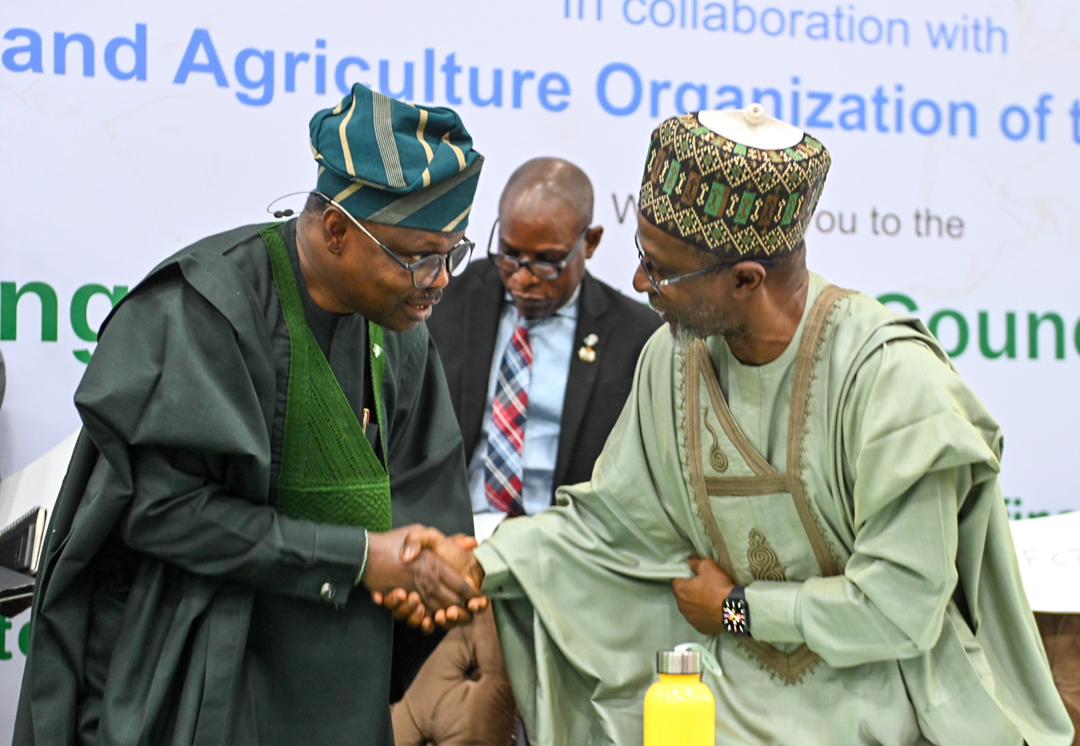
Environment Minister Says Swift and Decisive Actions Required to Mitigate Climate Change
By: Michael Mike
Minister of Environment, Malam Balarabe Lawal has said swift and decisive actions are needed to mitigate the adverse effects of climate change.
The Minister made the statement on Wednesday while delivering a speech at the 17th meeting of the Council of Environment in Abuja.
He decried that: “Climate change is threatening ecosystems, livelihoods, and biodiversity, environmental degradation disproportionately impacts marginalised communities, exacerbating inequalities and perpetuating social injustices.”
Lawal said: “We must redouble our efforts to mitigate greenhouse gas emissions, embrace renewable energy solutions, and foster sustainable practices across all sectors.
“Mobilising more financial inflow for environmental sustainability is essential because it allows for the allocation of resources towards projects and initiatives aimed at protecting and preserving the environment.
“As we are all aware, environment financing is capital intensive, to mobilise more financial inflow for environmental sustainability there is the need to implore innovative financing mechanisms, such as Green Bonds, Carbon Pricing, and Public-Private Partnerships,” noting that this will help in generating the resources needed for effective environmental protection and conservation efforts.
The Minister added: “I therefore urge members of this council to intensify exploration and implementation of financing mechanisms at their disposal.
“As we convene amidst pressing global challenges, from climate change to biodiversity loss, our duty as custodians of the environment has never been more paramount.
“Each decision we make within these walls reverberates far beyond, shaping the health and sustainability of our planet for generations to come.”
“Our nation stands at a critical juncture, where the urgency to act boldly on environmental issues is undeniable. As guardians of biodiversity, we must safeguard our precious ecosystems from degradation and exploitation,” he urged.
On his part, Minister of State for Environment, Dr Iziaq Salako, in an address of welcome stated that the need to galvanise more financial windows for environmental sustainability efforts is not just an aspiration but a commitment that would define our era.
He said: “In our drive to build a sustainable future for our generation and the ones yet unborn, mobilising funding for climate and environmental actions is a core imperative.
“In doing this, we need to emphasis our areas of comparative advantages and present such to the global community as our contribution to addressing the triple planetary crisis of climate change, biodiversity loss and pollution.
“The global north who are the greatest contributor to the environmental challenges being faced by the world is offering us all kinds of technologies, some of them controversial as the solution to the crisis.”
He tasked stakeholders not to loose touch with nature based solutions that offers natural advantages and possess a higher potential to reduce capital flight and improve the livelihoods of the people.
He noted that: “The Federal Ministry of Environment at COP 28 in Dubai December 2023 championed and launched the Ministerial Alliance for Ambition on Nature Finance.
Salako stressed that the launch was to give Nigeria a voice to prompt an ambition on biodiversity finance in global south countries like Nigeria where most of the biodiversity performing critical ecosystem services for the entire world is located.
He said: “As the developed world comes around with their technologies and carbon credit schemes where they almost exclusively determine the pricing, let us also put forward our rich biodiversity worth trillion of dollars.
“Let us remain dedicated to the cause of environmental sustainability in the firm conviction that our collective efforts can pave the way for a healthier and cleaner planet earth.”
Food and Agriculture Organisation of the United Nations (FAO) Representative in Nigeria and to ECOWAS, Mr Koffy Kouacou Dominque, on his part, noted that FAO is committed to supporting government at all levels to enhance sustainable natural resources management.
Dominque who was represented by one of the senior staff in the FAO, Nigeria’s office, Tofiq Braimah, said that the organisation’s area of supports are to implement, monitor and report climate commitments outlined in the National Determined Contribution document.
He assured FAO’s continuous support to access climate finance, partnership and technical support to mainstreaming agrifood systems to the National Biodiversity Strategy and Action Plans (NBSAPS), among others.
He however noted that our environment is under increasing pressure from climate change, deforestation, pollution, and other threats that require urgent attention and collaborative action.
Environment Minister Says Swift and Decisive Actions Required to Mitigate Climate Change



Troops arrest two suspects, recover suspected stolen goods in Plateau
By: Zagazola Makama
Troops of Sector 1, Operation Enduring Peace, have arrested two suspected criminals and recovered a vehicle loaded with suspected stolen items at Berger Junction, Mista-Ali, in Bassa Local Government Area of Plateau State.
The suspects were arrested at about 4:00 a.m. on September 18, 2026, following information about suspected criminals allegedly offloading stolen goods at the location.
The troops, acting on the report, swiftly mobilised to the area and arrested two suspects identified as Ibrahim Sulaiman, 33, and Ibrahim Husaini, 23.
The troops also recovered a Mercedes-Benz E220 vehicle allegedly loaded with suspected stolen items.
The recovered items included eight 25-litre containers of palm oil, four 4-litre containers of palm oil, two 50kg bags of rice, one 50kg bag of sugar, one carton of Maggi seasoning and an empty 25-litre jerrycan.
The suspects and recovered items were subsequently handed over to the Keystone Mista-Ali Outpost for further investigation and appropriate legal action.
Security sources said the arrest followed sustained intelligence gathering and patrol operations aimed at disrupting criminal activities and recovering stolen property in the area.
Troops arrest two suspects, recover suspected stolen goods in Plateau
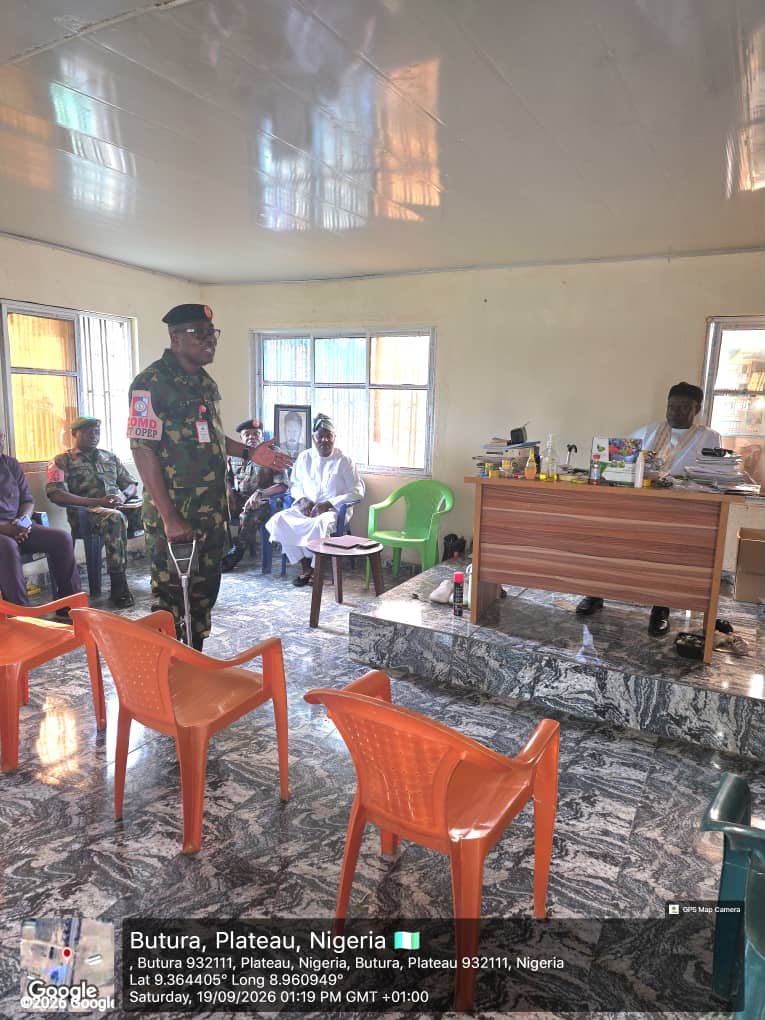
GOC 3 Division engages Bokkos stakeholders over farmer-herder conflicts
By: Zagazola Makama
The General Officer Commanding 3 Division and Commander, Operation Enduring Peace, Maj. Gen. W.M. Dangana, has engaged district heads and other stakeholders in Bokkos Local Government Area of Plateau State as part of efforts to address recurring farmer-herder conflicts in the area.
Maj. Gen. Dangana arrived at the headquarters of Sector 5, Operation Enduring Peace, in Bokkos at about 1:00 p.m. on September 19, 2026, where he was received by the Sector Commander.
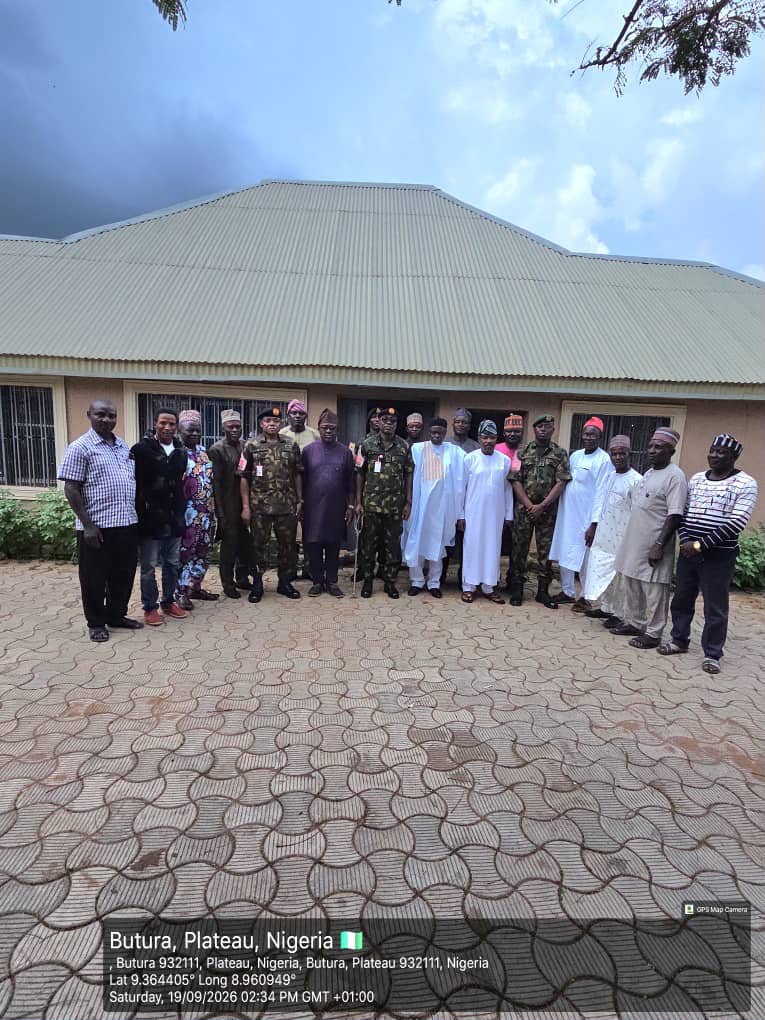
The GOC thereafter proceeded to the Palace of the Saf Bokkos, where he held an engagement meeting with district heads and other stakeholders from across the local government area.
The engagement formed part of ongoing non-kinetic efforts by the military and other stakeholders to address the underlying tensions between farming and herding communities and promote peaceful coexistence.
Discussions with traditional leaders and community stakeholders are expected to support the identification of local grievances, strengthen communication with security agencies and help prevent disputes from escalating into violence.
The engagement was conducted peacefully and without any incident.
GOC 3 Division engages Bokkos stakeholders over farmer-herder conflicts
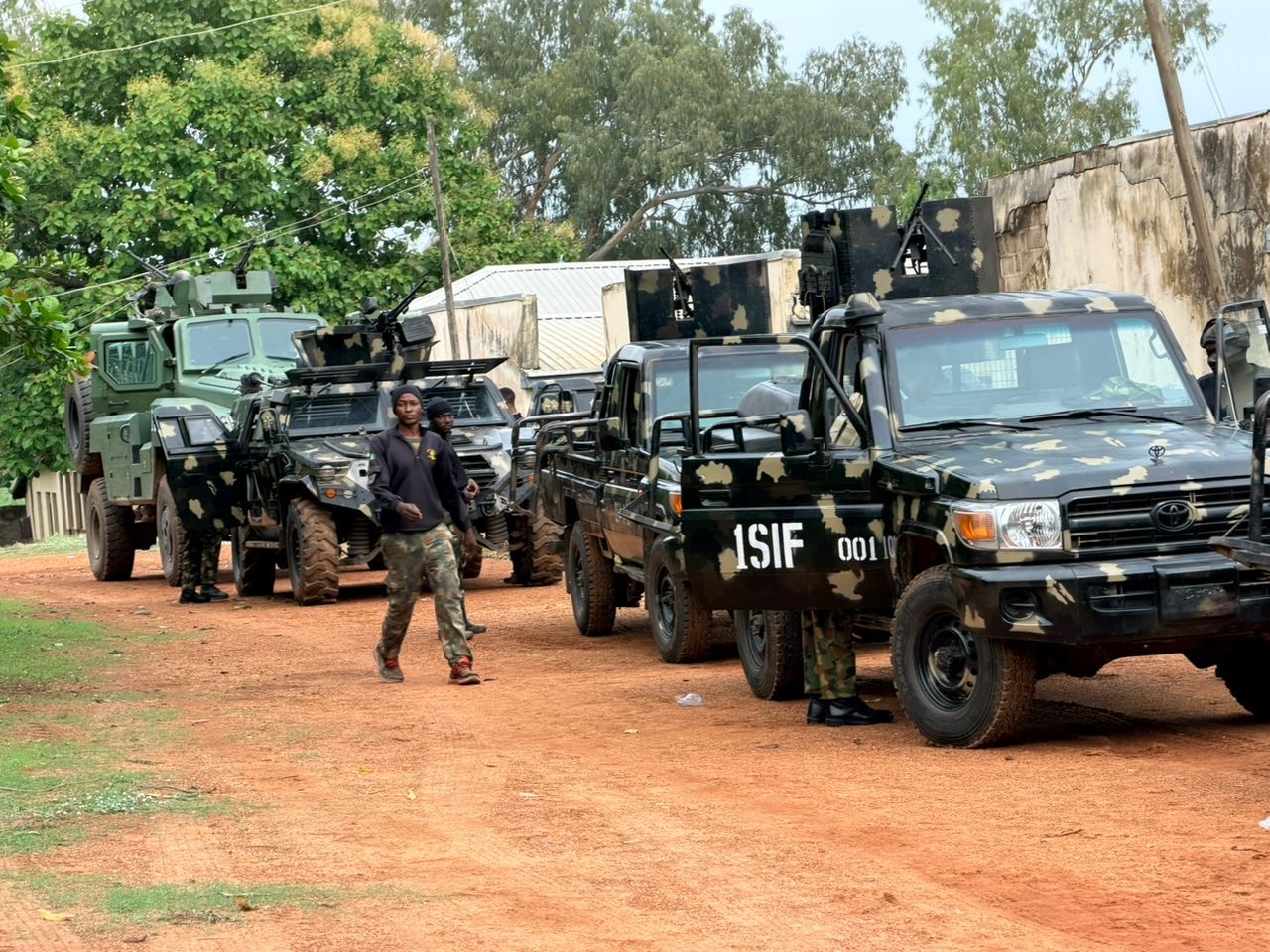
Troops neutralise suspected terrorist in Kaduna, others flee with gunshot wounds
By: Zagazola Makama
Troops of Sector 7, Sub-Sector 71 Sanga, have neutralised a suspected terrorist during an offensive operation at Ungwan Nungu village in Sanga Local Government Area of Kaduna State.
The operation was conducted at about 8:00 p.m. on September 18, 2026, after troops deployed at Ungwan Nungu responded to intelligence on the activities of suspected terrorists operating from a hideout in the community.
Upon arrival at the location, the troops made contact with the criminals, resulting in a gun battle during which one of the suspects, identified as Bashir Mohammed, was neutralised.
Other members of the group reportedly fled the scene with possible gunshot wounds sustained during the encounter.
Troops have commenced efforts to track and apprehend the fleeing suspects, while operations continue in the area to prevent the criminals from regrouping and further terrorising surrounding communities.
Troops neutralise suspected terrorist in Kaduna, others flee with gunshot wounds

2027: Tinubu’s trip to America puts an end to the chatter about his supposed inability to enter the United States.

Troops arrest two suspects, recover suspected stolen goods in Plateau

GOC 3 Division engages Bokkos stakeholders over farmer-herder conflicts

Roger Federer’s Shock as DNA Results Reveal Myla and Charlene Are Not His Biological Children

THE PLIGHT OF FARIDA

FAILED COUP IN BURKINA FASO: HOW TRAORÉ NARROWLY ESCAPED ASSASSINATION PLOT AMID FOREIGN INTERFERENCE CLAIMS
-
 News3 years ago
Roger Federer’s Shock as DNA Results Reveal Myla and Charlene Are Not His Biological Children
-
Opinions5 years ago
THE PLIGHT OF FARIDA
-
 News1 year ago
FAILED COUP IN BURKINA FASO: HOW TRAORÉ NARROWLY ESCAPED ASSASSINATION PLOT AMID FOREIGN INTERFERENCE CLAIMS
-

 News3 years ago
EYN: Rev. Billi, Distortion of History, and The Living Tamarind Tree
-
 Opinions5 years ago
POLICE CHARGE ROOMS, A MINTING PRESS
-

 ACADEMICS3 years ago
A History of Biu” (2015) and The Lingering Bura-Pabir Question (1)
-

 Columns3 years ago
Army University Biu: There is certain interest, but certainly not from Borno.
-

 Politics1 year ago
2027: Why Hon. Midala Balami Must Go, as Youths in Hawul and Asikira/Uba Federal Constituency Reject ₦500,000 as Sallah Gift
