
Uncategorized
Female drug kingpin arrested in Lagos with 23.5kg cocaine stashed children’s room

Female drug kingpin arrested in Lagos with 23.5kg cocaine stashed children’s room
By: Michael Mike
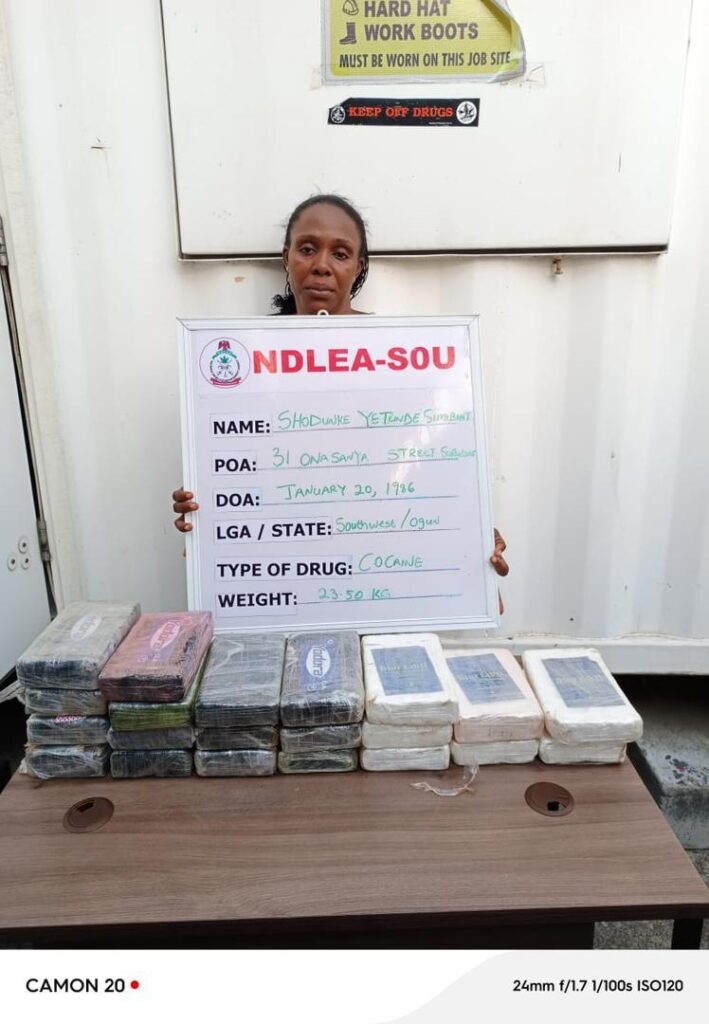
Twenty months after a cocaine trafficking cartel led by a couple: Toheebat Dauda and Lookman Dauda was smashed by operatives of the National Drug Law Enforcement Agency (NDLEA) with multi-billion-naira worth of illicit drug recovered, another leader of the syndicate Shodunke Simbiat who went underground since May 2024 has been nabbed in her Lagos home where additional 23.5 kilogrammes of the class A drug were recovered from her children’s room.
According to a press statement by the spokesman of the anti-narcotics agency, Femi Babafemi on Sunday, the kingpin Lookman and his queen Toheebat were arrested on Saturday 25th May 2024 by operatives of a special operations unit of NDLEA at Ibiye, along Lagos-Badagry expressway while attempting to cross the land border to deliver the consignment in Ghana.
Babafemi said at the point of their arrest, 42 blocks of cocaine weighing 47.5 kilogrammes were found on them, with a swift follow up operation in their residence at Plot 24/25 OPIC extension, Petedo road, Agbara, Ogun state, leading to the recovery of additional eight blocks of the same drug weighing 10 kilogrammes, bringing the total weight of the consignment seized from the couple to 57.5 kilogrammes.
The spokesman, said determined to rein in every member of the syndicate, the NDLEA operatives continued with follow up intelligence and surveillance on the trans-border drug trafficking organisation until a 39-year-old female stash keeper Shodunke Simbiat was identified as a key member of the DTO, which elicited her being trailed to her 31 Onasanya street, Surulere, Lagos residence on Tuesday 9th December 2025.
Babafemi revealed that a thorough search of her home led to the discovery of blocks of cocaine weighing 23.5 kilogrammes concealed in a black suit case recovered from her children’s room, a drug consignment worth over N5billion in street value that she subsequently admitted ownership of.
In other clampdowns, the NDLEA operatives attached to terminal II departure hall of the Murtala Muhammed International Airport, Lagos last Thursday intercepted a 36-year-old businessman Nwanwene Destiny with a total of 1,020 pills of tramadol 225mg and tapentadol 200mg concealed in his luggage while attempting to board a Royal Air-Maroc flight to Milan, Italy where he is based. He claimed the successful trafficking of the opioids to Italy would have fetched him €200 from the person he was to deliver them to.
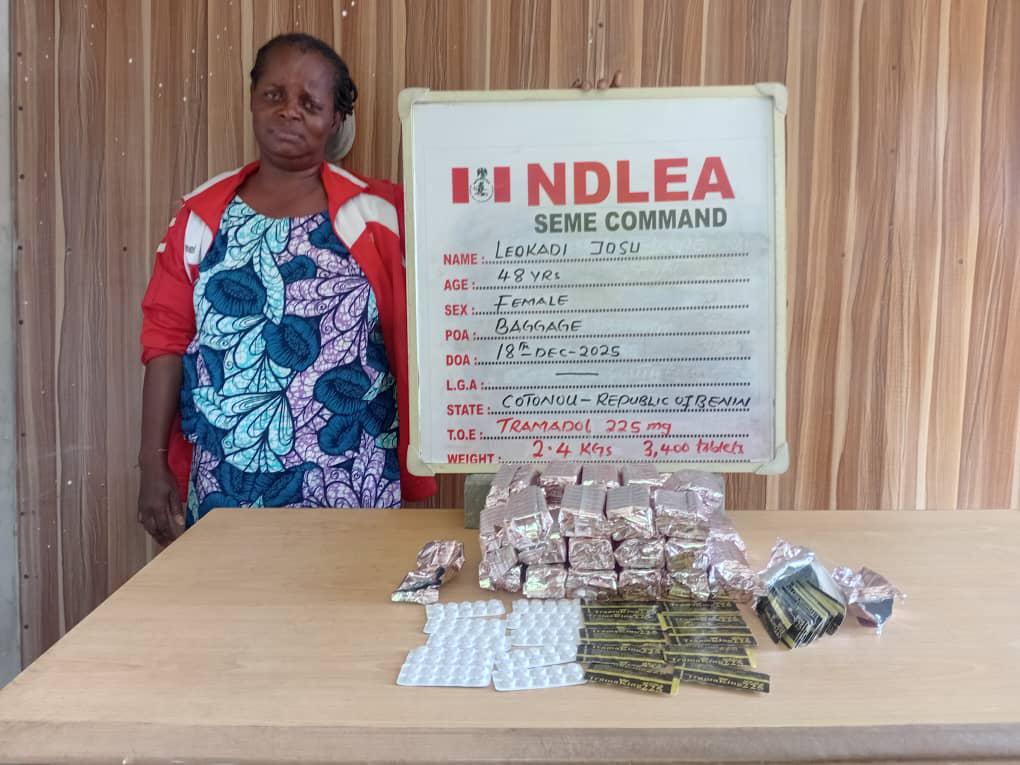
At the Seme border in Badagry area of Lagos, a 48-year-old Beninoise Leocardi Josu was last Thursday arrested by NDLEA officers while attempting to cross into Nigeria with 3,400 tablets of tramadol 225mg, even as a suspect Abdullahi Adamu, 30, was nabbed along Okene/Lokoja highway with 28.4 kilogrammes skunk, a strain of cannabis and Colorado, a synthetic cannabis last Friday.
In Oyo state, NDLEA operatives last Friday recovered 125,000 capsules of tramadol and 1,800 ampoules of pentazocine injection in a Toyota Hiace bus marked XD 592 AWL along Lagos-Ibadan expressway, while two suspects: Ogunlade Kazeem, 54, and Adeleke Ismail, 30, were arrested with 185.4 kilogrammes of skunk at Challenge motor park, Ibadan, last Wednesday.
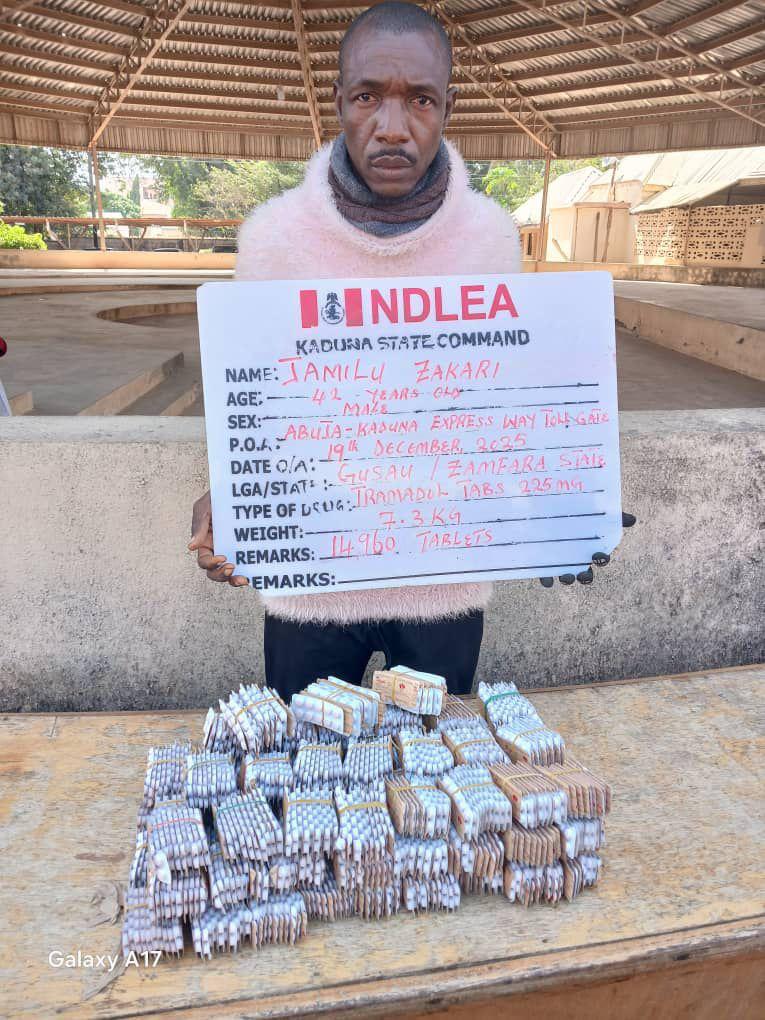
Babafemi disclosed that a total of 405 kilogrammes skunk was seized when NDLEA operatives raided Owena/Ijesha forest in Osun state where a suspect Charles James, 45, was nabbed last Friday, while another suspect Jamilu Zakari, 42, was arrested with 14,960 pills of tramadol 225mg at tollgate, along Abuja-Kaduna highway same day. The consignment of opioids was concealed in two kolanut sacks (huhun goro) coming from Abuja to Gusau, Zamfara state.
The spokesman said across all commands and formations of the agency nationwide, NDLEA officers continued their War Against Drug Abuse (WADA) sensitization activities in schools, worship centres, work places and communities among others in the past week.
Meantime, the Chairman/Chief Executive Officer of NDLEA, Brig. Gen. Buba Marwa (Rtd), while commending the officers and men of the Special Operations Unit, MMIA, Seme, Kogi, Kaduna, Oyo and Osun commands for the arrests, seizures and their dexterity, enjoined them and their colleagues across the country to remain extra vigilant during the festive season and ensure that highest standard of professionalism is maintained in all their drug supply reduction and drug demand reduction activities all through the period and beyond.
Female drug kingpin arrested in Lagos with 23.5kg cocaine stashed children’s room


The Sahel: Seeing Through Russia’s Disinformation Playbook in Africa
By: Umarou Sanou
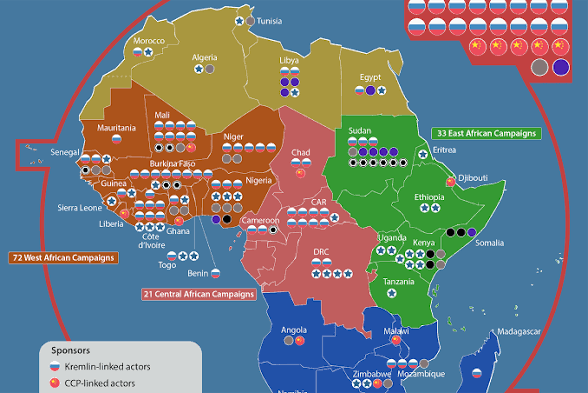
Africa is no stranger to foreign influence, be it from superpowers or emerging powers, from the West to the East, from Washington to Beijing, from the Kremlin to Paris, and from Tel Aviv to Tehran, among others. But what is unfolding today in the Sahel goes beyond influence; it is a deliberate, structured campaign of manipulation, carefully engineered through narratives, proxies, and disinformation.
Russia’s growing footprint in Africa, particularly across the Sahel, is often presented as solidarity, anti-imperialism, and strategic partnership. Yet beneath this carefully crafted messaging lies a far more calculated agenda: shaping African public opinion to serve Moscow’s geopolitical interests, especially its war in Ukraine, while offering little in real developmental value.
The uncomfortable truth is this: Russia has far more to gain from Africa than Africa has to gain from Russia.
Recent investigative work by Forbidden Stories has shed rare light on what can only be described as a coordinated influence architecture. Leaked documents attributed to Russian intelligence outline a clear objective to “reformat the African space” by building a belt of friendly regimes. Africa, in this framing, is not a partner. It is a theatre of operations.
At the centre of this strategy is the Sahel. The Alliance of Sahel States, comprising Mali, Burkina Faso, and Niger, is projected as a bold symbol of sovereignty and resistance. But in reality, it risks becoming a geopolitical outpost, a testing ground in the wider contest between Russia and the West. The rhetoric is powerful. The outcomes, however, remain underwhelming.
Security has not improved. Terrorist groups continue to expand their operational space. Economic transformation remains elusive. What has grown instead is a sophisticated machinery of influence.
This machinery operates quietly but effectively. Journalists are approached under the guise of partnerships, only to be offered payments for sponsored narratives.
Influencers and cultural figures are recruited to amplify pro-Russian messaging. Youth forums and pan-African platforms are repurposed as ideological channels. Entire media ecosystems are being constructed to bypass critical voices and flood the information space with curated content.
This is not engagement. It is infiltration. The real danger, however, lies not just in the content of these narratives, but in how they are constructed. They are tailored to resonate deeply with African history, invoking anti-colonial struggles, pan-African solidarity, and resistance to Western dominance.
The language is familiar. The appeal is emotional.
But it is also deceptive. Because rejecting one form of external influence only to embrace another is not liberation: it is substitution.
Russia presents itself as a champion against imperialism. Yet its actions tell a different story. From its conduct in Ukraine to its historical approach to internal dissent, Moscow’s record raises serious questions about the values it claims to export. It is difficult to position oneself as anti-imperialist while engaging in actions that mirror the very practices one condemns.
This contradiction is not accidental. It is strategic. Narratives, after all, are instruments of power. In the Sahel, these narratives are spreading like soap bubbles; colourful, attractive, and easy to absorb. But like all bubbles, they lack substance. They promise partnership without delivery, solidarity without sacrifice, and security without stability.
And yet, they are gaining traction. Part of the reason lies in Africa’s historical vulnerability to external storytelling. From colonial rule to Cold War alignments, the continent has often been positioned as an arena for competing global interests rather than as an autonomous actor. Today, that pattern risks repeating itself, this time through digital platforms, information warfare, and narrative manipulation.
But Africa’s challenges have evolved. The continent is no longer grappling with colonialism as its primary concern. The real issues today are governance, development, and security. The Sahel does not need competing propaganda. It needs functioning institutions. It does not need ideological alignment. It needs jobs, infrastructure, and stability.
It certainly does not need to be drawn into geopolitical rivalries that do not serve its interests.
Russia cannot solve these problems, and the evidence is increasingly clear. Where Russian-backed security arrangements have taken root, instability has persisted and, in some cases, deepened. Armed groups continue to exploit governance vacuums. Civilian populations remain vulnerable. Regional spillovers are affecting neighbouring countries, including Nigeria, Benin, and Ghana.
At the same time, Russia’s economic footprint in Africa remains limited. Trade volumes are modest compared to other global partners. Investment levels are low. Developmental impact is minimal.
In essence, the offer is simple: narratives in exchange for influence. This is not a partnership. It is a transaction.
None of this suggests that Africa should disengage from Russia or any other global power. Strategic engagement remains necessary in a complex world. But such engagement must be grounded in realism, not rhetoric.
Africa must judge its partners not by what they say, but by what they deliver. More importantly, Africa must begin to tell its own story.
The spread of disinformation in the Sahel is not solely a foreign problem. It is also a reflection of domestic vulnerabilities: weak institutions, underfunded media, and limited digital literacy. Addressing these gaps is as critical as countering external interference.
Journalists must uphold professional integrity and resist inducements that compromise credibility. Influencers and cultural voices must recognise their responsibility in shaping public discourse. Governments must invest in media literacy and transparent communication.
And citizens, especially the youth, must learn to question, verify, and think critically. Because ultimately, the battle is not just for territory or alliances. It is for the African mind.
Russia’s disinformation template in the Sahel is sophisticated and persistent. But it is not invincible. Its strength lies in perception, and once that perception is challenged, its influence weakens.
Africa stands at a defining moment. It can continue to be a stage for external ambitions, or it can assert itself as an actor, confident, strategic, and guided by its own interests.
The choice is clear. Africa does not need another patron. It needs clarity, sovereignty, and strategic discipline. And above all, it must learn to see through the illusion.
Umarou Sanou is a social critic, Pan-African observer, and researcher focusing on governance, security, and political transitions in the Sahel. He writes on geopolitics, regional stability, and African leadership dynamics.
Contact: sanououmarou386@gmail.com
The Sahel: Seeing Through Russia’s Disinformation Playbook in Africa
WTO Ministerial Talks Collapse as E-Commerce Tariff Deal Fails
By: Michael Mike
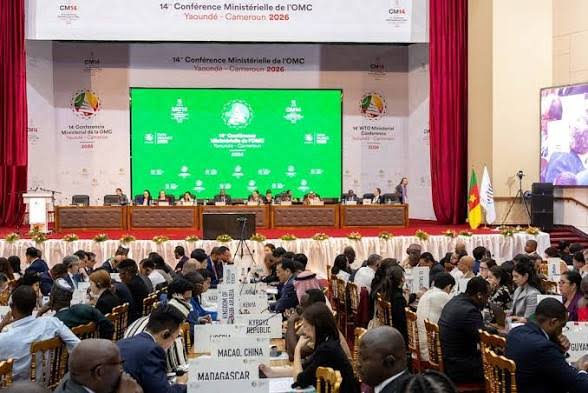
The 14th Ministerial Conference of the World Trade Organisation (WTO) ended in deadlock in Yaoundé, Cameroon, after member countries failed to reach consensus on extending a long-standing moratorium that prevents governments from imposing tariffs on digital transmissions.
The impasse occurred after Brazil and Turkey blocked a proposed agreement supported by most of the WTO’s 164 members to extend the moratorium on customs duties on electronic transmissions until December 31, 2030.
The breakdown halted progress on broader reform proposals championed by the United States and exposed deep divisions among member states over the future of global digital trade governance.
Reacting to the outcome, United States Trade Representative Jamieson Greer expressed frustration over what he described as a lack of seriousness among some members, noting that months of negotiations had failed to produce a compromise.
Greer said the inability to reach consensus on a digital trade issue after nearly three decades of the moratorium was a troubling signal for the future relevance of the global trade body.
“It is particularly frustrating that the WTO could not achieve consensus to make the e-commerce moratorium permanent or even extend it beyond a short period,” he said.
The moratorium, first adopted in 1998, has been periodically renewed to prevent tariffs on electronic transmissions such as software, digital media, and online services, which form a critical component of the modern digital economy.
According to Greer, despite the failure within the WTO framework, the United States has secured commitments from several major trading partners not to impose tariffs on American digital transmissions.
He added that Washington would pursue alternative arrangements outside the WTO if consensus remains impossible within the organisation.
“If the WTO cannot achieve this commonsense objective, the United States will work with willing partners to establish a plurilateral agreement on e-commerce tariffs,” he said.
Also commenting on the outcome, Deputy United States Trade Representative and U.S. Ambassador to the WTO Joseph Barloon said Washington remains committed to pushing reforms within the global trade institution despite the stalemate.
Barloon noted that although many member countries engaged constructively during the negotiations, the refusal by a few members to support the moratorium extension prevented a broader agreement that could have strengthened digital trade rules globally.
The ministerial conference, the highest decision-making forum of the WTO, brought together trade ministers and senior officials from member states to negotiate global trade policies and reforms.
During the week-long talks in Yaoundé, Greer held meetings with several counterparts including Cameroon’s trade minister Luc Magloire Mbarga Atangana, who chaired the conference, as well as representatives of least-developed countries coordinated by The Gambia.
The United States delegation also presented reform proposals aimed at modernising WTO operations and improving its capacity to address emerging trade challenges, particularly those linked to digital commerce.
However, the collapse of the talks highlighted growing tensions among WTO members over how global trade rules should adapt to the rapidly evolving digital economy.
Analysts say the failure to extend the e-commerce moratorium could introduce uncertainty for global digital trade, as countries may now consider imposing tariffs on cross-border electronic transmissions once the current arrangement expires.
WTO Ministerial Talks Collapse as E-Commerce Tariff Deal Fails
NDLEA, US-DEA Strengthen Partnership to Combat Narco-Terrorism
By: Michael Mike
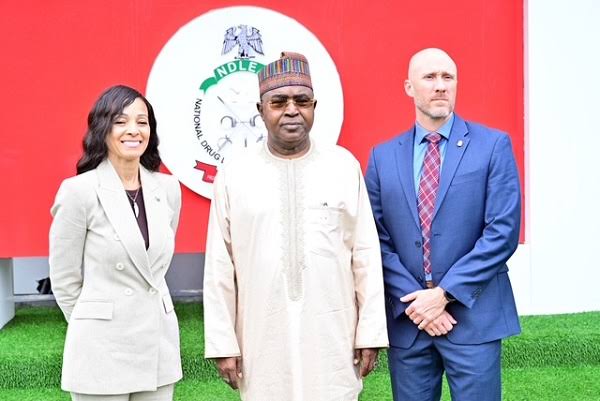
The National Drug Law Enforcement Agency and the United States Drug Enforcement Administration have renewed their commitment to deepen operational collaboration aimed at dismantling international drug cartels and cutting off funding sources for terrorism and other organised crimes.
The renewed partnership was reaffirmed during a bilateral strategic counter-narcotics workshop held at the NDLEA headquarters in Abuja on Tuesday.
Speaking at the opening session, Chairman and Chief Executive Officer of NDLEA, Mohamed Buba Marwa, described the workshop as both strategic and timely, noting that it brings together law enforcement leadership from Nigeria and the United States to address evolving global drug threats.
According to him, the meeting is expected to produce a joint declaration of priorities and a coordinated action plan for the next twelve months aimed at tackling illicit drug trafficking and related crimes.
“Our shared objective is to engage in frank, solution-driven discussions that will culminate in a joint declaration of shared priorities and a coordinated action plan for the next twelve months,” Marwa said.
He warned that the global drug trade has grown increasingly complex and now has strong links with terrorism and violent extremism, a phenomenon widely referred to as narco-terrorism.
Marwa explained that proceeds from illicit drug trafficking are often used by criminal groups to fund terrorist activities and procure weapons that destabilise communities.
“The proceeds from the poison sold on our streets are the same funds used to purchase the weapons that destabilise our regions. By attacking the drug trade, we are simultaneously starving the engines of terrorism,” he stated.
The NDLEA boss also noted that Nigeria’s strategic geographic location has made it a key target for international drug trafficking organisations.
He said recent enforcement pressure on drug cartels in Latin America has forced many of the criminal networks to shift their operations toward Africa, with Nigeria increasingly being used as a transit hub for drugs destined for Europe, North America and Asia.
According to him, the development underscores the transnational nature of the threat and highlights the urgent need for stronger international cooperation.
Marwa said the workshop offers an opportunity to deepen collaboration, strengthen intelligence-driven operations and build a unified front against drug trafficking networks and their associated criminal enterprises.
He also expressed appreciation to the United States government for its continued support to Nigeria in the fight against drug trafficking.
“The key output of this workshop will be a clearly defined framework for cooperation in which Nigeria will take leadership in executing agreed action points within its jurisdiction while the United States reinforces coordinated action against our common threats,” he added.
In her remarks, the Country Attaché of the DEA in Nigeria, Daphne Morrison, commended the NDLEA for the progress recorded under Marwa’s leadership.
She said the agency’s record-breaking seizures, arrests and convictions in recent years demonstrate its commitment to tackling drug trafficking and abuse.
“I would like to acknowledge the tremendous strides NDLEA has made under the leadership of Chairman Marwa. The record-breaking seizures, arrests and convictions over the past few years are a testament to his dedication,” Morrison said.
She described the partnership between both agencies as critical in confronting transnational criminal organisations attempting to turn Nigeria into a major drug trafficking hub.
According to her, the workshop aims to strengthen intelligence sharing, enhance joint operations and provide training to equip NDLEA operatives with the capacity to address modern drug trafficking challenges.
“Our goal is to ensure that collaboration between the DEA and NDLEA remains proactive, seamless and results-driven in disrupting drug financial networks and targeting high-level traffickers,” she said.
Morrison added that the strength of the partnership lies in shared responsibility and collective action, urging participants to develop innovative strategies that would help protect communities and enhance security in both countries.
Officials from both sides expressed optimism that outcomes from the workshop would translate into stronger operational cooperation, improved intelligence exchange and more effective actions against international drug trafficking networks.
NDLEA, US-DEA Strengthen Partnership to Combat Narco-Terrorism

Troops repel bandits’ attack in AgatuBenue

Troops recover another bodies of four herders, targeted and killed by Kaduna

Six more top bandit leaders eliminated alongside Ado Allero’s son in Zamfara offensive

Roger Federer’s Shock as DNA Results Reveal Myla and Charlene Are Not His Biological Children

THE PLIGHT OF FARIDA

FAILED COUP IN BURKINA FASO: HOW TRAORÉ NARROWLY ESCAPED ASSASSINATION PLOT AMID FOREIGN INTERFERENCE CLAIMS
-
 News2 years ago
Roger Federer’s Shock as DNA Results Reveal Myla and Charlene Are Not His Biological Children
-
Opinions4 years ago
THE PLIGHT OF FARIDA
-
 News12 months ago
FAILED COUP IN BURKINA FASO: HOW TRAORÉ NARROWLY ESCAPED ASSASSINATION PLOT AMID FOREIGN INTERFERENCE CLAIMS
-

 News2 years ago
EYN: Rev. Billi, Distortion of History, and The Living Tamarind Tree
-
 Opinions4 years ago
POLICE CHARGE ROOMS, A MINTING PRESS
-

 ACADEMICS2 years ago
A History of Biu” (2015) and The Lingering Bura-Pabir Question (1)
-

 Columns2 years ago
Army University Biu: There is certain interest, but certainly not from Borno.
-

 Opinions2 years ago
Tinubu,Shettima: The epidemic of economic, insecurity in Nigeria
