
Uncategorized
The Sahel: Seeing Through Russia’s Disinformation Playbook in Africa

The Sahel: Seeing Through Russia’s Disinformation Playbook in Africa
By: Umarou Sanou
Africa is no stranger to foreign influence, be it from superpowers or emerging powers, from the West to the East, from Washington to Beijing, from the Kremlin to Paris, and from Tel Aviv to Tehran, among others. But what is unfolding today in the Sahel goes beyond influence; it is a deliberate, structured campaign of manipulation, carefully engineered through narratives, proxies, and disinformation.
Russia’s growing footprint in Africa, particularly across the Sahel, is often presented as solidarity, anti-imperialism, and strategic partnership. Yet beneath this carefully crafted messaging lies a far more calculated agenda: shaping African public opinion to serve Moscow’s geopolitical interests, especially its war in Ukraine, while offering little in real developmental value.
The uncomfortable truth is this: Russia has far more to gain from Africa than Africa has to gain from Russia.
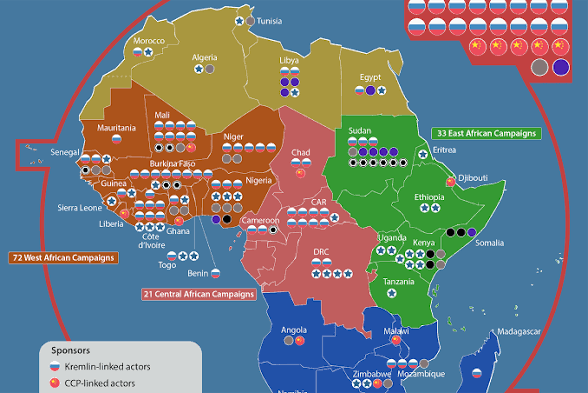
Recent investigative work by Forbidden Stories has shed rare light on what can only be described as a coordinated influence architecture. Leaked documents attributed to Russian intelligence outline a clear objective to “reformat the African space” by building a belt of friendly regimes. Africa, in this framing, is not a partner. It is a theatre of operations.
At the centre of this strategy is the Sahel. The Alliance of Sahel States, comprising Mali, Burkina Faso, and Niger, is projected as a bold symbol of sovereignty and resistance. But in reality, it risks becoming a geopolitical outpost, a testing ground in the wider contest between Russia and the West. The rhetoric is powerful. The outcomes, however, remain underwhelming.
Security has not improved. Terrorist groups continue to expand their operational space. Economic transformation remains elusive. What has grown instead is a sophisticated machinery of influence.
This machinery operates quietly but effectively. Journalists are approached under the guise of partnerships, only to be offered payments for sponsored narratives.
Influencers and cultural figures are recruited to amplify pro-Russian messaging. Youth forums and pan-African platforms are repurposed as ideological channels. Entire media ecosystems are being constructed to bypass critical voices and flood the information space with curated content.
This is not engagement. It is infiltration. The real danger, however, lies not just in the content of these narratives, but in how they are constructed. They are tailored to resonate deeply with African history, invoking anti-colonial struggles, pan-African solidarity, and resistance to Western dominance.
The language is familiar. The appeal is emotional.
But it is also deceptive. Because rejecting one form of external influence only to embrace another is not liberation: it is substitution.
Russia presents itself as a champion against imperialism. Yet its actions tell a different story. From its conduct in Ukraine to its historical approach to internal dissent, Moscow’s record raises serious questions about the values it claims to export. It is difficult to position oneself as anti-imperialist while engaging in actions that mirror the very practices one condemns.
This contradiction is not accidental. It is strategic. Narratives, after all, are instruments of power. In the Sahel, these narratives are spreading like soap bubbles; colourful, attractive, and easy to absorb. But like all bubbles, they lack substance. They promise partnership without delivery, solidarity without sacrifice, and security without stability.
And yet, they are gaining traction. Part of the reason lies in Africa’s historical vulnerability to external storytelling. From colonial rule to Cold War alignments, the continent has often been positioned as an arena for competing global interests rather than as an autonomous actor. Today, that pattern risks repeating itself, this time through digital platforms, information warfare, and narrative manipulation.
But Africa’s challenges have evolved. The continent is no longer grappling with colonialism as its primary concern. The real issues today are governance, development, and security. The Sahel does not need competing propaganda. It needs functioning institutions. It does not need ideological alignment. It needs jobs, infrastructure, and stability.
It certainly does not need to be drawn into geopolitical rivalries that do not serve its interests.
Russia cannot solve these problems, and the evidence is increasingly clear. Where Russian-backed security arrangements have taken root, instability has persisted and, in some cases, deepened. Armed groups continue to exploit governance vacuums. Civilian populations remain vulnerable. Regional spillovers are affecting neighbouring countries, including Nigeria, Benin, and Ghana.
At the same time, Russia’s economic footprint in Africa remains limited. Trade volumes are modest compared to other global partners. Investment levels are low. Developmental impact is minimal.
In essence, the offer is simple: narratives in exchange for influence. This is not a partnership. It is a transaction.
None of this suggests that Africa should disengage from Russia or any other global power. Strategic engagement remains necessary in a complex world. But such engagement must be grounded in realism, not rhetoric.
Africa must judge its partners not by what they say, but by what they deliver. More importantly, Africa must begin to tell its own story.
The spread of disinformation in the Sahel is not solely a foreign problem. It is also a reflection of domestic vulnerabilities: weak institutions, underfunded media, and limited digital literacy. Addressing these gaps is as critical as countering external interference.
Journalists must uphold professional integrity and resist inducements that compromise credibility. Influencers and cultural voices must recognise their responsibility in shaping public discourse. Governments must invest in media literacy and transparent communication.
And citizens, especially the youth, must learn to question, verify, and think critically. Because ultimately, the battle is not just for territory or alliances. It is for the African mind.
Russia’s disinformation template in the Sahel is sophisticated and persistent. But it is not invincible. Its strength lies in perception, and once that perception is challenged, its influence weakens.
Africa stands at a defining moment. It can continue to be a stage for external ambitions, or it can assert itself as an actor, confident, strategic, and guided by its own interests.
The choice is clear. Africa does not need another patron. It needs clarity, sovereignty, and strategic discipline. And above all, it must learn to see through the illusion.
Umarou Sanou is a social critic, Pan-African observer, and researcher focusing on governance, security, and political transitions in the Sahel. He writes on geopolitics, regional stability, and African leadership dynamics.
Contact: sanououmarou386@gmail.com
The Sahel: Seeing Through Russia’s Disinformation Playbook in Africa


Uncategorized
Grandma, PhD Student Lead NDLEA’s Major Cocaine Busts as Agency Tightens Noose on Drug Syndicates
Grandma, PhD Student Lead NDLEA’s Major Cocaine Busts as Agency Tightens Noose on Drug Syndicates
By: Michael Mike
The National Drug Law Enforcement Agency (NDLEA) has intensified its nationwide crackdown on international drug trafficking networks with the arrest of a 67-year-old Nigerian-British grandmother attempting to smuggle 13 kilogrammes of cocaine to the United Kingdom, alongside the dismantling of a Malaysia-bound cocaine syndicate allegedly led by a Nigerian PhD student studying abroad.
The high-profile arrests, announced on Sunday, underscored the increasingly sophisticated methods employed by drug traffickers and the growing involvement of elderly persons and highly educated individuals in transnational narcotics operations.
The agency also intercepted large consignments of tramadol hidden inside vehicle fuel tanks, seized hundreds of kilogrammes of cannabis and methamphetamine across several states, and arrested multiple suspects in coordinated operations nationwide.
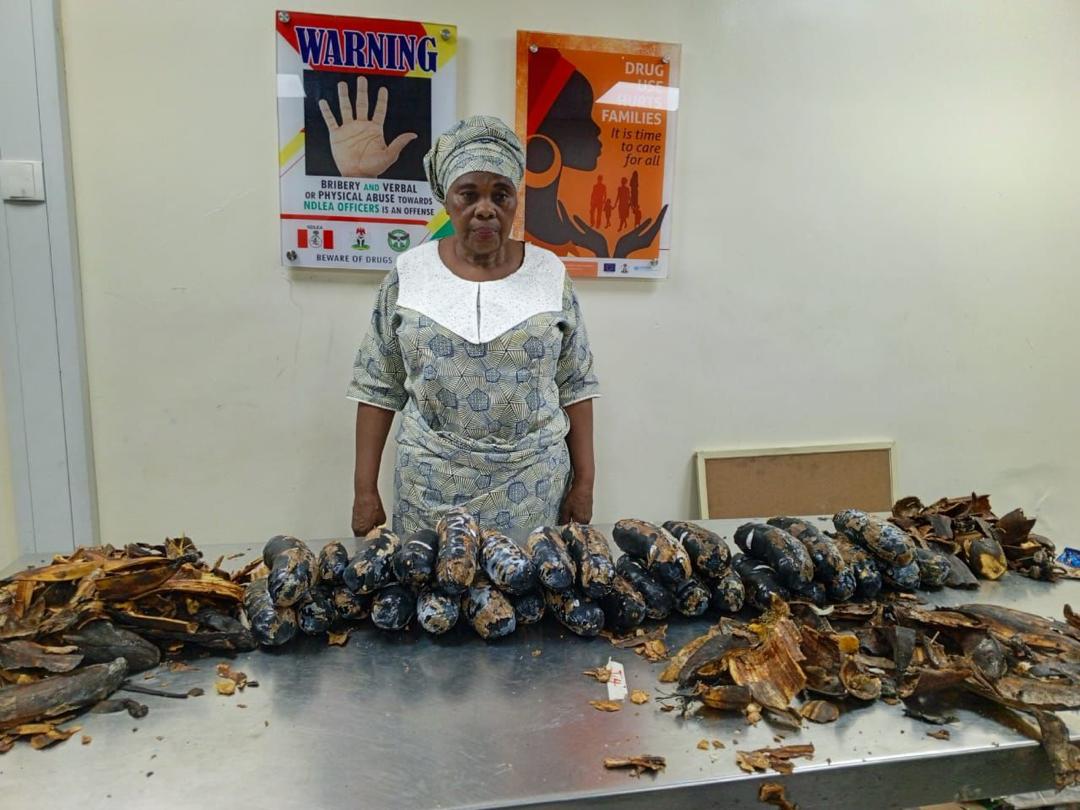
The biggest airport seizure involved 67-year-old Mrs. Mary Barek, a Nigerian-British citizen employed as a caregiver in the United Kingdom.
She was arrested at the departure hall of Terminal 2 of the Murtala Muhammed International Airport (MMIA), Lagos, while preparing to board a Virgin Atlantic flight to London.
NDLEA operatives who searched her luggage discovered 31 large wraps of cocaine ingeniously disguised as fresh plantain peels and packed among other food items. The illicit drug weighed 13 kilogrammes.
According to the agency, the suspect admitted ownership of the cocaine during interrogation.
In another breakthrough, NDLEA operatives dismantled an international drug syndicate attempting to smuggle cocaine to Malaysia through a shipment concealed inside the walls of cartons of Orijin Bitters.
According to a statement on Sunday by the spokesman of the anti-narcotics agency, Femi Babafemi, the operation culminated in the arrest of 45-year-old Nwabueze Onyeka, a PhD student at the University of Putra, Malaysia, who investigators identified as the alleged mastermind of the trafficking network.
The arrest followed the interception of 36 parcels of cocaine weighing 5.8 kilogrammes hidden inside nine cartons of the herbal alcoholic beverage that formed part of a consolidated cargo destined for Kuala Lumpur.
Babafemi said investigations initially led to the arrest of four suspects in Lagos, including a cargo agent, the driver who transported the consignment, a trader at the ASPANDA Market in the Lagos Trade Fair Complex, and another suspect who allegedly supplied the specially prepared cartons used for concealing the narcotics.
He stated that the trail eventually led operatives to Aziora community in Ozubulu, Ekwusigo Local Government Area of Anambra State, where Onyeka was arrested while allegedly hiding in his village.
Beyond the cocaine seizures, NDLEA operatives also intercepted 43,980 capsules of tramadol concealed inside two modified vehicle fuel tanks along the Wukari-Zaki Biam Road in Taraba State.
The suspect, Daniel Harrison Ugwuoke, 30, was reportedly transporting the consignment from Onitsha in Anambra State when he was arrested.
In Kaduna State, anti-narcotics officers arrested two suspects, Boniface Agu, 65, and Monday Nwaeze, 50, after recovering 1.7 kilogrammes of methamphetamine during a raid in Gwantu.
Another 231.7 kilogrammes of skunk were recovered in Ebonyi State from a 65-year-old suspect, Francis Eja.
In Plateau State, operatives arrested a 75-year-old suspect, Alhaji Babani, found in possession of 15 kilogrammes of skunk at Kurgwi in Qua’an Pan Local Government Area.
Similarly, in Gombe State, officers arrested two suspects, Dahiru Mohammed, 65, and Isiya Lawan, 36, with 587 blocks of cannabis sativa weighing 556 kilogrammes during an intelligence-led operation at Kuri village in Yamaltu-Deba Local Government Area.
Alongside the enforcement operations, the agency said it continued its nationwide War Against Drug Abuse (WADA) campaign, conducting sensitisation programmes in schools and communities across Anambra, Enugu, Ogun and Kano States.
Commending officers involved in the operations, NDLEA Chairman and Chief Executive Officer, Brigadier General Buba Marwa (retd.), praised the commands for combining aggressive drug supply reduction efforts with sustained public education campaigns.
The latest arrests come amid growing concerns by security agencies over the use of increasingly sophisticated concealment techniques and the recruitment of unsuspecting couriers, elderly persons and professionals into international drug trafficking networks, as Nigeria continues to strengthen border controls and intelligence-driven operations against transnational organised crime.
Grandma, PhD Student Lead NDLEA’s Major Cocaine Busts as Agency Tightens Noose on Drug Syndicates
FG Evacuates 593 Nigerians from South Africa, Denies Extortion Claims
By: Michael Mike
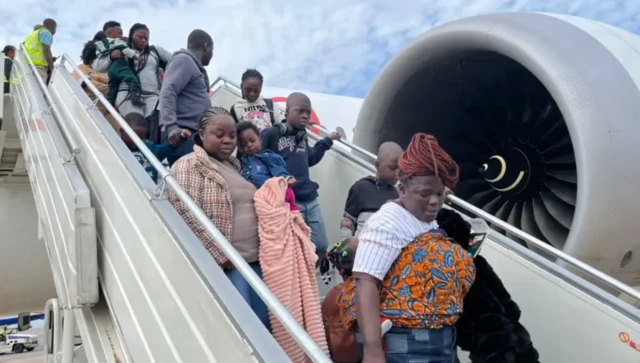
The Federal Government has evacuated 593 Nigerians from South Africa following recent xenophobic protests, with plans to bring home about 700 more citizens in the coming days.
In a statement issued on Thursday, the spokesperson for the Ministry of Foreign Affairs, Kimiebi Ebienfa, said the evacuation exercise underscores the government’s commitment to protecting Nigerians abroad and providing assistance to citizens affected by crises.
According to the ministry, the first batch of 258 evacuees arrived at the Murtala Muhammed International Airport on June 11 aboard a special flight operated by Air Peace.
The returnees were received by the Minister of State for Foreign Affairs, Sola Enikanolaiye, on behalf of the Federal Government before being handed over to relevant government agencies for documentation and profiling.
The ministry explained that logistical challenges delayed the second evacuation flight, resulting in some Nigerians being temporarily accommodated at the Nigerian High Commission in Pretoria, where they were cared for by officials.
It added that a Nigerian philanthropist voluntarily paid the airfare for 66 stranded citizens, enabling them to return to Lagos aboard a South African Airways flight on June 24.
A second government-arranged evacuation flight arrived on June 30 with 269 returnees, bringing the total number of evacuated Nigerians to 593.
The ministry said the evacuation exercise is continuing, with three additional flights scheduled over the next few days to return all Nigerians who voluntarily registered for evacuation and have completed the necessary screening and clearance processes.
It disclosed that about 700 more Nigerians are expected to be repatriated, with the next batch of 271 returnees scheduled to arrive at the Murtala Muhammed International Airport at about 5:30 a.m. on Friday, July 3.
The ministry also dismissed allegations circulating on social media that officials at the Nigerian mission in South Africa demanded money from citizens seeking evacuation.
It stressed that all special evacuation flights are fully funded by the Federal Government and that no returnee is required to pay for transportation.
“The insinuations and false allegations that some staff of the Nigerian Mission were requesting money before enlisting our nationals for the evacuation flights are totally false, fake news, and should be discarded,” the statement said.
The ministry commended the collaboration among relevant government agencies in executing the evacuation exercise, describing the operation as evidence of Nigeria’s commitment to safeguarding its citizens overseas.
It reiterated that the protection of Nigerians abroad remains a central pillar of the country’s foreign policy, adding that the government is determined to ensure that citizens affected by crises receive the necessary support, dignity and care.
“The lives of Nigerians living abroad matter, and we are trying our best as a Ministry to give them a sense of belonging,” the statement added.
FG Evacuates 593 Nigerians from South Africa, Denies Extortion Claims
Uncategorized
Conflict, Funding Cuts Push Northern Nigeria Hunger Crisis to Worst Level in Nearly a Decade, WFP Warns
Conflict, Funding Cuts Push Northern Nigeria Hunger Crisis to Worst Level in Nearly a Decade, WFP Warns
By: Michael Mike
Escalating conflict, shrinking humanitarian funding and worsening access constraints have pushed northern Nigeria into its most severe hunger crisis in almost a decade, with more than 17 million people now facing acute food insecurity, the United Nations World Food Programme (WFP) has warned.
The UN agency said the deteriorating security situation, particularly in the North-East, is forcing families from their homes and farms, disrupting humanitarian operations and leaving millions without life-saving food assistance.
According to the latest Cadre Harmonisé food security analysis, more than 17 million people across nine conflict-affected northern states are experiencing crisis, emergency or catastrophic levels of hunger—an increase of nearly two million people compared to the previous assessment.
The report painted an especially grim picture in Borno State, where renewed insurgent attacks coupled with the suspension of food assistance in some areas have left more than three million people acutely food insecure.
Of that figure, over 750,000 are experiencing severe hunger, while more than 10,000 people have slipped into catastrophic hunger—the highest level of food insecurity and one often associated with famine-like conditions.
Although those facing catastrophic hunger represent a relatively small proportion of Borno’s population, WFP warned that the figures signal a rapidly deteriorating humanitarian situation.
“What concerns us most is how this crisis is expanding,” said Kinday Samba.
“For years, insurgent attacks and violence were largely concentrated in parts of northeast Nigeria. Today, they are spreading across a much wider area and forcing people from farmland, driving displacement and restricting humanitarian access, meaning hunger is quick to follow.”
The agency said insecurity has significantly reduced access to vulnerable communities, with the number of locations partially inaccessible to humanitarian workers doubling in recent months.
An additional 15 areas are now considered difficult for WFP personnel to reach because of insecurity.
Humanitarian supply chains have also come under increasing pressure as attacks and illegal checkpoints disrupt the movement of relief materials along major transport corridors, leaving air transport as the only viable option in several locations.
Beyond insecurity, WFP identified severe funding shortages as a major factor worsening the crisis.
While an estimated 6.2 million people are now food insecure across the three insurgency-ravaged North-East states, the agency said it currently has sufficient resources to assist only about 740,000 people.
That leaves approximately 5.5 million people—many of them women and children—without essential food and nutrition support.
The figure represents a sharp decline from the 1.3 million people WFP assisted during the peak of the 2025 lean season.
The agency warned that the suspension of food assistance in several displacement camps is pushing desperate families toward dangerous coping mechanisms.
Communities have reported cases of people joining armed groups in exchange for food or income, highlighting the growing link between hunger, insecurity and recruitment by violent extremists.
WFP also raised alarm over increasing reports of exploitation and gender-based violence, particularly affecting women and children, following reductions in humanitarian assistance.
“When people lose access to food, the risks of displacement, exploitation and instability increase. Yet resources are at their lowest at the time they are needed most,” Samba said.
The new assessment also indicates that Nigeria’s food crisis extends well beyond conflict-hit northern communities.
Nationwide, an estimated 36.2 million people are now experiencing food insecurity, reflecting the combined impact of persistent insecurity, inflation, climate shocks and economic pressures that continue to erode household purchasing power and agricultural production.
The worsening humanitarian outlook comes as aid agencies struggle with declining donor support amid multiple global crises competing for limited humanitarian resources.
WFP warned that without urgent intervention, hunger, displacement and instability could intensify further across northern Nigeria and spill over into neighbouring countries.
To sustain emergency food assistance, nutrition programmes and humanitarian logistics over the next six months, the agency said it urgently requires 89 million US dollars in additional funding.
It appealed to international donors and development partners to step up support, warning that failure to act could reverse years of humanitarian gains and deepen one of West Africa’s most protracted crises.
Conflict, Funding Cuts Push Northern Nigeria Hunger Crisis to Worst Level in Nearly a Decade, WFP Warns

Troops Arrest Suspected Military Impostor in Katsina

Troops Recover 50 Rustled Cattle, Repel Suspected Rustlers in Kaduna

Troops Arrest Suspected Terrorist in Kogi, Suspect Confesses to Group Membership

Roger Federer’s Shock as DNA Results Reveal Myla and Charlene Are Not His Biological Children

THE PLIGHT OF FARIDA

FAILED COUP IN BURKINA FASO: HOW TRAORÉ NARROWLY ESCAPED ASSASSINATION PLOT AMID FOREIGN INTERFERENCE CLAIMS
-
 News2 years ago
Roger Federer’s Shock as DNA Results Reveal Myla and Charlene Are Not His Biological Children
-
Opinions4 years ago
THE PLIGHT OF FARIDA
-
 News1 year ago
FAILED COUP IN BURKINA FASO: HOW TRAORÉ NARROWLY ESCAPED ASSASSINATION PLOT AMID FOREIGN INTERFERENCE CLAIMS
-

 News2 years ago
EYN: Rev. Billi, Distortion of History, and The Living Tamarind Tree
-
 Opinions5 years ago
POLICE CHARGE ROOMS, A MINTING PRESS
-

 ACADEMICS2 years ago
A History of Biu” (2015) and The Lingering Bura-Pabir Question (1)
-

 Columns2 years ago
Army University Biu: There is certain interest, but certainly not from Borno.
-

 Politics1 year ago
2027: Why Hon. Midala Balami Must Go, as Youths in Hawul and Asikira/Uba Federal Constituency Reject ₦500,000 as Sallah Gift
