
News
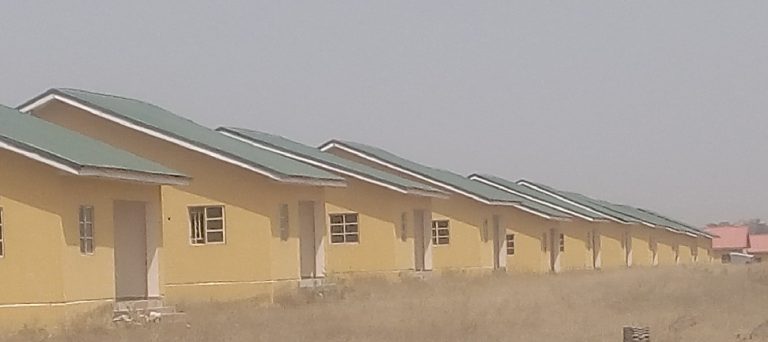
FG lauds Bauchi govt. for building 1,400 houses for low-income earners

FG lauds Bauchi govt. for building 1,400 houses for low-income earners
The Federal Government, through the Family Homes Funds Limited (FHFL), has lauded Bauchi State Government for constructing 1,400 quality and affordable houses for low-income earners in the state.
The FHFL is a Social Intervention Programme of the Federal Government aimed at providing affordable housing to low- and middle-income earners.
Alhaji Suleiman Barau, Chairman of the FHFL Board, said this while briefing newsmen after inspecting the housing project site on Thursday in Bauchi.
He said the board members were impressed with the quality of the project in the state.
“The state government has done a good job by constructing quality and affordable houses in Bauchi, Ningi, Missu, Dass, Katagum and Jamaare emirates.
“You can see the houses and the quality; we are really impressed with the strong partnership.
“Bauchi is among the states that have provided the best houses which are 90 per cent completed,” he said, saying the houses would soon be occupied by the citizens.
The chairman commended President Mohammadu Buhari’s vision of ensuring that low-income Nigerians have access to decent and affordable homes.
He also commended the state governor, Bala Mohammed, for providing an enabling environment and the quality houses for the people.
Mr Hamisu Shira, the Bauchi state Commissioner for Housing and Environment, appreciated the board members for encouraging the state government on the housing project.
He said government was determined to provide housing for the people of the state.
Shira said that the houses would be commissioned by the end of December.
FG lauds Bauchi govt. for building 1,400 houses for low-income earners


News
UN Launches Ambitious 2026–2030 Country Programme to Strengthen Nigeria’s Security, Justice, and Public Health
UN Launches Ambitious 2026–2030 Country Programme to Strengthen Nigeria’s Security, Justice, and Public Health
…Drug Abuse Escalates into National Crisis, NDLEA Warns
By: Michael Mike
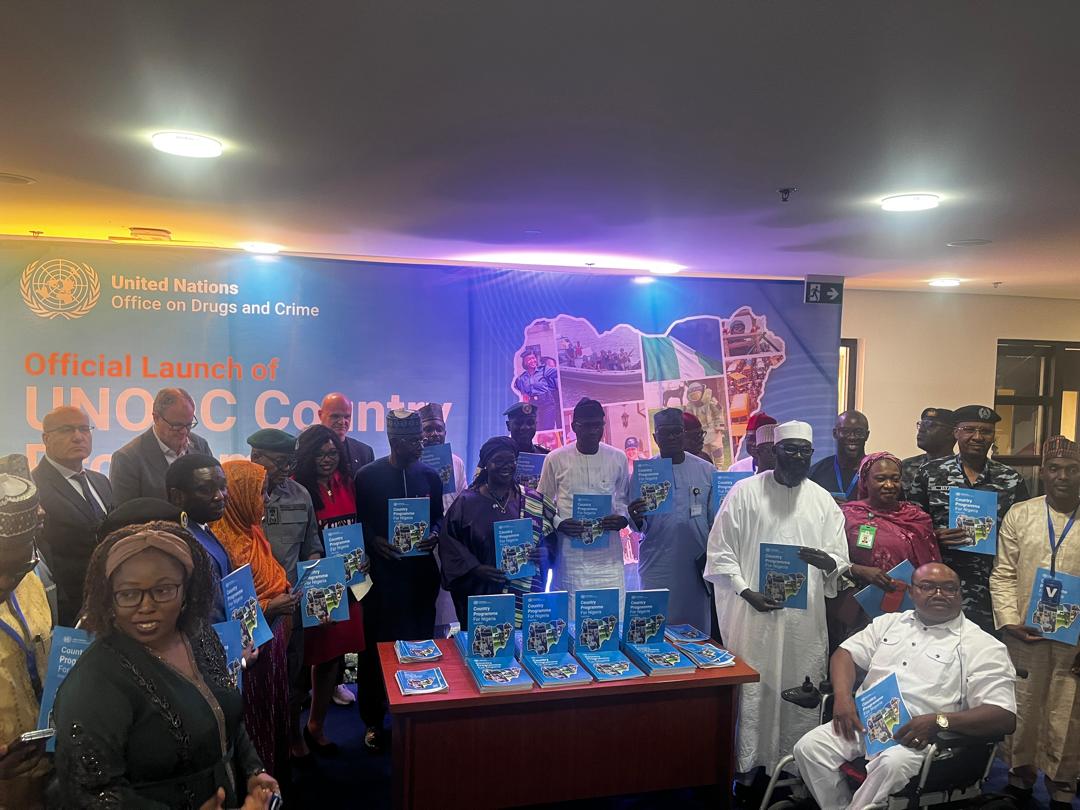
The United Nations Office on Drugs and Crime (UNODC) on Friday launched its most ambitious Country Programme for Nigeria, covering 2026–2030, aimed at strengthening criminal justice, countering organized crime, promoting public health, and reinforcing the rule of law.
Delivering the keynote at the launch in Abuja, the UNODC Representative in Nigeria, Cheikh Toure said: “It is my honour and privilege to welcome you to the launch of the UNODC Country Programme for Nigeria 2026–2030. Your presence… confirms a shared conviction: that peace, justice and development in Nigeria must be pursued together, as one integrated agenda.”
Highlighting the urgency of the programme, the official added, “Nigeria stands at a defining moment. As Africa’s largest economy and most populous nation… Nigeria is not only shaping its own future; it is helping shape the future of our region, our continent and our shared global community.”
Addressing the complex threats facing the country, the UNODC official said: “Persistent illicit drug trafficking and use; transnational organized crime, including human trafficking and maritime insecurity; violent extremism; entrenched corruption; and sustained pressure on institutions and communities… these are lived realities for families and communities, with consequences far beyond Nigeria’s borders.”
The programme’s scope, according to the UNODC representative, is “built on decades of partnership and broad consultations with government, civil society, development partners and communities. Above all, it is a programme rooted in respect for Nigeria’s sovereignty, institutions and people.”
On the framework’s pillars, the official explained: “First, it strengthens the criminal justice system – because fair, effective and accessible institutions are the foundation of public trust, including for women, children and other vulnerable groups.”
“Second, it tackles corruption and illicit financial flows, protecting public resources and reinforcing transparency and accountability essential for development.”
“Third, it supports Nigeria’s efforts to prevent and counter terrorism, in ways that are effective and firmly grounded in the rule of law and human rights.”
“Fourth, it addresses organized crime in all its forms – from trafficking in persons and smuggling of migrants to maritime, cyber and environmental crime – recognizing their impact on security, livelihoods, ecosystems and economic stability.”
“Finally, it promotes health, with a strong focus on preventing and treating drug use disorders and expanding access to evidence-based services. No society can be secure if its people are not healthy.”
Emphasizing inclusion and equity, the UNODC representative said: “Across all pillars, the Programme prioritizes youth, advances gender equality, strengthens partnerships at federal, state and community levels, and promotes inclusion of persons living with disabilities.”
On partnerships, the official expressed gratitude: “We are proud to work alongside NDLEA, NAPTIP, the Nigeria Police Force, the Nigerian Navy, EFCC, ICPC, the Nigerian Correctional Service and many others whose daily commitment to the rule of law inspires us.”
Urging political commitment and sustainable Programmed allocation, the UNODC representative stated: “With the greatest respect, allow me therefore to advocate clearly: for strong political commitment to this Country Programme at the highest levels; for concrete support to the enabling reforms that will sustain the results; and for the progressive allocation of domestic resources – budgetary, in-kind and institutional – to key areas of the Programme.”
Toure reminded stakeholders of the programme’s ultimate goal: “Justice delayed is justice denied – but justice under-resourced is also justice denied… The challenges we face are too complex for any one institution or country to address alone. We will only achieve lasting progress if we work in partnership – if we go farther together.”
The UNODC Country Programme for Nigeria 2026–2030 is designed to provide a cohesive, evidence-based, and nationally owned framework to tackle drug abuse, organized crime, corruption, and other threats, while promoting justice, health, and sustainable development across the country.
Meanwhile, drug abuse and trafficking in Nigeria have reached alarming levels, evolving into a serious public health and national security crisis, the Chairman of the National Drug Law Enforcement Agency (NDLEA), Buba Marwa, warned on Friday.
Marwa delivered the stark warning during the launch of the United Nations Office on Drugs and Crime (UNODC) Country Programme for Nigeria 2026–2030 in Abuja, highlighting the urgent need for a coordinated, multi-sectoral response.
“The drug challenge in Nigeria is no longer static; it is expanding and becoming more complex,” Marwa said, stressing that the problem fuels violent crime, money laundering, and social instability while threatening the health and future of citizens.
The NDLEA chief outlined a new strategic direction, moving beyond traditional enforcement. He said the agency has intensified intelligence-driven operations to dismantle trafficking networks while simultaneously focusing on prevention, rehabilitation, and counselling for drug-dependent individuals.
“We have strengthened enforcement, but we have also expanded our focus on prevention, counselling and rehabilitation,” Marwa explained. “This reflects a shift from a punitive system to a human-centred, restorative approach.”
The programme, he noted, is aligned with Nigeria’s priorities to implement data-driven interventions, strengthen institutional integrity, and adopt gender-sensitive approaches that recognise the unique vulnerabilities and roles of women in the drug landscape.
Looking ahead to 2030, Marwa said the success of national efforts should be measured by the number of lives saved and communities strengthened, rather than the quantity of drugs seized.
“No single agency can tackle this challenge alone,” he said, calling for collaboration among law enforcement, healthcare providers, educators, and civil society groups.
Marwa commended UNODC for the initiative, reaffirming NDLEA’s commitment to working closely with partners to ensure effective implementation and safeguard communities across Nigeria.
UN Launches Ambitious 2026–2030 Country Programme to Strengthen Nigeria’s Security, Justice, and Public Health
Troops uncover, neutralise IED along Wawa–Babans axis in Niger state
By: Zagazola Makama
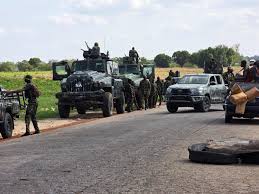
Troops of Operation SAVANNAH SHIELD have uncovered and safely neutralised an improvised explosive device (IED) along the Wawa–Babana road in Borgu Local Government Area of Niger State during an ongoing offensive operation.
Security sources said the operation was conducted at about 10:00 a.m. on March 25 by troops of 22 Brigade Sector 1, Operation Safe Secure Support (OPSS), in conjunction with 221 Battalion.
The sources said the troops were on patrol along the axis to assess a bridge previously damaged by an IED explosion when they encountered the security threat.
According to the sources, the troops quickly created an alternative route to bypass the damaged bridge and continued their movement along the operational axis.
During further advance towards Luma, the troops reportedly discovered another IED planted along the route.
The explosive device was subsequently recovered and safely disposed of by an Explosive Ordnance Disposal (EOD) team, preventing what could have been a major threat to troops and civilians.
Troops uncover, neutralise IED along Wawa–Babans axis in Niger state
Troops repel terrorist attack in Kwara, two injured in Oro-Ago incident
By: Zagazola Makama
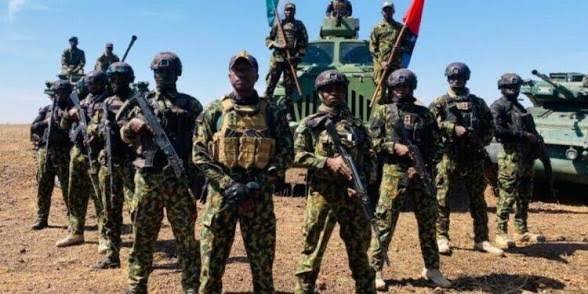
Troops of Operation SAVANNAH SHIELD have repelled a terrorist attack on Oro-Ago town in Ifelodun Local Government Area of Kwara State, in a swift response that restored calm to the area.
Security sources said the incident occurred at about 6:55 p.m. on March 25 when troops deployed at the Oro-Ago patrol base, in collaboration with local vigilantes, responded to credible intelligence on the attack.
According to the sources, the combined team engaged the assailants and successfully forced them to withdraw, preventing further destruction in the community.
During the encounter, one vigilante and one civilian sustained gunshot injuries.
The sources said the injured victims were immediately evacuated by troops to the General Hospital, Omu-Aran, for medical attention.
They added that troops have since maintained a strong presence in the area, conducting sustained patrols to prevent any possible regrouping of the attackers and to reassure residents of their safety.
Troops repel terrorist attack in Kwara, two injured in Oro-Ago incident

UN Launches Ambitious 2026–2030 Country Programme to Strengthen Nigeria’s Security, Justice, and Public Health

Germany, Agrofood Fair Drive Investment and Technology for Nigeria’s Food Processing Sector

Shettima Hosts Gates Foundation Delegation as 2027 Political Calculations Begin

Roger Federer’s Shock as DNA Results Reveal Myla and Charlene Are Not His Biological Children

THE PLIGHT OF FARIDA

FAILED COUP IN BURKINA FASO: HOW TRAORÉ NARROWLY ESCAPED ASSASSINATION PLOT AMID FOREIGN INTERFERENCE CLAIMS
-
 News2 years ago
Roger Federer’s Shock as DNA Results Reveal Myla and Charlene Are Not His Biological Children
-
Opinions4 years ago
THE PLIGHT OF FARIDA
-
 News11 months ago
FAILED COUP IN BURKINA FASO: HOW TRAORÉ NARROWLY ESCAPED ASSASSINATION PLOT AMID FOREIGN INTERFERENCE CLAIMS
-

 News2 years ago
EYN: Rev. Billi, Distortion of History, and The Living Tamarind Tree
-
 Opinions4 years ago
POLICE CHARGE ROOMS, A MINTING PRESS
-

 ACADEMICS2 years ago
A History of Biu” (2015) and The Lingering Bura-Pabir Question (1)
-

 Columns2 years ago
Army University Biu: There is certain interest, but certainly not from Borno.
-

 Opinions2 years ago
Tinubu,Shettima: The epidemic of economic, insecurity in Nigeria
