
News
FG Launches Passport Front Office in Auchi, Promises Home Delivery of Passport

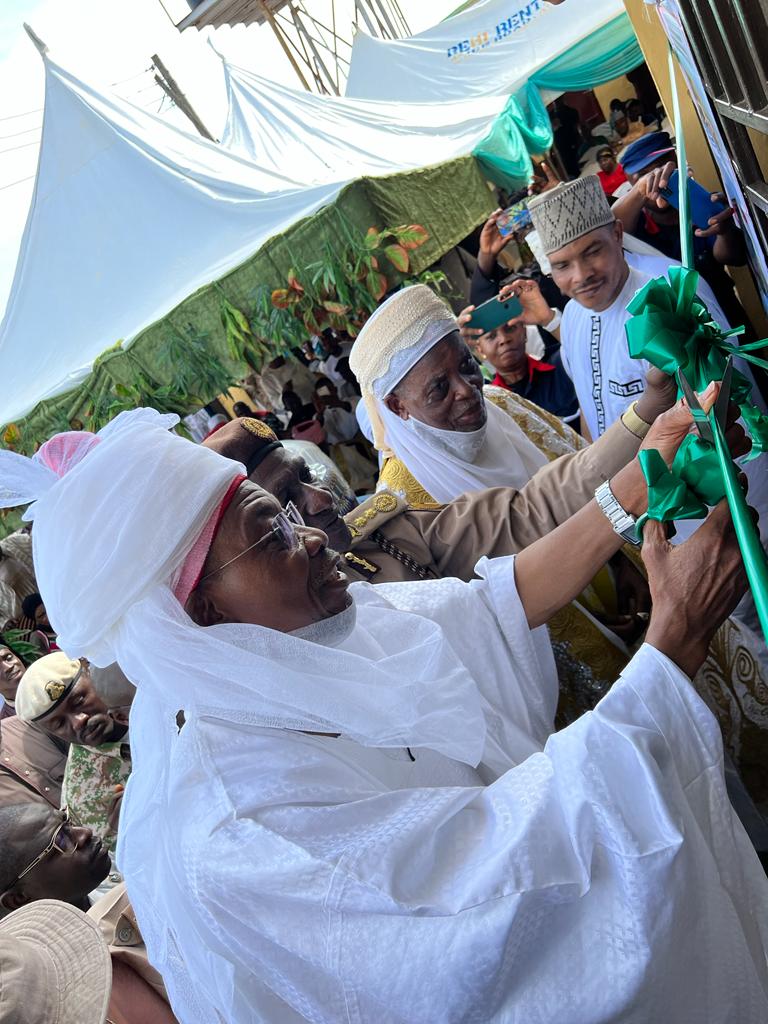
FG Launches Passport Front Office in Auchi, Promises Home Delivery of Passport
By: Michael Mike
The Federal Government has launched an additional Passport Front Office in Auchi, Edo State, as part of it’s effort towards effective service delivery to Nigerians. This is just as it promised to launch a home delivery service of passport.
The Minister of Interior, Ogbeni Rauf Aregbesola, who spoke at the opening of the Nigeria Immigration Service Passport Front Desk Office in Auchi, Edo State on Saturday, said that it is the intention of the government to provide the passport for anyone desirous of it within reasonable time at affordable price and without any stress.
He said the launch of another Passport Front Desk Office is significant as the Nigerian Passport is a proof of existence especially for those outside the country, warning that inability to produce it on demand may bring untoward consequences.
The Minister said: “What we are doing here is significant for two main reasons. The first is the right (and even the necessity) of Nigerians, especially those in the diaspora to hold the Nigerian passport. Except for those travelling outside the country or intend to, most of those who hold the passport do so for identification purposes. For some, it is also a thing of pride to be able to brandish the green back of the passport. But for those outside the country, the passport is the proof of their existence. Inability to produce it on demand may bring untoward consequences. The government therefore wants to provide the passport for anyone desirous of it within reasonable time, at affordable price and without any stress whatsoever.
“The second is the need, flowing from the first, to break out of the regular.”
Aregbesola promised to conclude negotiations with NIPOST on the usage of its speedy mail service to start delivering passport to Nigerians who opt for such service.
He revealed that: “We are in the final stage of concluding negotiations with NIPOST to begin using its speed mail service to deliver passports to Nigerians wherever they are in the world after production.”
Aregbesola, while stating that Edo State has one of the highest passport applications in Nigeria, also revealed that the waiting period between application and collection would likely increase due to the recent increase in demand.
He said: “Our current working schedule is that fresh application would take six weeks after biometric data registration and three weeks for renewal. This is reasonable, competitive and in line with the global best practices.
“The challenge however is the waiting period at the point of application and data registration. All applicants will be put on a queue, depending on the centre of their choice, to determine the registration date. Regrettably, it might take two months in some highly competitive centres where application is very high. We have no control over this.”
He however said that the Federal Government is intentional about opening more front desk offices, in order to increase the registration centres and reduce the waiting period before biometric data capture.
He said: “It is our projection that by the time we open more front offices like this, the waiting period will not be more than three days. Indeed, the more front offices we have, the less the waiting period. Our long term plan will be to involve private operators who will provide the lounge for a fee, but the equipment and personnel will be provided by the Nigeria Immigration Service (NIS).”
Commending the Nigeria Immigration Service (NIS) for improving on their services, which includes issuance of top quality passport booklet, Aregbesola affirmed that Nigeria is among the first five countries in the world and the first in Africa to have the enhanced e-passport.
Adding that: “The reform introduced to the NIS led to the Automated Passport issuance process which has eliminated touts and racketeers in Passport administration, introduction of E-border Management, MIDAS and the commencement of E-Passport across Passport Control Offices and Diplomatic Missions.”
He therefore advised applicants not to go through third parties but apply on any internet enabled device through the Nigeria Immigration Service portal. This is as he lamented the prevalence of a few unscrupulous officials subverting the system, cornering applications, inflating prices, extorting from applicants and hiding already produced passports.
The Minister said: “I will therefore plead with applicants not to go through them and other touts hanging around passport offices, soliciting from applicants. The application can be done in your bedroom on your android phone through the Nigeria Immigration Service portal. You do not need a third party. Those who patronise them are the ones encouraging their nefarious activities and frustrating our efforts at transparency and providing seamless service.”
He also urged applicants to plan ahead for their travelling, as travelling requires long term planning, whether for education, work, leisure or migration, except for urgent national assignment or medical emergency.
This year alone, the Minister of Interior have been in Daura in Katsina State, Alimosho in Lagos, Ilesa in Osun, Zaria in Kaduna and Oyo in Oyo State to commission Passport Front Desk Offices.
Speaking earlier, the Comptroller General of the Nigerian Immigration Service, Isah Idris, said that the choice of Auchi is apt, as Edo State ranks fifth amongst states with the highest volume of passport applications locally.
According to him, “In the past 365 days,
Edo state has processed 56,291 applications out of the 1.5 million
passports produced in Nigeria. The commissioning of this front office will no doubt go a long way in reducing the traffic in Edo State and other neighbouring States.
The NIS CG restated the necessity for prospective applicants to synchronize the data in their passport application with the information in
their National Identification Number.
He said: “May I quickly add that for the enhanced e-passport, it is essential to ensure that prospective passport applicants synchronize the data in their passport application with the information in their NIN (National Identification Number).”
While maintaining that the unveiling of front office and others like it, are crucial to achieving the NIS mandate of ensuring that the e-passport issuance process is brought closer to the people, Jere seized the opportunity to affirm the commitment of the Nigeria Immigration Service to meeting the rising demands for Passport services globally, thereby repositioning the Service towards attaining a truly world-class status to compete with its counterparts worldwide.
Meanwhile, during a visit to the Otaru of Auchi’s Palace, the Otaru, HRH, Alhaji Aliru H. Momoh, Ikelebe III, turbaned Minister of Interior, Ogbeni Rauf Aregbesola, and then installed him as the Rafeeq of Auchi Sacred Kingdom. The traditional ruler revealed that the title means Ogbeni Aregbesola a bossom friend of the Auchi Kingdom.
In response, the minister declared that, “everything happening here today is a surprise to me. I am excited, happy and joyous because it is coming at the right time. The depth of my joy has no word to describe it. When I retire, I plan to always wear my turban as a true and proper Muslim,” the minister declared.
FG Launches Passport Front Office in Auchi, Promises Home Delivery of Passport



Swift Troops’ Intervention Foils Attack on School, Saves Students in Kogi
By: Zagazola Makama
The timely intervention of security troops has prevented what could have been a major attack on students writing the ongoing West African Senior School Certificate Examination (WASSCE) in Iluke Community, Kabba-Bunu Local Government Area of Kogi State.
Eyewitnesses who spoke after the incident commended the swift response of the troops, saying their prompt arrival at the scene prevented the attackers from carrying out a mass abduction of students.
The attack occurred when armed men stormed the community and started shooting where students were writing their examinations.
According to eyewitness accounts, the assailants attempted to seize the students and move them into a nearby bush before security personnel responded to distress calls from residents.
“The situation would have been much worse if the soldiers had not arrived when they did. Their intervention saved the students and prevented what could have been a major tragedy,” one resident said.
Another eyewitness described the response of the troops as timely and professional, noting that the security operatives engaged the attackers and forced them to abandon their mission.
The residents said the arrival of the troops compelled the attackers to retreat from the area.
All the students were reportedly safe and unharmed and safely reunited with their families following the operation.
Community members also praised local security volunteers and other security agencies that supported the operation.
The incident, however, left the community in mourning following the death of three residents during the attack.
Security sources said one of the attackers was neutralised during the exchange of fire, while several others escaped with gunshot wounds.
A security operation is ongoing to track down the fleeing suspects and prevent further attacks in the area.
Residents of Iluke Community expressed gratitude to the troops for their courage and sacrifice, describing the intervention as a decisive action that prevented a larger humanitarian crisis.
They urged security agencies to sustain the ongoing operations and strengthen security presence in vulnerable communities across the area.
The Kogi State Government has also commended the troops and other security personnel involved in the operation, assuring residents of its commitment to safeguarding lives and property.
Swift Troops’ Intervention Foils Attack on School, Saves Students in Kogi

Digital Education: VP Shettima Lauds ProFuturo Foundation, Kukah Centre Partnership
Says training of 1,150 teachers, 72,000 students aligns with President Tinubu’s Renewed Hope Agenda
By: Our Reporter
The Vice President, Senator Kashim Shettima, has applauded the partnership between the Kukah Centre and the ProFuturo Foundation in support of quality digital education, especially in vulnerable communities across the country.
He said the foundation’s initiative for digital education aligns with the nation’s quest for skills education through the National Council on Skills and the Renewed Hope Agenda of the administration of President Asiwaju Bola Ahmed Tinubu.

Senator Shettima stated this, Wednesday, when he received on a courtesy visit to the Presidential Villa, a delegation from the Kukah Centre and the ProFuturo Foundation led by Bishop Matthew Kukah.
The Vice President who had earlier been briefed on the successes recorded in the digital education initiative of the ProFuturo foundation in Nigeria, expressed fulfilment with the feat attained in school enrolment as well as the quality of training and teaching since the commencement of the partnership in 2017.
He noted that though a lot have been achieved over the past years, there is still more grounds, given Nigeria’s growing population amidst competition in the allocation of scarce resources across the country.
Senator Shettima proposed an interface between the implementing partners of the digital education initiative and critical stakeholders such as the National Board for Technical Education (NABTE), the Industrial Training Fund (ITF), the Federal Ministry of Education, Universal Basic Education Commission (UBEC).
He said the interaction is to facilitate the cross-pollination of ideas that can help produce robust solutions to the issue of school enrolment in parts of Nigeria.

The Vice President also assured the delegation of his desire to introduce the ProFuturo initiative to the National Economic Council (NEC) for the purpose of digitizing the Universal Basic Education Boards across the country.
Earlier, the Founder of the Kukah Centre and leader of the delegation, Bishop Matthew Kukah, said the delegation was at the Presidential Villa to show solidarity with the administration of President Tinubu in the area of digital education.
He noted that Vice President Shettima’s commitment to the digital education initiative across the country was a demonstration of critical leadership necessary to proper Nigeria for the next phase of global development anchored on digital skills.
In his remarks, the Deputy Director to the President of the ProFuturo Foundation, Mr Albert Martinez, said the implementation of the initiative in Nigeria was supported by the combination of a strong local capability and commitment as well as a dedicated political leadership.
He also stated that since inception the project in Nigeria has continued to make significant strides as a result of the dedication of stakeholders to adjust where necessary to enable the partners to deepen and expand the ProFuturo digital education initiative.
Giving an overview of the programme implementation, the project coordinator, Dr Emmanuel Nkanta, said since its launch, 13 states, 123 schools, 72,000 students as well as 1,150 teachers have been impacted by the digital education initiative of the ProFuturo Foundation.

He noted there was need to bring on board more partners and improve funding to scale the interventions across the country.
Also present at the meeting with the Vice President were the Minister of Budget and Economic Planning, Senator Abubakar Bagudu; Head of Global Operations of the ProFuturo Foundation, Mr Tomas Mensi, and The Executive Secretary of the Universal Basic Education Commission (UBEC), Dr Aisha Garba, among other officials.
Digital Education: VP Shettima Lauds ProFuturo Foundation, Kukah Centre Partnership
News
Troops Record Major Breakthroughs as 1 Division Neutralises 24 Bandits, Rescues194 Hostages, in Kaduna Theatre
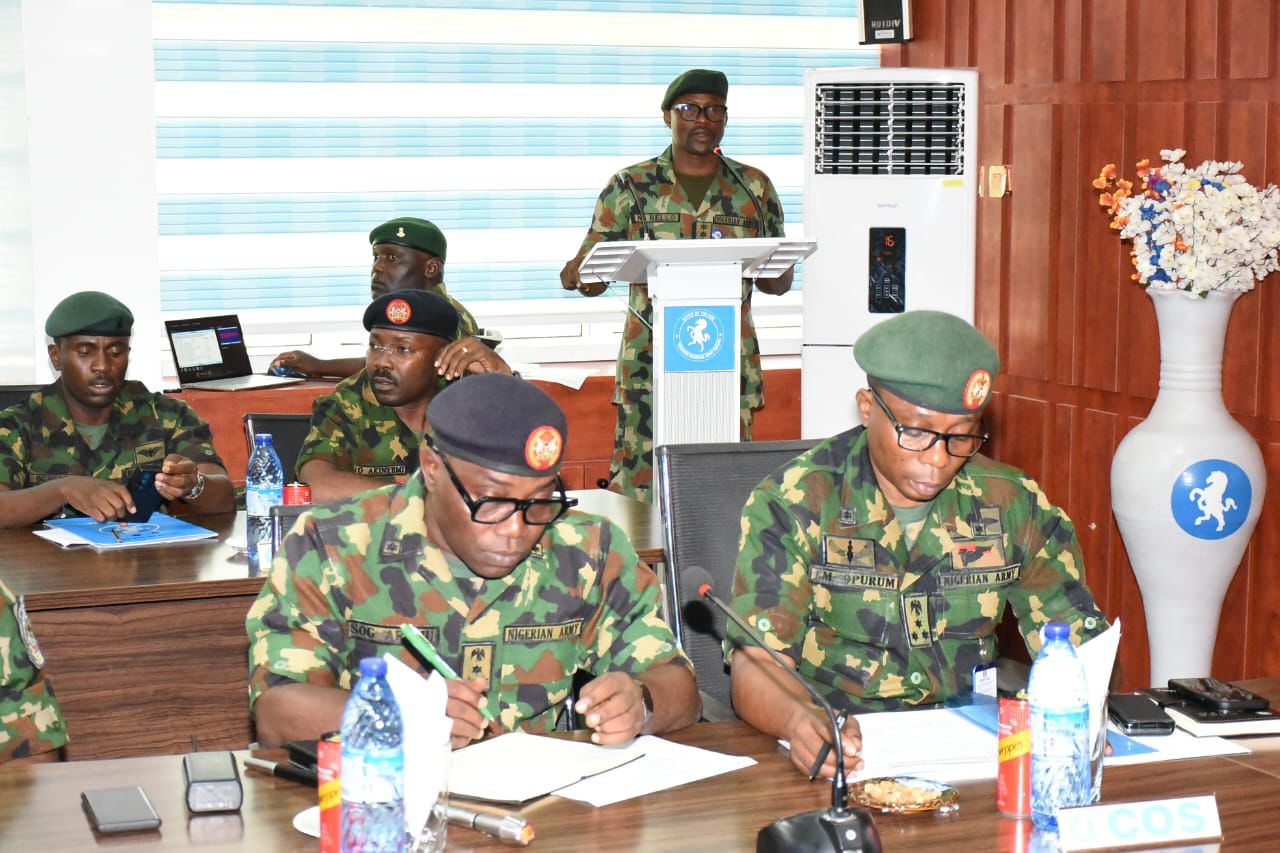
Troops Record Major Breakthroughs as 1 Division Neutralises 24 Bandits, Rescues
194 Hostages, in Kaduna Theatre
By Zagazola Makama
In a security environment marked by persistent threats from banditry, kidnapping, attacks on rural communities and attempts to sabotage critical national infrastructure, the Nigerian Army’s 1 Division and Sector 1 of Operation FANSAN YAMMA have continued to assert their operational dominance across parts of the North-West and North-Central regions.
The achievements of the formation during the first quarter of 2026 paint a picture of an aggressive, intelligence-driven and multidimensional military campaign aimed at denying criminal elements freedom of action while simultaneously building public confidence through non-kinetic engagements.
These successes were highlighted during an interaction with defence correspondents by the Chief of Staff, 1 Division Nigerian Army and Operation FANSAN YAMMA, Brig.-Gen. Timothy Opurum, who represented the General Officer Commanding (GOC) 1 Division and Commander Sector 1 Operation FANSAN YAMMA, Major General Muhammed Wase,
According to the military hierarchy, the Division remains one of the most strategically significant formations of the Nigerian Army, overseeing a vast operational area that cuts across Kaduna, Kano and Niger States. The formation commands several combat and support units, including formations in Kano and Niger States, the 26 Armoured Brigade and the 24 Reconnaissance Battalion, while coordinating security operations through six operational subsectors.
At the forefront of the Division’s operational strategy is the sustained deployment of ground and air assets in coordinated operations against armed bandits and terrorist elements operating within its area of responsibility.
Throughout the period under review, troops of the Division maintained a high operational tempo through a combination of offensive and defensive actions designed to disrupt criminal activities and dismantle terrorist infrastructure.
These operations included fighting patrols, ambushes, raids, clearance operations and targeted offensives against identified criminal enclaves.
The GOC noted that the primary objective was to deny bandits and terrorists freedom of movement, cut off their logistics routes, destroy their camps and prevent attacks against communities and strategic infrastructure.
The results, according to operational records presented during the briefing, were significant.
A total of 194 kidnapped victims were rescued through various military operations conducted across the Division’s area of responsibility. The rescued victims were freed from captivity following coordinated intelligence-led missions carried out by troops operating in difficult terrains and remote locations.
The successful rescue operations not only deprived criminal networks of financial gains but also restored hope to affected families and communities.
Beyond the rescue operations, troops arrested 36 suspected bandits and criminal collaborators, many of whom are believed to have provided logistics, intelligence and other forms of support to criminal groups operating within the region.
Wase explained that targeting support networks remains a critical component of ongoing counter-banditry operations, as criminal groups often rely heavily on informants, suppliers and local facilitators to sustain their activities.
The offensive operations also led to the neutralisation of 24 terrorists and violent extremists during engagements with troops. The elimination of these combatants was achieved during various combat encounters, ambushes and clearance operations conducted by units deployed across the operational theatre.
The neutralisation of these elements, military authorities noted, has significantly weakened the operational capabilities of criminal groups in several flashpoints within the Division’s area of responsibility.An equally important aspect of the Division’s achievements was the recovery of a substantial cache of weapons, ammunition and military-related equipment.
During the period under review, troops recovered more than 1,200 rounds of ammunition, alongside 1,212 assorted ammunition cartridges and 28 magazines from criminal elements.
He noted that every weapon or ammunition recovered from the battlefield translates into reduced firepower available to criminal groups and potentially fewer attacks on innocent civilians.
The recoveries also illustrated the effectiveness of intelligence gathering and follow-up operations conducted after military engagements.
Military authorities believe that disrupting access to weapons and ammunition remains one of the most effective ways of degrading the combat capabilities of armed groups operating in the North-West and North-Central regions.
Beyond kinetic operations, the Division also achieved notable successes in disrupting the economic foundations of criminal enterprises.
Troops recovered livestock estimated at over 2,000 animals, many of which had been rustled from rural communities by bandits.
Cattle rustling has long remained a major driver of insecurity in parts of Northern Nigeria, providing criminal groups with a lucrative source of revenue. By recovering stolen livestock and returning them to their rightful owners, the military not only inflicted financial losses on criminal networks but also restored livelihoods to affected communities.
The Division also recovered N874,625 believed to be proceeds linked to criminal activities.
The military high command noted that attacking the financial lifelines of criminal organisations remains essential in reducing their operational capacity and limiting their ability to recruit, procure weapons and sustain their operations.
In addition, troops recovered numerous communication devices, motorcycles and other operational equipment used by criminal groups for coordination, mobility and logistics.
One of the most critical aspects of the Division’s mandate is the protection of strategic national infrastructure. The operational environment under 1 Division includes assets of immense national importance such as the Kainji Hydroelectric Dam, power generation facilities and the Abuja-Kaduna railway corridor.
They revealed that troops maintained robust security coverage around these installations to prevent sabotage attempts by criminal and terrorist groups.
The protection of these assets remains vital not only for national security but also for economic stability, energy generation and transportation across the country.
Beyond kinetic operations, the Division has increasingly embraced non-kinetic approaches as part of a broader strategy to address the root causes of insecurity and build stronger relationships with local communities.
He explained that in line with the Chief of Army Staff’s command philosophy, which emphasises strategic partnerships and cooperation, the Division has strengthened collaboration with sister services, intelligence agencies and other security stakeholders.
This approach has facilitated improved intelligence gathering, information sharing, joint planning and coordinated execution of operations.
A key component of these efforts was the organisation of the Second Edition of the Security Stakeholders Engagement Forum in Kaduna State, which brought together security agencies, traditional leaders, community representatives and other critical stakeholders to discuss emerging security threats and collective responses.
Military authorities believe such engagements have enhanced public trust and encouraged communities to provide actionable intelligence that has contributed significantly to operational successes.
Troops Record Major Breakthroughs as 1 Division Neutralises 24 Bandits, Rescues
194 Hostages, in Kaduna Theatre

Troops Foil Terrorists’ Advance, Recover Motorcycle in Yobe

Swift Troops’ Intervention Foils Attack on School, Saves Students in Kogi

Digital Education: VP Shettima Lauds ProFuturo Foundation, Kukah Centre Partnership

Roger Federer’s Shock as DNA Results Reveal Myla and Charlene Are Not His Biological Children

THE PLIGHT OF FARIDA

FAILED COUP IN BURKINA FASO: HOW TRAORÉ NARROWLY ESCAPED ASSASSINATION PLOT AMID FOREIGN INTERFERENCE CLAIMS
-
 News2 years ago
Roger Federer’s Shock as DNA Results Reveal Myla and Charlene Are Not His Biological Children
-
Opinions4 years ago
THE PLIGHT OF FARIDA
-
 News1 year ago
FAILED COUP IN BURKINA FASO: HOW TRAORÉ NARROWLY ESCAPED ASSASSINATION PLOT AMID FOREIGN INTERFERENCE CLAIMS
-

 News2 years ago
EYN: Rev. Billi, Distortion of History, and The Living Tamarind Tree
-
 Opinions4 years ago
POLICE CHARGE ROOMS, A MINTING PRESS
-

 ACADEMICS2 years ago
A History of Biu” (2015) and The Lingering Bura-Pabir Question (1)
-

 Columns2 years ago
Army University Biu: There is certain interest, but certainly not from Borno.
-

 Politics12 months ago
2027: Why Hon. Midala Balami Must Go, as Youths in Hawul and Asikira/Uba Federal Constituency Reject ₦500,000 as Sallah Gift
