
News
From Kogi to the Global Stage: Why One Nigerian Innovator’s Second-Place Finish Signals a New Blue Economy for Africa

From Kogi to the Global Stage: Why One Nigerian Innovator’s Second-Place Finish Signals a New Blue Economy for Africa
By Danjuma Amodu
“My village gave me resilience. The farm taught me patience. The world is simply the next field I have been called to cultivate.” — Salifu Eyiojotule Daniel
Long before he stood on a global stage in London, Salifu Eyiojotule Daniel was a young boy growing up in Alagalani, one of the most remote settlements in Okpo District of Olamaboro Local Government Area, Kogi State.
Alagalani is the kind of place many Nigerians may never have heard of. It is the kind of place where dawn breaks to the sound of hoes striking the earth, the low hum of daily chores, and the steady rhythm of birds humming before taking flight to escape the catapults of young boys. This is a purposeful quiet: human labour and nature in unhurried sync, not the buzz of cars and horns. A place where opportunities often seem distant, where ambition frequently travels farther than infrastructure, and where success stories are usually told about people who left. Yet it was there, surrounded by farming communities and the realities of rural life, that Daniel first learned the values that would later define his journey: resilience, patience, hard work, and the courage to dream beyond circumstances.
His journey would later take him to Imane, another proud community in Olamaboro that became an important part of his upbringing and personal development. Between Alagalani and Imane, he learned to dream beyond geography while remaining deeply connected to the people and communities that shaped him.
Those early experiences carried him through St. Anthony Nursery and Primary School, Okpo; Gilgal High School, Ankpa; and eventually to the University of Agriculture, Makurdi, where he studied Aquaculture and Fisheries Management.
Years later, those same lessons would carry him beyond Kogi State and Nigeria to the Blue Food Innovation Summit in London, where he represented Nigeria as the only African founder selected among seven global startups invited to pitch on the summit’s main stage.
He would finish second. Not second in Nigeria. Not second in Africa. Second in a global competition decided by some of the world’s leading aquaculture investors, researchers, policymakers, and innovators.
FROM RURAL KOGI TO THE BLUE ECONOMY
Daniel is the Founder and CEO of AquaProX Africa, a youth-led organisation working to advance sustainable aquaculture, food security, youth empowerment, and blue economy development across Africa.
At the Blue Food Innovation Summit, AquaProX Africa’s innovation was presented before a global audience of investors, researchers, industry leaders, and policymakers.
The achievement was remarkable not simply because of the result, but because of what it represented.
A young Nigerian from Olamaboro Local Government Area in Kogi East stood shoulder to shoulder with innovators from across the world and proved that Africa has solutions worth listening to.
For Daniel, the experience reinforced a belief he has long held.
“Africa does not lack talent. We do not lack ideas. What we often lack is access to the systems, networks, knowledge, and opportunities that allow those ideas to scale.”
LEARNING HOW THE WORLD’S BEST SYSTEMS THINK
The competition became the beginning of something even bigger.
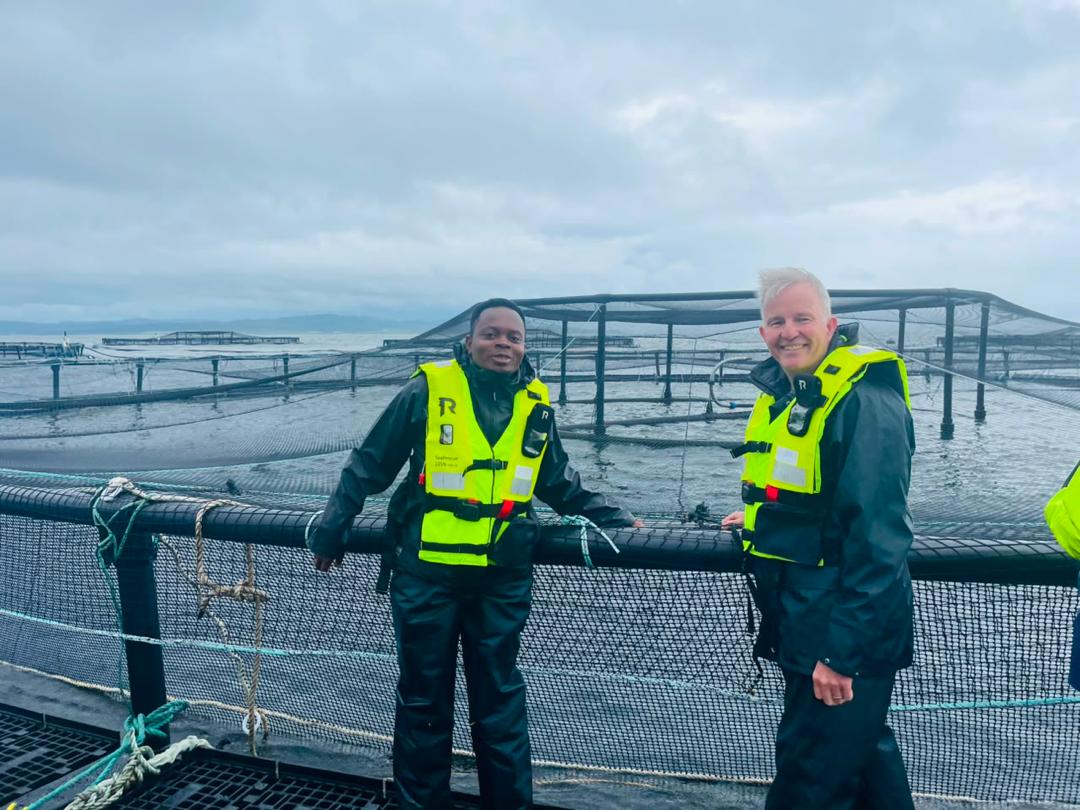
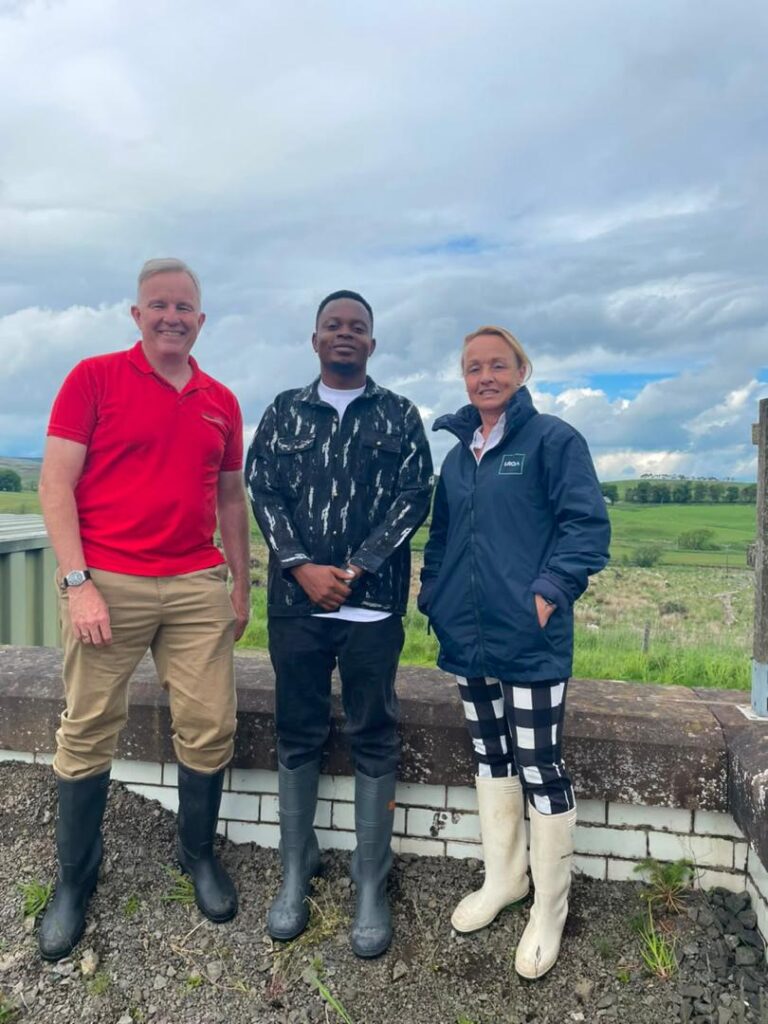
Following the summit, Daniel embarked on a two-week aquaculture learning tour across England and Scotland, visiting some of the most advanced aquaculture facilities, universities, hatcheries, technology centres, and feed manufacturing companies in the world.
At ChalkStream Foods in Hampshire, he observed integrated trout farming systems built around sustainability, animal welfare, and environmental stewardship.
At the Institute of Aquaculture, University of Stirling, one of the world’s most respected aquaculture institutions, he delivered a seminar on Nigerian aquaculture, discussing challenges facing African fish farmers and opportunities for collaboration between Africa and the United Kingdom.
At Forth Marine Hatchery in North Berwick, he witnessed how aquaculture can contribute to marine conservation through lobster restoration and ecosystem recovery projects.
Then came visits to Bakkafrost Scotland’s salmon operations, where real-time monitoring systems, predictive fish health technologies, environmental data platforms, and advanced management systems are used to anticipate challenges before they become crises.
He toured BioMar’s feed manufacturing facilities and explored how nutrition, technology, and sustainability are integrated into modern aquaculture production. The learning experience extended beyond fish farming.
At Heriot-Watt University’s National Robotarium in Edinburgh, Daniel engaged with researchers working on robotics and artificial intelligence applications for agriculture, environmental monitoring, healthcare, and offshore industries.
Standing face to face with humanoid robots and autonomous systems, he saw possibilities for applying similar technologies to challenges facing African fish farmers.
The lesson became increasingly clear at every stop.
“The challenge in Africa is not simply a lack of products or technologies,” Daniel explains. “The challenge is often access to integrated systems, data, knowledge, monitoring tools, and decision-support mechanisms that help farmers achieve better outcomes.”
BUILDING THE FUTURE THROUGH AQUAPROX AFRICA
Those lessons are now shaping the future of AquaProX Africa. The organisation is currently developing AquaProX AI, an intelligent aquaculture platform designed to help fish farmers transition from reactive farming practices to predictive management.
The platform is being developed in partnership with ObliquePath, a Nigerian artificial intelligence and automation company led by young Nigerian technology professionals.
Through data-driven insights, early warning systems, and intelligent decision-support tools, AquaProX AI aims to help farmers improve productivity, reduce losses, and strengthen food security.
But the vision extends beyond software.
Daniel and his team are also working toward establishing the AquaProX Hub, a multi-purpose centre that will combine practical aquaculture training, hatchery development, enterprise incubation, technology integration, innovation support, and youth empowerment.
The goal is not simply to introduce technology. The goal is to build an ecosystem. One capable of producing skilled entrepreneurs, innovative fish farmers, and sustainable aquaculture businesses across Africa.
WHY THIS MATTERS
The UK learning tour was made possible through the support of international aquaculture leaders, industry stakeholders, and a crowdfunding campaign backed by individuals who believed in the vision.
Among those who played key roles were Melanie Siggs, Global Head of Seafood at LRQA and Honorary Professor at the University of Stirling; Anton Immink and ThinkAqua; alongside researchers, entrepreneurs, and organisations across the United Kingdom.
Today, those relationships continue to open doors for knowledge exchange, collaboration, and partnerships between African stakeholders and global institutions.
For Daniel, however, the greatest lesson was not about technology.
It was about possibility.
His journey demonstrates that innovation can emerge from places often overlooked on the map.
That a young boy who once watched birds flee catapults in Alagalani can one day stand before global leaders in London.
That rural communities can produce world-class innovators.
And that Africa’s future in the blue economy will be shaped not only by investment and infrastructure, but by the young people willing to imagine what is possible and work relentlessly to build it.
The story is still being written. But one thing is already clear: From the remote communities of Olamaboro to the global stage, Salifu Eyiojotule Daniel is proving that innovation has no geographical boundaries.
And if his vision succeeds, the next generation of African aquaculture will be smarter, more productive, more sustainable, and led by young Africans who understand both the challenges and the opportunities of the continent they call home.
AquaProX Africa is a youth-led organisation advancing sustainable aquaculture, food security, youth empowerment, and blue economy development across Africa through technology, training, innovation, and enterprise incubation.
Danjuma Amodu is a journalist and public affairs analyst based in Abuja. He writes on governance, politics, digital infrastructure, climate change, youth development, and public policy.
From Kogi to the Global Stage: Why One Nigerian Innovator’s Second-Place Finish Signals a New Blue Economy for Africa



Troops Raid Illegal Shanties, Clear Criminal Hideouts in Abuja
By Zagazola Makama
Troops of Army Headquarters Garrison, in conjunction with Operation SWEEP, have conducted a clearance operation across several areas of the Federal Capital Territory, dismantling illegal shanties and structures suspected of providing cover for criminal activities.
The operation was conducted at about 4:00 p.m. on August 23, 2026, across Karshi, Jeje, Kurape and Nyanya areas of the Abuja Municipal Area Council (AMAC).
Security personnel raided and dismantled several illegal shanties and structures during the operation as part of efforts to deny criminal elements safe havens within the capital.
The operation is part of ongoing security efforts to improve surveillance and maintain control over vulnerable areas that could be exploited by criminals.
The Mai-Anguwa of Nyanya commended the troops for the operation and pledged to sustain effective communication with Army Headquarters Garrison and other security agencies by providing credible information on suspicious activities.
Security personnel are expected to sustain the operation and continue intelligence-led patrols in the affected areas to prevent criminal elements from re-establishing their presence.
The development highlights the importance of sustained community-security collaboration in identifying emerging threats and preventing criminal networks from exploiting informal settlements and unregulated structures.
Troops Raid Illegal Shanties, Clear Criminal Hideouts in Abuja

Troops Arrest Suspected Terrorist, Courier in Kogi
By Zagazola Makama
Troops of 12 Brigade have arrested two suspected terrorists, including an alleged terrorist courier linked to kidnapping activities along the Okene–Auchi road in Kogi State.
The suspects were apprehended at about 1:15 p.m. on August 23, 2026, around the Okene axis of Okene Local Government Area, following an intelligence report on the movement of suspected terrorist elements.
According to security sources, one of the suspects was allegedly involved in kidnapping operations along the Okene–Auchi road and adjoining areas.
Troops recovered two mobile phones with charging cords, a power bank, four litres of palm oil, portions of cow meat, clothing and ₦901,080 in cash from the suspects.
The suspects and recovered items are currently in military custody for further investigation and necessary action.
Security sources said the arrests provide an opportunity to investigate the logistics and support networks sustaining criminal activities along the Okene–Auchi corridor.
The military is expected to intensify intelligence-led operations in the area to identify other members of the suspected network and disrupt their movement and supply channels.
Troops Arrest Suspected Terrorist, Courier in Kogi

Troops Repel Terrorist Attack, Recover AK-47 and Communication Devices in Niger
By Zagazola Makama
Troops of Operation SAVANNAH SHIELD have repelled an attack by suspected terrorists on their position at Dekara in Borgu Local Government Area of Niger State.
The attack occurred at about 8:24 a.m. on August 23, 2026, when suspected terrorists engaged troops deployed in the area.
The troops responded and successfully repelled the attackers, forcing them to withdraw towards the surrounding forest.
During subsequent exploitation of the area, troops recovered one AK-47 rifle loaded with four rounds of 7.62mm special ammunition.
Security personnel also recovered six motorcycles, 49 mobile phones, nine batteries and 10 memory cards reportedly abandoned by the fleeing terrorists.
Drone surveillance subsequently captured two suspected injured terrorists being evacuated on motorcycles towards the Kainji Lake National Park.
Troops have continued to dominate the area and maintain pressure on the fleeing terrorists to deny them freedom of action and prevent them from regrouping.
The recovery of the weapons and communication devices is expected to provide valuable intelligence for ongoing operations, particularly in identifying terrorist networks, their communication channels and movement corridors around the Kainji Lake National Park.
The operation comes amid intensified security efforts to prevent terrorist elements from exploiting the forested areas along the Nigeria–Benin border as safe havens and mobility corridors.
Troops Repel Terrorist Attack, Recover AK-47 and Communication Devices in Niger
Zulum @ 57: A Legacy of Service, Courage, and Hope

Jungle Justice Is Murder, Not Justice — IGP Disu Orders Nationwide Crackdown on Mob Killings

Troops Raid Illegal Shanties, Clear Criminal Hideouts in Abuja

Roger Federer’s Shock as DNA Results Reveal Myla and Charlene Are Not His Biological Children

THE PLIGHT OF FARIDA

FAILED COUP IN BURKINA FASO: HOW TRAORÉ NARROWLY ESCAPED ASSASSINATION PLOT AMID FOREIGN INTERFERENCE CLAIMS
-
 News2 years ago
Roger Federer’s Shock as DNA Results Reveal Myla and Charlene Are Not His Biological Children
-
Opinions5 years ago
THE PLIGHT OF FARIDA
-
 News1 year ago
FAILED COUP IN BURKINA FASO: HOW TRAORÉ NARROWLY ESCAPED ASSASSINATION PLOT AMID FOREIGN INTERFERENCE CLAIMS
-

 News2 years ago
EYN: Rev. Billi, Distortion of History, and The Living Tamarind Tree
-
 Opinions5 years ago
POLICE CHARGE ROOMS, A MINTING PRESS
-

 ACADEMICS2 years ago
A History of Biu” (2015) and The Lingering Bura-Pabir Question (1)
-

 Columns2 years ago
Army University Biu: There is certain interest, but certainly not from Borno.
-

 Politics1 year ago
2027: Why Hon. Midala Balami Must Go, as Youths in Hawul and Asikira/Uba Federal Constituency Reject ₦500,000 as Sallah Gift
