
News
From Sambisa to Kainji: how Boko Haram- Bandits- JNIM are driving a cross-regional terror alliance in Nigeria

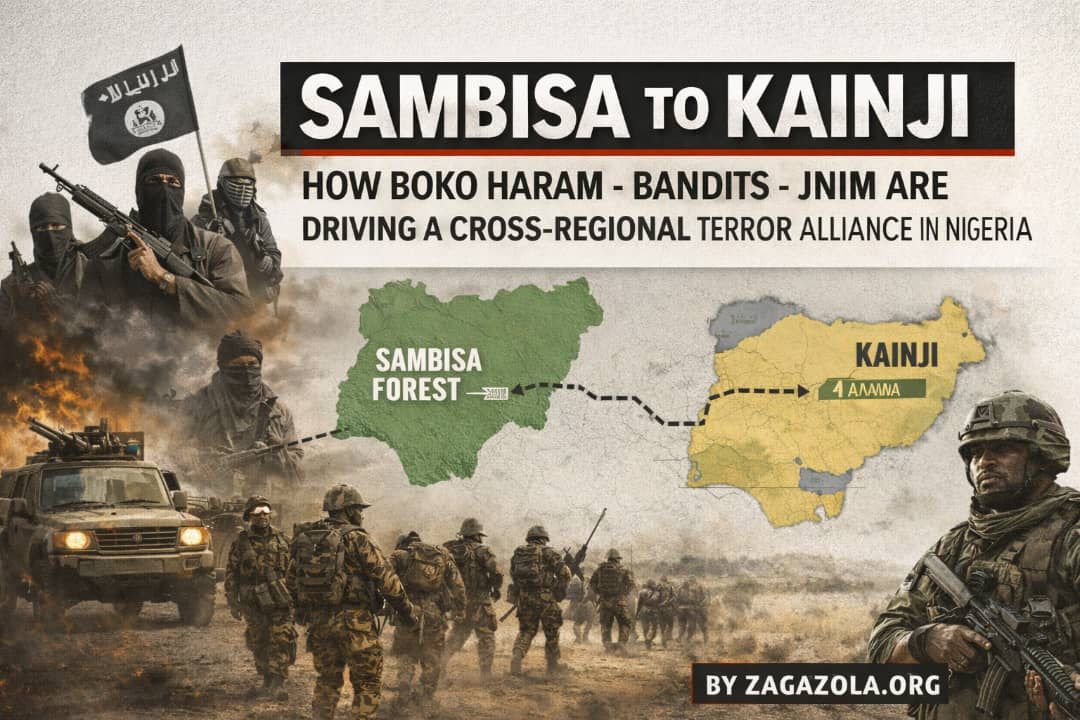
From Sambisa to Kainji: how Boko Haram- Bandits- JNIM are driving a cross-regional terror alliance in Nigeria
By: Zagazola Makama
Emerging security assessments identifying specific commanders, bomb-makers and facilitators point to a deepening, evidence-based pattern in which Boko Haram’s Jama’atu Ahlis Sunna Lidda’awati wal-Jihad (JAS), organised bandit groups and Jama’at Nasr al-Islam wal-Muslimin (JNIM) elements are increasingly functioning as a loose but lethal coalition across Nigeria’s North-East, North-West and North-Central zones. Please
At the core of the emerging threat is a JAS suicide-bombing network traced to the Ali Ngulde camp, with technical direction allegedly provided by veteran IED expert Munzir Abu Ziyadah. Intelligence indicates that Abu Ziyadah’s team prepared up to 10 person-borne IED (PBIED) attacks, routed through the Ngoshe Mountains, transiting Gazuwa and Ngom, before infiltrating towns across Borno State.
The Dec. 24 suicide bombing at Gamboru Market mosque in Maiduguri Metropolitan Council (MMC) is assessed by Zagazola Makama as one execution point within this wider plan, rather than a stand-alone operation. Subsequent intelligence specifically flagged Gwoza and Pulka, particularly on market days, as prospective targets, with reports confirming that one female Boko Haram member was embedded among the PBIED elements an operational detail consistent with past JAS tactics in soft targets.
Deep sources further sheds light on JAS’ internal Militant structure. Before his reported death, Ustaz, the Amir al-Jaish in Barwa, served as the de facto number two to Bakura Doro, overseeing the security of JAS’ headquarters. Alongside him, JAS maintained a decentralized command arrangement under three principal terrorist leaders : Ali Ngulde (Mandara Mountains axis), Sadikku (North-West and North-Central axis), and Ustaz (Barwa).
Recent clashes point to how rivalry within jihadist factions can intensify violence. Following a surprise JAS attack on ISWAP positions around the Lake Chad islands, ISWAP reportedly retaliated by killing Ustaz, signalling that internecine conflict remains a driver of high-impact attacks as factions seek to reassert dominance.
While the North-East continues to face the classic Boko Haram suicide threat, developments in the North-West reveal a dangerous mutation. Intelligence linking bandit kingpins to former Sambisa-based IED experts marks a significant escalation in the character of violence in Zamfara and neighbouring states.
Sources names Alhaji Beti, identified as the younger brother of slain JAS/Ansaru leader Alhaji Bello, as a central facilitator of terror-bandit collaboration. Bello was killed in Rijana Forest, Kaduna State, in 2024, but his network appears to have survived.
According to the sources, Alhaji Beti is hosting Sambisa-linked IED experts inside Gando Forest, Zamfara State. These specialists are reportedly fabricating IEDs intended for deployment along critical access routes in Bukkuyum Local Government Area, with spillover risk into Sokoto and Kebbi States. The fabrication of roadside and vehicle-borne IEDs for deployment along major supply routes in Bukkuyum, parts of Sokoto and Kebbi represents a strategic shift aimed at disrupting movement, strangling commerce and stretching military response capacity.
As of Dec. 25, intelligence and community confirmations indicated that about 25 IED couriers had laid road-side IED (RSBIED) lanes along the Kyarum–Kairu MSR in Bukkuyum.
This evolution manifested starkly on Dec. 27 along the Dansadau–Gusau corridor, where coordinated IED detonations against a civilian convoy, followed by an attempted ambush on military elements, killed eight civilians.
The attack bore hallmarks of jihadist doctrine: layered explosives, exploitation of panic, and a follow-on armed engagement. Zagazola describe it as a clear departure from traditional bandit hit-and-run tactics. It pointed to how banditry is evolving beyond ransom-driven crime into terror-style warfare.
This intelligence also aligns with the Dec. 27 incident near Mai-Ayaya Village, Magami District, Gusau LGA, where multiple IEDs struck a civilian convoy escorted by troops, killing eight civilians. The follow-on ambush against an Army tanker reflects tactics commonly associated with jihadist groups rather than traditional banditry, lending weight to assessments that Boko Haram expertise is being exported into the North-West theatre.
Baba Adamu, also known as Kachallah Sadikku, was actively training the Dogo Gide-led group in IED construction to escalate attacks in the North-Central zone. This training pipeline coincides with reported collaboration between JNIM, Ansaru and JAS elements.
A case in point was the Dec. 22 attack on an NSCDC checkpoint at Ibrahim Leteh Village, along the Wawa–Luma MSR in Borgu LGA, Niger State. The attackers suspected JNIM fighters operating with Ansaru/JAS elements escaped through the Kainji National Park axis after seizing a rifle. The outpost’s proximity about 3 km to Wawa town and 9 km to the 221 Armoured Brigade barracks illustrate the strategic intent behind the assault.
Zagazola Makama identify Kainji National Park as a critical sanctuary, repeatedly referenced as a rear base for insurgents operating across the Niger–Kwara corridor. Communities such as Nuku, Durumma, Woro, Wawa and Babanna have formed a ring of recent attack sites around the park, reinforcing concerns that jihadist groups are methodically making preparation for more ambitious operations. The most recent attacks coordinated by Boko Haram terror networks was the abduction of 130 students from the St. Mary’s Catholic School, Papiri in November 24 and 26, 2025.
Taken together, the intelligence paints a picture of a multi-zonal, adaptive and increasingly lethal threat. The convergence of JAS suicide expertise, bandit mobility networks and JNIM operational doctrine represents a qualitative escalation that blurs the line between insurgency and organised crime.
This convergence reflects a deliberate strategy: JAS supplies suicide bombing and IED know-how; bandit leaders provide terrain access and logistics; JNIM contributes regional connectivity and combat experience. The result is a hybrid threat capable of mass-casualty attacks on highways, markets and places of worship.
For Nigeria’s security architecture, the implications are profound. The prioritisation of EOD-led route clearance on vulnerable MSRs, intensified surveillance of forest sanctuaries, and proactive intelligence fusion across theatres are no longer optional, they are strategic imperatives. Equally critical is sustained community engagement, without which early warning and HUMINT pipelines will remain fragile.
Zagazola Makama therefore calls for the need for anticipatory action rather than reactive deployments. As extremist actors seek to widen their operational depth and geographic reach, the cost of delayed or fragmented responses will be measured not only in disrupted trade and insecurity, but in civilian lives.
Zagazola Makama is a Counter Insurgency Expert and Security Analyst in the Lake Chad region.
From Sambisa to Kainji: how Boko Haram- Bandits- JNIM are driving a cross-regional terror alliance in Nigeria



Zulum Dissolves Borno State Executive Council
By: Our Reporter
Borno State Governor, Professor Babagana Umara Zulum, has approved the immediate dissolution of the State Executive Council.
The decision is to provide an enabling environment for any member of the council who may wish to contest elective positions in the forthcoming general elections.
The Governor has therefore directed all Commissioners to hand over the affairs of their respective ministries to the Permanent Secretaries on or before Friday, April 3, 2026.
Governor Zulum expressed his profound appreciation to the outgoing Commissioners for their dedication, commitment, and invaluable contributions to the development and service of the people of Borno State.
Zulum Dissolves Borno State Executive Council

How corp member Samuel Orji bowed to humanity at the recent Monday market tragedy
By: Bodunrin Kayode
Corp member Samuel Orji is not new to Monday market because he was raised in a restaurant right in front of the place as a kid because his mother used to be a food vendor to the traders within the vicinity.
Till the day of his death, he had friends and associates along the popular Ahmadu Bello way right down to Ali Kotoko Street where traders used to patronize his mother’s buka food.

But his mother have since left the town for Abuja leaving him and his brother Steve because he was still a student attending Ramat Polytechnic where he studied Electrical engineering when she left.
Having grown up in Maiduguri, he already knew that Improvised explosive devices IED could explode at any time during the day but never knew a semblance of the worse days could return to the city of yerwa.
For people who grew up in Maiduguri, the worse days are really over when everyone goes home before six pm so he was obviously rounding off his hustling that night when the explosion went off on Ahmadu Bello way which hit his legs and brought him down.

Though we all share a common humanity, living in the north east war theatre of hadin kai, we all go out each day for our daily bread not knowing what the end of the day will be like but taking each day as it comes.
Likewise, when corp member Samuel Orji left the house of his next of kin in Maduganari that fateful black Monday, he never planned not to return home, but as fate would have it, he was one of the victims that got hit by the suicide bomb explosion in front of the Monday market.
After being called up to the National Youth Service Corp (NYSC) with number NYSC/RPM/25/185709, the young Orji was still serving at the engineering department of the Nigerian television authority (NTA) Potiskum in Yobe state when he lost his life.
Orji with YB/25B/1003 now serving in Damaturu found himself in Maiduguri the weekend before that black Monday because he had taken a pass to spend the public holiday with his brother and next of kin Stephen Orji who lives in Maduganari a suburban area of Maiduguri.
Speaking with this reporter after the tragedy, Borno State coordinator of the NYSC Bashir Nasir said the entire tragedy was a shock to him after a long spell of calmness in the city.
As soon as the incident happened, he was contacted by his headquarters (HQ) in Abuja to conduct a census of his Corp members to ensure all was well and report back to them.
It was in the process that he realized that his team was fine and that the fellow that died was indeed a Corp member but was serving the nation from Damaturu and that he had died as a result of the Monday blast on Ahmadu Bello way at the entrance of the market place.
“I quickly went into action by visiting all the places I know my corp members are based. And I was sure the fellow was not serving here in Borno after the roll call.
” Later a call came from his next of kin Steve to one of our staff in Yobe who indeed linked up with us here and that was when it was ascertained that Samuel Orji was a corp member serving in Yobe.
” I then went to the home of his next of kin Stephen Orji at Maduganari and that was how we took charge by handling all the preliminary expenses to ensure he is taken home for burial.
” The Yobe axis arranged for an ambulance and staff to convey his corpse to Enugu on Monday last week for burial.
” As a result of that triple blast I had to halt routine activities of corp members in the state except the medical officers among them who were released to assist in the hospitals on the condition that management will release ambulances from them to go and return safely to their bases. ” Said the state coordinator.
Challenges of the Corp in Borno state
The main challenge is obviously tied to their security which is why they are using the Arabic Teachers secondary school as a temporary location for now.
The original location has been tendered not usable after idps used it from 2012 to 3021
However, the governor in his magnanimity has given them a new camp of one km by one Km at Auno in the outskirts of the city.
Meanwhile the coordinator who would be one year next month since he assumed duty hinted that 506 Corp members of the batch A stream one of 2005 will pass out this week on the 31st of March.
Another bold set of Corp members of the batch A stream one of 2026 will however be sworn in on the 22nd April.
How corp member Samuel Orji bowed to humanity at the recent Monday market tragedy
Tension in jos north council area as government slams curfew over sunday’s killings in Plateau
By: Bodunrin Kayode
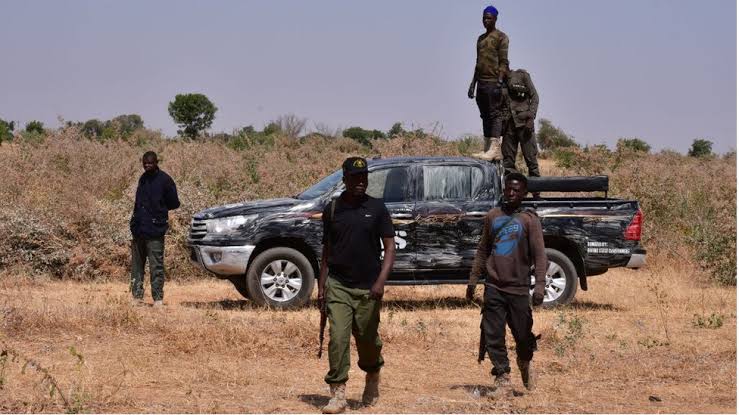
Reports coming from Jos North council area of plateau State indicates that there is palpable tension in the city as suspected gunmen on motorcycle allegedly opened fire on some residents of Angwan Rukubu area Sunday evening.
The unprovoked shooting of innocent citizens caused serious pandemonium in the area forcing many residents to flee from the scene and avoided the general area until late at night when the government resultantly slammed a curfew in the area.
Residents were advised to avoid wandering around the general area from tomorrow in view of the incident so as not to fall victim of possible reprisals by young residents of the area.
PLATEAU STATE GOVERNMENT ORDERS 48 HOURS CURFEW IN JOS NORTH COUNCIL AREA
Reacting to the situation, the government has placed a 48 hour curfew on the area which is highly tensed according to eye witnesses for now.
A release signed by the Commissioner of information Joyce Ramnap stated that “Following the tragic security incident that occurred at Gari Ya Waye community Angwan Rukuba today Sunday 29th March 2028 resulting in the loss of lives, while several others sustained varying degrees of injuries.
”The Plateau State Government in conjunction with security agencies wishes to inform the general public of the imposition of a 48 hour curfew within Jos North Local government Area with immediate effect, commencing from 12 midnight of 29th March, to 1st April, 2026.
“The government under the leadership of His Excellency, Governor Caleb Manasseh Mutfwang strongly condemns this barbaric and unprovoked attack on innocent citizens and assures the public that all necessary measures are being taken to apprehend the perpetrators and bring them to justice.
“Citizens are urged to remain calm, stay vigilant, and cooperate fully with security agencies by providing any useful information that may aid ongoing investigations.” Noted the release.
Tension in jos north council area as government slams curfew over sunday’s killings in Plateau

Zulum Dissolves Borno State Executive Council

How corp member Samuel Orji bowed to humanity at the recent Monday market tragedy

Tension in jos north council area as government slams curfew over sunday’s killings in Plateau

Roger Federer’s Shock as DNA Results Reveal Myla and Charlene Are Not His Biological Children

THE PLIGHT OF FARIDA

FAILED COUP IN BURKINA FASO: HOW TRAORÉ NARROWLY ESCAPED ASSASSINATION PLOT AMID FOREIGN INTERFERENCE CLAIMS
-
 News2 years ago
Roger Federer’s Shock as DNA Results Reveal Myla and Charlene Are Not His Biological Children
-
Opinions4 years ago
THE PLIGHT OF FARIDA
-
 News11 months ago
FAILED COUP IN BURKINA FASO: HOW TRAORÉ NARROWLY ESCAPED ASSASSINATION PLOT AMID FOREIGN INTERFERENCE CLAIMS
-

 News2 years ago
EYN: Rev. Billi, Distortion of History, and The Living Tamarind Tree
-
 Opinions4 years ago
POLICE CHARGE ROOMS, A MINTING PRESS
-

 ACADEMICS2 years ago
A History of Biu” (2015) and The Lingering Bura-Pabir Question (1)
-

 Columns2 years ago
Army University Biu: There is certain interest, but certainly not from Borno.
-

 Opinions2 years ago
Tinubu,Shettima: The epidemic of economic, insecurity in Nigeria
