
News
GIFSEP Empowers Women to Champion Renewable Energy in Nigeria

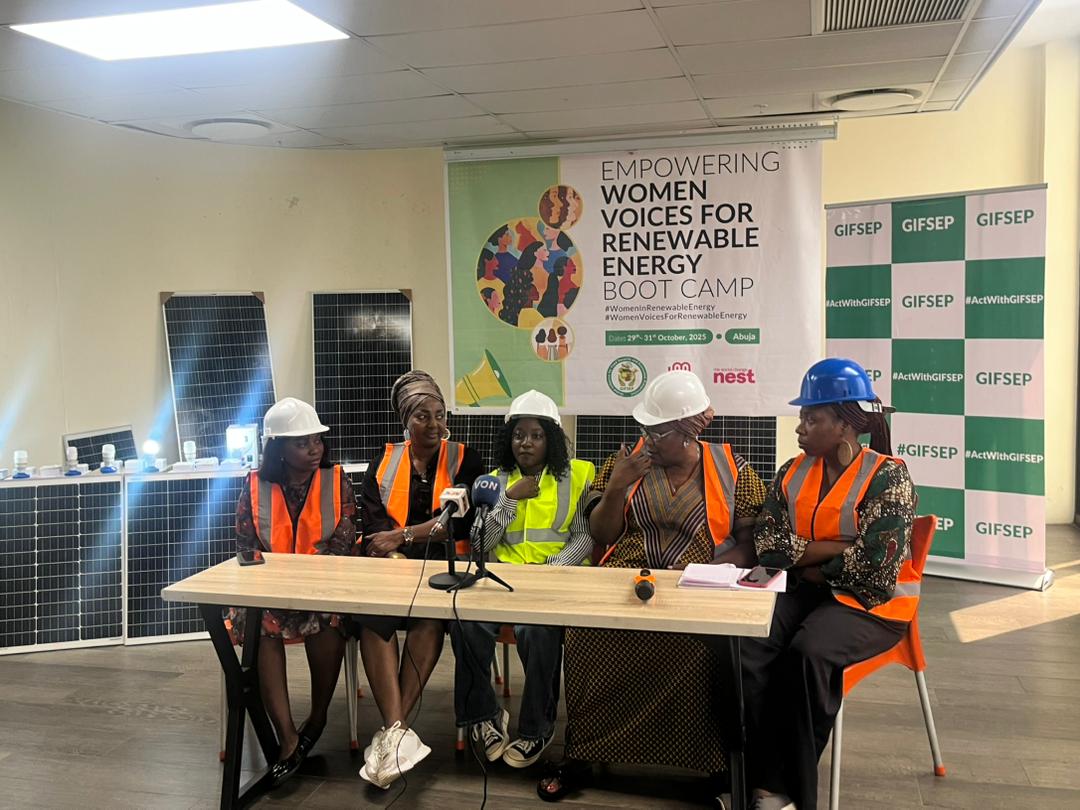
GIFSEP Empowers Women to Champion Renewable Energy in Nigeria
By: Michael Mike
The Global Initiative for Food Security and Ecosystem Preservation (GIFSEP) has launched a campaign to empower women as key voices in Nigeria’s renewable energy transition.
The organization convened a media parley and exhibition under the theme “Empowering Women Voices for Renewable Energy: Media Coverage Parley and Exhibition in Nigeria” at Novare Mall, Shoprite, Wuse Zone 5, Abuja, bringing together women leaders, activists, and clean energy advocates to promote gender inclusion in climate and energy solutions.
The gathering, which drew women from various communities and organizations, highlighted the urgent need for a shift from fossil fuels to renewable energy in Nigeria.
In his statement, Dr. Michael Terungwa David, Executive Director of GIFSEP, emphasized that women are disproportionately affected by the country’s reliance on oil, gas, and coal, which continue to pollute the environment and deepen poverty.
Nigeria, despite being Africa’s largest economy, still has over 85 million citizens without access to electricity, forcing many families especially in rural areas to depend on kerosene, firewood, and diesel generators.
Dr. David noted that these traditional energy sources endanger women’s health, limit educational opportunities for girls, and worsen economic inequality.
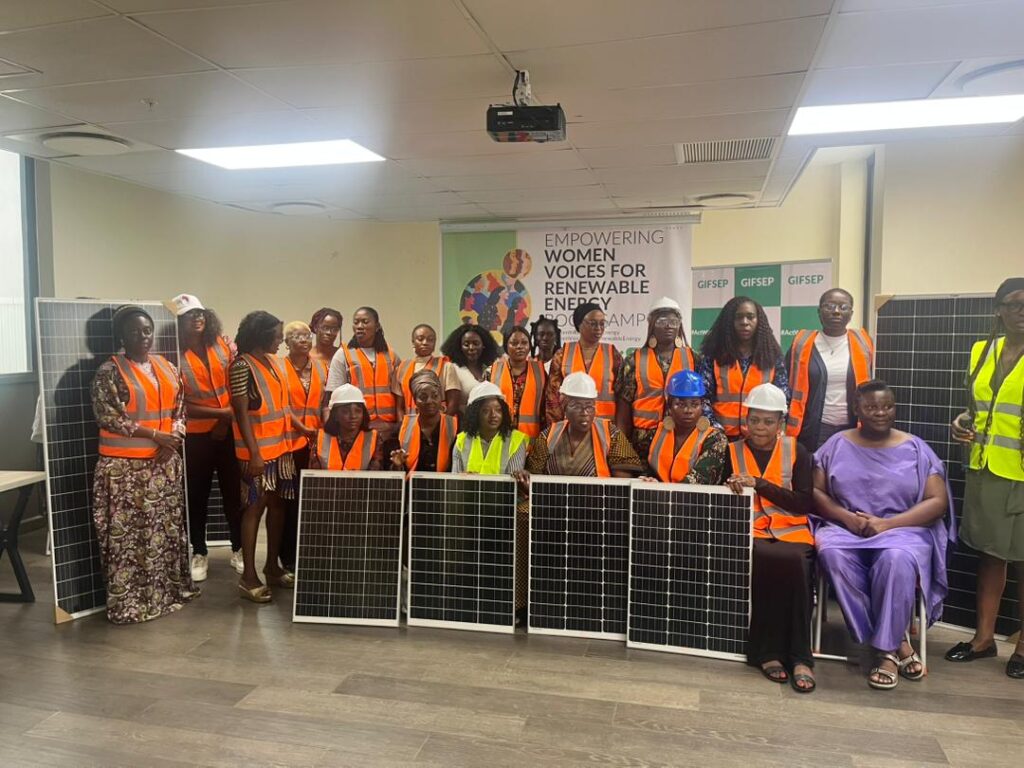
GIFSEP’s recent Women for Renewable Energy Boot Camp, supported by Social Change Nest and UMI Fund, trained women from fossil fuel-impacted communities as solar technicians and clean energy advocates.
Participants received hands-on instruction in solar installation, maintenance, and community education, equipping them to lead clean energy adoption in their localities.
Speaking at the event, Dr. Michael Terungwa David emphasized the urgent need for a just energy transition in Nigeria, calling on governments, partners, and the private sector to support women-led renewable energy initiatives. He stressed that access to clean energy is a human right and key to equity, health, and opportunity.
“As the world prepares for COP30, GIFSEP calls on government agencies, development partners, and the private sector to invest in women-led renewable energy solutions and scale up climate and adaptation finance that directly reaches local communities. Energy is not just power, it’s health, education, and opportunity.
World leaders must remember that renewable energy access is not charity; it’s a human right. A just energy transition in Nigeria must prioritize equity, inclusiveness, and community ownership ensuring that no one, especially women and the poor, is left behind. Together, with women, we can power Nigeria’s future with clean energy, justice, and hope.’”
Dr. David also revealed that GIFSEP has launched the Women Voices for Renewable Energy in Nigeria initiative, training women from fossil fuel–impacted communities as solar technicians and clean energy advocates. The program equips participants with practical skills to transform their communities.
He further stated “Recognizing this gap, GIFSEP has taken proactive steps to empower women as key drivers of Nigeria’s energy transition through the Women Voices for Renewable Energy in Nigeria initiative with support from Social Change Nest and UMI Fund. Over the past three days, we held a Women for Renewable Energy Boot Camp, where we trained women and girls from fossil fuel–impacted communities to become solar technicians and clean energy advocates.
Through hands-on sessions and mentorship, participants gained practical skills in solar installation, maintenance, and community energy education, preparing them to return to their communities as both practitioners and change agents for renewable energy adoption.’” He stated .
He further disclosed Nigeria’s dependence on oil, gas, and coal, particularly in the Niger Delta and North Central regions, continues to fuel greenhouse gas emissions, air and water pollution, and severe environmental degradation.
“Nigeria stands at a crossroads. The country’s dependence on oil, gas, and coal particularly in the Niger Delta and North Central regions continues to fuel greenhouse gas emissions, air and water pollution, and severe environmental degradation. Gas flaring and fossil fuel combustion release significant amounts of methane and carbon dioxide, driving both climate change and environmental injustice in host communities.”
He emphasized that Nigeria Despite being Africa’s largest economy, over 85 million Nigerians more than 40% of the population still lack electricity, keeping many trapped in cycles of poverty and limiting economic development.
“Despite being Africa’s largest economy, over 85 million Nigerians more than 40% of the population still lack access to electricity. This persistent energy poverty stifles economic development, worsens inequality, and keeps millions trapped in cycles of hardship.”
Women and girls are disproportionately affected by energy poverty. Traditional fuels like firewood and kerosene expose them to health risks and reduce opportunities for education and income generation.
“Families across rural Nigeria continue to depend on kerosene, firewood, and diesel generators options that are expensive, unsafe, and harmful to human health and the environment. The consequences are especially severe for women and girls, who spend hours fetching firewood and are exposed to dangerous indoor smoke, losing valuable time for education, income generation, and rest.”he added.
Doorcas Nicanor, Team Lead of Women Voices for Renewable Energy, introduced the women participants and highlighted the importance of energy access as a human right for communities, homes, schools, and health facilities.
“Energy access is not charity, it is a human right ,it is renewable energy for our small scale businesses.” She stated .
Juliat Ooja Okoh, Coordinator of Owukpa Women in Training, spoke on the challenges women face in coal-impacted communities like Owukpa and Awo, emphasizing energy deprivation and the empowering effect of the boot camp.
“For us, renewable energy is no longer charity, it’s our right lending our voices to the issues of renewable energy is going to make the world know what women are going through.”she added.
Amanie Stella, Executive Director of Women and Youth Affairs (SWAYA), highlighted the Niger Delta’s oil exploitation, environmental degradation, and energy poverty, calling for climate and energy justice for women and their communities.
“This boot camp has given us the opportunity as women to demand climate justice ,it will be nice if women have clean energy in their homes so their children can read at night.”
Rejoice Asoloko, a member of Brum Brum Community, addressed the poverty and insecurity in mineral-rich areas like Asraigon, noting that renewable energy access can empower women and improve community development.
“This boot camp is an eye opener,it shows the need for women to get involved in renewable energy and have access to it.”
Best Nbani of Lekeh Development Foundation, representing youth from the Niger Delta, called on multinational oil companies like Shell to remediate environmental damage in Oguni, linking energy access to justice and environmental restoration ahead of COP30.
“Shell should come and clean up Oguni land ,Shell should remediate, restore, and repair.” She added.
GIFSEP Empowers Women to Champion Renewable Energy in Nigeria



OPEP troops foil suspected Fulani bandits reprisal attack on Jwerk Kargung village in Plateau
By: Zagazola Makama
Troops of Sector 8, Sub-Sector 81, Operation Hakorin Damisa (OPEP), have foiled an attempted reprisal attack on Jwerk Kargung Village in Mangu Local Government Area of Plateau State.
The incident occurred at about 8:35 p.m. on Sept. 20, 2026, following reports of sporadic gunshots around the community.
Troops deployed at Mangu Halle, alongside personnel of Operation Rainbow and Keystone Mangu Division, swiftly responded to the report and moved to the affected area.
According to military sources, the quick intervention of the troops forced the gunmen, suspected to be Fulani militias, who were allegedly attempting to attack the village, to withdraw into the bush.
The troops subsequently dominated the general area and commenced offensive operations to frustrate further criminal activities and prevent the attackers from regrouping.
Security forces are maintaining patrols around the community as efforts continue to safeguard residents and prevent further attacks.
OPEP troops foil suspected Fulani bandits reprisal attack on Jwerk Kargung village in Plateau

NIS Enrolls 8,552 Nigerians in Diaspora Passport Intervention
By: Michael Mike
The Nigeria Immigration Service has enrolled 8,552 Nigerians in the diaspora under targeted passport intervention exercises conducted in the United States, Canada, Qatar and the United Kingdom.
The Service said the exercises were undertaken in line with its commitment to improving passport service delivery to Nigerians abroad and under the directive of the Minister of Interior, Dr. Olubunmi Tunji-Ojo.
According to the Service, the intervention was designed to bring passport services closer to Nigerians in various cities and was conducted in collaboration with Nigerian diplomatic missions and representatives of Nigerian communities to ensure a coordinated and responsive service delivery process.
According to a statement on Monday by the spokesman of NIS, Akinsola Akinlabi, in the United States, the exercise was held between 7th and 15th September 2026 across Chicago, Michigan and Milwaukee where 535 applicants were enrolled. In Canada, the exercise which ran from 6th to 19th September 2026 across Manitoba, Toronto, Saskatoon, Alberta and New Brunswick enrolled 2,257 Nigerians.
The exercise in Qatar which held from 9th to 24th August 2026 enrolled 751 applicants.
The exercise in the United Kingdom covering London and Manchester which has enrolled 5,099 applicants is still ongoing.
Akinsola said passport production and dispatch are being carried out concurrently with the enrolment in the United Kingdom.
The Nigeria Immigration Service advised applicants who were unable to secure appointment slots during the exercises, as well as those who may prefer not to physically visit the centres or the High Commission, to utilise the Contactless Passport Application System for their applications.
The Service reiterated its commitment to responsive and accessible passport services for Nigerians in the diaspora and to ensuring timely, efficient and convenient service delivery.
NIS Enrolls 8,552 Nigerians in Diaspora Passport Intervention
Experts Warn that Climate Crisis is Paramount to Explosion of Insecurity in West Africa
By: Michael Mike
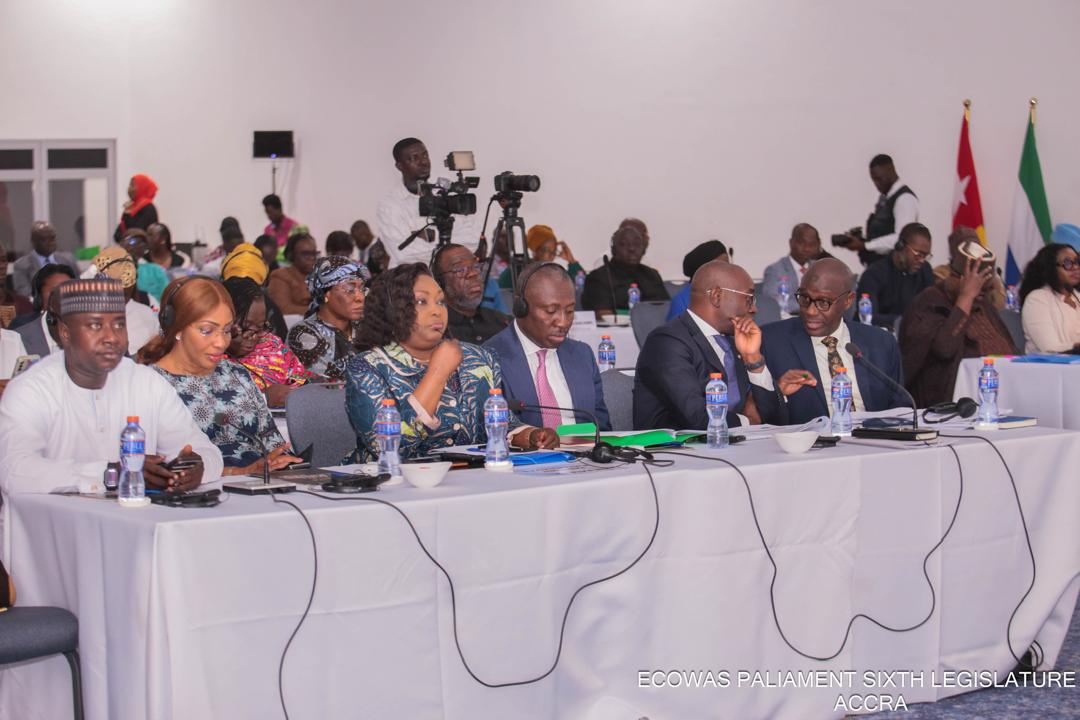
Climate change is fueling population displacement and threatening regional stability across West Africa, experts warned Monday as the Second Extraordinary Session of the ECOWAS Parliament opened in Accra.
The warning was issued at the Second Extraordinary Session and Second Parliamentary Seminar with the theme: “Climate Change as a Driver of Environmental Degradation, Population Displacement and Rising Insecurity in the ECOWAS Region.” The session will run from 21st to 28th September 2026 in Accra, Republic of Ghana.
Experts told lawmakers that rising temperatures, extreme weather, drought, unpredictable rainfall, flooding, rising sea levels and land degradation are putting direct pressure on livelihoods, critical infrastructure and security.
Opening proceedings, Speaker of the ECOWAS Parliament, Hadja Memounatou Ibrahima, said the session was convened at a critical time for the region. She drew attention to Ghana’s Founder’s Day, marking the birth of Ghana’s first President Dr. Kwame Nkrumah, and called on participants to honour his vision of a free and united Africa. A minute of silence was observed in his honour.
Dr. Derek Sarfo-Yiadom, Senior Programme Officer, Climate Change and Ozone Directorate of Ghana’s Environmental Protection Authority, said climate hazards were no longer distant threats.
He noted that: “Climate hazards are with us,” listing extreme heat, drought, heavy and unpredictable rainfall and rising sea levels as growing concerns.
Sarfo-Yiadom said seasonal temperatures have risen by between one and three degrees Celsius since 1970, driving hotter heatwaves and unpredictable weather.
He lamented that changing rainfall patterns are increasing flood risks while drought and heat are crippling farming, while identifying farmers, low-income communities, coastal settlements and displaced populations as the most vulnerable.
He decried that homes, irrigation, electricity, transport networks, ports, markets and public services are at risk.
He however warned that the impact becomes a disaster when exposed communities lack capacity to cope, and that climate pressure is already contributing to displacement and conflict in agriculture-dependent communities.
He called for increased investment in adaptation, flood-proof zoning, expansion of climate-risk mapping, early-warning systems that reach vulnerable communities, and accountability for climate-related spending.
On his part, the Principal Officer, Climate Change and Climate Services at the ECOWAS Commission, Mr. Raoul Kouame, said ECOWAS must harmonise regional climate policies and support member states to implement their commitments under the Paris Agreement.
“The challenge is no longer just to define climate commitments,” Kouame said.
He identified institutional fragmentation, differences in national capacities and difficulties accessing climate finance as the main obstacles to action.
Kouame advocated stronger coordination between regional and national institutions and mechanisms to help countries align national frameworks with regional structures. He said cooperation must cover climate services, early warning systems, forest and ecosystem protection, carbon markets and access to finance.
The gap is huge. The ECOWAS Regional Strategy for Access to and Mobilization of Climate Finance, adopted in 2022, had estimated the region’s climate financing needs at $294 billion, based on conditional requirements contained in the NDCs 2.0. ECOWAS officials have warned that 32m West Africans risk displacement, with $294bn needed to tackle the crisis.
In 2024 the Commission began a new regional process, in line with ECOWAS Vision 2050 and the African Union’s Agenda 2063, to develop a harmonized framework for a regional carbon market platform.
Dr. Abdou Ali, climate, water and meteorology expert with the Permanent Inter-State Committee for Drought Control in the Sahel (CILSS), told lawmakers that West Africa has been here before.
He noted that CILSS itself was created in 1973 during the first great drought in the region, in the wake of the devastating droughts of 1968-1970, stating that its mandate remains food security and combating drought and desertification.
Ali said regional cooperation is essential because climate risks do not stop at national borders. He listed agriculture, coastal areas, biodiversity, disaster risk and human displacement as areas requiring coordinated adaptation, and said climate action must be integrated into agriculture, forestry, energy, transport, industrialisation and waste management policies.
He stressed that regional strategies need adequate financing, stronger institutions and effective implementation mechanisms.
The presentations converged on one point: adaptation measures must account for the needs and livelihoods of affected communities to avoid creating new vulnerabilities.
Parliamentarians are now in closed deliberations on the expert presentations.
Experts Warn that Climate Crisis is Paramount to Explosion of Insecurity in West Africa

OPEP troops foil suspected Fulani bandits reprisal attack on Jwerk Kargung village in Plateau

NIS Enrolls 8,552 Nigerians in Diaspora Passport Intervention

Experts Warn that Climate Crisis is Paramount to Explosion of Insecurity in West Africa

Roger Federer’s Shock as DNA Results Reveal Myla and Charlene Are Not His Biological Children

THE PLIGHT OF FARIDA

FAILED COUP IN BURKINA FASO: HOW TRAORÉ NARROWLY ESCAPED ASSASSINATION PLOT AMID FOREIGN INTERFERENCE CLAIMS
-
 News3 years ago
Roger Federer’s Shock as DNA Results Reveal Myla and Charlene Are Not His Biological Children
-
Opinions5 years ago
THE PLIGHT OF FARIDA
-
 News1 year ago
FAILED COUP IN BURKINA FASO: HOW TRAORÉ NARROWLY ESCAPED ASSASSINATION PLOT AMID FOREIGN INTERFERENCE CLAIMS
-

 News3 years ago
EYN: Rev. Billi, Distortion of History, and The Living Tamarind Tree
-
 Opinions5 years ago
POLICE CHARGE ROOMS, A MINTING PRESS
-

 ACADEMICS3 years ago
A History of Biu” (2015) and The Lingering Bura-Pabir Question (1)
-

 Columns3 years ago
Army University Biu: There is certain interest, but certainly not from Borno.
-

 Politics1 year ago
2027: Why Hon. Midala Balami Must Go, as Youths in Hawul and Asikira/Uba Federal Constituency Reject ₦500,000 as Sallah Gift
