
Crime
Milan, Dubai-bound drugs busted by NDLEA at Lagos Airport

Milan, Dubai-bound drugs busted by NDLEA at Lagos Airport
By: Michael Mike
Operatives of the National Drug Law Enforcement Agency (NDLEA) have busted fresh attempts by drug cartels to smuggled drugs through the Murtala Muhammed International Airport, Lagos to Italy and United Arab Emirates (UAE).
The NDLEA also busted drug operations in Abia, Kaduna, Yobe and Kogi States where 203,879 tablets of various pharmaceutical opioids and illicit substances were seized in raids across the states.
A statement on Sunday by the spokesman of the NDLEA, Femi Babafemi read: “Fresh bids by drug cartels to export tramadol, Ecstasy MDMA and cannabis to Milan, Italy and Dubai, United Arab Emirates through the Murtala Muhammed International Airport, MMIA, Ikeja Lagos have been foiled by operatives of the National Drug Law Enforcement Agency, who also seized 203,879 tablets of various pharmaceutical opioids and illicit substances in raids across Abia, Kaduna, Yobe and Kogi state.”
He disclosed that at the Lagos airport, a female passenger, Odia Efe was arrested last Monday while trying to board Royal Air Moroc flight from Lagos via Casablanca to Milan, Italy with 1000 tablets of tramadol 200mg concealed in food items, while five
days after, last Friday, a freight agent Kareem Ibrahim was arrested at the SAHCO cargo shed of the airport for attempting to export food items in which were hidden blocks of cannabis weighing 6.65 kilogrammes and 24 grammes of ecstasy drug, MDMA to Dubai in UAE.
He said in Abia State, three trucks loaded with drugs coming from Lagos and Onitsha, Anambra were intercepted in Aba, and when properly searched in the presence of the owners last Wednesday 67,100 tablets/capsules of tramadol and 12,650 ampules of pentazocine, morphine and dopamine were recovered.
He equally said, on the same day, NDLEA operatives in Kaduna arrested a notorious drug dealer, Shehu Kabiru a.k.a Dan-Zaira, who had been wanted by the Kastina Command of the agency for jumping bail, disclosing that recovered from him include: 45,000 tablets of Diazepam weighing 41.5 kilogrammes; 50,000 tablets of Exol, weighing 15.6 kilogrammes; 1,500 tablets of Rohypnol weighing 700 grammes and 300 bottles of codeine weighing 41.5 kilogrammes.
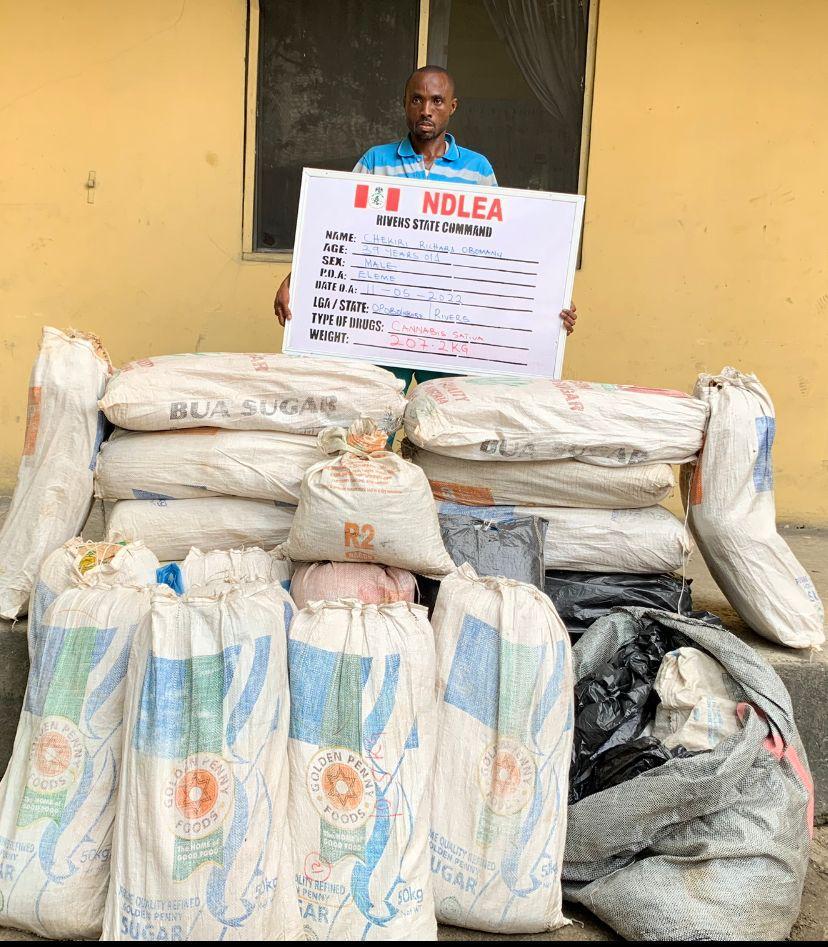
Babafemi said in Yobe State, no fewer than 7,029 tablets of tramadol, D5, and Exol as well as 1.5 kilogrammes cannabis were recovered from a drug dealer, Ibrahim Yakubu when his hideout was raided in Unguru town on Sunday 8th May, while in Rivers state, one Chekiri Richard Obomanu was arrested at Eleme area last Wednesday with 207.2 kilogrammes cannabis.
He added that not less than 19,600 tablets of tramadol coming from Onitsha, Anambra state to Abuja were intercepted and recovered along Okene/Abuja highway last Wednesday by NDLEA operatives in Kogi state.
In another development, five members of a syndicate, which conducts fake recruitment into security agencies, have been arrested in coordinated operations in Zamfara, Kebbi and Bauchi States. He said leader of the gang, Yakubu Sani was first arrested in Gusau, Zamfara state, alleging that his criminal gang issues fake NDLEA employment letters and identity cards to unsuspecting members of the public for the sum of N400,000 per person.
Also Read: More revelation over killing of a female student for…
Babafemi said a follow up operation in Zuru, Kebbi State led to the arrest of another gang member, Ibrahim Isah, while three others; Dahiru Limanchi, Gambo Danladi and Umar Abubakar were nabbed in Bauchi state.
He said recovered from them include: a fake NDLEA ID card; NDLEA guarantor form; INEC offer of appointment letter; Nigerian Customs Special Replacement Form and appointment letter; Nigerian Correctional Service Replacement Form; Credentials of some Applicants; Receipts and passport photos; Five sim packs and one MTN SIM card.
Meanwhile, the Chairman/Chief Executive of NDLEA, Brig. Gen. Buba Marwa (Retd) has commended the officers and men of the MMIA, Abia, Kaduna, Yobe, Rivers and Kogi for the arrests and seizures, while equally acknowledged the well-conducted operations in Zamfara, Kebbi and Bauchi that nailed five members of a criminal gang scamming innocent job seekers with fake employment letters.
He however charged them and their compatriots across all Commands not to rest on their oars but should continue to aspire to beat previous records.
Milan, Dubai-bound drugs busted by NDLEA at Lagos Airport



Troops Neutralise Suspected Kidnapper While Attempting Escape in Plateau
By: Zagazola Makama
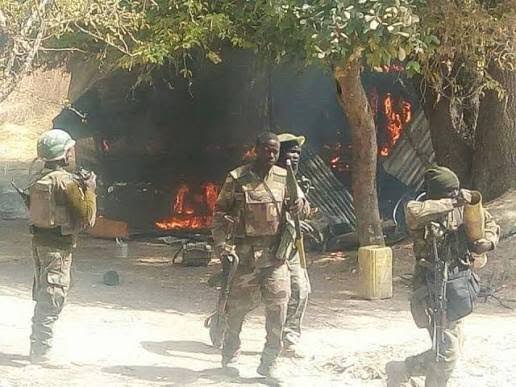
Troops of Operation ENDURING PEACE (OPEP) have neutralised a suspected kidnapper and cattle rustler while he was allegedly attempting to escape from custody in Plateau State.
Security sources told Zagazola Makama that the suspect, identified as Samaila Shuibu, had earlier been arrested with arms at Hurti community in Bokkos Local Government Area of the state.
The sources said the incident occurred on Saturday while troops of Sector 5, Operation ENDURING PEACE, were transporting the suspect to the Joint Task Force (JTF) headquarters in Jos for further investigation and possible prosecution.
According to the sources, the military vehicle conveying the suspect developed a flat tyre along the route, prompting the troops to stop and replace it.
“During the process of changing the tyre, the suspect reportedly jumped out of the vehicle and attempted to escape.
“The troops immediately pursued him, and he was neutralised during the ensuing encounter,” a security source said.
The source added that three rounds of 7.62mm special ammunition were expended during the operation.
Military authorities said the movement and subsequent operation were conducted without any further incident.
They noted that troops deployed under Operation ENDURING PEACE remain committed to ongoing efforts aimed at tackling kidnapping, cattle rustling and other criminal activities across Plateau State and its environs.
Troops Neutralise Suspected Kidnapper While Attempting Escape in Plateau
Brazil-Based Businessman Held as NDLEA Uncovers Cocaine-Soaked Shirts at Lagos Airport
By: Michael Mike
Operatives of the National Drug Law Enforcement Agency (NDLEA) have intercepted a Brazil-based Nigerian businessman at the Murtala Muhammed International Airport, Lagos, after discovering shirts and towels allegedly impregnated with liquid cocaine in a major anti-narcotics operation that also led to the seizure of over two tonnes of illicit drugs across the country.
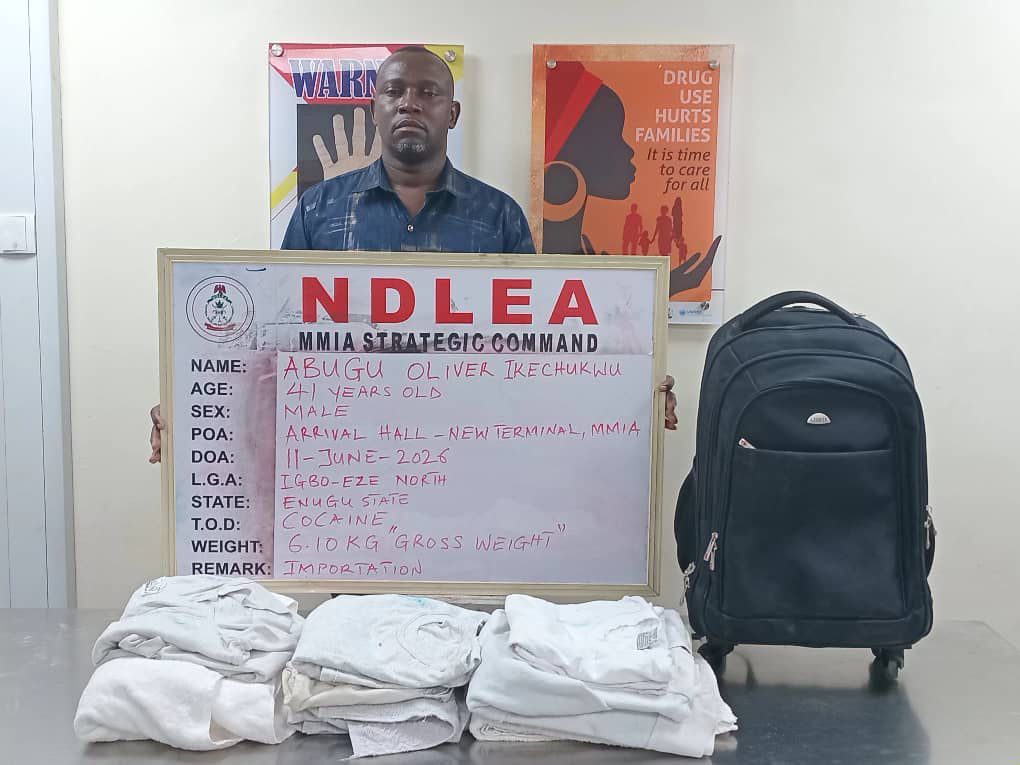
The suspect, 41-year-old Abugu Ikechukwu, was arrested upon arrival from São Paulo, Brazil, via Addis Ababa, Ethiopia, aboard an Ethiopian Airlines flight. NDLEA said a detailed examination of his luggage uncovered 14 shirts and towels soaked in liquid cocaine, dried and carefully ironed to evade detection.
The spokesman of the anti-narcotics agency, Femi Babafemi in a statement on Sunday, said forensic analysis revealed the concealed narcotics weighed 6.1 kilogrammes.
Abugu reportedly told investigators that he had lived in Brazil for more than 14 years where he operates an African restaurant and had travelled to Nigeria to visit his family and purchase food supplies for his business.
The arrest was part of a nationwide crackdown that saw NDLEA operatives recover massive consignments of cannabis, tramadol and other controlled substances in multiple states and the Federal Capital Territory.
In a development highlighting the growing reach of drug trafficking networks, the agency also arrested two persons living with disabilities for alleged involvement in the illicit drug trade. A 60-year-old woman, Chidimma Sunday, was taken into custody in Abia State after being caught with 1.8 kilogrammes of skunk, while 28-year-old Abubakar Usman was arrested in Rivers State with cannabis, methamphetamine, tramadol, diazepam and other prohibited substances.
In Taraba State, NDLEA operatives raided the warehouse of a suspected drug kingpin, Ali Adamu, at Maihula village in Bali Local Government Area, where 63 jumbo bags of cannabis sativa weighing 1,121.5 kilogrammes were recovered.
Another major haul was recorded in Lagos where operatives seized 1,102 kilogrammes of Ghana Loud, a potent strain of cannabis, around the Alaba International Market in Ojo.
The agency also intercepted a vehicle along Bode Saadu Road in Kwara State carrying 304 kilogrammes of compressed cannabis blocks concealed in a Toyota jeep. Two suspects, Nasiru Hamza and Muhammad Sani, were arrested in connection with the shipment.
In Abuja, NDLEA officers on patrol along the Gwagwalada Expressway arrested Emmanuel Nnadi and recovered thousands of pills of tramadol, pregabalin and ecstasy, as well as hundreds of bottles of codeine-based syrup.
Other operations in Delta, Gombe and Kano states resulted in the arrest of several suspected traffickers and the seizure of additional consignments of cannabis and pharmaceutical opioids.
Beyond enforcement activities, the agency said it sustained its nationwide War Against Drug Abuse (WADA) campaign through sensitisation programmes in schools, communities and traditional institutions across several states.
Meanwhile, NDLEA Chairman and Chief Executive, Buba Marwa, commended officers involved in the operations, describing the seizures and arrests as further evidence of the agency’s commitment to reducing drug supply while intensifying public awareness against substance abuse.
He urged commands across the country to sustain the momentum and continue surpassing previous operational records in the fight against illicit drugs.
Brazil-Based Businessman Held as NDLEA Uncovers Cocaine-Soaked Shirts at Lagos Airport
Troops Recover AK-47 Rifle, Ammunition in Failed ISWAP Reconnaissance Operation in Borno
By: Zagazola Makama
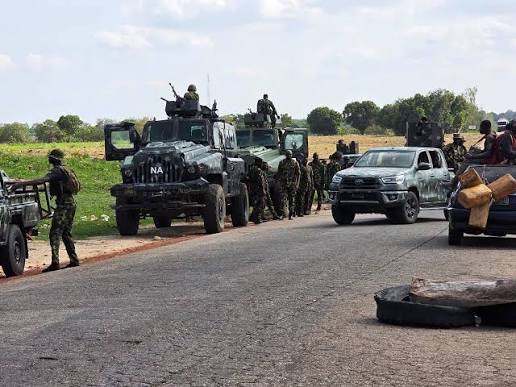
Troops of 68 Battalion, Mallam Fatori, have recovered one AK-47 rifle and 31 rounds of ammunition during an operation against suspected ISWAP elements in Abadam Local Government Area of Borno State.
Security sources said the incident occurred at about 9:07 a.m. on June 11 when troops observed the movement of two ISWAP reconnaissance teams ahead of their defensive area of responsibility.
According to the sources, an ambush team was immediately deployed to flank the suspected terrorists, but the insurgents fled upon sighting the troops and opened fire while escaping.
Following an exploitation of the area, troops recovered one AK-47 rifle and 31 rounds of 7.62mm special ammunition.
The sources added that follow-up operations were ongoing to track the fleeing terrorists and deny them freedom of movement within the general area.
Military authorities said the operation was part of sustained efforts to disrupt terrorist reconnaissance activities and strengthen security across the Lake Chad axis.
They reaffirmed commitment to maintaining pressure on insurgent groups until they are fully degraded.
Troops Recover AK-47 Rifle, Ammunition in Failed ISWAP Reconnaissance Operation in Borno

The ‘Hyenas’ and The Fear of Radical Changes

Parliamentarians in Sierra Leone mourn colleague Lucinda Kelly

Troops Neutralise Suspected Kidnapper While Attempting Escape in Plateau

Roger Federer’s Shock as DNA Results Reveal Myla and Charlene Are Not His Biological Children

THE PLIGHT OF FARIDA

FAILED COUP IN BURKINA FASO: HOW TRAORÉ NARROWLY ESCAPED ASSASSINATION PLOT AMID FOREIGN INTERFERENCE CLAIMS
-
 News2 years ago
Roger Federer’s Shock as DNA Results Reveal Myla and Charlene Are Not His Biological Children
-
Opinions4 years ago
THE PLIGHT OF FARIDA
-
 News1 year ago
FAILED COUP IN BURKINA FASO: HOW TRAORÉ NARROWLY ESCAPED ASSASSINATION PLOT AMID FOREIGN INTERFERENCE CLAIMS
-

 News2 years ago
EYN: Rev. Billi, Distortion of History, and The Living Tamarind Tree
-
 Opinions4 years ago
POLICE CHARGE ROOMS, A MINTING PRESS
-

 ACADEMICS2 years ago
A History of Biu” (2015) and The Lingering Bura-Pabir Question (1)
-

 Columns2 years ago
Army University Biu: There is certain interest, but certainly not from Borno.
-

 Politics1 year ago
2027: Why Hon. Midala Balami Must Go, as Youths in Hawul and Asikira/Uba Federal Constituency Reject ₦500,000 as Sallah Gift
