
News
Modi Advocates for Conservation of Big Cats

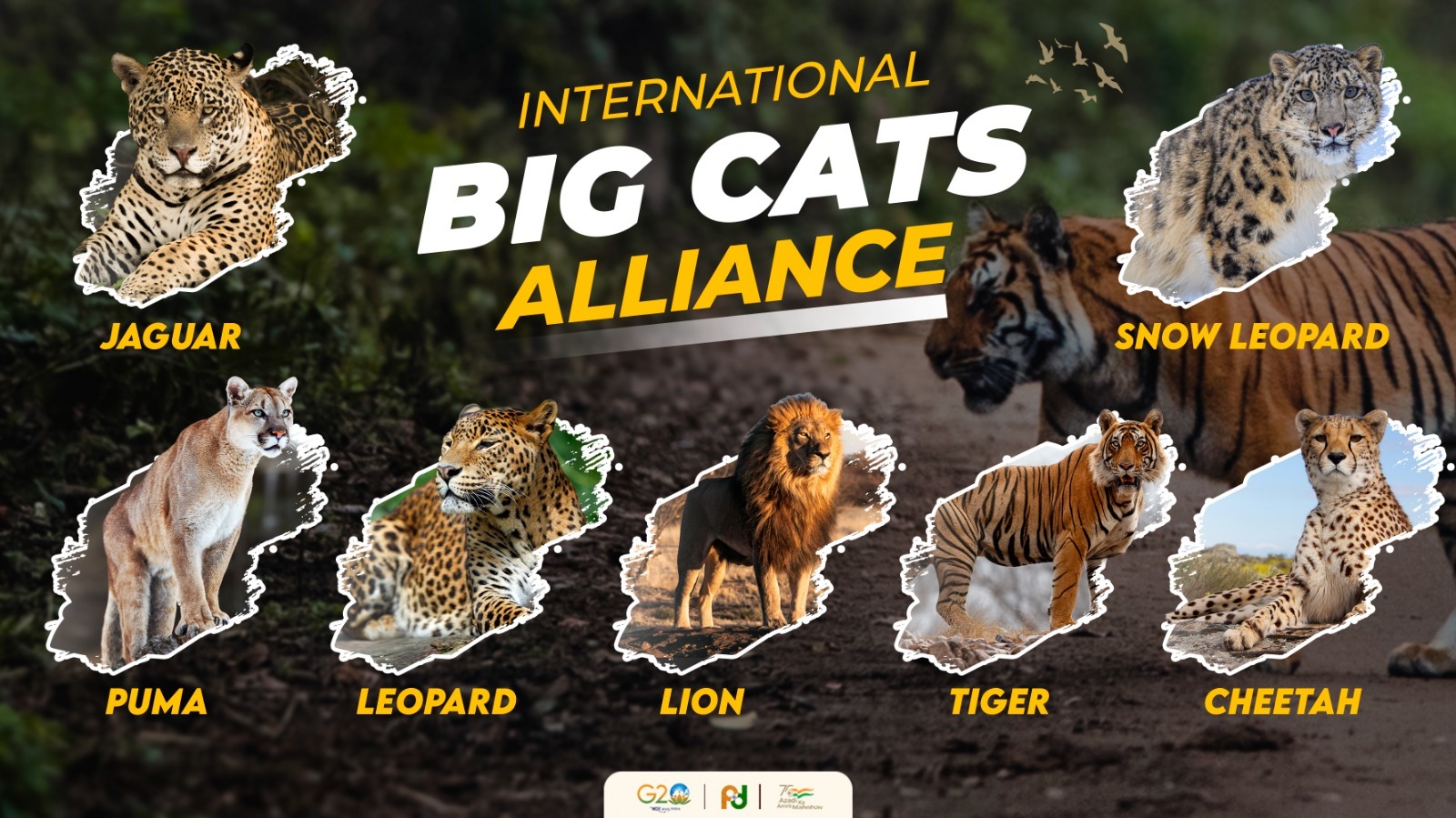
Modi Advocates for Conservation of Big Cats
By: Michael Mike
India’s Prime Minister, Shri Narendra Modi has advocated for the conservation of the big cats in order to prevent their extinction.
The Prime Minister, in a mega international event held on Sunday at Mysuru, Karnataka, to commemorate 50 years of Project Tiger, made the call for their conservation.
Modi while launching the International Big Cat Alliance (IBCA) for conservation of seven big cats namely Tiger, Lion, Leopard, Snow Leopard, Cheetah, Jaguar and Puma harbouring our planet, noted that India has a long-standing experience on the tiger agenda and conservation of other big cats like lion, snow leopard, leopard, now the translocation of the Cheetah to bring an extinct big cat back to its natural habitat.
According to a report from one of India’s major newspapers, IBCA will focus on protection and conservation of seven major big cats of the world such as tiger, lion, leopard, snow leopard, puma, jaguar, and cheetah in collaboration with countries harbouring these species.
“The belief of Narendra Modi has been integral in the environmental consciousness. Wide-ranging efforts have been undertaken, which have together positively impacted the wildlife in the country,” according to a government release.
The IBCA will provide assured support over five years with guaranteed funding of over Rs 800 crore.
The group will work towards the protection of the seven big cats — tiger, lion, leopard, snow leopard, puma, jaguar and cheetah.
Membership to the alliance will be open to 97 “range” countries, which contain the natural habitat of these big cats, as well as other interested nations, international organisations, etc.
The IBCA will engage in advocacy, partnership, knowledge e-portal, capacity building, eco-tourism, partnerships between expert groups and finance tapping.
The main objective of the alliance is to rehabilitate the big cats, with the alliance disseminating information on benchmarked practices, capacity building, resources repository, research and development, and awareness creation.
In July 2019, Prime Minister Modi had called for an Alliance of Global Leaders to firmly curb poaching and illegal wildlife trade in Asia.
According to the government, the population of tigers increased by 33% over 4 years to 2,967 in 2018.
Earlier in the day, Prime Minister Modi visited Bandipur Tiger Reserve in Karnataka where he interacted with frontline field staff and self-help groups involved in conservation efforts, as part of programmes to mark 50 years of ‘Project Tiger’.
Chairing the Ministerial session on global status of big cat conservation Union Minister for Environment, Forest and Climate Change Shri Bhupender Yadav said conserving big cats and their habitats can secure some of the most important natural ecosystems on Earth leading to natural climate change adaptation, water, and food security for millions of people, and provide livelihood and sustenance to forest communities.
He said the Alliance will strengthen global efforts and partnerships on big cat conservation, while evolving a platform for convergence of knowledge and best practices, supporting existing species specific inter-governmental platforms, while also providing direct support to recovery efforts in potential range habitats.
Shri Yadav said with big cats as mascots for sustainable development and livelihood security, India and the big cat range countries can usher in major efforts on environmental resilience and climate change mitigation, while paving a future where natural ecosystems continue to thrive, and gain centrality in economic and development policies in the “Amrit Kaal”.
The Ministers of Big Cat Range countries acknowledged and appreciated the leadership of India in big cat conservation and praised the efforts of Prime Minister, Union Minister and senior forest officials of the Ministry of Environment, Forest & Climate change.
The Ministers of Big Cat Range Countries made the following remarks on the momentous event of launch of International Big Cat Alliance by the Prime Minister of India.
Forest Minister of Bhutan in his speech accepted the leadership of India in guiding them. His passing remarks like may Goddess Chamundi shower her blessings on all of the forest fraternity and his words in Hindi reverberated around the hall.
Forest Minister of Bangladesh praised India in helping in their conservation efforts in saving their pride that is Sundermani and Chittagong tigers.
His Excellency from Cambodia, was enthusiastic in getting tigers from India and rehabilitating them in in their Cardamom Hills and in their Sripok Wildlife Sanctuary.
He also spoke about the re-introduction plan prepared by them.
Kenya’s Minister of Wildlife, Tourism and Culture, through her video message lauded the help rendered by Government of India and Indian Forest Service, in formulating the protocols, good managerial practices, in the conduct and evaluating of Census results of wild animals especially Lions in her country.
Minister from Nepal, accepted the leadership of India in the field of wildlife conservation and offered all support to the alliance.
Ethiopian Forest Minister without mincing words expressed his greatest satisfaction in being a part of an endeavour to save big cats all around the world.
His Royal Highness the Regent of Pahang was all praise for India’s efforts and wanted assistance in recovery of tiger population in Malaysia. Besides this Ministers and head of delegations of Suriname, Armenia, Tanzania, Nigeria, Vietnam, Thailand and Lao also expressed their appreciation for the said initiative.
The Union Minister Shri Bhupender Yadav acknowledging the overwhelming support promised to work on modalities to take the launch of IBCA forward and thanked everyone for their participation.



NGX boss restates commitment to gender equality
The Group Chairman Nigerian Exchange Group, Dr. Umaru Kwairanga has restated the NGX’s commitment to gender equality and diversity at all levels of the organisation.
Kwairanga stated this in Lagos on Tuesday while delivering his welcome address on the occasion of the closing ceremony in honour of the Honourable Minister of Women Affairs and Social Development, Hajiya Imaan Sulaiman-Ibrahim, who visited the floor of the Nigerian Exchange.
He stated that the Nigerian Exchange Group as an organisation remained committed to inclusiveness that drive growth and development at all levels of the NGX’s dealings.
He stated that through such inclusive representation, the NGX has achieved near parity at the board levels of the organisation and was working to improve the representation of female employees down the line.
“As an institution committed to sustainable growth and practices, we recognise the important qualities and values that women bring to the workplace and know that they perform just as well, if not better than men.
“It is a tradition in finance and investment that can be traced to the origins of the banking, finance and investment professions when most of the trade guilds that evolved into those professions were largely composed of men.
“The tradition has persisted for hundreds of years but despite that nomenclature, let me assure you that the investment and securities sector is very welcoming to and open to city gentlemen who are female.
“Women are very well represented at all levels of our industry and I can confide in you that the next President of the Chartered Institute of Stockbrokers is going to be a woman,” he said.
Kwairanga stated that the NGX would partner with the Ministry to accelerate progress for women’s rights and improve the lot of female gender across the country.
He commended Sulaiman-Ibrahim for her several bold and innovative initiatives that would have positive impact on women and the country as a whole.
NGX boss restates commitment to gender equality
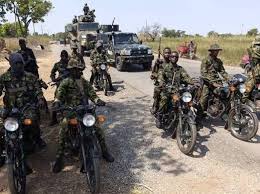
Benue troops neutralize one terrorist, arrest four suspects in Gwer West LGA
By: Zagazola Makama
Troops of Sector 1 Operation Wirld Stroke deployed at FOB Bilawa-Jor conducted a fighting patrol within Mbapa and Mbabuande general areas on March 23, 2026.
During the operation, troops made contact with terrorists, neutralizing one suspect while others fled.
Following a pursuit, four additional suspects were apprehended and are currently in the custody of security forces for further investigation and prosecution.
In a similar development the troops
recovered a vehicle carrying two cows abandoned by suspected cattle rustlers in Uhemba.
The incident occurred at about 0348hrs on March 24, 2026, when the troops responded to intelligence reports of rustling activities in the area.
Upon the arrival of troops, the suspects fled, leaving behind the vehicle and livestock.
The recovered vehicle and cows are now in the custody of the troops for further investigation and legal action.
Military continue to urge the public to provide timely information on criminal activities to support ongoing security efforts.
Benue troops neutralize one terrorist, arrest four suspects in Gwer West LGA
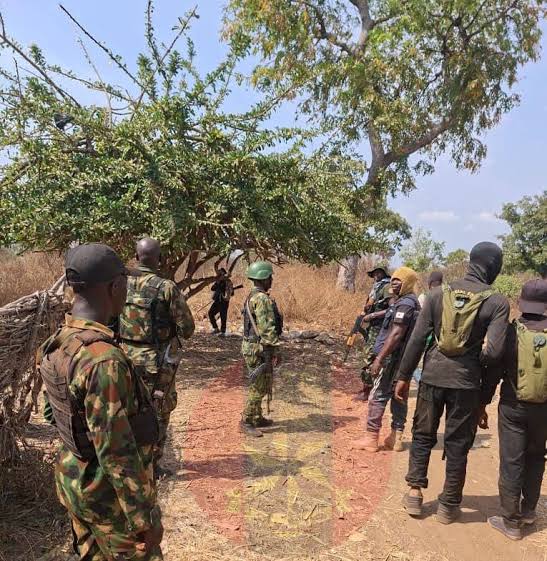
Kogi troops neutralize suspected terrorist in Kabba/Bunu LGA
By: Zagazola Makama
Troops of 12 Brigade have neutralized a suspected terrorist during a fighting patrol at Odoape–Adankolo Forest in Kabba/Bunu LGA.
The encounter occurred at about 1400hrs on March 23, 2026, when the patrol team made contact with the fleeing suspect.
Preliminary investigation identified the neutralized individual as a notorious terrorist involved in providing intelligence and targets for kidnappings, as well as participating in cattle rustling and supplying logs to terrorist groups.
The military has reaffirmed its commitment to sustaining aggressive patrols and intelligence-led operations to curb criminal activities and protect residents in the area.
Kogi troops neutralize suspected terrorist in Kabba/Bunu LGA

NGX boss restates commitment to gender equality

General Chris Musa, Hi-tech Fencing of Nigerian Porous Borders and the Foolish Pride of Sowore

Benue troops neutralize one terrorist, arrest four suspects in Gwer West LGA

Roger Federer’s Shock as DNA Results Reveal Myla and Charlene Are Not His Biological Children

THE PLIGHT OF FARIDA

FAILED COUP IN BURKINA FASO: HOW TRAORÉ NARROWLY ESCAPED ASSASSINATION PLOT AMID FOREIGN INTERFERENCE CLAIMS
-
 News2 years ago
Roger Federer’s Shock as DNA Results Reveal Myla and Charlene Are Not His Biological Children
-
Opinions4 years ago
THE PLIGHT OF FARIDA
-
 News11 months ago
FAILED COUP IN BURKINA FASO: HOW TRAORÉ NARROWLY ESCAPED ASSASSINATION PLOT AMID FOREIGN INTERFERENCE CLAIMS
-

 News2 years ago
EYN: Rev. Billi, Distortion of History, and The Living Tamarind Tree
-
 Opinions4 years ago
POLICE CHARGE ROOMS, A MINTING PRESS
-

 ACADEMICS2 years ago
A History of Biu” (2015) and The Lingering Bura-Pabir Question (1)
-

 Columns2 years ago
Army University Biu: There is certain interest, but certainly not from Borno.
-

 Opinions2 years ago
Tinubu,Shettima: The epidemic of economic, insecurity in Nigeria
