
News
NHRC Announces Programmes for 16 Days of Activism on GBV

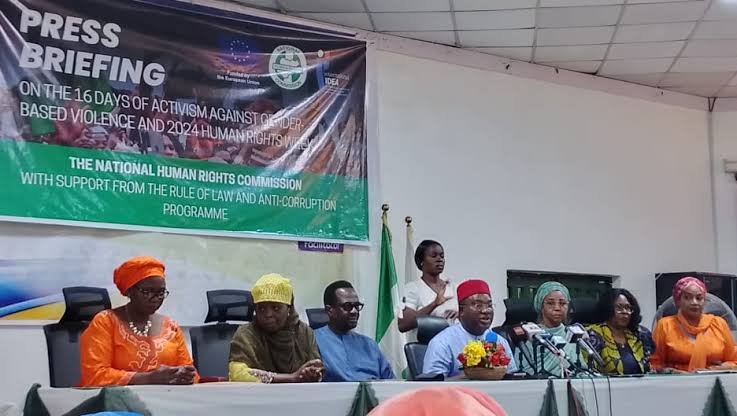
NHRC Announces Programmes for 16 Days of Activism on GBV
By: Michael Mike
The National Human Rights Commission (NHRC) has announced its plans for the 2025 International 16 Days of Activism Against Gender-Based Violence.
The activities which commences on Monday, showed a sweeping nationwide plan and a renewed call for stronger protections for women and girls, as the Commission also marks its 30th anniversary.
Addressing journalists at a press briefing in Abuja, the Executive Secretary of NHRC, Dr. Tony Ojukwu said the anniversary provided an important moment to reflect on three decades of work advancing justice, dignity, and equality in Nigeria — while acknowledging that gender-based violence (GBV) remains one of the gravest human rights violations confronting the country.
He said: “For 30 years, the Commission has remained a steadfast voice for accountability and human rights. This year’s campaign gives us the opportunity not only to reflect on our journey but to intensify the fight against all forms of violence, especially against women and girls.”
The 16 Days of Activism — observed annually from November 25 to December 10 — is part of a global movement launched in 1991 by the Centre for Women’s Global Leadership. It links the International Day for the Elimination of Violence Against Women with Human Rights Day, symbolizing that violence against women is a direct violation of human rights.
Ojukwu noted that Nigeria remains committed to this global call.
He said: “Gender-based violence is unacceptable in every form. These 16 days remind us that survivors must be heard, supported, and protected.”
This year’s programme, one of the NHRC’s most extensive yet, includes coordinated activities across all 36 states and the Federal Capital Territory.
According to Ojukwu, the activities are designed to strengthen prevention, improve accountability, and reinforce protection structures nationwide.
Marking its 30-year milestone, the NHRC urged the National Assembly to pass legislation creating special constituencies for women — a long-standing proposal aimed at improving female representation in public office.
“Denying affirmative action is itself a form of violence against women,” the Commission emphasized. “Empowerment must include political participation.”
The Commission also highlighted multiple empowerment programmes conducted in partnership with local and international organisations. These include:Support for over 60 survivors of sexual and gender-based violence under the EU/UNDP Spotlight Initiative; Financial grants for vulnerable women in collaboration with the Taipei Trade Office; Economic empowerment for more than 100 indigent women through the Thelma Lion Foundation; Distribution of sewing machines, grinding machines, and hair dryers to over 300 women through partnerships with National Assembly members; Ongoing collaboration with the Dorothy Njemanze Foundation to support SGBV survivors.
Ojukwu said: “These interventions are meant to strengthen the socio-economic resilience of women and reduce vulnerabilities.”
He reassured Nigerians that the commission will continue to carry out its mandate with fairness and impartiality.
He said: “We will not allow gender-based violence or any human rights violation to go unaddressed. Every complaint matters, and every perpetrator must be held accountable.”
As the 16-day campaign begins, Ojukwu called on government institutions, traditional and religious leaders, civil society groups, the private sector, and individuals to join in the fight to end violence against women.
“Awareness is not enough,”Ojukwu said. “We must turn commitments into action and build a Nigeria where women and girls can live free from fear, discrimination, and harmful practices.”
NHRC Announces Programmes for 16 Days of Activism on GBV


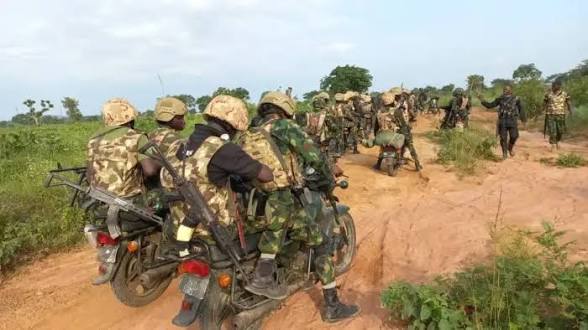
Troops rescue three abducted victims, recover ammunition in Borno
By: Zagazola Makama
Troops of Operation Hadin Kai have rescued three abducted civilians and recovered ammunition during an operation in Bama Local Government Area of Borno State.
Security sources said the operation was carried out at about 10:00 a.m. on March 30 by troops of 202 Battalion in collaboration with volunteer forces at BOCOBS.
According to the sources, the troops responded to credible intelligence indicating that suspected members of the Islamic State West Africa Province and Boko Haram had abducted three locals in the area.
The sources said the troops made contact with the insurgents and successfully rescued all three victims during the operation.
Items recovered from the scene include one AK-47 rifle magazine loaded with 30 rounds of 7.62mm special ammunition.
The sources added that the rescued victims are safe, while troops have continued to dominate the general area to prevent further incidents.
They said the operation is part of sustained efforts to protect civilians and dismantle terrorist activities across the North-East theatre.
Troops rescue three abducted victims, recover ammunition in Borno
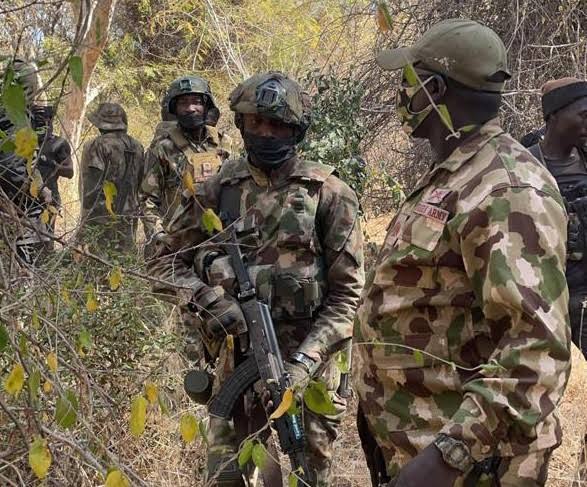
Troops repel terrorist attack in Yobe
By: Zagazola Makama
Troops of Operation Hadin Kai have repelled an attack by suspected members of the Islamic State West Africa Province and Boko Haram on a Forward Operating Base in Yunusari Local Government Area of Yobe State.
Security sources said the incident occurred at about 10:05 p.m. on March 30 at Forward Operating Base Bukarti.
According to the sources, the terrorists launched an attack on the troops’ position, prompting a fierce engagement during which the troops successfully repelled the assailants.
During the encounter, one soldier sustained injuries and has since been stabilised and is responding to treatment.
The sources added that the attackers carted away a gun truck mounted with a QJC gun, a Civilian Joint Task Force vehicle, two motorcycles, a PKT machine gun and a Baofeng radio.
They said troops have continued to maintain operational presence in the area, while efforts are ongoing to recover the stolen equipment and further degrade the capabilities of the insurgents.
Troops repel terrorist attack in Yobe

CJTF member accidentally shot by colleague in Borno
By: Zagazola Makama
A member of the Civilian Joint Task Force (CJTF) has been injured in an accidental shooting incident in Biu Local Government Area of Borno State.
Security sources said the incident occurred at about 3:50 a.m. on March 31 at the location of 162 Amphibious Battalion in Mandara-Girau.
According to the sources, the CJTF member was on duty when he was mistakenly shot in the left leg by a colleague.
The victim was immediately evacuated to the battalion’s medical facility, where he is currently receiving treatment.
Sources said the injured personnel are responding to treatment, while further details surrounding the incident are being awaited.
CJTF member accidentally shot by colleague in Borno

Troops arrest two suspected terrorist collaborators in Pulka

Troops rescue three abducted victims, recover ammunition in Borno

Troops repel terrorist attack in Yobe

Roger Federer’s Shock as DNA Results Reveal Myla and Charlene Are Not His Biological Children

THE PLIGHT OF FARIDA

FAILED COUP IN BURKINA FASO: HOW TRAORÉ NARROWLY ESCAPED ASSASSINATION PLOT AMID FOREIGN INTERFERENCE CLAIMS
-
 News2 years ago
Roger Federer’s Shock as DNA Results Reveal Myla and Charlene Are Not His Biological Children
-
Opinions4 years ago
THE PLIGHT OF FARIDA
-
 News12 months ago
FAILED COUP IN BURKINA FASO: HOW TRAORÉ NARROWLY ESCAPED ASSASSINATION PLOT AMID FOREIGN INTERFERENCE CLAIMS
-

 News2 years ago
EYN: Rev. Billi, Distortion of History, and The Living Tamarind Tree
-
 Opinions4 years ago
POLICE CHARGE ROOMS, A MINTING PRESS
-

 ACADEMICS2 years ago
A History of Biu” (2015) and The Lingering Bura-Pabir Question (1)
-

 Columns2 years ago
Army University Biu: There is certain interest, but certainly not from Borno.
-

 Opinions2 years ago
Tinubu,Shettima: The epidemic of economic, insecurity in Nigeria
