News
NHRC Announces Programmes for 16 Days of Activism on GBV
By: Michael Mike
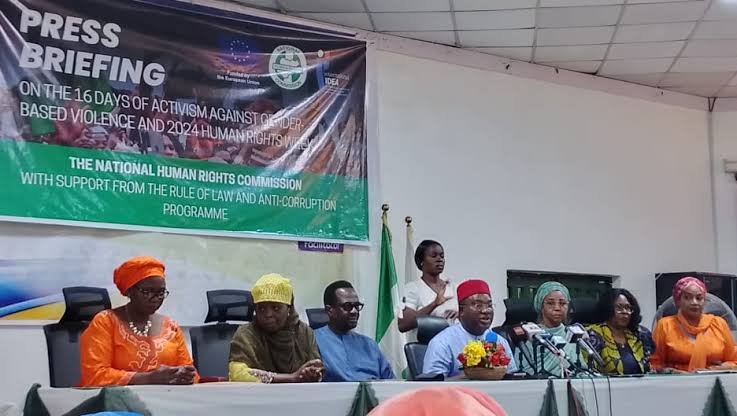
The National Human Rights Commission (NHRC) has announced its plans for the 2025 International 16 Days of Activism Against Gender-Based Violence.
The activities which commences on Monday, showed a sweeping nationwide plan and a renewed call for stronger protections for women and girls, as the Commission also marks its 30th anniversary.
Addressing journalists at a press briefing in Abuja, the Executive Secretary of NHRC, Dr. Tony Ojukwu said the anniversary provided an important moment to reflect on three decades of work advancing justice, dignity, and equality in Nigeria — while acknowledging that gender-based violence (GBV) remains one of the gravest human rights violations confronting the country.
He said: “For 30 years, the Commission has remained a steadfast voice for accountability and human rights. This year’s campaign gives us the opportunity not only to reflect on our journey but to intensify the fight against all forms of violence, especially against women and girls.”
The 16 Days of Activism — observed annually from November 25 to December 10 — is part of a global movement launched in 1991 by the Centre for Women’s Global Leadership. It links the International Day for the Elimination of Violence Against Women with Human Rights Day, symbolizing that violence against women is a direct violation of human rights.
Ojukwu noted that Nigeria remains committed to this global call.
He said: “Gender-based violence is unacceptable in every form. These 16 days remind us that survivors must be heard, supported, and protected.”
This year’s programme, one of the NHRC’s most extensive yet, includes coordinated activities across all 36 states and the Federal Capital Territory.
According to Ojukwu, the activities are designed to strengthen prevention, improve accountability, and reinforce protection structures nationwide.
Marking its 30-year milestone, the NHRC urged the National Assembly to pass legislation creating special constituencies for women — a long-standing proposal aimed at improving female representation in public office.
“Denying affirmative action is itself a form of violence against women,” the Commission emphasized. “Empowerment must include political participation.”
The Commission also highlighted multiple empowerment programmes conducted in partnership with local and international organisations. These include:Support for over 60 survivors of sexual and gender-based violence under the EU/UNDP Spotlight Initiative; Financial grants for vulnerable women in collaboration with the Taipei Trade Office; Economic empowerment for more than 100 indigent women through the Thelma Lion Foundation; Distribution of sewing machines, grinding machines, and hair dryers to over 300 women through partnerships with National Assembly members; Ongoing collaboration with the Dorothy Njemanze Foundation to support SGBV survivors.
Ojukwu said: “These interventions are meant to strengthen the socio-economic resilience of women and reduce vulnerabilities.”
He reassured Nigerians that the commission will continue to carry out its mandate with fairness and impartiality.
He said: “We will not allow gender-based violence or any human rights violation to go unaddressed. Every complaint matters, and every perpetrator must be held accountable.”
As the 16-day campaign begins, Ojukwu called on government institutions, traditional and religious leaders, civil society groups, the private sector, and individuals to join in the fight to end violence against women.
“Awareness is not enough,”Ojukwu said. “We must turn commitments into action and build a Nigeria where women and girls can live free from fear, discrimination, and harmful practices.”
NHRC Announces Programmes for 16 Days of Activism on GBV
News
ECOWAS Court Raises Alarm Over Gender Violence, Low Compliance With Judgments
By: Michael Mike
The President of the ECOWAS Court of Justice, Claudio Monteiro Gonçalves, has called for stronger regional action to combat gender-based violence and ensure justice for women and girls across West Africa, warning that many victims still suffer in silence.
Gonçalves, who was represented by the Acting Deputy Registrar of the ECOWAS Court of Justice, Mrs. Marie Sanie, made the call in Abuja during the court’s celebration of International Women’s Day, organised by the CCJ Women Forum under the theme “Rights, Justice, Action for All Women and Girls,” with a sub-theme urging stakeholders to “Break the Silence: End Gender-Based Violence Now.”
He said the protection of women’s rights remains central to the court’s mandate of advancing the rule of law and safeguarding fundamental human rights across the Economic Community of West African States.
According to him, the court has, through its judgments, played a significant role in challenging discrimination, addressing sexual and gender-based violence and providing remedies for victims across the region.
“These groundbreaking decisions have not only delivered justice to individuals but have also set important legal precedents that reinforce the dignity and protection of women and girls throughout the region,” he said.
Among the landmark rulings highlighted by the court president was the 2008 case of Hadijatou Mani Koraou v Republic of Niger, which addressed slavery practices in Niger, and the 2017 case of Dorothy Chioma Njemanze & 3 Ors v Federal Republic of Nigeria that condemned discrimination and degrading treatment against women.
Other notable cases cited include WARDC & IHRDA (Mary Sunday) v Federal Republic of Nigeria on domestic violence, WAVES & 1 Or v Republic of Sierra Leone on discrimination based on pregnancy, Adama Vandi v Republic of Sierra Leone on rape and the failure to provide effective remedy for victims, and Forum Against Harmful Practices (FAHP) & 2 Ors v Republic of Sierra Leone concerning female genital mutilation.
Gonçalves stressed that gender-based violence remains a major obstacle to equality, justice and sustainable development across the region.
“Too often, survivors suffer in silence due to stigma, fear or lack of support to seek justice. Today we affirm that silence must end and justice must be translated into action,” he said.
The court president also expressed concern over the low level of compliance with the court’s rulings by member states, revealing that only about 20 per cent of its judgments have been fully implemented.
He warned that the low enforcement rate could undermine the authority and credibility of the regional court if not addressed urgently.
To tackle the challenge, he said the court recently carried out bilateral engagement missions to several member states, including Sierra Leone, Nigeria and Guinea-Conakry, as part of activities marking the 50th anniversary of the Economic Community of West African States.
The missions, he explained, were aimed at encouraging governments to implement the court’s decisions and fulfil their treaty obligations.
Gonçalves also noted that the court regularly conducts awareness and outreach missions across member states to educate citizens on how to access the court and seek redress for human rights violations.
He emphasised that justice would only be fully realised when citizens are aware of their rights and governments ensure that court judgments are respected and implemented.
While celebrating the achievements of women working within the ECOWAS Court, he acknowledged that challenges remain, particularly in ensuring greater representation of women in leadership positions and creating supportive work environments that promote work-life balance.
Despite the challenges, he reaffirmed the court’s commitment to strengthening legal protections for women and girls in the region.
“As we celebrate the achievements of women today, we reaffirm our commitment to delivering justice, advancing the rule of law and building a region where every woman and girl can live in safety and dignity,” he said.
Meanwhile, the Patron of the ECJ Women Forum, Justice Dupe Atoki, has called for stronger commitment to protecting the rights of women and girls, stressing that legal protections must go beyond promises to ensure real justice and equality.
Atoki made the call during the celebration of International Women’s Day at the ECOWAS Court of Justice in Abuja, where officials, diplomats and legal practitioners gathered to discuss the role of justice systems in safeguarding women’s rights across West Africa.
Speaking on the global theme for this year’s commemoration, the judge said the theme serves as both a reminder and a call to responsibility for governments, institutions and society at large.
She emphasised that the rights of women and girls should never be treated as privileges granted at convenience but as fundamental human rights that must be respected, protected and fulfilled.
According to her, although progress has been made globally in advancing gender equality, many women and girls still face barriers that limit their opportunities, silence their voices and restrict their participation in social, political and economic life.
“The emphasis on rights reminds us that the rights of women and girls are not privileges to be granted at convenience, but fundamental human rights that must be respected, protected and fulfilled,” she said.
Atoki noted that justice systems have a critical responsibility in addressing discrimination, violence and exclusion against women, adding that courts and legal institutions must remain accessible, impartial and responsive to the realities women face.
She said effective justice mechanisms are essential in ensuring that laws protecting women are properly enforced and that perpetrators of abuse are held accountable.
“The call for justice highlights the vital role of laws, institutions and courts in safeguarding equality and dignity. Justice must be accessible, impartial and responsive to the realities faced by women and girls,” she stated.
Atoki also stressed that achieving gender equality requires more than commitments and declarations, noting that deliberate action is necessary to dismantle structural barriers that hinder the progress of women and girls.
According to her, governments and institutions must translate policy commitments into practical measures that create safe and supportive environments for women to thrive.
“The call for action reminds us that commitments alone are not enough. Real progress requires deliberate steps through policies, institutions and collective effort to dismantle structural barriers and create environments where women and girls can thrive,” she said.
She urged stakeholders across the region to renew their commitment to advancing women’s rights, strengthening access to justice and ensuring that gender equality becomes a lived reality rather than a distant aspiration.
Atoki concluded by calling on governments, civil society organisations and legal institutions to work together to ensure that the promise of rights, justice and action is realised for all women and girls across the West African region.
ECOWAS Court Raises Alarm Over Gender Violence, Low Compliance With Judgments
News
NHRC Takes Rights Campaign to Grassroots, Holds Women’s Day Town Hall in Abuja Community
By: Michael Mike
The National Human Rights Commission (NHRC) has intensified advocacy for the protection of women and girls by organising a community town hall meeting in Bwari as part of activities marking the 2026 International Women’s Day.
The sensitisation programme brought together traditional rulers, youth leaders, women groups and other community stakeholders to discuss the need for stronger action against discrimination and violence affecting women.

Executive Secretary of the Commission, Tony Ojukwu, said the annual commemoration of International Women’s Day provides an important opportunity to celebrate the achievements of women while drawing attention to the obstacles that still limit their full participation in society.
Ojukwu, who was represented at the event by the Director of the Commission’s Women and Children Department, Ngozi Okorie stressed that the theme of the 2026 celebration, “Rights. Justice. Action. For All Women and Girls,” calls for practical and sustained efforts to remove barriers confronting women in many communities.
He noted that despite growing awareness of gender equality, women and girls continue to face gender-based violence, discrimination, limited access to justice and socio-economic inequalities.
According to him, addressing these challenges requires the collective commitment of government institutions, community leaders and citizens.
“The rights of women and girls are fundamental human rights. Protecting them demands deliberate and sustained action from all stakeholders,” he said.
The NHRC boss reaffirmed the Commission’s determination to promote and safeguard the rights of all Nigerians, particularly vulnerable groups such as women and children.
He explained that the Bwari town hall meeting was designed to deepen public awareness of human rights and provide a platform for dialogue on practical measures that could strengthen the protection of women and girls at the grassroots.
Traditional rulers who attended the forum commended the Commission for bringing the conversation on human rights closer to local communities.
The Esu of Bwari, represented by Mai Anguwa of FCDA Quarters, Zakwoi Ibrahim, described the initiative as timely, noting that such engagements would help educate residents about their rights and responsibilities.
Also speaking, Youth President of Bwari Area Council, Comrade Dr Awoyi Bwari, praised the NHRC for organising the programme, saying it would boost awareness on human rights issues among both men and women in the community.
Representatives of women’s organisations, including faith-based groups and market associations, also participated in the meeting and pledged their support for efforts aimed at promoting and protecting the rights and welfare of women and girls.
NHRC Takes Rights Campaign to Grassroots, Holds Women’s Day Town Hall in Abuja Community
News
Interior, Information Ministries Forge Stronger Partnership, Spotlight Key Reforms in Passport, Security, Identity Services
By: Michael Mike
The Ministry of Interior has strengthened its collaboration with the Federal Ministry of Information and National Orientation to improve public awareness of key government reforms in passport services, border security, identity management, and national safety.
The engagement took place during a high-level visit by the Minister of Information and National Orientation, Mohammed Idris, to the Ministry of Interior, where he was received by the Minister of Interior, Olubunmi Tunji-Ojo.
Tunji-Ojo while welcoming the delegation, highlighted the critical need for coordinated communication to ensure Nigerians are fully informed about government achievements under the Renewed Hope Agenda.

Tunji-Ojo noted that the Ministry of Interior oversees key agencies, including the Nigerian Immigration Service, Federal Fire Service, Nigerian Security and Civil Defence Corps, Nigerian Correctional Service, and the National Identity Management Commission. He described the last two and a half years as a period of transformative reforms across these agencies, resulting in significant improvements in service delivery, security, and citizen engagement.
Among the Ministry’s notable achievements, Tunji-Ojo highlighted the rapid clearance of over 204,000 pending passport applications, the introduction of contactless passport renewals for Nigerians abroad, and the establishment of Nigeria’s first centralised passport personalisation centre in Abuja. He also pointed to advanced border management technologies, including the deployment of Advanced Passenger Information (API) and Passenger Name Record (PNR) systems, and the introduction of electronic immigration gates at major airports.
In the area of identity management, Tunji-Ojo announced that over 130 million Nigerians have been enrolled in the National Identity Database, while the launch of the ECOWAS National Biometric Identity Card now facilitates regional travel within West Africa without passports. The Minister further highlighted correctional reforms, skills development for inmates, the construction of a National Fire Academy, and deployment of Mining Marshals to protect critical mining sites.
Tunji-Ojo emphasized that these reforms require strong public communication and urged the Ministry of Information to collaborate on a coordinated strategy to ensure accurate and timely dissemination of information to Nigerians and the international community.
In his response, Idris commended the Ministry of Interior for the remarkable reforms, stressing that consistent government messaging on security and development initiatives would boost Nigeria’s international image and attract foreign investment. He also announced that Nigeria would host the World Public Relations Forum later this year in partnership with the Nigerian Institute of Public Relations (NIPR), a move expected to bring global communication experts to the country.
Both Ministers agreed to deepen collaboration in strategic communication to ensure that government achievements and reforms under the Renewed Hope Agenda are widely publicized and accessible to Nigerians. Tunji-Ojo reaffirmed the Ministry’s commitment to sustaining reforms that translate into tangible benefits for citizens.
The partnership signals a renewed focus on transparency, institutional reform, and enhanced citizen engagement, positioning Nigeria to showcase its progress on governance, security, and development to both domestic and international audiences.
Interior, Information Ministries Forge Stronger Partnership, Spotlight Key Reforms in Passport, Security, Identity Services
-
News2 years agoRoger Federer’s Shock as DNA Results Reveal Myla and Charlene Are Not His Biological Children

-
Opinions4 years agoTHE PLIGHT OF FARIDA
-
News11 months agoFAILED COUP IN BURKINA FASO: HOW TRAORÉ NARROWLY ESCAPED ASSASSINATION PLOT AMID FOREIGN INTERFERENCE CLAIMS
-

News2 years agoEYN: Rev. Billi, Distortion of History, and The Living Tamarind Tree
-

Opinions4 years agoPOLICE CHARGE ROOMS, A MINTING PRESS
-

ACADEMICS2 years agoA History of Biu” (2015) and The Lingering Bura-Pabir Question (1)
-

Columns2 years agoArmy University Biu: There is certain interest, but certainly not from Borno.
-

Opinions2 years agoTinubu,Shettima: The epidemic of economic, insecurity in Nigeria