
Uncategorized
Nigeria to Host Young Diplomats Conference


Nigeria to Host Young Diplomats Conference
By: Michael Mike
Nigeria is set to host the inaugural Africa Young Diplomats and Changemakers Conference on the continent.
The country intention was made known after the successful participation of Nigerian delegate at the Best Diplomat Conference held in Turkey between March 1-4, 2024
The Best Diplomat Conference brought together young leaders and professionals from around the world to discuss pressing global issues through diplomatic relations and simulations. A delegation of young Nigerians played a pivotal role in the conference’s success.
Speaking on the conference, Diplomat Valentina Ofi Amiebi-Uchegbu, a member of the Nigerian delegation, said: “Our participation alongside delegates from various African nations was significant,” adding that: “We shared experiences and insights, emphasizing the challenges facing the Middle East as a central agenda.”
She noted that the conference culminated in the creation of “Africa Young Diplomats and Changemakers,” a platform designed to equip young Africans with the skills and knowledge to navigate diplomacy and foster cross-cultural understanding.
“Africa Young Diplomats and Changemakers is tailored for African youths aspiring to become changemakers and diplomats,” explained Amiebi-Uchegbu.
She added that: “It offers transformative opportunities for collaboration and innovation, addressing shared challenges across the continent.”
She revealed that the Nigerian delegation is now setting its sights on hosting the inaugural Africa Young Diplomats and Changemakers Conference on the continent.
She said: “We intend to seize upon this opportunity to secure a consultative status with the African Union (AU) and pertinent Regional Bodies,” adding that: “We look forward to elaborating on our plans and strategies to realize this important endeavor.”
In his assessment of the impact of the conference in Turkey, Pilate Seluka, Diplomat from Malawi and Simulation Representative of Botswana, said: “The sight of one of our own young man swiping the prestigious title; Best Diplomat was incredible!!! Young and passionate African Leaders are rising & prepositioning to prepare the continent for the 22nd century. Africa is the future of the world.”
In her view, Mrs Valentina Ofi Amiebi-Uchegbu, Diplomat of Nigeria and Simulation Representative of SHELL PLC, says, “The experience at Best Diplomats Conference left me with the belief that we can collaborate better in solving various challenges across the Continent of Africa.
“The preparation before the conference and the simulation during the conference was well managed by the organisers.
“Representatives of countries came together to discuss possible solutions and arrive at a common way forward on the highlighted issue/case study.
“This we achieved successfully which resulted in friendships formed due to the meeting of like minds.
“I look forward to participating in future conferences.”
On her part, Ihunda Eucharia Kejeh
Diplomat of Nigeria and Simulation Representative of Georgia, is more than excited. She said: “The biggest Learning from the Best Diplomats Conference was how exposed and learned we are as Africans, our attention to detail and the true advocation for peace, safety and unity for all is what gives us a common goal. – Tatenda Mushaike, Diplomat of Zimbabwe simulating Zambia
“When I set out to attend the Best Diplomats Simulation at Istanbul Turkiye, I didn’t know what to expect and no it wasn’t exactly zero expectations, it was my anticipation, the thought of being a part of something as big as the United Nations was exhilarating.
“The Best Diplomats Simulation, was indeed Diplomacy Beyond Barriers. Meeting people from all over the world, working together and sharing ideas irrespective of our cultural diversity was a Beauty to behold.”
Nigeria to Host Young Diplomats Conference


DSS Frees Cardiac Surgeon Martin Aghaji on Bail Over Alleged Economic Crime
By: Michael Mike
A consultant cardiac surgeon, Prof. Martin Aghaji, has been released on bail by the Department of State Services (DSS) following his arrest over an alleged economic crime.
The Nigerian Medical Association (NMA) disclosed this in a statement issued by the Chairman of its Lagos State branch, Babajide Kehinde Saheed, who confirmed that the renowned surgeon was arrested by DSS operatives at his residence in Enugu on Thursday, July 2, before being flown to the DSS Lagos State Command for interrogation.
According to the association, the Director of the DSS Lagos State Command informed the Lagos NMA leadership of the arrest and invited its officials to the command, citing the longstanding cordial relationship between the security agency and the medical body.

The statement said a delegation representing the National Officers’ Committee of the NMA, led by its National Publicity Secretary, Olayinka Atilola, visited the DSS office in Lagos on Sunday alongside the Lagos State Chairman, Babajide Kehinde Saheed, the Lagos State Publicity Secretary, Bisoye Akinsulire, and the representative of the Enugu State branch, **Placid Ajachukwu>.
Following the visit, Prof. Aghaji was granted bail on what the association described as liberal terms after the stipulated conditions were met. He was subsequently released into the custody of the NMA delegation.
The NMA said it would not disclose details of the allegations or the ongoing investigation, explaining that the information remains classified to protect the integrity of the probe.
The association also confirmed that neither it nor the DSS would comment on the specific nature of the alleged economic offence at this stage.
The DSS has yet to issue an official public statement on the matter, while investigations into the allegations are continuing.
DSS Frees Cardiac Surgeon Martin Aghaji on Bail Over Alleged Economic Crime
Uncategorized
Grandma, PhD Student Lead NDLEA’s Major Cocaine Busts as Agency Tightens Noose on Drug Syndicates
Grandma, PhD Student Lead NDLEA’s Major Cocaine Busts as Agency Tightens Noose on Drug Syndicates
By: Michael Mike
The National Drug Law Enforcement Agency (NDLEA) has intensified its nationwide crackdown on international drug trafficking networks with the arrest of a 67-year-old Nigerian-British grandmother attempting to smuggle 13 kilogrammes of cocaine to the United Kingdom, alongside the dismantling of a Malaysia-bound cocaine syndicate allegedly led by a Nigerian PhD student studying abroad.
The high-profile arrests, announced on Sunday, underscored the increasingly sophisticated methods employed by drug traffickers and the growing involvement of elderly persons and highly educated individuals in transnational narcotics operations.
The agency also intercepted large consignments of tramadol hidden inside vehicle fuel tanks, seized hundreds of kilogrammes of cannabis and methamphetamine across several states, and arrested multiple suspects in coordinated operations nationwide.
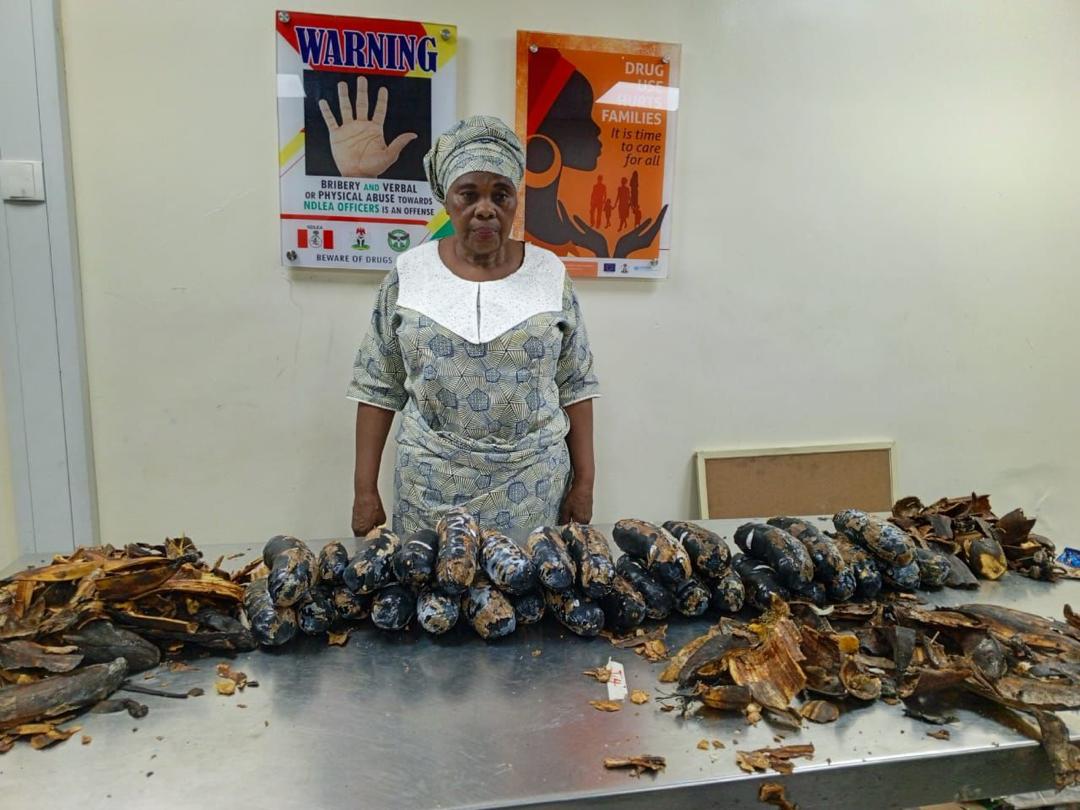
The biggest airport seizure involved 67-year-old Mrs. Mary Barek, a Nigerian-British citizen employed as a caregiver in the United Kingdom.
She was arrested at the departure hall of Terminal 2 of the Murtala Muhammed International Airport (MMIA), Lagos, while preparing to board a Virgin Atlantic flight to London.
NDLEA operatives who searched her luggage discovered 31 large wraps of cocaine ingeniously disguised as fresh plantain peels and packed among other food items. The illicit drug weighed 13 kilogrammes.
According to the agency, the suspect admitted ownership of the cocaine during interrogation.
In another breakthrough, NDLEA operatives dismantled an international drug syndicate attempting to smuggle cocaine to Malaysia through a shipment concealed inside the walls of cartons of Orijin Bitters.
According to a statement on Sunday by the spokesman of the anti-narcotics agency, Femi Babafemi, the operation culminated in the arrest of 45-year-old Nwabueze Onyeka, a PhD student at the University of Putra, Malaysia, who investigators identified as the alleged mastermind of the trafficking network.
The arrest followed the interception of 36 parcels of cocaine weighing 5.8 kilogrammes hidden inside nine cartons of the herbal alcoholic beverage that formed part of a consolidated cargo destined for Kuala Lumpur.
Babafemi said investigations initially led to the arrest of four suspects in Lagos, including a cargo agent, the driver who transported the consignment, a trader at the ASPANDA Market in the Lagos Trade Fair Complex, and another suspect who allegedly supplied the specially prepared cartons used for concealing the narcotics.
He stated that the trail eventually led operatives to Aziora community in Ozubulu, Ekwusigo Local Government Area of Anambra State, where Onyeka was arrested while allegedly hiding in his village.
Beyond the cocaine seizures, NDLEA operatives also intercepted 43,980 capsules of tramadol concealed inside two modified vehicle fuel tanks along the Wukari-Zaki Biam Road in Taraba State.
The suspect, Daniel Harrison Ugwuoke, 30, was reportedly transporting the consignment from Onitsha in Anambra State when he was arrested.
In Kaduna State, anti-narcotics officers arrested two suspects, Boniface Agu, 65, and Monday Nwaeze, 50, after recovering 1.7 kilogrammes of methamphetamine during a raid in Gwantu.
Another 231.7 kilogrammes of skunk were recovered in Ebonyi State from a 65-year-old suspect, Francis Eja.
In Plateau State, operatives arrested a 75-year-old suspect, Alhaji Babani, found in possession of 15 kilogrammes of skunk at Kurgwi in Qua’an Pan Local Government Area.
Similarly, in Gombe State, officers arrested two suspects, Dahiru Mohammed, 65, and Isiya Lawan, 36, with 587 blocks of cannabis sativa weighing 556 kilogrammes during an intelligence-led operation at Kuri village in Yamaltu-Deba Local Government Area.
Alongside the enforcement operations, the agency said it continued its nationwide War Against Drug Abuse (WADA) campaign, conducting sensitisation programmes in schools and communities across Anambra, Enugu, Ogun and Kano States.
Commending officers involved in the operations, NDLEA Chairman and Chief Executive Officer, Brigadier General Buba Marwa (retd.), praised the commands for combining aggressive drug supply reduction efforts with sustained public education campaigns.
The latest arrests come amid growing concerns by security agencies over the use of increasingly sophisticated concealment techniques and the recruitment of unsuspecting couriers, elderly persons and professionals into international drug trafficking networks, as Nigeria continues to strengthen border controls and intelligence-driven operations against transnational organised crime.
Grandma, PhD Student Lead NDLEA’s Major Cocaine Busts as Agency Tightens Noose on Drug Syndicates
FG Evacuates 593 Nigerians from South Africa, Denies Extortion Claims
By: Michael Mike
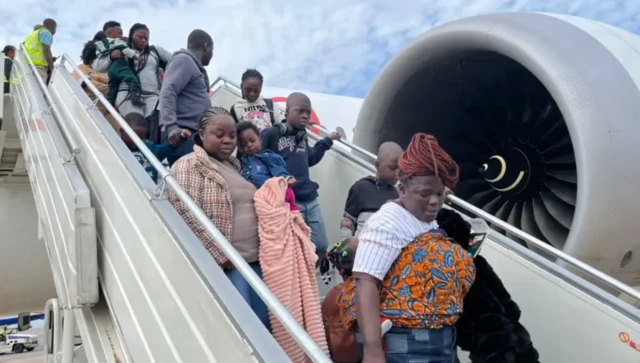
The Federal Government has evacuated 593 Nigerians from South Africa following recent xenophobic protests, with plans to bring home about 700 more citizens in the coming days.
In a statement issued on Thursday, the spokesperson for the Ministry of Foreign Affairs, Kimiebi Ebienfa, said the evacuation exercise underscores the government’s commitment to protecting Nigerians abroad and providing assistance to citizens affected by crises.
According to the ministry, the first batch of 258 evacuees arrived at the Murtala Muhammed International Airport on June 11 aboard a special flight operated by Air Peace.
The returnees were received by the Minister of State for Foreign Affairs, Sola Enikanolaiye, on behalf of the Federal Government before being handed over to relevant government agencies for documentation and profiling.
The ministry explained that logistical challenges delayed the second evacuation flight, resulting in some Nigerians being temporarily accommodated at the Nigerian High Commission in Pretoria, where they were cared for by officials.
It added that a Nigerian philanthropist voluntarily paid the airfare for 66 stranded citizens, enabling them to return to Lagos aboard a South African Airways flight on June 24.
A second government-arranged evacuation flight arrived on June 30 with 269 returnees, bringing the total number of evacuated Nigerians to 593.
The ministry said the evacuation exercise is continuing, with three additional flights scheduled over the next few days to return all Nigerians who voluntarily registered for evacuation and have completed the necessary screening and clearance processes.
It disclosed that about 700 more Nigerians are expected to be repatriated, with the next batch of 271 returnees scheduled to arrive at the Murtala Muhammed International Airport at about 5:30 a.m. on Friday, July 3.
The ministry also dismissed allegations circulating on social media that officials at the Nigerian mission in South Africa demanded money from citizens seeking evacuation.
It stressed that all special evacuation flights are fully funded by the Federal Government and that no returnee is required to pay for transportation.
“The insinuations and false allegations that some staff of the Nigerian Mission were requesting money before enlisting our nationals for the evacuation flights are totally false, fake news, and should be discarded,” the statement said.
The ministry commended the collaboration among relevant government agencies in executing the evacuation exercise, describing the operation as evidence of Nigeria’s commitment to safeguarding its citizens overseas.
It reiterated that the protection of Nigerians abroad remains a central pillar of the country’s foreign policy, adding that the government is determined to ensure that citizens affected by crises receive the necessary support, dignity and care.
“The lives of Nigerians living abroad matter, and we are trying our best as a Ministry to give them a sense of belonging,” the statement added.
FG Evacuates 593 Nigerians from South Africa, Denies Extortion Claims

Zulum Appoints Engr Peter Samuel as General Manager BOSAMA

DSS Frees Cardiac Surgeon Martin Aghaji on Bail Over Alleged Economic Crime

Troops Arrest Suspected Military Impostor in Katsina

Roger Federer’s Shock as DNA Results Reveal Myla and Charlene Are Not His Biological Children

THE PLIGHT OF FARIDA

FAILED COUP IN BURKINA FASO: HOW TRAORÉ NARROWLY ESCAPED ASSASSINATION PLOT AMID FOREIGN INTERFERENCE CLAIMS
-
 News2 years ago
Roger Federer’s Shock as DNA Results Reveal Myla and Charlene Are Not His Biological Children
-
Opinions4 years ago
THE PLIGHT OF FARIDA
-
 News1 year ago
FAILED COUP IN BURKINA FASO: HOW TRAORÉ NARROWLY ESCAPED ASSASSINATION PLOT AMID FOREIGN INTERFERENCE CLAIMS
-

 News2 years ago
EYN: Rev. Billi, Distortion of History, and The Living Tamarind Tree
-
 Opinions5 years ago
POLICE CHARGE ROOMS, A MINTING PRESS
-

 ACADEMICS2 years ago
A History of Biu” (2015) and The Lingering Bura-Pabir Question (1)
-

 Columns2 years ago
Army University Biu: There is certain interest, but certainly not from Borno.
-

 Politics1 year ago
2027: Why Hon. Midala Balami Must Go, as Youths in Hawul and Asikira/Uba Federal Constituency Reject ₦500,000 as Sallah Gift
