
News
Nigeria’s Budget Should Build Lives, Not Fund Luxury – ActionAid

Nigeria’s Budget Should Build Lives, Not Fund Luxury – ActionAid
By: Michael Mike
ActionAid Nigeria has called on the Federal Government and state governments to redirect public spending from what it described as “prestige projects” and excessive government luxuries to investments that directly improve the lives of Nigerians, saying the country’s limited resources should be deployed to sectors with the greatest social impact.
The organisation made the call on Sunday while reacting to President Bola Tinubu’s recent directive to state governors to stop constructing unnecessary flyovers in areas without traffic congestion and instead focus on projects that address the needs of citizens.
In a statement signed by its Country Director, Dr. Andrew Mamedu, ActionAid Nigeria said the President’s comments should spark a broader national debate on public finance and the need to prioritise people-centred development over projects driven by political visibility.
According to the organisation, while infrastructure remains important, Nigeria’s challenge lies in a pattern of public expenditure that often favours prestige over citizens’ welfare.
It noted that with millions of Nigerians grappling with economic hardship, every naira of public funds should deliver measurable benefits.
ActionAid therefore urged governments at all levels to review spending on projects and activities it considers to have limited public value, including unnecessary prestige projects, luxury acquisitions, oversized official delegations, excessive local and foreign travel, and discretionary expenditures that lack transparency and accountability.
The organisation cited figures from the Budget Office of the Federation showing that President Tinubu and Vice President Kashim Shettima are proposed to receive a combined ₦9.36 billion in the 2026 budget for local travel, foreign travel, food and refreshments.
It, however, observed that the allocation does not necessarily represent the total cost of official trips, noting that expenses for accompanying officials and operational support are often captured separately in the budgets of other government agencies.
ActionAid argued that reducing the proposed allocation by half would free about ₦4.68 billion, which could be redirected to critical public services.
It estimated that such savings could finance approximately 62 three-classroom school blocks, 208 solar-powered boreholes and five fully equipped primary healthcare centres, based on recently published government project costs.
Mamedu said Nigeria’s budget should reflect the country’s development priorities rather than government extravagance.
“This is not merely a question of reducing expenditure; it is about changing national priorities. Every unnecessary luxury purchase represents classrooms that were never built. Every unjustifiable trip represents medicines that never reached a primary healthcare centre.
“Every unaccounted security vote represents communities that continue to live in fear without knowing how public resources intended for their protection were spent. Every prestige project that fails to address citizens’ needs represents another missed opportunity to reduce poverty and inequality. Public budgets are moral documents. They reveal whose interests governments choose to protect,” he said.
The organisation maintained that Nigeria’s development challenge is not the absence of resources but the choices governments make in allocating them.
It called on federal and state governments to prioritise spending on quality education, primary healthcare, water and sanitation, food security, climate resilience and social protection.
ActionAid also urged authorities to reduce the cost of governance by cutting unnecessary official travel, luxury purchases and oversized government delegations, while strengthening transparency and accountability in discretionary public spending, including security-related expenditure without compromising national security.
The organisation further advocated that infrastructure projects should be selected based on evidence, community needs and measurable development outcomes rather than political considerations, while calling for greater citizen participation in budget planning, implementation and monitoring.
It stressed that the true measure of governance is not the number of monuments erected but the number of lives transformed through improved education, healthcare, safe water, decent livelihoods and opportunities for citizens.
Nigeria’s Budget Should Build Lives, Not Fund Luxury – ActionAid


News
81st UNGA: Nigeria Will Be Guided By National Interest, Multilateralism, Tinubu’s Reform Agenda – VP Shettima
81st UNGA: Nigeria Will Be Guided By National Interest, Multilateralism, Tinubu’s Reform Agenda – VP Shettima
** *Arrives New York with Fubara, Sanwo-Olu, Hassan Hadejia, Bianca Ojukwu, other ministers
By: Michael Mike
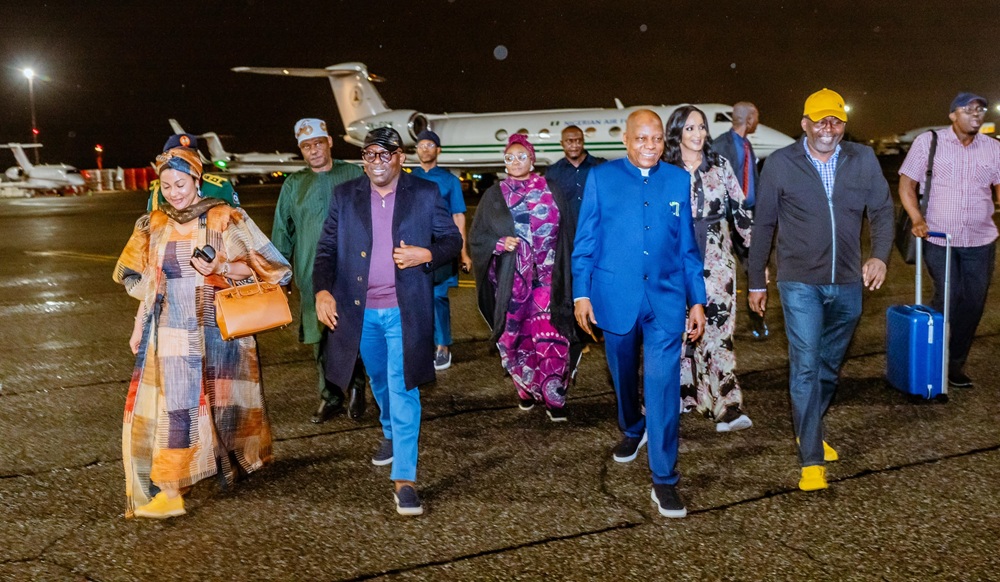
Vice President Kashim Shettima has arrived in New York, United States, to represent President Bola Ahmed Tinubu and lead Nigeria’s delegation to the 81st Session of the United Nations General Assembly, UNGA.
VP Shettima said Nigeria’s engagements at the global gathering will be guided by the country’s national interest, commitment to multilateralism and President Tinubu’s consistent advocacy for reforms of global institutions to reflect contemporary economic and demographic realities.
“Our message in New York is clear. Nigeria believes in multilateralism, but the institutions that govern our world must become more representative, equitable, and responsive to the realities of today,” Senator Shettima said.
“We will engage our partners firmly from the standpoint of Nigeria’s national interest while advancing President Tinubu’s call for a global system that gives developing countries a stronger voice and a fairer opportunity to prosper.”
The Vice President arrived in the company of Governor Siminalayi Fubara of Rivers State; Minister of State for Budget and Economic Planning, Dr Doris Uzoka-Anite, and other senior government officials.
On arrival in New York, VP Shettima was received by Governor Babajide Sanwo-Olu of Lagos State, the Deputy Chief of Staff to the President (Office of the Vice President), Senator Ibrahim Hassan Hadejia; Minister of Foreign Affairs, Ambassador Bianca Odumegwu-Ojukwu; Minister of Women Affairs, Hajiya Imaan Sulaiman-Ibrahim; Minister of Solid Mineral Development, Chief Dele Alake; Nigeria’s Permanent Representative to the United Nations, Ambassador Jimoh Ibrahim, and other senior government and diplomatic officials.
During the General Debate, VP Shettima will deliver Nigeria’s national statement, outlining the country’s position on major international issues and priorities with direct implications for peace and security, development, economic growth and global cooperation.
Senator Shettima will also participate in high-level meetings and hold bilateral engagements with world leaders, international organisations, and development partners on the sidelines of the General Assembly.
Nigeria is expected to use the engagements to reinforce its positions on reform of international financial architecture, sustainable development, climate finance, technology access, and stronger representation for Africa in global decision-making.
81st UNGA: Nigeria Will Be Guided By National Interest, Multilateralism, Tinubu’s Reform Agenda – VP Shettima
Abuja Turns into West Africa’s Deal Room as 60 Startups Chase $65,000 and $5m Jackpot
….6,000 applied, 60 picked, 20 to pitch live September 30 as ECOWAS bets on innovation to drive integration and jobs
By: Michael Mike
The future of West African trade is being negotiated this week not in a summit hall, but on a pitch stage.
Sixty of the region’s most promising startups — sieved from more than 6,000 applications — opened a 10-day battle in Abuja on Sunday for the 2nd ECOWAS Startup Awards, a festival that will mix masterclasses, exhibitions and investor deal rooms and climax with a live regional final on September 30.
It is the biggest and most commercially driven startup programme ECOWAS has ever staged.
The second edition, which runs from September 21 to 30, 2026, started with virtual masterclasses and startup clinics from September 21 to 25, followed by a physical programme in Abuja from September 28 to 30.
Twenty finalists will emerge from the 60 to pitch before an independent jury of industry experts, investors and policy stakeholders.
At stake is $65,000 in seed capital — $30,000 for the winner, $20,000 for first runner-up and $15,000 for second runner-up. Beyond the cheques, organisers are targeting about $5 million worth of investment deals across six thematic tracks.
The 60 were drawn from the 12 ECOWAS member states across sectors that define the region’s youth economy and survival economy: EdTech and Skills Development; FinTech; HealthTech; AgriTech and Food Systems; CleanTech, Climate and Green Innovation; and Tourism, Hospitality and TravelTech.
The programme is expected to bring together 300 participants, including the 60 startups, 12 technology hubs and accelerators, investors, policymakers, industry leaders and development partners. It is organised by the ECOWAS Commission in partnership with the Pan African Alliance of Small and Medium Industries and the Investment Promotion Agencies of West African states.
The ECOWAS Commission said the award was designed to tackle the familiar killer of West African startups — products with breakthrough potential that die because founders lack managerial capacity, access to finance, market access and regulatory support.
“The ECOWAS Start-up Awards is designed to mobilise innovation, particularly by start-ups,” said Oluonye Peter, Acting Director, Private Sector and Industry, ECOWAS Commission, in a statement issued in Abuja on Monday.
He said many founders “have innovated to address unique and specific solutions that ordinarily have breakthroughs or disruption in the system, but they cannot take their products to the market because they have little market preparation.”
“We have realised that it’s not just enough to hand over a cheque to the winner. We want to accompany the winner to the point where the firm becomes a success story, and we are able to showcase them as inspirations to the youth,” Peter said.
That accompaniment will be a six-month post-award acceleration and mentorship programme to help winners move from early-stage to growth stage, and connect them to venture capitalists, impact investors and financial institutions.
Henry Emejuo, Director-General of the Pan African Alliance for Small and Medium Scale Enterprises, said the awards go beyond recognition.
“ECOWAS is an important tool for economic integration. If you may remember, the core mandate of the ECOWAS Commission is to drive economic integration among member states,” Emejuo said, describing the awards as an institutional platform to assess and strengthen startup capacity.
The first edition was held in Niamey, Niger Republic, from November 18 to 20, 2021, attracting 55 startups from 11 member states. Following its success, ECOWAS Heads of State directed that it be institutionalised.
Applications for this edition opened August 3 and closed August 31. The portal, ecowasstartupawards.ipawas.org, received more than 6,000 entries.
For a 12-member bloc seeking to rebuild economic confidence and create jobs for its 400 million people, Abuja this week is offering a different metric for integration — not communiques signed, but deals closed and startups scaled.
The top three will be known September 30.
Abuja Turns into West Africa’s Deal Room as 60 Startups Chase $65,000 and $5m Jackpot
News
The growing role of local militias, criminal networks and possible external forces in the escalation of violence in Plateau State
The growing role of local militias, criminal networks and possible external forces in the escalation of violence in Plateau State
By: Zagazola Makama
The security crisis in Plateau State is increasingly moving beyond the traditional description of a farmer-herder dispute. What is emerging is a multi-layered armed conflict in which communal grievances, local militia mobilisation, criminality, retaliatory violence and information manipulation are reinforcing one another.
The most important distinction for the Federal Government is this: ordinary Berom, Mwaghavul and Fulani citizens are not the enemy. The security threat is posed by identifiable individuals and armed group networks operating within or around these communities.
Available evidence shows that armed groups associated with both farming and pastoralist communities have been involved in violence. BBC, ACLED and Zagazola Media Network have documented attacks involving both farmer and pastoralist communities in Plateau and warned that attacks frequently trigger reprisal violence, producing a cycle of retaliation. The present danger is that this cycle is becoming institutionalised.
There are now repeated reports of armed groups dressed in black moving between communities, conducting mass attacks and withdrawing to hide in the same communities before security forces arrive.
On August 11, troops reportedly engaged an armed group identified by security sources as Berom militia after intelligence indicated that the group was moving from Barkin Ladi towards communities in Mangu. The same reporting also recorded an encounter with suspected Fulani militia in another part of Mangu.
The following day, three people one local resident and two Fulani herders were killed in a clash involving Mwaghavul youths and herders in Jwak Maitumbi, Mangu. Troops intervened and used surveillance to clear the area.
More recently, troops reportedly foiled an attempted attack by suspected local militias moving towards Manja in Mangu on September 17. The attackers reportedly exchanged fire with troops and, while withdrawing, set houses on the outskirts of the community ablaze.
These incidents demonstrate a serious reality that armed communal networks exist, possess firearms and are capable of moving offensively across community boundaries and should be treated as a national security problem. The same cycle is consuming both sides. The danger is particularly visible in the sequence of attacks recorded in September.
On September 12, three young Fulani herders were reportedly killed in Alohom, Mangu, while dozens of cattle were also shot. Community leaders alleged that the attackers were Mwaghavul militia members dressed in black. Some bullets were recovered at the scene.
Less than 24 hours later, six commuters were reportedly killed when the same gunmen dressed in black attacked a commercial vehicle at Dungus Kuru in Jos South, killing both Muslims and Christians. Suspicion is not evidence. But suspicion itself can become a weapon. Both groups traded blames on who was responsible for the attacks.
Once communities believe that one attack must have been retaliation for another, young men will just mobilise before investigators establish what actually happened and carry out a deadly attack on the other community. That is how a single criminal attack becomes a communal war.
Berom and Mwaghavul armed groups require the same scrutiny as armed Fulani groups. They are all criminals and have perpetrated terror. It would be dangerous and analytically dishonest to discuss Plateau insecurity while examining only one side, as many mediums domiciled in Plateau state are doing. There have been hundreds of documented reports of armed Berom militias, including the most recent August incident in which troops reportedly intercepted a group moving towards communities in Mangu.
There have also been clashes involving Mwaghavul youths and herders, as recorded in Jwak Maitumbi.
At the same time, there are repeated reports of attacks attributed by community members to armed Fulani bandits. For example, the Mwaghavul Youth Movement recently alleged that armed Fulani elements were responsible for attacks in Kikyau, Larkas, Ntul and Kinat in Mangu. While some of the reports were true, some of them were rejected by MACBAN.
The security principle should therefore be that if an armed Berom group attacks civilians, pursue it. If an armed Mwaghavul group attacks civilians, pursue it. If an armed Fulani group attacks civilians, pursue it. If a criminal gang exploits the conflict, pursue it. Use the same energy used to go after Fulani bandits to go after Berom and Mwaghavul militias. Their actions show that they are all part of the same security problem when they engage in organised violence against civilians.
The most dangerous development may be the emergence of conflict entrepreneurs, which deserves much greater attention.
Youth groups in Plateau are already turning communal fear into an economic and social enterprise. There is no gainsaying that some individuals are financially benefiting from inflammatory content, mobilisation or conflict-related activities. The underlying phenomenon is real enough to warrant investigation. An attack committed by criminals can be transformed into evidence of a national religious conspiracy. And once such a narrative takes hold, facts become almost irrelevant.
The algorithm rewards anger. The conflict entrepreneur monetises it. The community pays the price. Emotional mobilisation can become another weapon This is perhaps one of the most uncomfortable truths recently revealed by the BBC investigation in Plateau.
A 2026 Premium Times investigation documented how misinformation, old photographs and videos, inflammatory narratives and unverified claims circulated on social media during Plateau violence and helped intensify perceptions of impending reprisals. The investigation found that online narratives could move faster than official clarification and contribute to real-world tension.
This creates a new type of warfare: the person who does not carry a rifle but helps create the environment in which someone else picks one up. The people must begin to ask: Who benefits financially, politically or socially from keeping Plateau permanently in crises? That question deserves the same seriousness as the question of who pulled the trigger.
This is how communities become militarised:
Attack → fear → mobilisation → revenge → counter-revenge → displacement → arming of youths → media propaganda → another attack.
Eventually, young people who previously had no interest in violence begin to believe that joining an armed group is necessary for survival. At that point, the conflict develops its own recruitment mechanism. The state is then fighting not merely armed men, but an entire ecosystem of fear.
Perhaps the most disturbing allegation emerging from affected communities is that some of the worst attacks may involve non-local gunmen or hired fighters who enter a community, conduct mass attacks and disappear into areas where they are difficult to identify. If evidence confirms that mercenaries are being formed in Plateau to conduct attacks and then sheltered by local networks, the character of the conflict changes substantially.
It would mean that some attacks are not merely spontaneous communal reprisals. They could represent organised armed operations using local knowledge, local logistics and external manpower. That claim cannot be simply accepted, but neither should it be ignored.
One of the most persistent claims in Plateau is that local residents, youths groups and traditional authorities know the individuals responsible for carrying out attacks. While these individuals carry out terror, their host communities view them as heroes or defenders of the land. The communities always protect the criminals even when they genuinely possess information about perpetrators, making peace efforts difficult for security agencies.
The greatest obstacle is often fear and, in many cases, complicity from within. A resident who identifies an armed perpetrator may fear retaliation from that person’s relatives or associates, likewise, a traditional ruler may fear that publicly naming suspects could trigger another attack. A youth leader may possess information but fear being branded a traitor.
The Federal Ministry of Defence and the Armed Forces already recognise the need for a combination of military pressure, intelligence and peace-building. The Chief of Army Staff, Lt.-Gen. Waidi Shaibu, had during his visit to Plateau State directed troops to sustain pressure on criminal groups while supporting peace-building, stronger intelligence gathering and cooperation with traditional and community leaders.
The next step should be to turn that principle into a specific Plateau armed-group strategy, while a dedicated multi-agency cell should map:
armed Fulani networks, armed Berom networks, armed Mwaghavul networks, criminal or kidnapping gangs, weapons suppliers and gun runners,financiers, informants and logistics networks. suspected external actors; and online actors demonstrably linked to mobilisation or threats.The purpose should be individual identification and prosecution.
Develop an attack attribution system.Every major attack should generate a formal case file containing: location + time + victims + weapons + ammunition + direction of attack + escape route + witnesses + communications intelligence + previous incidents + suspects + evidence. This would make it harder for perpetrators to sometimes disappear behind the phrase “unknown gunmen.”
Treat weapons as evidence, not just recovered items.The recovery of an AK-47, locally fabricated rifle or ammunition should trigger ballistic and intelligence exploitation. The question should be: Where has this weapon appeared before? A weapon used in three attacks across different LGAs could provide a direct link between incidents that communities currently regard as separate.
The person who fires the weapon is only one part of an organised attack. Establish a rapid-reaction architecture around known flashpoints. Mangu, Barkin Ladi, Riyom, Bokkos and vulnerable approaches to Jos South require sustained intelligence-led patrols.
The message to Plateau’s communities must also change. The Federal Government should make one point unmistakable: No community has a licence to kill another community in the name of self-defence. A Fulani civilian must not be treated as a militia member or a terrorist simply because he is Fulani. The same goes for Berom and Mwaghavul.The state must pursue armed individuals based on evidence of conduct, not identity.
The greatest threat to Plateau is not simply the number of people killed in individual attacks.
The problem is that people are gradually normalising killings as if they were nothing. Once that continues to happen, every road becomes a potential frontline, every market becomes a potential target, every cattle route becomes a security corridor, and every social-media post can become an early-warning signal for revenge.
Identify the armed networks. Identify their financiers. Identify their weapons. Identify their logistics. Identify those who shelter them. Identify those who incite attacks. Build admissible evidence. Arrest suspects. Protect witnesses. Prosecute cases. And do this regardless of whether the perpetrator is associated with a Berom, Mwaghavul, Fulani or any other community.
Plateau’s conflict is no longer adequately understood as two communities simply fighting over land. It is increasingly a security ecosystem involving communal grievances, armed local networks, criminal opportunists, retaliatory mobilisation and information warfare.
The Federal Government therefore has an opportunity to change the trajectory of the crisis: move from responding to communities after they are attacked to dismantling the armed networks that repeatedly produce the attacks.
Zagazola Makama is a Counter Insurgency Expert and Security Analyst in the Lake Chad Region.
The growing role of local militias, criminal networks and possible external forces in the escalation of violence in Plateau State

81st UNGA: Nigeria Will Be Guided By National Interest, Multilateralism, Tinubu’s Reform Agenda – VP Shettima

Abuja Turns into West Africa’s Deal Room as 60 Startups Chase $65,000 and $5m Jackpot

The growing role of local militias, criminal networks and possible external forces in the escalation of violence in Plateau State

Roger Federer’s Shock as DNA Results Reveal Myla and Charlene Are Not His Biological Children

THE PLIGHT OF FARIDA

FAILED COUP IN BURKINA FASO: HOW TRAORÉ NARROWLY ESCAPED ASSASSINATION PLOT AMID FOREIGN INTERFERENCE CLAIMS
-
 News3 years ago
Roger Federer’s Shock as DNA Results Reveal Myla and Charlene Are Not His Biological Children
-
Opinions5 years ago
THE PLIGHT OF FARIDA
-
 News1 year ago
FAILED COUP IN BURKINA FASO: HOW TRAORÉ NARROWLY ESCAPED ASSASSINATION PLOT AMID FOREIGN INTERFERENCE CLAIMS
-

 News3 years ago
EYN: Rev. Billi, Distortion of History, and The Living Tamarind Tree
-
 Opinions5 years ago
POLICE CHARGE ROOMS, A MINTING PRESS
-

 ACADEMICS3 years ago
A History of Biu” (2015) and The Lingering Bura-Pabir Question (1)
-

 Columns3 years ago
Army University Biu: There is certain interest, but certainly not from Borno.
-

 Politics1 year ago
2027: Why Hon. Midala Balami Must Go, as Youths in Hawul and Asikira/Uba Federal Constituency Reject ₦500,000 as Sallah Gift
