News
NSITF Restoring Hope to Injured Nigerian Workers Through Compensation Scheme — Faleye

NSITF Restoring Hope to Injured Nigerian Workers Through Compensation Scheme — Faleye
By: Michael Mike
The Nigeria Social Insurance Trust Fund (NSITF) has intensified efforts to restore dignity, confidence and economic relevance to Nigerian workers injured in the line of duty through its Employees’ Compensation Scheme (ECS), with the Managing Director and Chief Executive Officer of the Fund, Oluwaseun Faleye, declaring that no worker should be abandoned after suffering workplace accidents.
Faleye made the declaration in Abuja during the presentation of prosthetic limbs to 10 beneficiaries under the Fund’s rehabilitation and reintegration programme, describing the intervention as a practical demonstration of government’s commitment to social protection and workers’ welfare.
Represented by the General Manager, Claims and Compensation, Mrs. Nkiru Ogunnike, the NSITF boss said the scheme has continued to serve as a lifeline for workers whose lives were disrupted by industrial accidents, occupational diseases and other work-related hazards.
He stressed that the Employees’ Compensation Scheme was not designed merely to pay compensation, but to restore injured workers physically, emotionally and psychologically so they could reintegrate into society with renewed confidence.
According to him, many workplace accidents leave victims permanently altered, with some battling emotional trauma, social stigma and uncertainty about their future livelihoods.
“For many Nigerian workers, a single workplace incident can permanently alter the course of their lives. Through the intervention of the NSITF as administrators of the ECS, affected workers are given a second chance to rebuild their lives and regain independence,” he said.
Faleye cited the case of Daniel Etim, a staff member of the University of Uyo Printing Press, whose arm was amputated after it became trapped in an industrial machine during routine work in May 2024.
He explained that the NSITF not only covered Daniel’s medical expenses under the Employees’ Compensation Scheme but also provided him with a prosthetic arm to aid his rehabilitation and restore his functionality.
“Beyond the payment of medical bills, the Fund extended further rehabilitative support by providing him with a prosthetic arm, reaffirming its commitment not only to compensation but also to restoring dignity, confidence and functionality to injured workers,” he stated.
Faleye also recounted the experience of Festus Okpara, an employee of Tower Aluminium Laos, who lost his hand in a workplace accident in 2015 and endured years of emotional distress and social discomfort.
According to him, the provision of a silicone prosthetic hand by the NSITF has helped Okpara regain confidence and interact freely in public once again.
“Beyond the trauma of the accident itself was the constant public attention, the quizzical looks and the pitying stares that made social interactions difficult. The intervention of the NSITF has helped restore his sense of inclusion and self-worth,” he added.
One of the beneficiaries, Festus Okpara, expressed appreciation to the Fund for what he described as life-changing support.
“I thank NSITF for coming all this way to help. At least with this, I can go out in public and feel free. NSITF has reduced the level of trauma,” he said.

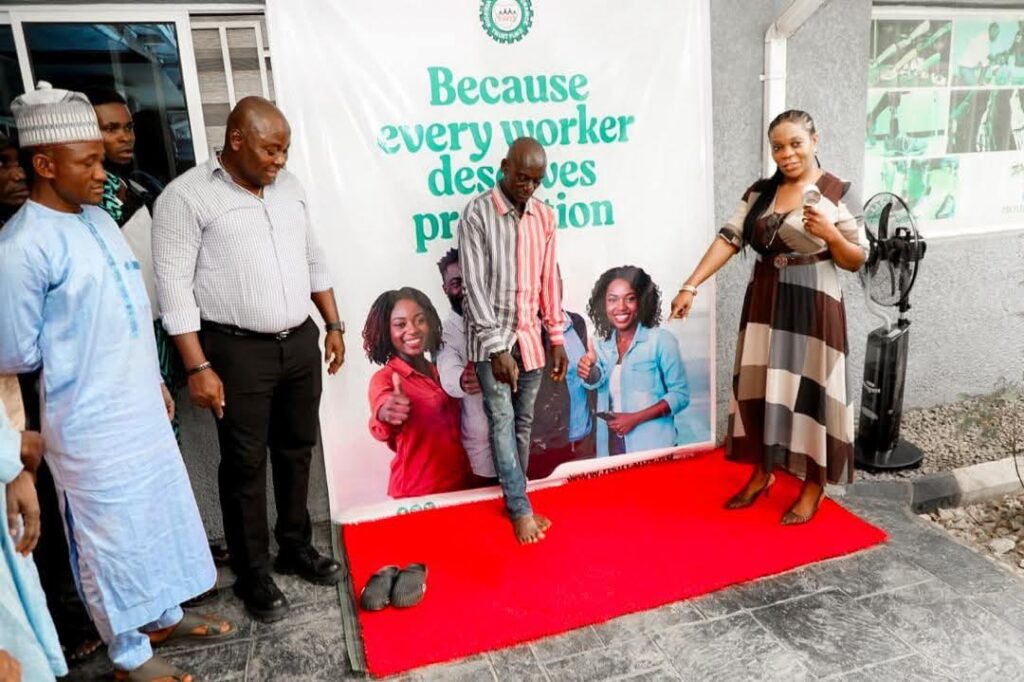
The latest intervention is part of the ongoing rehabilitation and reintegration programme of the NSITF, under which 78 beneficiaries have recently been fitted with artificial limbs.
The Employees’ Compensation Scheme was established under the Employees’ Compensation Act of 2010 to provide compensation for workers who suffer injuries, disabilities, diseases or death arising from workplace activities.
The scheme, funded through employer contributions, was introduced to replace the defunct Workmen’s Compensation Act and broaden social protection for Nigerian workers in both the public and private sectors.
Over the years, labour stakeholders have repeatedly raised concerns over poor workplace safety standards in several sectors of the economy, especially manufacturing, construction and heavy industry, where industrial accidents remain prevalent.
Analysts say the increasing intervention of the NSITF in rehabilitation and compensation is gradually strengthening confidence in Nigeria’s social insurance system and drawing attention to the need for stricter enforcement of occupational safety measures across workplaces.
For many beneficiaries, however, the interventions represent something deeper than compensation — a restoration of hope after tragedy.
NSITF Restoring Hope to Injured Nigerian Workers Through Compensation Scheme — Faleye