
News
PLATEAU STATE: EVEN THIS DARKNESS SHALL PASS AWAY

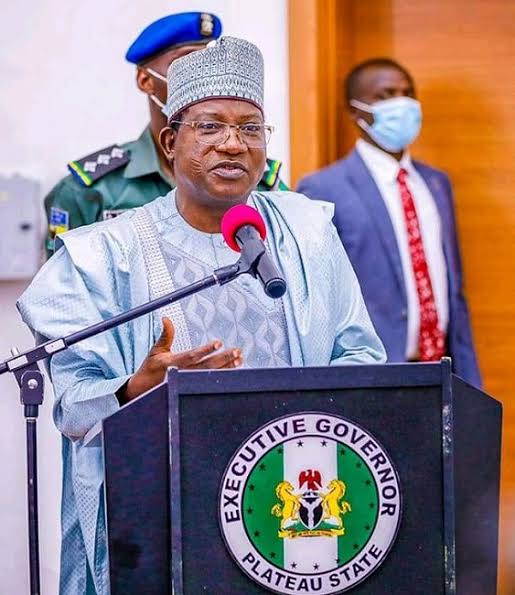
PLATEAU STATE: EVEN THIS DARKNESS SHALL PASS AWAY
BY CHRIS GYANG
Nothing poignantly symbolizes the decrepit and gloomy face of governance in Plateau State such as the thick darkness that envelopes the Plateau State Government House at Little Rayfield every night.
Driving past that seat of government from the well-lit, ritzy and upscale Rayfield at sunset, you will never imagine that just a few metres to your left is the fence of what used to be one of the most magnificent government houses in the entire country. Close associates say that Governor Lalong harbours a deep aversion for the government house, built by his predecessor, because its sheer magnificence is a constant, niggling, reminder of his own disastrous outing as governor.
At daytime, the atmosphere of despondency is thicker, more palpable. The dilapidation and unkemptness that afflict both the fence and huge buildings within tell an even worse story; the sad tale of a governor who long ago let go of governance for fanciful frivolities that inflate his parched ego. Citizens here fittingly refer to him as ‘The Absentee Governor’.
The very structures within this expansive estate that were once the pride of Plateau people now desperately beg for a fresh coat of paint; yearn for their once lush lawns to be trimmed and watered; and pray for the overgrown grass and assorted weeds to be mown, perhaps for the first time in only God knows how many years.
Sadly, it is this sense of listlessness and abandonment that pervade both the people and atmosphere of Plateau State under His Excellency, Governor Simon Bako Lalong. And, yes, never fail to add to his string of aliases the fact that he also occupies the exalted position of the Chairman of the Northern Governors’ Forum and is likewise the Director-General of the All Progressives Party’s Presidential Campaign Council – which tickles him exceedingly, more than anything else these days.
It is this latest assignment, which he misconstrues as a reward for his exceptional leadership qualities, that he uses as yet another alibi to escape responsibility from the serious work of governance. His exaggerated sense of personal worth is now at its peak. But in his excitement, he failed to ask himself why the man who made him Director-General of his campaign team never thought him fit and worthy to be his running-mate, which, it must be admitted, Mr. Lalong straineously hankered after.
For a man who can settle for any position as far it gives him a semblance of public visibility, anything goes, warts and all. And knowing that his strength does not lie in taking and resolutely maintaining principled stands on fundamental issues, Tinubu and his kitchen cabinet fully understood that, at the least prompting, Governor Lalong would easily abandon his original quest and succumb to taking up the lesser, more temporary, position of Campaign DG.
At least, in his own reckoning, that would allow him share in the limelight that would shine on the APC’s high and mighty, as long as the campaigns last.
Other serious governors are making last minute efforts to consolidate on their achievements by commissioning projects and tidying up policies and programmes to strengthen and make them solid, robust and enduring. But Governor Lalong is squandering sleepless nights and precious resources hopping around the country on an exercise that is as self-serving as it is futile.
His efforts are akin to the gimmicks of a failed salesman struggling to market an essentially flawed product. Unfortunately, the best he can get for Tinubu in Plateau State cannot be more than what he was able to eke out for Buhari in the 2019 presidential ballot – a spectacularly humiliating result.
Moreover, the albatross of the Muslim-Muslim ticket that malignantly hangs on Mr. Lalong’s neck will be very difficult to cast off. This will, among other heavy moral baggage, make his job of selling the Tinubu/Shettima ticket very awkward to his immediate Christian constituency, both in Plateau State and elsewhere in the country. His task is further compounded by the fact that he is a Knight of the Catholic Faith.
What little time Mr. Lalong scrapes out to run the affairs of the state is devoted to empty state ceremonies still aimed at boosting his ego and picking up the pieces of the APC in the state which he single-handedly destroyed by turning it into a personal estate for his own pleasure. Today, many men and women who stood behind him in most of his inglorious seven years in office have been forced to either abandon him or join other political parties.
Even members in Jos North, who formed the fulcrum of the strength of the APC in the state, have rebelled against Mr. Lalong. His high-handedness and nepotism in handling both party and state affairs have been their chief motivations. Political analysts say that, as things stand, there is no way the APC can make any meaningful impact in the 2023 general elections.
Also, pundits further suggest that it is perhaps the highly fractious governorship primaries of the APC that finally nailed the coffin of the APC in Plateau State. The governor was seen to have deliberately skewed the process to favour his preferred aspirant which did not go down well with a majority of the contestants who took the matter to court.
Unfortunately, the outcome did not favour the aggrieved aspirants. But they have vowed to pursue the case up to the Supreme Court. However, many see this as a strategy to distract the APC from concentrating on the electioneering campaigns as more than 95 per cent of them are set to pitch their tents with the political party that has shown the greatest potential of defeating the APC in the forthcoming polls.
In the midst of all these, the people of Plateau State continue to suffer. As we write, civil servants are set to commence a five-day Sit-At-Home warning strike from midnight of Sunday, December 11, to Friday, December 16, 2022. They want to push home their demands for the payment of their five months’ salaries.
In fact, they had planned to start this industrial action before the flag-off of the APC presidential campaign in Jos on November 15. But, in order to stave off the embarrassment that would have caused Governor Lalong, being the arrowhead of the Tinubu campaign organisation, the workers were hoodwinked into calling it off when some workers started receiving salary alerts. But that was discontinued immediately after that political fiesta.
It later emerged that only a handful of workers had actually been paid a month or two’s outstanding salaries. Barely one month after, the workers have not heard any more from the state government regarding that matter.
With the governor perpetually absent and the levers of governance abandoned, it is only natural to expect these kinds of upheavals in the system arising from citizens’ frustrations with their wretched conditions. Abject conditions underscored by poverty for which Plateau State is now officially recognised as occupying the fifth position in the entire country.
Statistics released by the National Bureau of Statistics (NBS) in November, revealed that 133 million Nigerians (63 per cent of the population) are multi-dimensionally poor due to lack of access to health care, education, proper living standards, employment and security.
PUNCH newspaper (November 18, 2022) reported: “The NBS further showed [that] Sokoto, Bayelsa, Gombe, Jigawa and Plateau are the top poorest states in 2022.
“Sokoto leads the poorest with 90.5 per cent of the people in the state poor. It is followed by Bayelsa with 88.5 per cent people, Gombe with 86.2 per cent, Jigawa with 84.3 per cent and Plateau with 84 per cent.”
Certainly, the Lalong administration should not be surprised at this bleak chunk of reality. To expect anything to the contrary would be to engage in the highest form of self-delusion. This is only the natural outcome of the government’s total lack of any concrete and practical economic blueprint aimed at harnessing and channelling the huge natural and human potentials of the state.
Like all else about the Lalong administration, its economic policies have been largely driven by a haphazard, trial-by-error, approach which is at best pedestrian and completely reliant on the old way receiving monthly handouts from the Federation Account. Most of which is deployed towards oiling huge and extensive political wheels and buying personal favours and loyalties of cheap political strumpets.
This is but a slice of the tragedy in which Plateau State is currently wallowing, emblematic of the darkness hanging over the Little Rayfield Government House. But come May, 29, 2023, its flamboyance, verve and splendour shall be restored, along with the natural vibrancy and pride of citizens. Citizens who are confident that, through their concerted and selfless efforts, they shall restore honour to their despoiled destiny so that even this darkness shall pass away.
(GYANG is the Chairman of the N.G.O, Journalists Coalition for Citizens’ Rights Initiative – JCCRI. Emails: info@jccri-online.org; chrisgyang01@gmail.com)


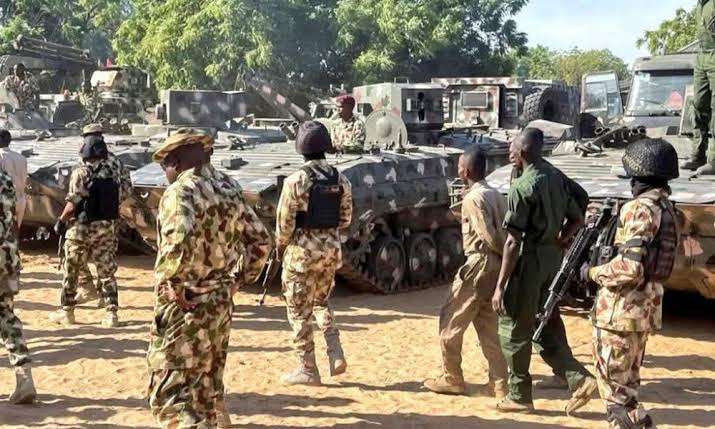
Troops arrest suspected foreign national along Azir–Damboa road in Borno
By Zagazola Makama
Troops of 25 Brigade, in collaboration with the Civilian Joint Task Force (CJTF), have arrested a suspected foreign national along the Azir–Damboa road in Borno State.
Military sources told Zagazola Makama that the suspect was apprehended at about 5:55 p.m. on Sept. 5 following a tip-off from local residents about the movement of a suspected foreigner along the route.
During preliminary questioning, the suspect reportedly identified himself as a national of the Republic of Cameroon.
He told the troops that he entered Nigeria through Taraba State and was travelling towards Niger State in search of artisanal work but lost his way.
The suspect remains in military custody for further investigation and necessary action, while authorities work to establish his identity, travel history and circumstances surrounding his presence in the area.
Troops arrest suspected foreign national along Azir–Damboa road in Borno
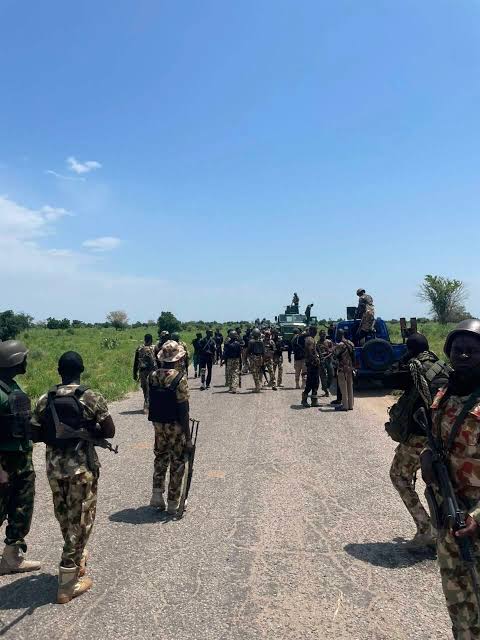
Troops arrest suspected ISWAP member with gunshot wound in Borno
By Zagazola Makama
Troops of 82 Division Task Force Battalion have arrested a suspected ISWAP member who was found loitering around Papa 7 location in Borno State.
Military sources told Zagazola Makama that the suspect was apprehended at about 9:35 a.m. on Sept. 6 while troops were conducting picketing duties in the area.
The suspect was found with a gunshot wound and was taken into custody for questioning.
Preliminary interrogation reportedly indicated that the suspect had descended from Gava in the Mandara Mountains in search of medical attention.
Sources attributed his movement to the effects of sustained military pressure and psychological operations targeting terrorist enclaves in the area.
The suspect remains in military custody for further investigation, while security forces continue operations aimed at degrading terrorist groups and disrupting their activities in the Mandara Mountains.
Troops arrest suspected ISWAP member with gunshot wound in Borno
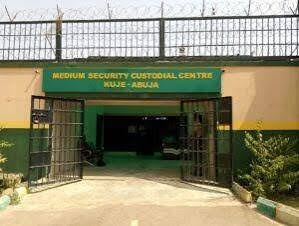
Investigation begins as SNCO dies after shooting incident at Kuje custodial centre
By Zagazola Makama
Authorities have commenced an investigation into a shooting incident involving a senior non-commissioned officer at the Kuje Medium Security Custodial Centre in the Federal Capital Territory.
Sources told Zagazola Makama that the incident occurred at about 9:37 a.m. on Sept. 7 while the personnel was on duty at the facility.
According to the sources, the SNCO fired at his commanding officer, but the shot missed after the officer moved away.
The SNCO subsequently died from a self-inflicted gunshot wound.
The circumstances surrounding the incident remain unclear, and an investigation has been launched to establish what led to the shooting.
The remains of the deceased personnel were evacuated to the University of Abuja Teaching Hospital (UATH) for further action.
Authorities are expected to provide additional details as the investigation progresses.
Investigation begins as SNCO dies after shooting incident at Kuje custodial centre

Troops arrest suspected foreign national along Azir–Damboa road in Borno

Troops arrest suspected ISWAP member with gunshot wound in Borno

Investigation begins as SNCO dies after shooting incident at Kuje custodial centre

Roger Federer’s Shock as DNA Results Reveal Myla and Charlene Are Not His Biological Children

THE PLIGHT OF FARIDA

FAILED COUP IN BURKINA FASO: HOW TRAORÉ NARROWLY ESCAPED ASSASSINATION PLOT AMID FOREIGN INTERFERENCE CLAIMS
-
 News2 years ago
Roger Federer’s Shock as DNA Results Reveal Myla and Charlene Are Not His Biological Children
-
Opinions5 years ago
THE PLIGHT OF FARIDA
-
 News1 year ago
FAILED COUP IN BURKINA FASO: HOW TRAORÉ NARROWLY ESCAPED ASSASSINATION PLOT AMID FOREIGN INTERFERENCE CLAIMS
-

 News2 years ago
EYN: Rev. Billi, Distortion of History, and The Living Tamarind Tree
-
 Opinions5 years ago
POLICE CHARGE ROOMS, A MINTING PRESS
-

 ACADEMICS3 years ago
A History of Biu” (2015) and The Lingering Bura-Pabir Question (1)
-

 Columns3 years ago
Army University Biu: There is certain interest, but certainly not from Borno.
-

 Politics1 year ago
2027: Why Hon. Midala Balami Must Go, as Youths in Hawul and Asikira/Uba Federal Constituency Reject ₦500,000 as Sallah Gift
