
News
Rising Tensions in Zamfara as war of supremacy is set to begin between Bandits and LAKURAWA militants

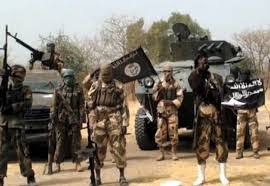
Rising Tensions in Zamfara as war of supremacy is set to begin between Bandits and LAKURAWA militants
By: Zagazola Makama
The intricate dynamics of banditry in Northwest Nigeria have taken a significant turn, with prominent leaders Dogo Gide and Najaja navigating an evolving challenge posed by the presence of the Lakurawa faction. This faction, which has established a camp in Bagega, Zamfara State, has reportedly sought to recruit these bandit leaders into its plans of creating an “Islamic state.” However, their refusal has not only strained relations but also set the stage for a potential confrontation.
In the volatile landscape of the brewing conflict between the notorious bandit leaders and a formidable militant group threatens to plunge the region into further chaos. Dogo Gide and Najaja, two prominent bandit leaders, find themselves at a critical crossroads as they confront the encroaching presence of Lakurawa, a group.
The stakes are high for Gide and Najaja. The presence of Lakurawa not only challenges their authority but also invites an increased military presence in the region, a scenario that could disrupt their operations and lead to violent confrontations. Local communities, however, are caught in a complex web of conflicting desires; they pray for a resolution to the banditry that has plagued their lives, even as they yearn for more robust security measures to protect them from both bandit attacks and the looming threat of Lakurawa.
One other disturbing trend was the infiltration of a six-member Improvised Explosive Device (IED) making team from Nigeria’s northeastern region into the northwest and north-central areas. Trained by NANAYE, a former Boko Haram IED expert who has since surrendered. These individuals have already made their way to the camps of the insurgents in Niger and Zamfara states.
The implications of their presence are dire. A series of recent Remote Controlled Suicide Bombing (RSBIED) incidents four recorded in Zamfara and two in Niger State have been linked to this IED group. The group’s activities have raised alarms among security agencies and local populations alike, as the sophistication of these attacks indicates a significant escalation in the tactics employed by bandit factions.
The timeline of violence in the region has been alarming. On December 7, 2024, the first RSBIED incident occurred along the major supply route (MSR) connecting Angwan Usman and Bassa in Shiroro Local Government Area, resulting in the tragic death of a bicycle rider. Just days later, on December 19, another RSBIED attack took place in Bassa Village, claiming the lives of five individuals and injuring three others.
This incident was particularly chilling; the attackers employed a dual-layered strategy, with one explosive designed to detonate upon contact and a second set to trigger in response to rescue efforts. Victims of the December 19 incident were swiftly evacuated to IBB Specialist Hospital in Minna, Niger State, but the scars of violence run deep. Families mourn their losses, and the fear of further attacks looms large over the region.
The IED group is believed to operate within camps led by: Sadikku’s JAS faction in Allawa-Madawaki, Niger State. Turji and Dogo Auta’s factions in Barikin Daji and Dan Bagudu Hills, Talata Mafara LGA, Zamfara State.
These groups, leveraging their deep entrenchment in the region, appear to be integrating IED strategies into their operational arsenal, intensifying the threat to civilians and security forces alike.
Regional Implications
The presence of Lakurawa and the integration of IED tactics signal a troubling shift in the conflict landscape. For communities in Zamfara and Niger states, the stakes are high. Many are calling for sustained military intervention and strategies that address both the immediate threats and the underlying drivers of insecurity.
As tensions simmer among bandit factions and the use of IEDs becomes more frequent, the need for a coordinated and robust security response has never been more urgent. Local leaders and security experts are urging a mix of kinetic and non-kinetic approaches to stabilize the region and restore normalcy.
In this climate of uncertainty, the Nigerian government and security forces must act decisively to address the threats posed by both bandits and militant groups. Failure to do so could result in a humanitarian crisis, further destabilizing an already fragile region and leaving its inhabitants vulnerable to the ravages of violence and insecurity. The time for action is now, before the situation spirals beyond control.
Zagazola Makama is a Counter Insurgency Expert and Security Analyst in the Lake Chad Region.
Rising Tensions in Zamfara as war of supremacy is set to begin between Bandits and LAKURAWA militants


NDLEA Warns Nigerians Against Fake Vehicle Auction Scam Using Officials’ Names
By: Michael Mike
The National Drug Law Enforcement Agency (NDLEA) has alerted Nigerians to a fraudulent scheme in which scammers are impersonating senior officials of the agency to deceive unsuspecting members of the public with fake offers of forfeited vehicles purportedly being sold at discounted auction prices.
In a disclaimer issued on Friday, the agency said the fraudsters have been circulating forged private letters and messages, particularly in the name of the NDLEA’s Secretary, Shadrach Haruna, claiming that seized vehicles are available for purchase through private arrangements.
The agency described the offers as entirely fraudulent, warning that they are designed solely to swindle victims out of their money.
According to the NDLEA, no official of the agency has the authority to privately allocate, sell or offer forfeited vehicles or any other seized assets to individuals under any circumstance.
It explained that assets forfeited as proceeds of drug-related offences are disposed of only through publicly advertised auctions conducted by government-appointed and registered auctioneers, in accordance with extant legal provisions and public procurement regulations.
The agency stressed that whenever such auctions are approved, they are widely publicised through national newspapers and the NDLEA’s official communication platforms to ensure transparency and equal access for interested members of the public.
The anti-narcotics agency therefore urged Nigerians to disregard any private letters, text messages, emails or social media posts claiming to offer forfeited vehicles for sale on behalf of Barrister Haruna or any other NDLEA official.
It also advised anyone approached with such offers to report the matter immediately to the nearest NDLEA command or through the agency’s official communication channels.
The statement, signed by NDLEA Director of Media and Advocacy, Femi Babafemi, reaffirmed the agency’s commitment to transparency, accountability and due process in the disposal of forfeited assets, while urging Nigerians to remain vigilant and avoid falling victim to the activities of fraudsters exploiting the agency’s name.
NDLEA Warns Nigerians Against Fake Vehicle Auction Scam Using Officials’ Names
News
Troops Repel Multiple Terrorist Attacks, Rescue District Head, Recover Arms in Katsina, Zamfara
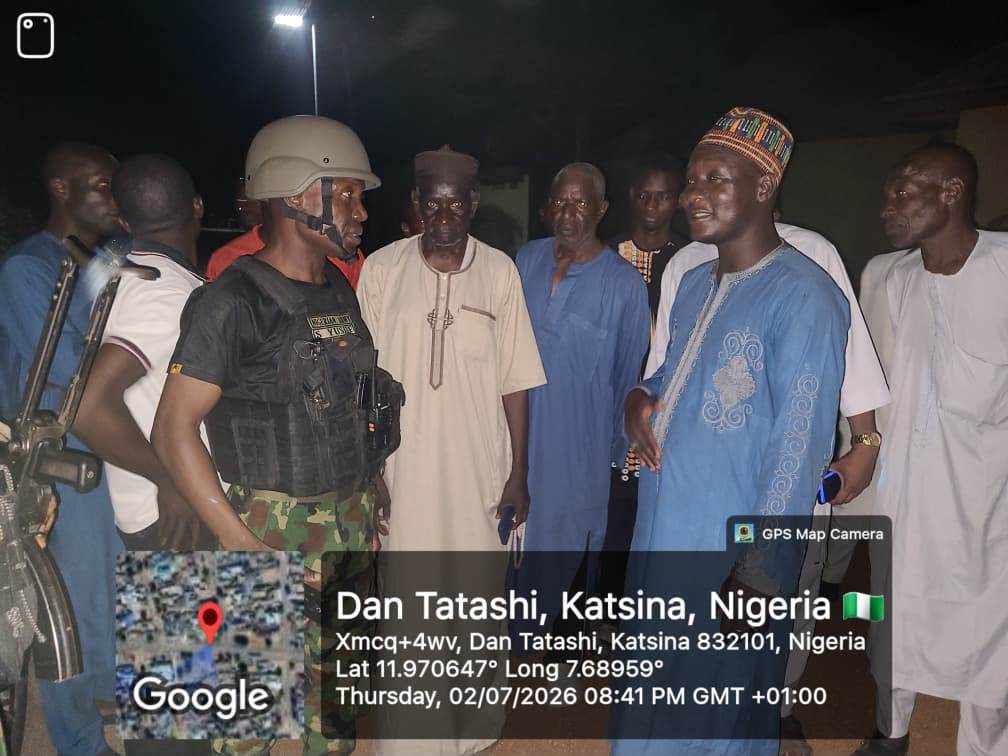
Troops Repel Multiple Terrorist Attacks, Rescue District Head, Recover Arms in Katsina, Zamfara
By: Zagazola Makama
Troops of the Joint Task Force North West, Operation FANSAN YAMMA, have repelled multiple terrorist attacks, rescued an abducted district head and recovered arms and other combat equipment during coordinated operations across Katsina and Zamfara states.
The military disclosed that the operations, conducted on July 2, demonstrated the sustained offensive against terrorist groups operating in the North-West.
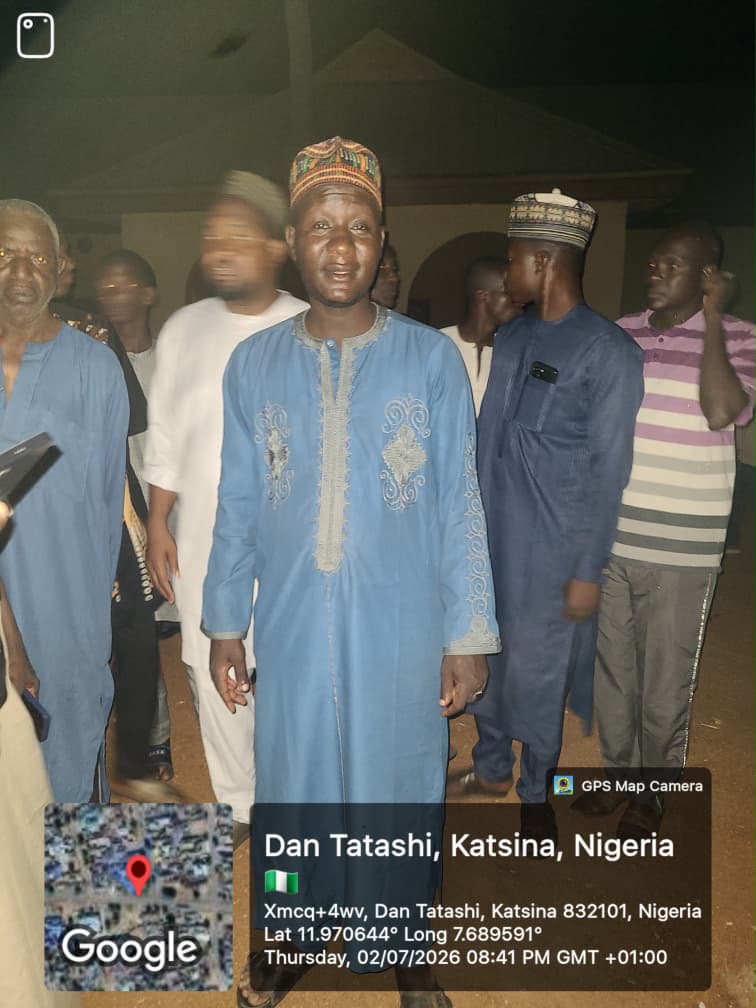
In Katsina State, troops of Sector 2 on a fighting patrol engaged terrorists between Amara and Chakau Junction in Danmusa Local Government Area after the fleeing criminals opened fire on the advancing troops.
The troops responded with superior firepower, forcing the terrorists to flee and abandon their mission.
Items recovered from the scene included one AK-47 rifle, one magazine loaded with eight rounds of 7.62mm ammunition and two motorcycles believed to have been used by the terrorists.
In another operation on the outskirts of Sabon Garin and Dantakeri villages in Dutsinma Local Government Area, troops, in collaboration with other security agencies and local vigilantes, responded to a terrorist attack and engaged the assailants in a firefight.
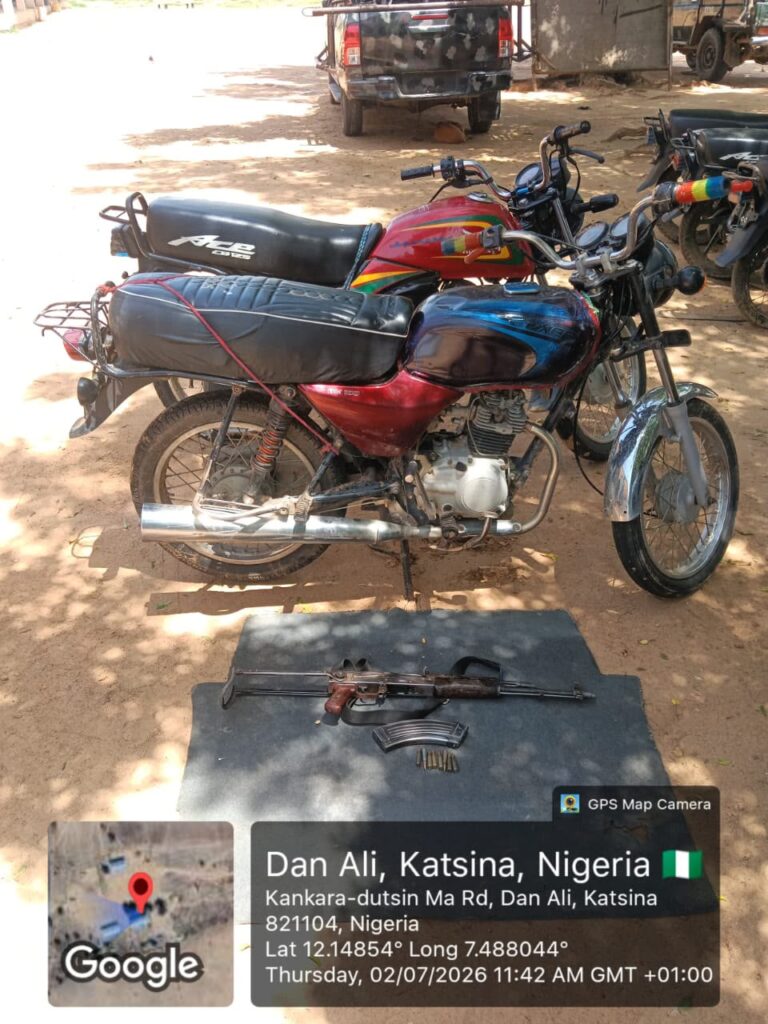
One terrorist was neutralised during the encounter, while the remaining attackers fled with varying degrees of gunshot wounds, according to military sources.
Also in Katsina, troops of Sector 2, working with other security agencies, responded to intelligence that terrorists had invaded Farin Hawa Village in Malumfashi Local Government Area and abducted the District Head, Mr. Mubarak Sharin.
The troops immediately pursued the fleeing terrorists, made contact with them and engaged them in a gun battle, killing one of the kidnappers and forcing the others to abandon the abducted traditional ruler.
The district head was rescued unhurt and reunited with his family.
Meanwhile, in Zamfara State, troops of Sector 2 successfully repelled a terrorist attack on their position at Dauran in Bukkuyum Local Government Area.
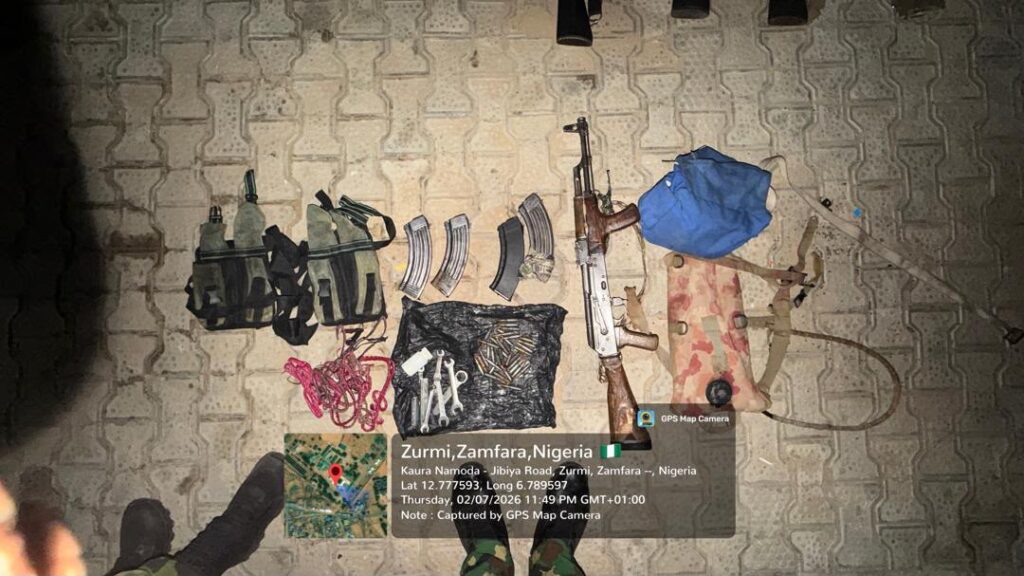
Military sources said reinforcement troops joined the battle, forcing the terrorists to retreat in disarray.
A subsequent exploitation of the area led to the recovery of one AK-47 rifle, four magazines, 35 rounds of 7.62mm ammunition, a bandolier and a hydration pack (CamelBak).
The military commended the courage, professionalism and resilience displayed by the troops as well as the support of other security agencies and local vigilantes during the operations.
It reaffirmed its commitment to sustaining offensive operations against terrorist groups while working closely with local communities to improve security and protect lives and property across the North-West.
Troops Repel Multiple Terrorist Attacks, Rescue District Head, Recover Arms in Katsina, Zamfara
News
MAJOR SETBACK FOR IBUSA AS COURT REFUSES EXECUTION ORDER, STRENGTHENS OGWASHI-UKU’S POSITION IN LAND BATTLE

MAJOR SETBACK FOR IBUSA AS COURT REFUSES EXECUTION ORDER, STRENGTHENS OGWASHI-UKU’S POSITION IN LAND BATTLE
The Obi of Ogwashi-Uku, HRM Obi (Dr.) Ifechukwude Aninshi Okonjo II, on behalf of the people of Ogwashi-Uku Kingdom, has recorded what community leaders have described as a significant legal victory in the long-running land dispute involving the Esemese Community of Ibusa.
In a ruling delivered on 15 June 2026 in Suit No. A/M/62/2015, the Delta State High Court, presided over by Hon. Justice Flora Ngozi Azinge, declined the principal application by the Esemese Community of Ibusa seeking an order for the execution of the judgment arising from the earlier litigation between the parties.
The applicants, through their counsel, Barrister P. U. Lotobi, had sought, among other reliefs, an order permitting the execution of the judgment and the substitution of several deceased parties to the proceedings. While the Court granted the applications relating to the substitution of deceased parties in the Esemese community, it declined the principal relief seeking an order of execution.
The Court also approved the substitution of the late HRM Obi Professor Chukwuka Okonjo with the present Obi of Ogwashi-Uku, HRM Obi (Dr.) Ifechukwude Aninshi Okonjo II, who is represented in the proceedings by Chief Arthur Obi Okafor, SAN.
The ruling marks an important development in a dispute that has its origins in earlier litigation in Suit No. A/28/66.
According to the Ogwashi-Uku Kingdom, concerns had previously arisen over the interpretation of the litigation survey plan associated with the Supreme Court judgment. The Kingdom maintained that attempts had been made to rely on a survey plan that differed from the original litigation survey relied upon by the Court.
Following applications by the Ogwashi-Uku community before the Supreme Court, the Kingdom states that the Court restored the original litigation survey plan forming part of the earlier proceedings. In the present proceedings, the High Court further directed that a registered surveyor interpret the litigation survey plan.
Leaders of the Ogwashi-Uku Kingdom have welcomed the ruling, describing it as an important safeguard against what they contend were attempts to extend the earlier judgment beyond the land actually litigated.
Speaking after the ruling, the Chief of Aboh Ogwashi-Uku, Chief Barrister Jude Obidi, described the decision as a landmark development and that the boundary between Ogwashi-Uku and Ibusa remains at the Oboshi River.
According to him, the ruling reinforces the principle that court judgments must be enforced strictly within the boundaries of the land actually determined by the courts and not beyond them.
He further noted that the broader boundary dispute between Ogwashi-Uku and Ibusa remains pending before the Delta State High Court in a separate action instituted by the Obi of Ogwashi-Uku to determine the precise boundary between the two neighbouring communities.
Chief Obidi commended the Obi of Ogwashi-Uku for what he described as his steadfast commitment to protecting the territorial interests of the Kingdom through lawful means and the judicial process.
The latest ruling is expected to have significant implications for future attempts to enforce the earlier judgment pending the final determination of the boundary dispute between both communities. With this ruling, the claims by Ibusa for the areas around Admiralty University have been thrown into serious doubt.
The Palace of the Obi of Ogwashi-Uku through the Chief of Staff to the Obi of Ogwashi-Uku, Prince Onyema Okonjo when contacted welcomed the rejection of the request by the Ibusa community by the Delta State High Court in Ogwashi-Uku but also maintained that the Obi of Ogwashi-Uku reserves the right to seek appellate review of any portion of the ruling it wasn’t happy with. He also cautioned members of the Ibusa community from resorting to self help in using thugs and attempting to enter Ogwashi-Uku land any further to make illegal claims outside any court approved enforcement.
MAJOR SETBACK FOR IBUSA AS COURT REFUSES EXECUTION ORDER, STRENGTHENS OGWASHI-UKU’S POSITION IN LAND BATTLE

PEBEC Targets Seamless Digital Government as 98% of MDAs Meet Business Reform Standards

NDLEA Warns Nigerians Against Fake Vehicle Auction Scam Using Officials’ Names

ECOWAS Hands Nigeria Assistive Devices, Unveils Regional Push for Disability Inclusion

Roger Federer’s Shock as DNA Results Reveal Myla and Charlene Are Not His Biological Children

THE PLIGHT OF FARIDA

FAILED COUP IN BURKINA FASO: HOW TRAORÉ NARROWLY ESCAPED ASSASSINATION PLOT AMID FOREIGN INTERFERENCE CLAIMS
-
 News2 years ago
Roger Federer’s Shock as DNA Results Reveal Myla and Charlene Are Not His Biological Children
-
Opinions4 years ago
THE PLIGHT OF FARIDA
-
 News1 year ago
FAILED COUP IN BURKINA FASO: HOW TRAORÉ NARROWLY ESCAPED ASSASSINATION PLOT AMID FOREIGN INTERFERENCE CLAIMS
-

 News2 years ago
EYN: Rev. Billi, Distortion of History, and The Living Tamarind Tree
-
 Opinions5 years ago
POLICE CHARGE ROOMS, A MINTING PRESS
-

 ACADEMICS2 years ago
A History of Biu” (2015) and The Lingering Bura-Pabir Question (1)
-

 Columns2 years ago
Army University Biu: There is certain interest, but certainly not from Borno.
-

 Politics1 year ago
2027: Why Hon. Midala Balami Must Go, as Youths in Hawul and Asikira/Uba Federal Constituency Reject ₦500,000 as Sallah Gift
