
National News
Tinubu Flags Off Dikwa–Gamboru Ngala, Bama–Banki Road Projects

Tinubu Flags Off Dikwa–Gamboru Ngala, Bama–Banki Road Projects
..:Describes Zulum Best Performing Governor
…Zulum Hails Tinubu’s Commitment to Borno Recovery Process
By: Our Reporter
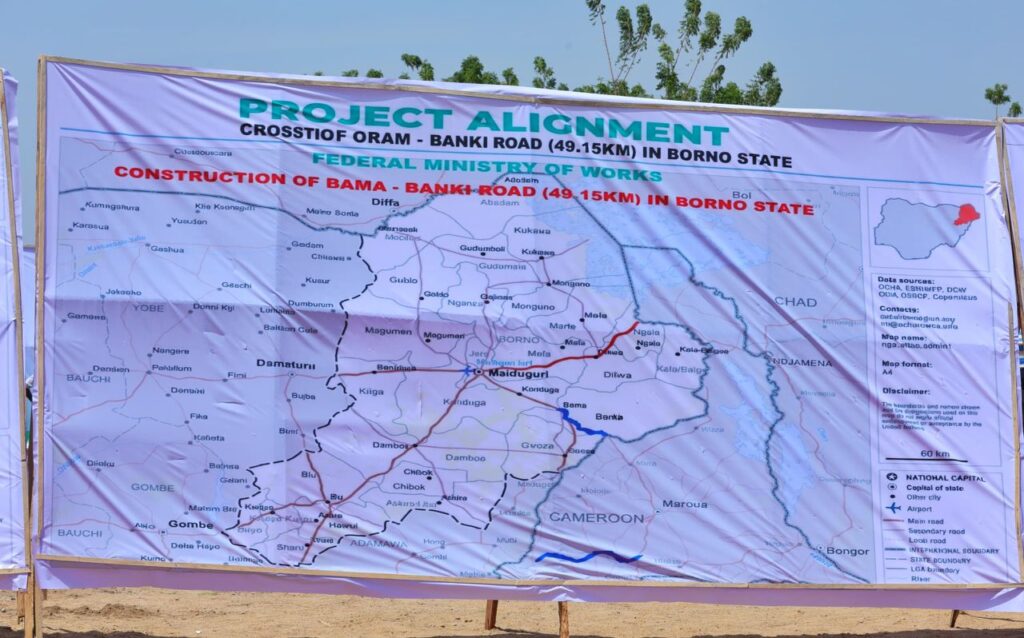
President Bola Ahmed Tinubu on Saturday flagged off the construction of the 49.55-kilometre Dikwa–Gamboru Ngala Road and the 49.15-kilometre Bama–Banki Road, describing the strategic highways as critical to economic growth, regional integration, and national security.
The two road projects, regarded as economic lifelines of the North-East, serve as key gateways to neighbouring African countries, which will bolster cross-border trade, facilitate the movement of agricultural produce, and strengthen security operations in a region recovering from over a decade of insurgency.
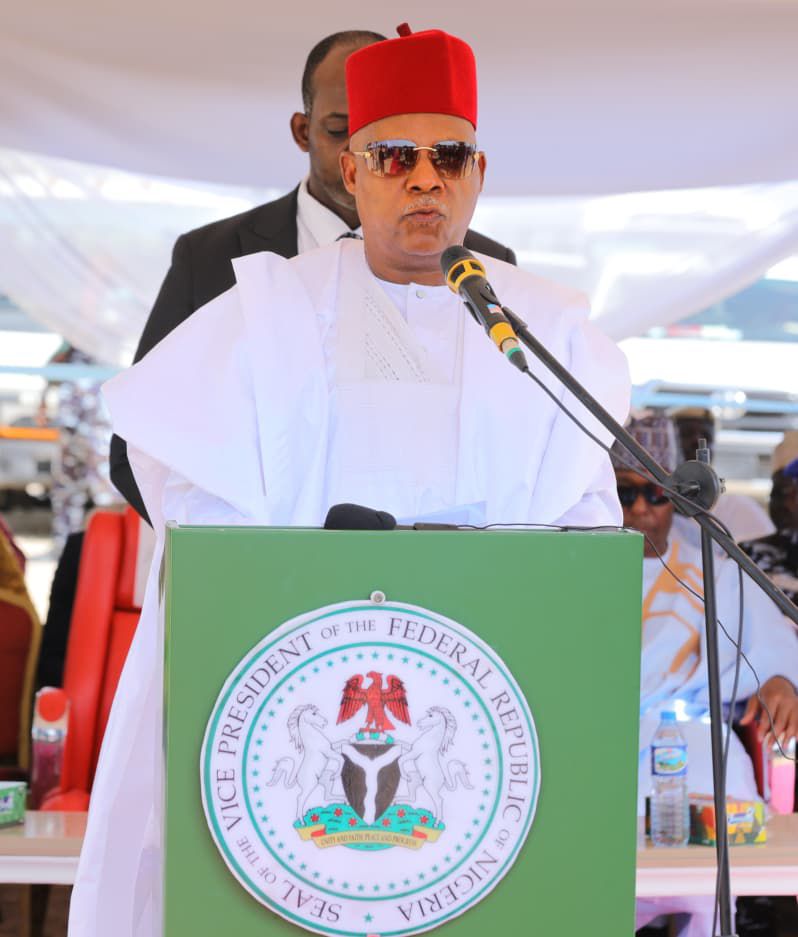
The groundbreaking ceremony was held along the Maiduguri–Gamboru Ngala Road, where President Tinubu was represented by Vice President Senator Kashim Shettima.
The Vice President said the rehabilitation of the roads would improve connectivity and deliver on the administration’s commitment to infrastructure development across the country.
“His Excellency, President Bola Ahmed Tinubu, GCFR, has made infrastructure a central priority. This is what Mr. President promised Nigerians, and I’m here today to affirm our readiness to redeem the promise and to convey his goodwill and gratitude for the support you have shown us,” Shettima said.
“The Bama–Banki Corridor carries special strategic weight. It is a top route of agriculture, movement, and national security. The Dikwa–Gamboru Ngala Road belongs to the same vision of reconnecting communities and restoring economic confidence across Borno State.”
The Vice President also commended Borno State Governor, Professor Babagana Umara Zulum, for prioritising infrastructure and maintaining a strong partnership with the Federal Government.
“The partnership between the Federal Government and Borno State shows what becomes possible when public institutions are united by the urgency of service. Certainly, Your Excellency, Professor Babagana Umara Zulum, you are one of the best-performing governors in the federation,” the Vice President stated.
Governor Zulum expressed appreciation to President Tinubu for approving the road projects and other critical interventions in Borno State.
“The successful commencement of this project reflects the strong partnership between the Federal Government and the Borno State Government. We deeply appreciate and remain eternally grateful to the President of the Federal Republic of Nigeria, President Bola Ahmed Tinubu, GCFR, for his unwavering commitment to the development, peace, and security of the North East and Nigeria as a whole,” Zulum remarked.
“Borno State Government recognizes that infrastructure remains a critical foundation for development. Since assuming office, our administration has prioritized the rehabilitation and construction of roads, schools, hospitals, water facilities, and other critical infrastructure as part of our commitment to improving the lives of our citizens,” he added.
Governor Zulum also pledged the state’s political support for President Tinubu in the next presidential election.
“I want to assure the President and indeed the Vice President that, Insha Allah, come January 2027, the people of Borno State will overwhelmingly vote him into office.”
The governor equally praised Vice President Shettima for his sustained support towards the reconstruction and development of Borno State.
“Your Excellency, your personal interest in the reconstruction and development of our state continues to inspire confidence among our people. We sincerely appreciate your leadership and steadfast commitment.”
Zulum also acknowledged the humanitarian contributions of Alhaji Aliko Dangote, particularly through the Aliko Dangote Foundation, during the state’s recovery from insurgency and the 2024 flood disaster.
He recalled the construction of Dangote Village, the donation of ₦1.5 billion to the National Emergency Management Agency (NEMA), ₦1 billion to the Borno State Government following the 2024 flood, and the distribution of relief materials to internally displaced persons.
“Through the Aliko Dangote Foundation, thousands of displaced persons received food and non-food items. Essentially, in 2017, he donated 106 trucks of food to IDPs. Alhaji Aliko Dangote has also donated ₦1.5 billion to NEMA to support flood victims in Borno State in the year 2024.”
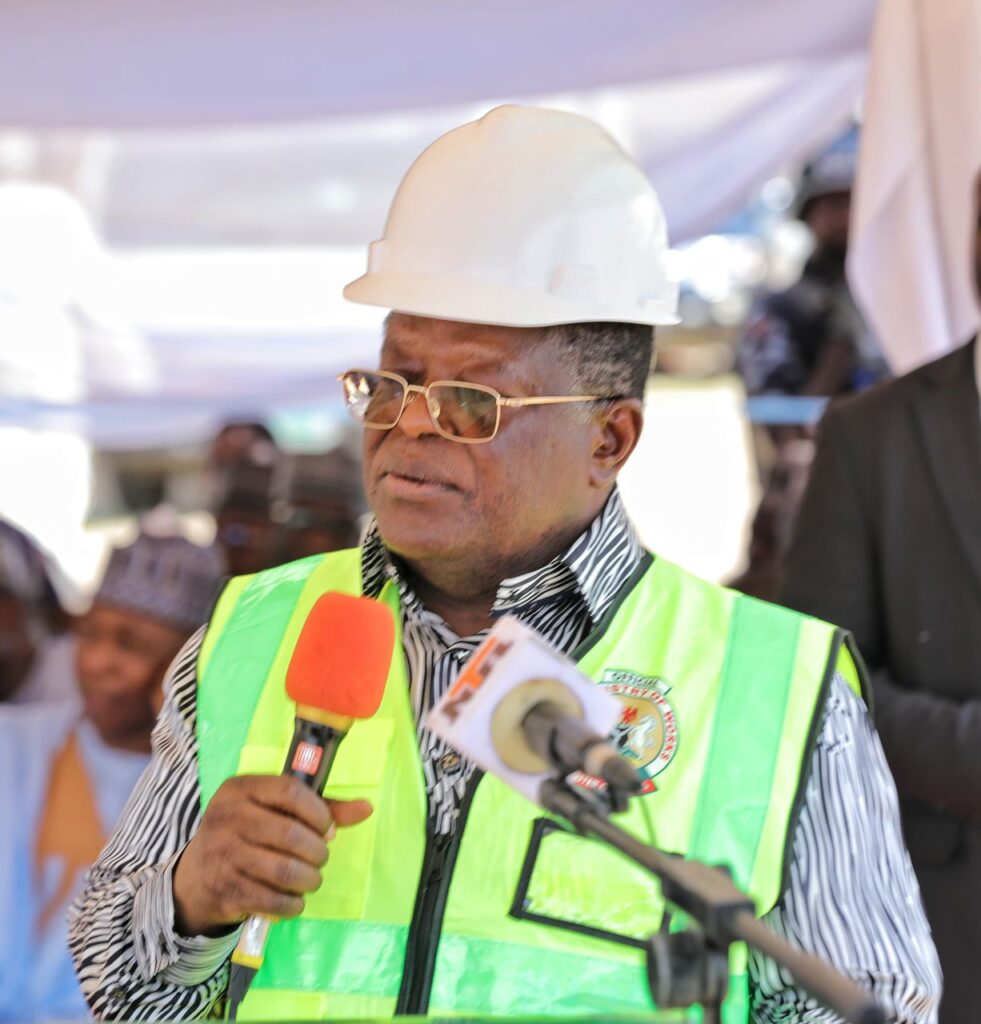
Governor Zulum assured that the road projects would be closely monitored to ensure value for money and strict compliance with quality standards. He also appealed to the Minister of Works to grant the Borno State Government a waiver to regulate the activities of heavy-duty truck drivers using the roads.
Earlier, the Minister of Works, Senator David Umahi, disclosed that the projects would be executed in two phases and expressed confidence that construction would be completed within six months.
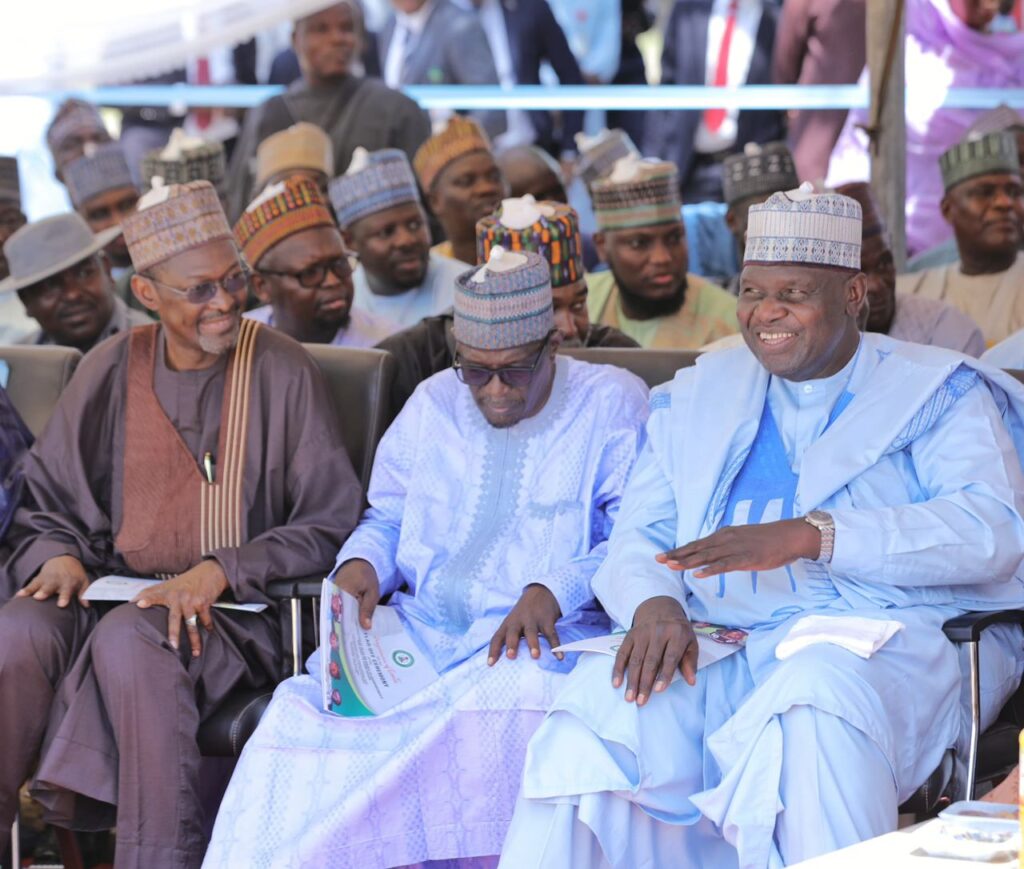
The ceremony was attended by the Borno State Deputy Governor, Hon. Umar Usman Kadafur; APC Deputy National Chairman (North), Hon. Ali Bukar Dalori; senators; members of the House of Representatives; the Shehu of Borno, represented by the Shehu of Dikwa; ministers; members of the Borno State House of Assembly; APC leaders; the Secretary to the State Government; the Head of Service; the Acting Chief of Staff; commissioners; heads of government agencies; and other dignitaries.
Tinubu Flags Off Dikwa–Gamboru Ngala, Bama–Banki Road Projects


National News
Jungle Justice Is Murder, Not Justice — IGP Disu Orders Nationwide Crackdown on Mob Killings

Jungle Justice Is Murder, Not Justice — IGP Disu Orders Nationwide Crackdown on Mob Killings
By Zagazola Makama
The Inspector-General of Police, IGP Olatunji Rilwan Disu, has declared a firm war against jungle justice and mob action across Nigeria, directing Commissioners of Police in the 36 states and the Federal Capital Territory to treat every case of mob violence as homicide and investigate such incidents with the same seriousness accorded other killings.
Disu, in a strong-worded public address, on Sunday said no Nigerian, community, vigilante group or association had the legal authority to arrest, try, convict or execute another person on the basis of suspicion, accusation, rumour or social media evidence.
The IGP’s declaration comes amid renewed public concern over cases in which suspected criminals are subjected to beatings, burning, stabbing and other forms of extrajudicial punishment before security agencies can intervene.
He said the Police Force would no longer regard such incidents as mere community disputes or spontaneous public reactions, but as serious criminal offences requiring full investigation and prosecution.
“Jungle justice is murder. It is not justice. It is a crime, and the Nigeria Police Force will treat it as such,” Disu said.
The police chief stressed that Nigeria operates under the rule of law and not mob rule, warning that no citizen or group has the constitutional authority to determine the guilt of another person or impose punishment outside a competent court.
‘Nobody has the right to take another person’s life’
According to the IGP, Sections 33, 34 and 36 of the 1999 Constitution, as amended, guarantee fundamental rights including the right to life, dignity and fair hearing.
He said those rights remain applicable even when a person is suspected of committing a serious crime.
Disu argued that the growing practice of gathering around an alleged criminal, beating the person and sometimes killing him or her before the police arrive represents a direct assault on the country’s justice system.
He said an accusation does not amount to proof of guilt. A person shouting “thief”, a viral video, a photograph circulated online or an allegation made by a member of the public, he maintained, cannot replace a police investigation or judicial determination.
“The law presumes everybody innocent until proven guilty in a court of law, not in the street, not by a mob, not by a phone video because you saw him in video,” he said.
The IGP cited the March 2025 killing of 16 travellers in Uromi, Edo State, as a painful reminder of the consequences of mob justice.
The victims, who were reportedly travelling from Rivers State towards Kano, were intercepted after local security personnel found locally made weapons in their vehicle. The situation escalated after they were suspected of being kidnappers, resulting in the mob attack that claimed 16 lives. Police subsequently arrested suspects in connection with the incident.
The incident generated nationwide outrage and renewed calls for stronger action against mob killings. Amnesty International also called for a transparent investigation into the Uromi killings, describing the incident as a brutal lynching.
The IGP said Nigeria had witnessed several disturbing cases in which individuals were killed over allegations that were either unverified or subsequently found to be mistaken.
He referenced cases involving students accused of stealing phones, travellers mistaken for criminals, and young people attacked over allegations of blasphemy or ritual activities.
Such cases, he said, demonstrate the deadly consequences of allowing rumours and accusations to substitute for evidence.
The warning is particularly significant in an era where videos and allegations can spread rapidly across social media platforms.
A short video clip can be shared thousands of times within minutes, while an accusation attached to it can quickly become accepted as fact before investigators establish what actually happened.
Disu made clear that the police investigation would not stop with the individual who physically killed the victim.
He directed police commands to identify and prosecute ringleaders, instigators and other participants whose actions contributed to the mob violence, where the evidence supports criminal liability.
The IGP said investigators would use video recordings, eyewitness accounts, community intelligence and forensic evidence to reconstruct incidents and identify those involved.
The implication is that the traditional excuse of “I did not touch him” may not necessarily shield a person whose conduct amounts to criminal participation. Those who plan, incite, encourage or facilitate mob action may face investigation for conspiracy or other offences, depending on the facts and applicable law.
In one of the strongest elements of his warning, the IGP also addressed people who record mob attacks on their phones.
He said filming incidents, circulating the videos, mobilising crowds or preventing security personnel from rescuing a suspect could attract criminal consequences where such conduct amounts to an offence.
The warning is significant because videos of mob killings have increasingly become part of the evidence available to investigators.
Rather than helping perpetrators escape, such recordings can potentially provide investigators with a trail of evidence showing who was present, who attacked the victim, who encouraged the crowd and who prevented intervention.
The IGP therefore warned Nigerians against assuming that remaining behind a camera automatically removes them from criminal responsibility.
Police officers who look away will also face consequences. Disu’s directive was not directed exclusively at civilians.
He also placed responsibility on police officers who fail to intervene when mob action is taking place.
The IGP warned that officers who stand by, look away or fail to take reasonable action to protect a suspect from a violent crowd could face disciplinary measures.
This aspect of the directive is particularly important because the responsibility to protect life remains central to policing. A suspect may eventually be convicted. A suspect may eventually be acquitted. But while the investigation and trial are ongoing, the state remains responsible for protecting that person’s life and dignity.
Disu therefore told officers that protecting life was not an optional responsibility attached to wearing the police uniform.
‘Take suspected criminals to the police’
The IGP appealed to Nigerians to redirect their anger and frustration through lawful channels.
He urged anyone who suspects another person of committing a crime to immediately alert the police or the nearest security agency rather than attempting to punish the suspect.
He also called on community leaders, religious leaders, market associations and other influential groups to use their platforms to discourage mob violence.
According to him, community vigilance should complement law enforcement, not replace it.
A responsible community member, he said, should help the police identify a suspected criminal, preserve evidence and provide information—not become judge, jury and executioner.
The IGP’s intervention comes at a time when public frustration over insecurity, criminality and delays in the justice system can easily translate into demands for immediate punishment.
In many communities, jungle justice is sometimes rationalised as a response to the belief that criminals will escape justice if handed over to the authorities. But the police chief rejected that logic.
He acknowledged the frustration created by crime and the slow pace of justice but maintained that the answer to institutional weakness is reform and stronger enforcement, not extrajudicial killing.
A society cannot simultaneously demand respect for the rule of law while allowing crowds to determine who deserves to live or die.
Disu’s declaration is strong, but its ultimate impact will depend on enforcement.
The police will have to demonstrate that cases of mob justice can be investigated with the same determination applied to other homicide cases.
Investigators will have to identify suspects from often chaotic scenes, preserve digital evidence, obtain witness statements, establish individual culpability and work with prosecutors to build cases capable of surviving judicial scrutiny.
There is also the question of police response.
Where officers arrive early enough to prevent a mob killing, their intervention can mean the difference between a criminal investigation and a homicide investigation. Where officers fail to act, the IGP’s promise of disciplinary action will therefore be closely watched.
Perhaps the most important message from the IGP is that criminal responsibility does not necessarily begin only when the fatal blow is delivered.
It can begin with the decision to mobilise the crowd. It can begin with incitement. It can involve preventing the police from taking custody of a suspect. It can involve encouraging the attackers.
And, depending on the evidence and the law applicable to the particular conduct, it can extend to other forms of participation in the offence. The police are therefore drawing a new line around mob violence:
If you suspect someone, report them.
If you have evidence, submit it. If the person is arrested, allow the law to take its course.
But if a crowd gathers and turns an accusation into a death sentence, the people involved should not expect the law to describe the killing as “community justice.” It will be investigated as a crime.
The central message of IGP Disu’s declaration is ultimately about the kind of country Nigeria wants to be. One system of justice cannot operate in the courtroom while another operates on the street. The court must remain the place where guilt is established.
The police must remain the institution responsible for investigating crime. Citizens must remain witnesses, complainants and partners in crime prevention not executioners.
And communities must understand that protecting themselves from criminals does not require them to become criminals themselves.
The Uromi killings demonstrated the catastrophic consequences of allowing suspicion to become collective punishment. The IGP’s latest directive is an attempt to ensure that such incidents are neither normalised nor dismissed as spontaneous expressions of public anger.
The message from the police chief is therefore unequivocal: Jungle justice is not justice.
Mob action is not a court. A viral video is not a conviction. An accusation is not a death sentence.
And where a mob takes a person’s life, the police will treat the incident not as justice served, but as a crime to be investigated and prosecuted.
Jungle Justice Is Murder, Not Justice — IGP Disu Orders Nationwide Crackdown on Mob Killings

NHRC Boss Honoured for Victim-Centred Human Rights Push
…UTA rewards Ojukwu for compensation, restorative justice, empowerment of rights-abuse victims
By: Michael Mike
The Executive Secretary of the National Human Rights Commission (NHRC), Chief Tony Ojukwu, has been honoured with the 2026 UTA International Humanitarian Award for championing a victim-centred approach to human rights protection, including compensation, economic empowerment and restorative justice for victims of violations.
The United Towns Agency for North-South Cooperation (UTA), Nigeria Chapter, presented the award to Ojukwu in Abuja on Thursday as part of activities marking World Humanitarian Day 2026.
The recognition, according to UTA, was in acknowledgement of Ojukwu’s sustained efforts to promote human dignity, expand access to justice and protect vulnerable and marginalised Nigerians.
Rather than limiting the response to documenting violations, the interventions highlighted by UTA focused on helping victims recover and rebuild their lives through economic empowerment, compensation and restorative support.
The initiatives also include transitional and restorative justice programmes in the North-East and efforts to improve access to justice for poor and marginalised persons.
The recognition comes against the backdrop of Nigeria’s continuing humanitarian and human rights challenges arising from conflict, displacement, poverty and other forms of vulnerability.
Under Ojukwu’s leadership, the NHRC has increasingly positioned victims at the centre of its interventions, pursuing not only accountability for violations but also remedies, restoration and practical support for affected persons.
Receiving the award, Ojukwu described it as both an honour and a fresh call to humanitarian service.
“As a humanitarian myself, this award has stimulated me to do more,” he said.
He stressed the importance of placing victims, dignity and justice at the heart of human rights protection, particularly in a country facing complex humanitarian challenges.
UTA described the NHRC chief’s interventions as contributing to the advancement of human dignity and the protection of vulnerable populations.
The organisation is a United Nations-affiliated non-governmental organisation with consultative status with the United Nations Economic and Social Council (ECOSOC).
The award ceremony attracted government officials, diplomats, humanitarian actors and other stakeholders.
The Vice President, Senator Kashim Shettima, was represented by the Director-General of the National Emergency Management Agency (NEMA), Hajiya Zubaida Abubakar Umar.
Also present were representatives of the Zamfara State Governor; the Comptroller-General of the Nigeria Customs Service, Adewale Adeniyi; the Minister of Humanitarian Affairs and Poverty Alleviation, Bernard Doro; members of the diplomatic corps; UTA International Global Secretary-General, Dr. (Amb.) Eya Essif; and UTA-Nigeria Country President, Amb. Princess Abigail Amalaha.
The honour effectively places renewed attention on the humanitarian dimension of human rights protection in Nigeria, particularly the need to move from responding to violations to ensuring that victims receive justice, restitution and the means to regain sustainable livelihoods.
NHRC Boss Honoured for Victim-Centred Human Rights Push
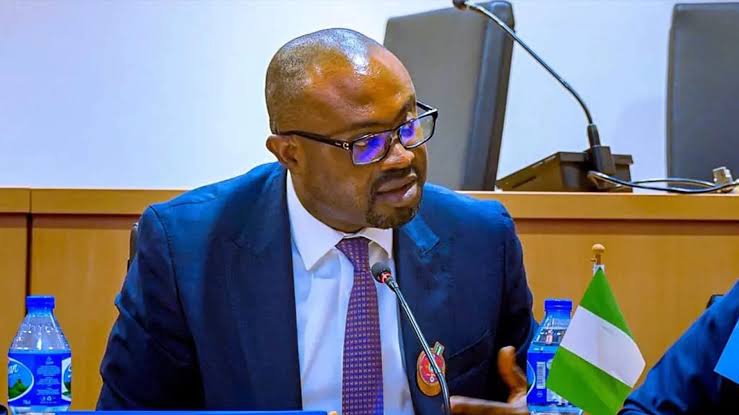
FG Declares Tuesday Holiday for Eid-ul-Mawlid, Charges Nigerians on Peace, Unity
By: Michael Mike
The Federal Government has declared Tuesday, August 25, 2026, a public holiday to mark the 2026 Eid-ul-Mawlid, the anniversary of the birth of Prophet Muhammad, with the government urging Nigerians to turn the religious celebration into a renewed commitment to peace, unity and national cohesion.
The Minister of Interior, Olubunmi Tunji-Ojo, announced the declaration on behalf of the Federal Government in a statement issued on Friday by the ministry’s Permanent Secretary, Dr Magdalene Ajani.
The declaration gives Muslim faithful across the country a day to commemorate the occasion, while the minister urged Nigerians to look beyond the festivities and draw practical lessons from the life and teachings of Prophet Muhammad.
Tunji-Ojo identified compassion, humility and service to humanity as some of the values associated with the Prophet’s life, saying they were particularly relevant to Nigeria’s current quest for peace and national development.
“Every Eid ul Mawlid gives us reason to pause and draw lessons from a life defined by compassion, humility and service to others.
“These are qualities our nation needs now more than ever, and I encourage every Nigerian, not just our Muslim brothers and sisters, to reflect on them,” he said.
The minister called on Nigerians to use the occasion to pray for peace, unity and national cohesion, stressing that the responsibility for building and sustaining a peaceful nation rested on all citizens.
He also urged Muslim faithful and other Nigerians to celebrate responsibly, with restraint, mutual respect and consideration for people of different faiths and backgrounds.
According to him, the values of peaceful coexistence and respect for one another remained essential to strengthening the bonds that hold the country together.
Tunji-Ojo congratulated Muslims in Nigeria and across the diaspora on the celebration and wished them a peaceful and joyous Eid-ul-Mawlid.
He further reaffirmed the commitment of the President Bola Tinubu administration to protecting lives and property and promoting peace and stability across the country.
The minister urged citizens to support government and community efforts aimed at strengthening national unity, fostering peaceful coexistence and building a more stable and prosperous Nigeria.
The public holiday will therefore provide Muslim faithful with an opportunity to mark the religious occasion while joining other Nigerians in reflecting on the values of tolerance, compassion, service and peaceful coexistence highlighted by the Federal Government.
FG Declares Tuesday Holiday for Eid-ul-Mawlid, Charges Nigerians on Peace, Unity

Jungle Justice Is Murder, Not Justice — IGP Disu Orders Nationwide Crackdown on Mob Killings

Troops Raid Illegal Shanties, Clear Criminal Hideouts in Abuja

Troops Arrest Suspected Terrorist, Courier in Kogi

Roger Federer’s Shock as DNA Results Reveal Myla and Charlene Are Not His Biological Children

THE PLIGHT OF FARIDA

FAILED COUP IN BURKINA FASO: HOW TRAORÉ NARROWLY ESCAPED ASSASSINATION PLOT AMID FOREIGN INTERFERENCE CLAIMS
-
 News2 years ago
Roger Federer’s Shock as DNA Results Reveal Myla and Charlene Are Not His Biological Children
-
Opinions5 years ago
THE PLIGHT OF FARIDA
-
 News1 year ago
FAILED COUP IN BURKINA FASO: HOW TRAORÉ NARROWLY ESCAPED ASSASSINATION PLOT AMID FOREIGN INTERFERENCE CLAIMS
-

 News2 years ago
EYN: Rev. Billi, Distortion of History, and The Living Tamarind Tree
-
 Opinions5 years ago
POLICE CHARGE ROOMS, A MINTING PRESS
-

 ACADEMICS2 years ago
A History of Biu” (2015) and The Lingering Bura-Pabir Question (1)
-

 Columns2 years ago
Army University Biu: There is certain interest, but certainly not from Borno.
-

 Politics1 year ago
2027: Why Hon. Midala Balami Must Go, as Youths in Hawul and Asikira/Uba Federal Constituency Reject ₦500,000 as Sallah Gift
