
News
VP SHETTIMA AT NISS GRADUATION CEREMONY: ‘We Must Form Global Alliances To End External Aggressions, Domestic Threats’

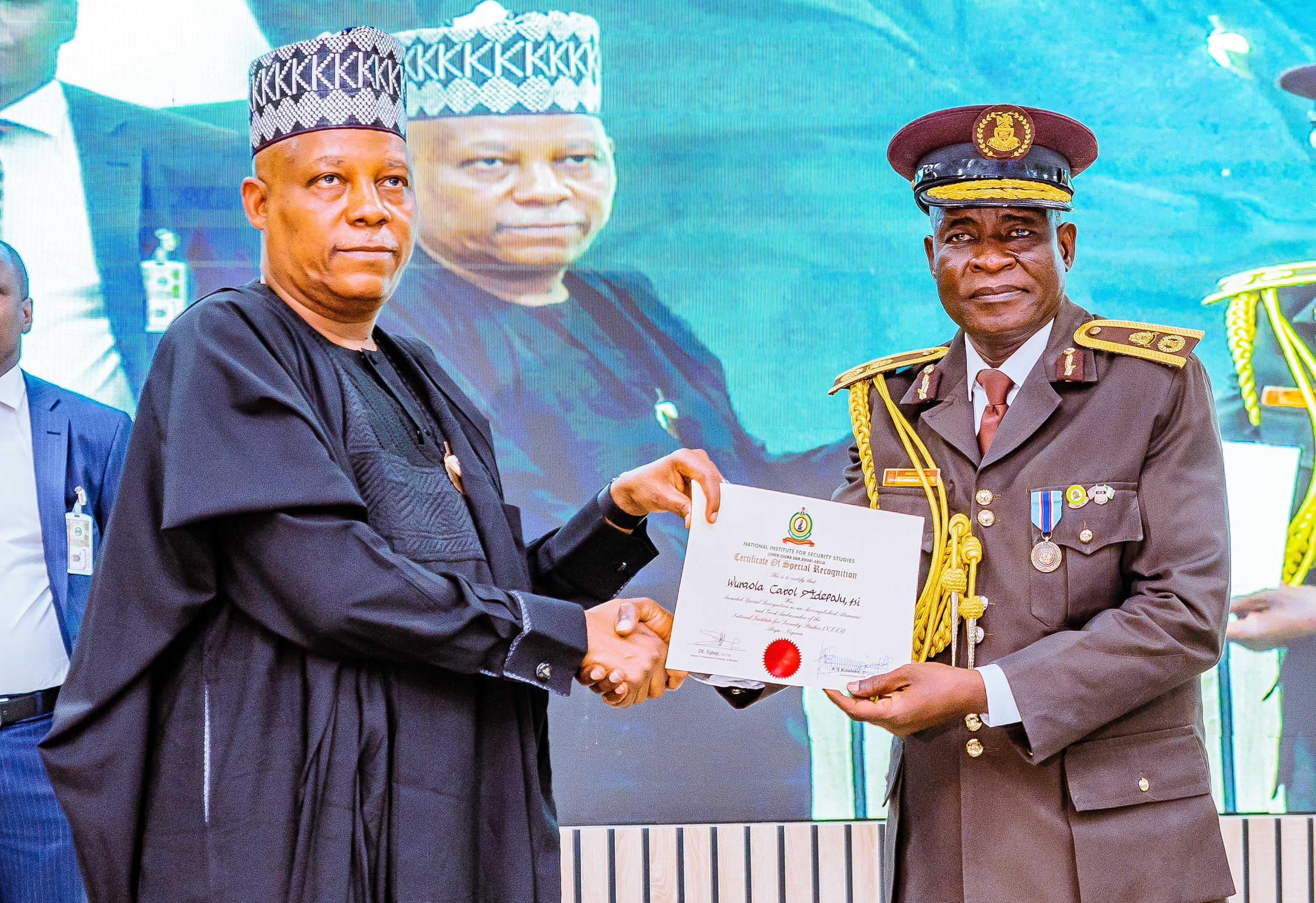
VP SHETTIMA AT NISS GRADUATION CEREMONY: ‘We Must Form Global Alliances To End External Aggressions, Domestic Threats’
- Urges graduands to move against transnational crime, terrorism, others
By: Our Reporter
The Vice President, Sen. Kashim Shettima, has drawn attention to the need for Nigeria and other African countries to form global alliances to tame crises caused by external aggressions and domestic threats.
Specifically, he noted that Nigeria and other countries are saddled with the responsibility of protecting their citizens from transnational crimes, including terrorism, climate change and cyber crime, among other global crises.
The Vice President who spoke on Saturday during the graduation ceremony of the Executive Intelligence Management Course 16, 2023 of the National Institute for Security Studies (NISS) in Abuja told the graduands that they are the great minds armed with the required knowledge to combat these external aggressions and domestic threats in a bid to maintain regional stability on the continent.
Delivering his speech titled, “From Crisis to Stability: Our Shared Global Responsibility,” Sen. Shettima listed cutting-edge knowledge, transformative skills and innovative ideas such as the one acquired by graduands from NISS as necessary for Nigeria and its neighbours to protect their nations from threats within their borders and beyond.
He stated: “Every part of the world today has been working around the clock to form alliances to stop external aggressions and forge solutions to domestic threats. This practical approach is crucial to tame crises and drive stability.
“However, none of these aspirations can be realised without the stewardship of trained minds at the helm of institutions tasked with the solemn duty of making decisions to safeguard lives, defend properties, and preserve peace. This is why we are here.
“You are here because you have chosen to be the custodians of this responsibility, the torchbearers of knowledge and expertise essential for steering the course towards a safer world. Your presence here today is, without a doubt, a celebration—a celebration of the integration of strategic ideas and decisive action, the cornerstone upon which a secure and harmonious world stands poised to thrive.”
Noting that past happenings in Nigeria confirm that the country is as vulnerable as the world around it, VP Shettima said “anything that disrupts wheat production in Asia, crude oil production in the Middle East or commodity market in Africa brings consequences for the entire world.
“I have learned that this cohort, the sixteenth of the flagship program in this institution, has studied the consequences of our existence in a globalized economy on our sustainable development, and I am impressed by your ambition.
“We have found ourselves not only at the crossroads of an era where the world has become a global village, connected through an invisible web of technological advancements, economic interdependence, and social exchange but also challenged to prepare for the disruptions that come with it,” he added.
The VP reminded the graduands that the task before them is to join in the bid to address the situation, saying, “We are tasked with the responsibility of protecting our people as transnational crime, terrorism, climate change, and pandemics loom large as formidable adversaries.
“We don’t need a balance of threat theorist to remind us that these geopolitical tensions demand a collective, cohesive response. We have proven again and again that we can never be an annex of any invidious group or be held ransom by any evil ideology. We have averted descent into a war economy because of this conviction, and believe that modern warfare isn’t waged on the field alone.”
Stating that they were not only coming to help Africa manage the crises, he said the graduands also have the task of ensuring no African country is short-changed in building regional economic integration amid crisis, as well as bear the mantle of fostering regional stability.
Expressing delight with the idea that the graduands are not only Nigerians, as some of them are from neighboring countries, Sen. Shettima said, “Your role, esteemed graduates of the National Institute for Security Studies, extends far beyond the boundaries of our nation.
“You are the guardians of regional stability, the ambassadors of peace, and the architects of sustainable development across and beyond the continent. Your commitment to excellence, coupled with your unwavering determination, makes you the pillars upon which the future of our region stands.”
Earlier, Commandant of NISS, Ayodele Adeleke, explained that the Executive Management Course is aimed at producing committed managers of security, describing the graduation ceremony as a milestone in the professional development of the graduands.
He said 89 participants started the course, with six of them from African countries, but died before the end of the 10 month course, even as he later conferred the prestigious title of fellow of the security institute (Fsi) on all the graduands.
On his part, the Director General of Department of State Services (DSS), Yusuf Bichi, commended the Commandant and management of the Institute for taking the citadel of learning to greater heights.
He availed himself the opportunity provided by ceremony to admonish the people of Plateau State to eschew violence and embrace peace to give room for development.
Bichi who pledged more support for the National Institute for Security Studies expressed his commitment to improving the welfare of personnel of the Department of State Services.
Other dignitaries at the graduation ceremony were Senate President, Godswill Akpabio, represented by Chairman Senate Committee on National Security and Intelligence, Sen Shehu Umar; Minister of Foreign Affairs, Yusuf Tuggar, Minister of State Police Affairs, Imaan Suleiman Ibrahim; representatives of Jigawa and Yobe State Governors, and business mogul, Mr Femi Otedola, represented by Col Olusegun Oladuntoye (rtd).
Others are Group Chief Executive Officer NNPC, Mele Kyari; representatives of IGP, Chief of Air Staff; EFCC Chairman, Mr Ola Olukoyede; former Governor of Bauchi State, Barr Mohammed Abibakar, Ooni of Ife, HRM Oba Adeyeye Enitan Ojaja II; Dein of Agbor, Dein Keagborekuzi, and Chief Kola Karim.
VP SHETTIMA AT NISS GRADUATION CEREMONY: ‘We Must Form Global Alliances To End External Aggressions, Domestic Threats’


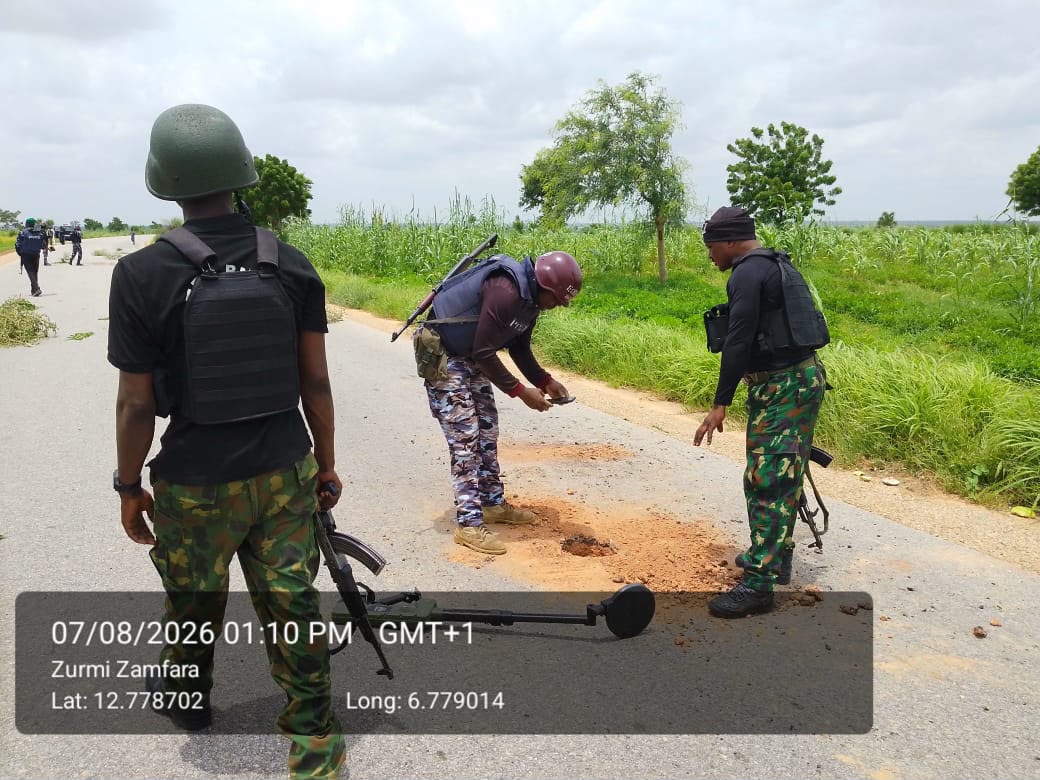
Troops, Police Recover Suspected IED, Reopen Road in Zamfara
By Zagazola Makama
Troops of Operation FANSAN YANMA and the Nigerian Police Force have safely recovered a suspected improvised explosive device (IED) planted along a road in Zurmi Local Government Area of Zamfara State.
The operation was conducted at about 1:55 p.m. on Aug. 7 by troops of CSI Battalion VI/CT 2, Joint Task Force North West Operation FANSAN YAMMA, deployed at Forward Operating Base Kaura Namoda, in conjunction with a Nigeria Police Force Explosive Ordnance Disposal (EOD) team and troops of the 1 Brigade Quick Reaction Force.

The team mobilised to Jabanda village, following a report of a suspected IED planted along the road.
According to military sources, the team located and successfully cleared the suspected explosive device.
Following the successful operation, the road was declared safe and reopened to motorists, restoring normal vehicular movement along the route.
The security forces subsequently continued their operations to ensure the safety of commuters and residents in the area.
Troops, Police Recover Suspected IED, Reopen Road in Zamfara

Law School Student Dies in Suspected Suicide at Lagos Hostel
By Zagazola Makama
A 23-year-old student of the Nigerian Law School has died in a suspected suicide incident at the school’s hostel in Victoria Island, Lagos.
The incident occurred in the early hours of Friday, Aug. 7, 2026, when the deceased, identified as Alayande Faith Ajoke, was found dead within the hostel premises.
According to sources, the Chief Matron of the Law School, Mrs. Igbokwe Juliana, reported the incident at the Victoria Island Police Division at about 6:30 a.m.
The report stated that at about 4:30 a.m., a student who had just completed her internship, Ojo Abisoye Tinuola, informed the matron about a suspected suicide involving her roommate, Alayande.
The matron subsequently proceeded to the scene, where the deceased was found lying on the ground within the hostel premises.
Preliminary observations indicated that the deceased may have jumped from the rooftop of the four-storey hostel building.
Police sources said preliminary investigation further revealed that the deceased allegedly left behind two notes addressed to her stepfather and roommate.
Following the report, a team of police detectives visited the scene, documented the area and took photographs of the scene and the body.
The remains were subsequently evacuated to the Mainland General Hospital Mortuary, Yaba, for preservation and autopsy.
The police said investigation into the circumstances surrounding the death is ongoing.
Law School Student Dies in Suspected Suicide at Lagos Hostel
News
Gov Abiodun Commends Army, Police, DSS, Others for Intelligence-led Rescue of 5 Kidnapped Poly Students, 2 Others

Breaking…
Gov Abiodun Commends Army, Police, DSS, Others for Intelligence-led Rescue of 5 Kidnapped Poly Students, 2 Others
- 5 Suspects Arrested
Governor Dapo Abiodun of Ogun State has lauded the Department of State Services (DSS), the Nigerian Army, the Nigerian Police, as well as Civil Defence Corps (NSCDC), for rescuing five kidnapped students of Gateway ICT Polytechnic, Saapade, in Remo North Local Government Area of the state.
The students, who were abducted by suspected kidnappers earlier this week, were rescued in the early hours of Friday, in an intelligence-led operation around Alamala community, off Ayetoro Road Roundabout, of the state capital. Also rescued were two non-students.
The governor described the rescue as a major breakthrough in its fight against kidnapping, even as he reaffirmed his administration’s unwavering commitment to ensuring that kidnappers and other criminal elements have no hiding place in the state.
He described the operation, which included members of the State Security Network Agency (Amotekun Corps), local vigilantes and hunters, as a demonstration of the success that can be achieved when security agencies work together.
“One of the victims sustained a gunshot injury during the incident and was immediately evacuated for medical attention. The student has since been stabilised.
“This operation is still ongoing, and I wish to assure the good people of Ogun State that our security agencies remain on the trail of every individual connected with this criminal enterprise,” said the governor.
“Our resolve is very clear. Ogun State will remain hostile to criminality and safe for every law-abiding citizen, resident and investor,” the Governor declared, stressing that
According to him, recent joint security initiatives, particularly Operation Kò S’Áyé, have demonstrated the effectiveness of intelligence sharing, inter-agency collaboration and sustained operational pressure against criminal elements.
The governor also commended President Bola Ahmed Tinubu for his administration’s commitment to combating banditry, terrorism and kidnapping across the country, noting that the recent rescue of 308 abducted victims by Nigerian security forces underscores the growing effectiveness of coordinated security operations nationwide. (Reuters)
“At this juncture, I must acknowledge the purposeful leadership of President Bola Ahmed Tinubu, whose administration has placed the restoration of peace and security at the centre of Nigeria’s development agenda through sustained investment in the operational capacity of the Armed Forces and other security agencies.
“The strengthening of intelligence coordination, the acquisition of modern security assets and his deliberate reforms have continued to deepen inter-agency collaboration,” he said.
The governor further noted that the Federal Government has continued to strengthen the nation’s security architecture, adding that the recent approval of a substantial salary increase for officers and men of the Armed Forces would further boost personnel welfare and morale.
“One of the kidnapped victims sustained a gunshot injuries during the operation and was immediately evacuated for medical attention and has since been stabilised.” disclosed a security source.
Gov Abiodun Commends Army, Police, DSS, Others for Intelligence-led Rescue of 5 Kidnapped Poly Students, 2 Others

Troops Arrest Four Armed Militia, Recover Two Pistols in Jos

Four Houses Set Ablaze in Jos Community Amid Dispute

Troops, Police Recover Suspected IED, Reopen Road in Zamfara

Roger Federer’s Shock as DNA Results Reveal Myla and Charlene Are Not His Biological Children

THE PLIGHT OF FARIDA

FAILED COUP IN BURKINA FASO: HOW TRAORÉ NARROWLY ESCAPED ASSASSINATION PLOT AMID FOREIGN INTERFERENCE CLAIMS
-
 News2 years ago
Roger Federer’s Shock as DNA Results Reveal Myla and Charlene Are Not His Biological Children
-
Opinions4 years ago
THE PLIGHT OF FARIDA
-
 News1 year ago
FAILED COUP IN BURKINA FASO: HOW TRAORÉ NARROWLY ESCAPED ASSASSINATION PLOT AMID FOREIGN INTERFERENCE CLAIMS
-

 News2 years ago
EYN: Rev. Billi, Distortion of History, and The Living Tamarind Tree
-
 Opinions5 years ago
POLICE CHARGE ROOMS, A MINTING PRESS
-

 ACADEMICS2 years ago
A History of Biu” (2015) and The Lingering Bura-Pabir Question (1)
-

 Columns2 years ago
Army University Biu: There is certain interest, but certainly not from Borno.
-

 Politics1 year ago
2027: Why Hon. Midala Balami Must Go, as Youths in Hawul and Asikira/Uba Federal Constituency Reject ₦500,000 as Sallah Gift
