News
West African Leaders Move to Deepen Regional Security Cooperation at Accra Conference

West African Leaders Move to Deepen Regional Security Cooperation at Accra Conference
By: Michael Mike
Leaders from several West African countries have agreed to pursue a new, structured approach to regional cooperation aimed at tackling terrorism, cross-border crime, and deepening insecurity across the sub-region.
The commitment was reached at the end of a two-day High-Level Consultative Conference on Regional Cooperation and Security held in Accra from January 29 to 30, 2026.
The meeting was chaired by Ghana’s President, John Dramani Mahama, with Presidents Julius Maada Bio of Sierra Leone and Joseph Boakai of Liberia leading their respective delegations.
Representatives from Burkina Faso, Mali, Mauritania, Nigeria, Senegal, and Togo also participated.

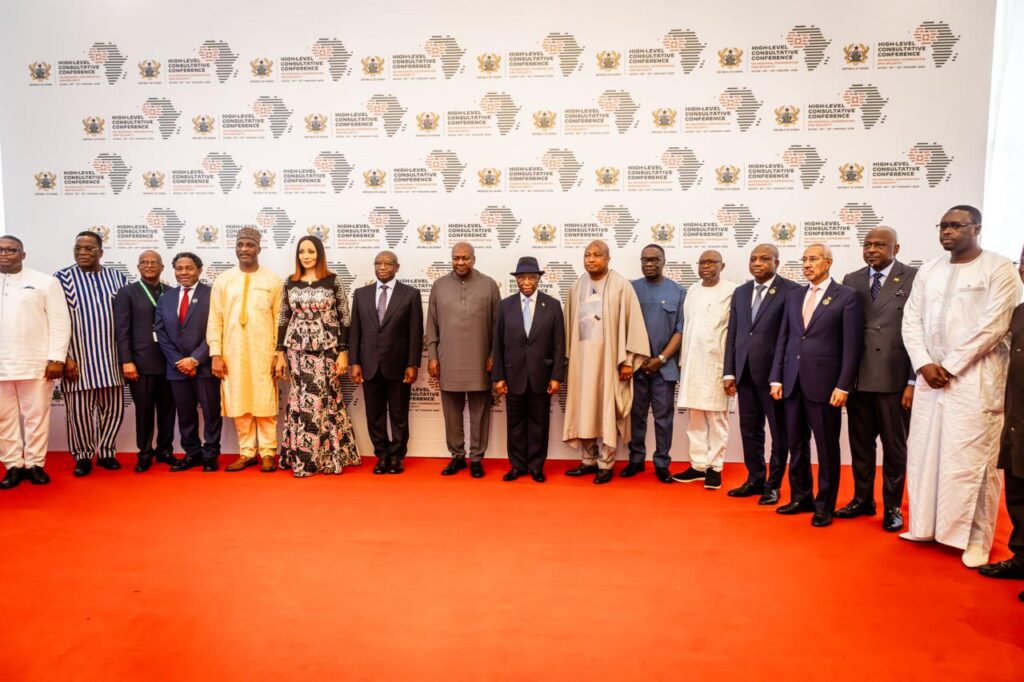
Discussions at the conference focused on the worsening security situation in West Africa, which leaders described as facing an alarming rise in terrorism and violent extremism. Participants noted that the frequency of attacks and loss of civilian lives now pose a serious threat to regional stability, economic activity, and social cohesion, making coordinated action unavoidable.
The conference followed earlier technical sessions involving Ministers of Foreign Affairs, Defence, and Security, as well as intelligence chiefs from participating states. Development partners, including the African Union Commission and the United Nations Development Programme (UNDP), alongside civil society organisations, contributed to the deliberations.
Leaders agreed that existing responses to insecurity have been too fragmented and largely reactive. As a result, the conference resolved to work toward a permanent framework for cooperation that would strengthen collective responses, improve information sharing, and address the structural drivers of insecurity across borders.
A key outcome of the meeting was a renewed emphasis on a human security approach, recognising that military measures alone cannot deliver lasting peace.
The leaders pledged to prioritise governance reforms, job creation, access to education and healthcare, and community-based peacebuilding as part of national and regional security strategies.
On counterterrorism, the conference agreed to enhance intelligence and information sharing, harmonise legal frameworks to support cross-border prosecution of terrorism-related crimes, and expand deradicalisation programmes while upholding human rights standards. Measures to combat trafficking in arms, narcotics, and persons were also highlighted.
To strengthen border security, participants committed to exploring joint operational measures, including possible “hot-pursuit” arrangements through bilateral or multilateral agreements. They further agreed to develop a foundational Memorandum of Understanding (MoU) on cooperation and security within six months, with Ghana’s Minister of Foreign Affairs tasked with leading the drafting process.
The conference also addressed humanitarian and climate-related challenges, recognising climate change as a factor that intensifies conflict and displacement. Leaders agreed to integrate climate and food security into regional peace planning and to work toward a shared disaster preparedness and humanitarian response framework.
At the close of the meeting, participants agreed to institutionalise the consultative conference as a bi-annual platform and to establish a mechanism for tracking and monitoring the implementation of agreed decisions.
The conference ended with a renewed pledge by regional leaders to translate commitments into concrete actions that safeguard lives, protect livelihoods, and strengthen stability across West Africa.
Nigeria’s Minister of State for Foreign Affairs, Ambassador Bianca Odumegwu-Ojukwu led the country’s delegation to the meeting.
West African Leaders Move to Deepen Regional Security Cooperation at Accra Conference