Politics
Yobe 2027: Consensus, G-Six, and the Crucible of Direct Primaries

Yobe 2027: Consensus, G-Six, and the Crucible of Direct Primaries
By: Dr. James Bwala
The political landscape in Yobe State is presently a microcosm of the broader democratic challenges Nigeria faces. As the All Progressives Congress (APC) prepares for its gubernatorial primaries slated for May 23, 2027, tensions and divisions within the party have laid bare the complexities of internal party democracy. Central to this unfolding drama is the interplay between the principle of consensus, the influential G-six faction, and the imminent test of direct primaries. The recent intervention of Vice President Senator Kashim Shettima, which culminated in Alhaji Lawan Kolo Geidam stepping down for the party’s anointed candidate Alhaji Baba Malam Wali, marked a pivotal moment. Yet, beneath this surface reconciliation lies a fraught path that could significantly influence not only the immediate future of Yobe politics but also the democratic ethos of the APC as a whole.
At the heart of the Yobe episode is the practice of consensus candidates, a mechanism often employed by Nigerian political parties to present united fronts during elections. Proponents argue that consensus preempts protracted primary battles, preserves party unity, and channels resources toward winning general elections. In Yobe, Mala Buni’s endorsement of Baba Malam Wali as the consensus candidate was intended to consolidate the APC’s strength and sideline factional rifts. However, the arrival of the G-six, a formidable bloc that includes stalwarts such as Alhaji Lawan Kolo Geidam and is backed by other significant figures like Senator Muhammed Bomai, Hon. Bashir Sheriff Machina, former IGP Usman Alkali Baba, and business mogul Kashim Musa Tumsa, contested this top-down approach. Their resistance underscored a growing restiveness against predetermined candidacies perceived as exclusionary or undemocratic.
READ ALSO: https://newsng.ng/2027-the-dynamics-of-consensus-candidates-and-the-crisis-of-succession-in-nigerias-democratic-party-politics/
This tension spotlights a crucial debate in Nigerian party politics: does consensus undermine or enhance democracy? Critics of consensus argue that it often amounts to imposed candidacies, which stifle intra-party competition and disenfranchise grassroots members who seek genuine participation through voting. This critique holds substantive weight, especially in a polity where internal democracy remains nascent, and many party decisions are heavily influenced by kingmakers or political godfathers rather than transparent processes. On the other hand, given Nigeria’s often fractious and ethnically charged political environment, consensus is sometimes defended as a pragmatic tool for avoiding bitter contests that can fracture party cohesiveness and harm electoral chances.


In Yobe’s context, the G-six’s initial refusal to accept the consensus candidate, culminating in the last-minute withdrawal of Lawan Kolo Geidam after Vice President Shettima’s peace intervention, embodies the high stakes and emotional entanglements involved. The VP’s role in mediating the dispute was critical; his call for peace and collective support symbolized the necessity of compromise in the intricate dance of Nigerian politics. It also affirmed the reality that behind factional disagreements lie broader strategic interests, including the desire to present a united front against opposition parties in the general elections. Nonetheless, this peace is uneasy and fragile, as evidenced by lingering frustrations from supporters of other aspirants like Engr. Mustapha Yunusa Maihaja, IGP Usman Alkali Baba (RTD), Senator Muhammed Bomai, Hon. Machina, and Kashim Musa Tulsa, whose exclusion from the anointed consensus stirs sentiments of betrayal.
READ ALSO: https://newsng.ng/2027-the-dynamics-of-consensus-candidates-and-the-crisis-of-succession-in-nigerias-democratic-party-politics/
The impending direct primaries scheduled for May 23 now stand as a critical litmus test for the APC in Yobe. Unlike consensus, direct primaries offer an avenue for party members at all levels to exercise their franchise openly, potentially reinvigorating democratic norms within the party. If conducted transparently and fairly, the primaries could serve as an opportunity to heal divisions by granting legitimacy to the selected candidate, whether it remains the consensus choice or surfaces from the ranks of contesting aspirants. Moreover, it aligns with democratic ideals where leaders emerge through participatory mechanisms rather than prearranged accords. Such a process could also recalibrate power dynamics within the APC, empowering grassroots actors and ensuring accountability.

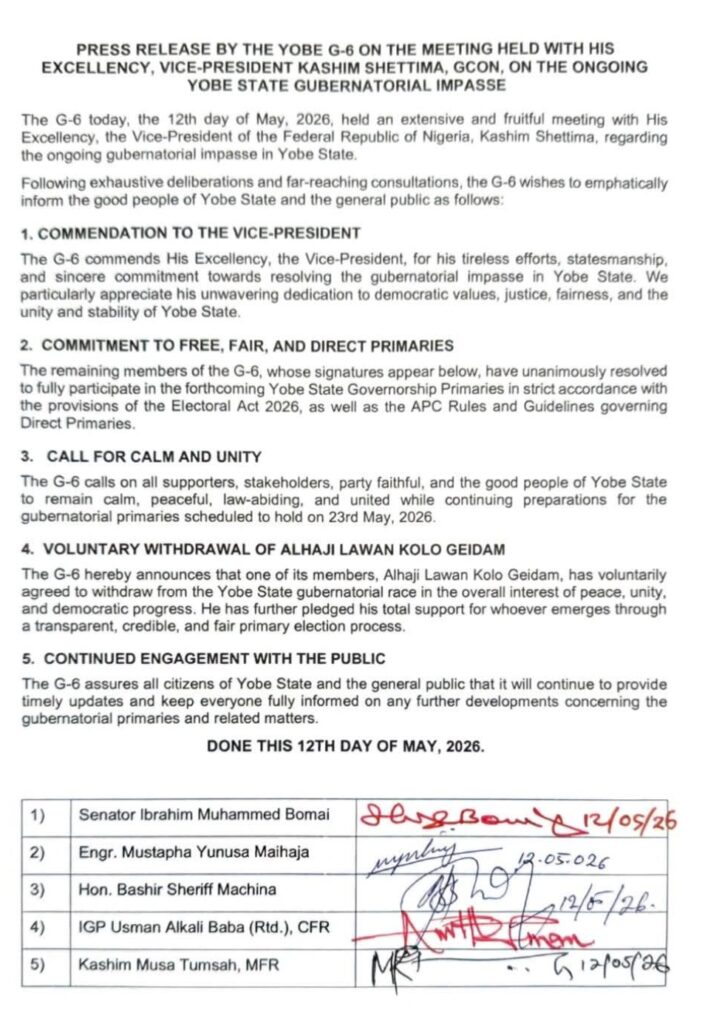
However, the primaries could equally exacerbate existing fissures if marred by manipulation or violence, thus deepening mistrust among competing camps. The risk of rancor and post-primary agitations is significant given the emotional investment of various supporter groups. For Governor Mai Mala Buni, whose political capital and future influence in Yobe heavily depend on the outcome and spirit of the primaries, this is a defining moment. Should the process be seen as credible and inclusive, it will enhance his standing as a unifying figure championing democratic values. Conversely, perceptions of imposition or electoral malpractice could erode his legitimacy and weaken his leadership not just within Yobe, but more broadly within the APC’s national framework.
READ ALSO: https://newsng.ng/2027-the-dynamics-of-consensus-candidates-and-the-crisis-of-succession-in-nigerias-democratic-party-politics/
Beyond the immediate political calculus, the Yobe experience offers instructive lessons for Nigerian democracy. The oscillation between consensus and direct primaries reflects tensions inherent in balancing party unity with democratic participation. While consensus may sometimes be expedient, it should not become a veil for autocratic decision-making that disenfranchises party members. Conversely, direct primaries, while aspirationally democratic, demand rigorous safeguards against abuse to fulfill their promise. The integrity of these processes and the willingness of party leaders to embrace transparency ultimately determine whether democracy is deepened or diluted.
To navigate these challenges effectively, the APC and other parties must institutionalize internal democracy by codifying transparent rules that govern consensus arrangements and primary elections. Political stakeholders, including influential figures like Governor Buni, bear responsibility to model democratic conduct, promote inclusion, and respect dissenting voices. Additionally, civil society and electoral bodies should engage actively to monitor primaries and advocate for fairness, reinforcing public confidence in party processes.
READ ALSO: https://newsng.ng/2027-the-dynamics-of-consensus-candidates-and-the-crisis-of-succession-in-nigerias-democratic-party-politics/
The saga of ‘Yobe 2027’ encapsulates a critical juncture for the APC and Nigerian politics at large. The convergence of consensus candidacy, the assertive G-six faction, and the pending direct primaries embodies the perennial struggle between entrenched political practices and the aspiration for genuine democracy. While the recent peace brokered by the vice president is commendable, it is the conduct and outcome of the May 3 primaries that will truly test the party’s commitment to democratic ideals.
The choices made in Yobe will resonate beyond state borders, shaping narratives around political inclusivity, leadership legitimacy, and democratic consolidation in Nigeria’s evolving political landscape. For democracy to flourish, political actors must transcend narrow interests, embrace transparency, and commit to the principle that leadership derives from the will of the many, not the dictates of the few. Only then can Yobe’s political future—and indeed Nigeria’s—be assured of progress, stability, and genuine representation.
* James Bwala, PhD, writes from Abuja
Yobe 2027: Consensus, G-Six, and the Crucible of Direct Primaries