
News
Zulum Presents N584.76 billion Appropriation Bill for 2025 Fiscal Year


Zulum Presents N584.76 billion Appropriation Bill for 2025 Fiscal Year
By: Michael Mike
Borno State Governor, Professor Babagana Zulum on Monday presented an appropriation bill of ₦584.76 billion to the state House of Assembly for 2025 fiscal year.
The bill tagged: “Budget of Recovery and Continuity,” gives priority to health, education, and economic recovery, including critical investments in security, infrastructure, and social services.
The governor, while presenting the bill on the floor of the State House of Assembly, explained that it comprised a Capital Expenditure of ₦380.84 billion and a Recurrent Expenditure of ₦203.92 billion
Zulum disclosed that the proposed budget will be financed through Recurrent Revenue from Federation Allocation Account of ₦311.7 billion, Internally Generated Revenue (IGR) of ₦30.09 billion, and Capital Receipts of ₦237.96 billion.
He noted that the health sector will receive significant allocation, with ₦89.97 billion, representing 15.39% of the total budget and would fund projects such as the construction of an Orthopaedic Hospital in Maiduguri, establishment of General Hospitals in various local government areas, and rehabilitation of hospitals in Baga and Mulai.
The education sector would be allocated he ₦69.81 billion for projects, including the establishment of modern schools and rehabilitation of facilities in 50 schools across the state.
He said to address food insecurity, ₦10 billion has been allocated for procurement of food items, cultivation of 100,000 hectares for rain-fed farming, and 50,000 hectares for irrigation. Additionally, ₦22 billion has been set aside for victim support and reconstruction of damaged infrastructure.
The governor noted that other priority projects in the 2025 budget include the establishment of Maiduguri Dry Port, dualization of the Maiduguri-Biu Road, and modernization of Borno Radio and Television (BRTV).
Zulum reaffirmed his administration’s dedication to addressing key challenges, including clearing the backlog of pensions and gratuities and implementing the ₦72,000 minimum wage for civil servants and teachers.
He appealed to members of the House of Assembly to expedite passage of the proposed budget, insisting that it is with cooperation, support, and understanding that the state can be great again.
He said: “We recognize that our success hinges on this partnership, which will drive sustainable growth, enhance public services, and ensure that no one is left behind.”
Meanwhile, the Speaker of Borno State House of Assembly, Abdulkarim Lawan, commended the governor for the resettlement of victims of Boko Haram insurgency, while acknowledging the cordial working relationship between the legislature and the executive arms.
Zulum Presents N584.76 billion Appropriation Bill for 2025 Fiscal Year


Farmers in Gombe urge FG to revive NAGS-AP
Farmers in Gombe State have appealed to the Federal Government to revive the National Agricultural Growth Scheme–Agro-Pocket (NAGS-AP) programme.
According to the farmers, the programme is a strategic instrument for supporting farmers and strengthening the agricultural value chain.
Alhaji Modibbo Ahmad, the Chairman, All Farmers’ Association of Nigeria (AFAN), Gombe State chapter, made the appeal on Monday in a statement.
‘’It has become imperative because many farmers are already struggling with rising production costs, uncertain rainfall, pest outbreaks, fluctuating produce prices and the financial risks associated with cultivation.
‘’Nigeria needs the NAGS-AP as an agricultural intervention that works for farmers in practical terms, strengthens local input distribution networks, and produces measurable results in food production, ‘’ he said.
He said that the NAGS-AP’s agricultural input support and distribution approach offered a framework through which government assistance reached farmers while engaging agro-dealers and other stakeholders in the input supply chain.
‘’The Federal Government should, therefore, review the programme’s previous implementation, identify its strengths and weaknesses, address any shortcomings and establish a clear framework for its effective continuation.
‘’The objective should be to ensure that public resources translate into tangible benefits for Nigerian farmers, ‘’ the chairman said.
Ahmad said that reviving NAGS-AP would strengthen food security, increase agricultural productivity, create employment and reduce the cost of living.
He, therefore, called on the Federal Government to place the future of NAGS-AP on its agricultural policy agenda.
‘’The government should also engage relevant stakeholders and take evidence-based action towards a sustainable and effective agricultural input support system, ‘’ he said.
Ahmad said that the experiences of farmers and input distributors should inform policy decisions.
He said, therefore, a structured consultation would help the government determine whether NAGS-AP should be restored in its previous form.
‘’It will also help determine whether the programme is reformed to address identified weaknesses or integrated into a broader national agricultural input support strategy.
“If NAGS-AP is revived, the government should ensure that participating agro-dealers and suppliers are selected through transparent procedures.
‘’The government should also ensure that they receive clear operational guidelines and are paid promptly for verified supplies delivered under approved programme arrangements,” he said.
The chairman said also that reviving the NAGS-AP would help boost dry season farming.
He stressed that Nigeria’s agricultural development strategy must recognise the enormous opportunities offered by dry-season farming, particularly in crops such as wheat and rice.
According to him, dry-season agriculture can contribute to increased domestic food production and reduce the country’s vulnerability to seasonal shortages.
‘’This can be possible with appropriate irrigation facilities, improved seeds, fertilisers, technical support and reliable market access, ‘’ he said.
He said, however, that farmers who participated in dry-season production needed timely access to inputs as delayed support could cause them to miss critical planting windows.
That, he said, could reduce the potential benefits of an entire production cycle.
The News Agency of Nigeria (NAN) reports that the NAGS-AP is a federal scheme that gives farmers growing maize, rice, cassava, sorghum, soybean or wheat subsidised seed, fertiliser and other inputs.
It also gives advice from extension agents, so the farmers can grow more food and cut Nigeria’s food-import bill.
Farmers in Gombe urge FG to revive NAGS-AP
Femicide: NHRC, AU Rights Envoy Mount Pressure on Nigeria to Ratify Convention
…As envoy demands 15-country push to bring treaty into force, seeks reserved parliamentary seats for women ahead of 2027 elections
By: Michael Mike
The National Human Rights Commission (NHRC) and the African Commission on Human and Peoples’ Rights have stepped up pressure on Nigeria to ratify the African Union Convention on Ending Violence Against Women and Girls, amid growing concerns over femicide, sexual violence and the increasing use of digital platforms to intimidate women.
The push, which comes ahead of the 2027 general elections, also includes demands for affirmative action and reserved seats for women in parliament to address persistent barriers to their political representation.
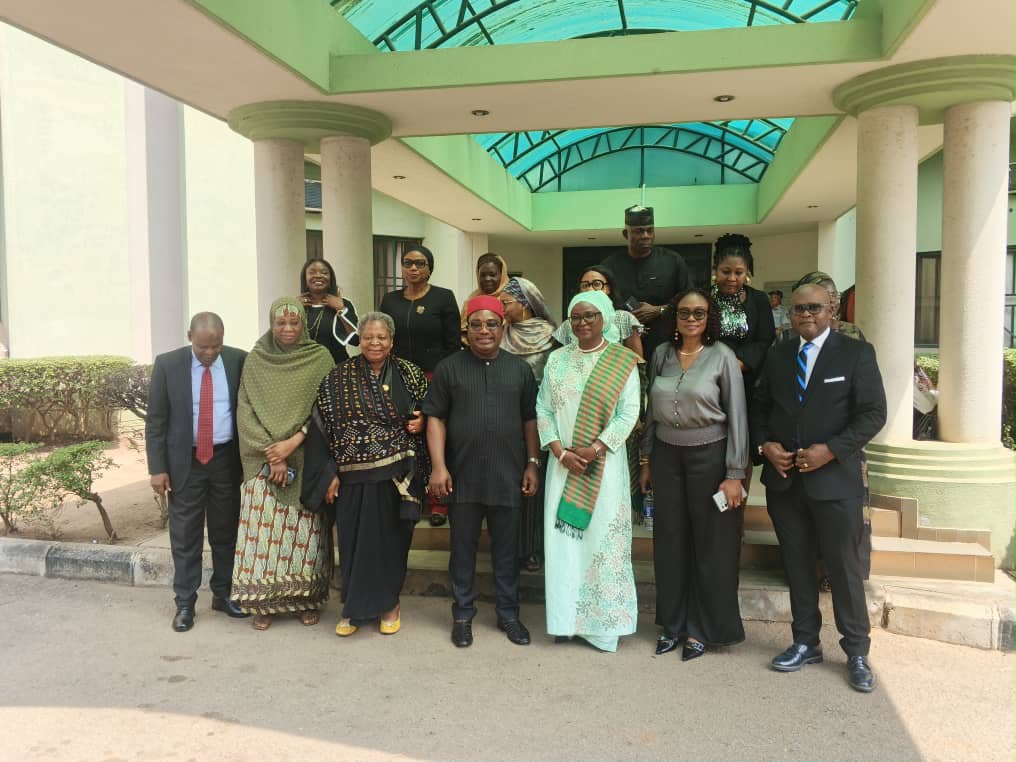
The Executive Secretary of the NHRC, Tony Ojukwu, gave the commitment during an advocacy meeting with the African Commission’s Special Rapporteur on the Rights of Women in Africa, Hon. Janet Ramatoulie Sallah-Njie, at the commission’s headquarters.
The proposed ratification would commit Nigeria to a stronger regional framework for preventing and addressing violence against women and girls, including femicide, while strengthening accountability and protection mechanisms.
Ojukwu said the NHRC would mobilise civil society organisations and other stakeholders to intensify advocacy for Nigeria’s adoption and ratification of the instrument, assuring that the commission would pursue concrete actions rather than allow the engagement to end with expressions of commitment.
He said observations by the African Commission on Nigeria’s human rights reports had highlighted troubling developments, particularly femicide and technology-facilitated violence against women, requiring stronger legislative, institutional and enforcement responses.
The NHRC boss said the commission would also work with relevant institutions to improve access to justice for victims of gender-based violence and ensure that recommendations from the African Commission were implemented.
The urgency of the campaign was underscored by Sallah-Njie, who challenged Nigeria to use its continental influence to help secure the entry into force of the convention by becoming one of the 15 countries required to facilitate its implementation.
She disclosed that the African Union adopted the convention in February 2025, describing it as a significant addition to existing continental human rights protections because of its response to emerging forms of violence against women and girls.
According to her, Nigeria’s ratification would demonstrate its commitment to protecting women and girls while strengthening the continent’s collective response to gender-based violence.
She expressed concern over femicide in Nigeria, alongside developments in Cameroon and South Africa, and called on the NHRC to champion the ratification campaign, prepare relevant national reports and monitor the implementation of laws protecting women and girls.
Sallah-Njie particularly highlighted the importance of the convention’s explicit recognition and prohibition of femicide, arguing that stronger legal recognition was necessary to confront the killing of women because of their gender.
But beyond the ratification campaign, the visiting envoy raised another major concern: the exclusion of women from political decision-making and the violence increasingly accompanying their participation in electoral activities.
With the 2027 elections approaching, she called for temporary special measures, including affirmative action and reserved seats for women in parliament, arguing that granting women the right to contest elections was insufficient without measures to overcome structural and socio-cultural disadvantages.
She said women continued to face barriers that prevented them from competing on equal terms with men, insisting that deliberate interventions were necessary to translate formal political rights into meaningful representation.
The Special Rapporteur urged Nigerian women to scrutinise the voting records of their representatives on legislation affecting women’s rights and hold them accountable, while encouraging more women to contest elective positions.
She also warned that attacks, intimidation and victimisation of women pursuing political ambitions could discourage others from seeking public office.
Of particular concern, she identified election-related sexual violence, harassment and technology-facilitated abuse as threats capable of pushing women out of the political space.
She urged the NHRC and other relevant authorities to monitor such violations and establish preventive mechanisms to ensure that women could campaign, vote and contest elections without fear of violence or discrimination.
Sallah-Njie further called for women’s inclusion in peacebuilding and conflict-resolution processes, maintaining that decisions on security and the future of communities must not exclude half of the population.
Responding to the concerns, Ojukwu disclosed that the NHRC had established thematic departments, including a dedicated Department of Women and Children, to strengthen its response to violations affecting vulnerable groups.
He said the restructuring was intended to provide specialised attention to human rights concerns rather than rely solely on a general institutional approach.
He also highlighted the commission’s collaboration with the African Commission, noting that regional resolutions and recommendations were important in strengthening Nigeria’s human rights protection framework.
The NHRC, he added, had linked its website with that of the African Commission to make relevant human rights instruments, resolutions and recommendations more accessible to Nigerians seeking information and remedies.
The Executive Director of Baobab for Women’s Human Rights, Yèyé Bunmi Dipo-Salami, supported the call for affirmative action, recalling previous advocacy for special seats for women in the National Assembly.
She said the proposal had faced resistance from some lawmakers who argued that reserving seats for women would discriminate against men.
Dipo-Salami, however, maintained that affirmative action was an internationally recognised mechanism for addressing historical inequalities and ensuring meaningful representation of disadvantaged groups.
She commended the NHRC for creating specialised departments and providing leadership opportunities for women, while pledging civil society support for efforts to advance gender equality.
The delegation also included representatives of the Women’s Advocacy Research and Documentation Centre (WARDC), among other stakeholders.
Sallah-Njie said she would report the outcome of the engagement in her next intersessional report to the African human rights community, expressing hope that Nigeria would demonstrate measurable progress in ratifying and implementing the convention.
She said tangible action by Nigeria would strengthen the continent’s efforts to end violence against women and girls.
Femicide: NHRC, AU Rights Envoy Mount Pressure on Nigeria to Ratify Convention

UMTH: CMD visits NEDC seeks more healthcare intervention
By: Our Reporter
As part of measures to further strengthen existing cordial relationship between the University of Maiduguri Teaching Hospital and the North East Development Commission NEDC, the New Chief Medical Director Professor Faruk Buba incompany of Top Management Committee of the hospital paid a courtesy visit to Managing Director/ CEO of NEDC Dr. Mohammed Goni Alkali at the Commission’s head office In Maiduguri.
Professor Faruk Buba recounted on the giant strides in healthcare interventions done to the hospital by the NEDC which cut across establishment of the Burns Centre, provision of steady water supply through drilling of boreholes, procurement and installation of High-tech Magnetic Resonance Imaging also known as MRI, High-efficiency generators as well as the recent establishment of Fertility Care Centre and en-suite maternity complex among others.
These and many more he said have contributed immensely to being the largest Hospital in Nigeria and longstanding Centre of Excellence in Immunology and Infectious Diseases.
The Chief Medical Director further solicited more interventions from the Commission especially in procurement of more up-to-date equipment to enhance the hospital capacity in healthcare service delivery to the teaming population of Borno state, the North East region, Nigeria and Beyond.
Responding, MD/CEO North East Development Dr. Mohammed Goni Alkali said the University of Maiduguri Teaching Hospital has been a partner in progress adding that UMTH has played critical roles in extending the Commission’s numerous life-touching interventions for the people in the region one of which is provision of accessible and affordable healthcare service delivery.
Dr. Alkali revealed that large consignments of Healthcare equipment are en-route to the region and as always, Tertiary Health institutions like the UMTH will be given priority consideration.
Meanwhile, the Chief Medical Director alongside top management Committee had paid condolences visit to Medical Director, Hospitals Management Board Borno state Professor Abubakar Kullima over the demise of his sister and offered prayers for the grieving families.
UMTH: CMD visits NEDC seeks more healthcare intervention

Building Beyond His Tenure: Why Zulum’s Transformative Footprints Will Outlive His Government

Farmers in Gombe urge FG to revive NAGS-AP

Femicide: NHRC, AU Rights Envoy Mount Pressure on Nigeria to Ratify Convention

Roger Federer’s Shock as DNA Results Reveal Myla and Charlene Are Not His Biological Children

THE PLIGHT OF FARIDA

FAILED COUP IN BURKINA FASO: HOW TRAORÉ NARROWLY ESCAPED ASSASSINATION PLOT AMID FOREIGN INTERFERENCE CLAIMS
-
 News3 years ago
Roger Federer’s Shock as DNA Results Reveal Myla and Charlene Are Not His Biological Children
-
Opinions5 years ago
THE PLIGHT OF FARIDA
-
 News2 years ago
FAILED COUP IN BURKINA FASO: HOW TRAORÉ NARROWLY ESCAPED ASSASSINATION PLOT AMID FOREIGN INTERFERENCE CLAIMS
-
 Opinions5 years ago
POLICE CHARGE ROOMS, A MINTING PRESS
-

 News3 years ago
EYN: Rev. Billi, Distortion of History, and The Living Tamarind Tree
-

 ACADEMICS3 years ago
A History of Biu” (2015) and The Lingering Bura-Pabir Question (1)
-

 Columns3 years ago
Army University Biu: There is certain interest, but certainly not from Borno.
-

 Politics1 year ago
2027: Why Hon. Midala Balami Must Go, as Youths in Hawul and Asikira/Uba Federal Constituency Reject ₦500,000 as Sallah Gift
