
Uncategorized
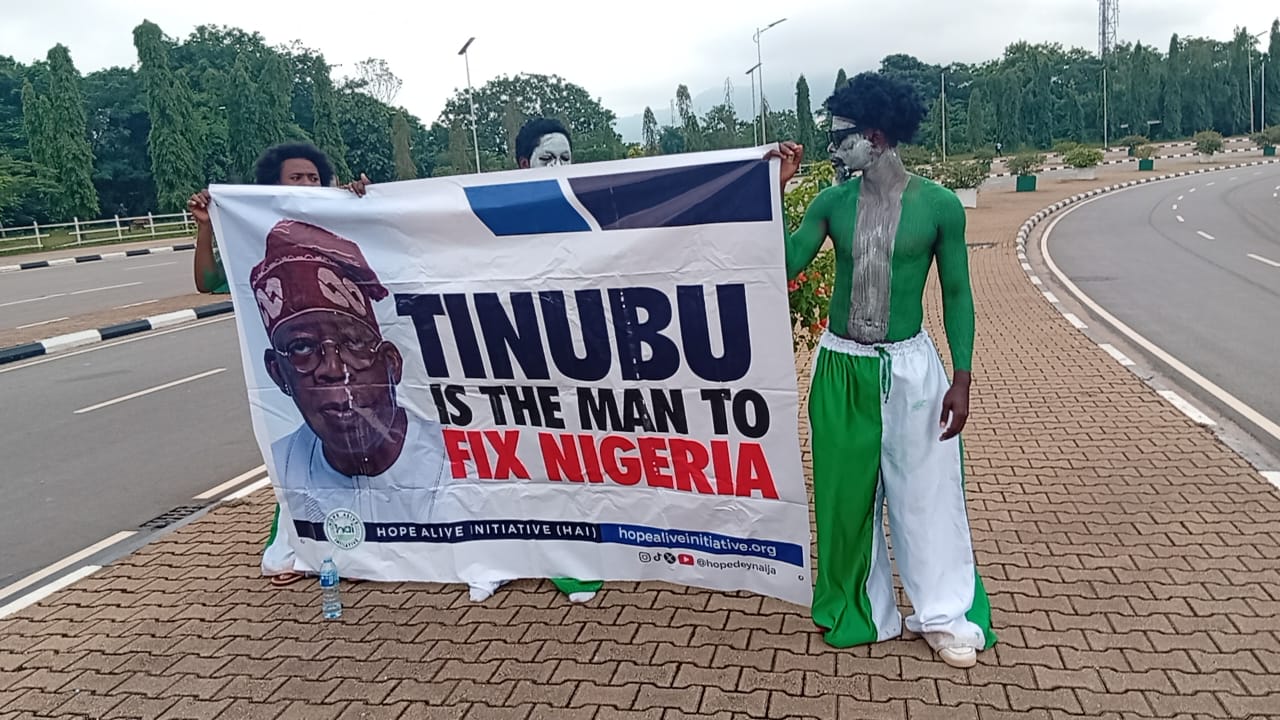
2027: Group Takes Tinubu Re-election Campaign to Abuja Streets

2027: Group Takes Tinubu Re-election Campaign to Abuja Streets
By: Michael Mike
The 2027 presidential election campaign took an early turn towards grassroots mobilisation in Abuja on Wednesday as the Hope Alive Initiative (HAI) deployed about 40 giant, colourful human mascots across strategic locations in the Federal Capital Territory to promote President Bola Ahmed Tinubu’s re-election bid.
The unusual street activation, which marked the opening phase of HAI’s multi-platform campaign, saw the mascots deployed around major roundabouts, markets, motor parks and other busy areas, drawing the attention of motorists, commuters and residents.
Carrying banners and campaign messages, the mascots moved through parts of the capital as HAI sought to take its pro-Tinubu message beyond conventional political gatherings and directly into public spaces.
The initiative is the first phase of a broader campaign that will combine physical mobilisation with digital and traditional media, including a city-wide SMS campaign, a weekly Pidgin-language radio programme and an original campaign jingle.

In a statement signed by its Director of Press and Communications, Ernest Omoarelojie, HAI said it decided to support Tinubu’s re-election based on what it described as the administration’s “bold reforms and initiatives” aimed at repositioning the Nigerian economy and strengthening national institutions.
The organisation listed reforms in the petroleum sector, developments in the foreign exchange market, increased government revenue and foreign reserves, moves towards greater Local Government autonomy, police and internal security reforms, the Nigerian Education Loan Fund (NELFUND), tax reforms and major road projects among the areas it believes should inform the 2027 electoral debate.
“While these reforms have come with short-term challenges, we believe they are difficult but necessary steps towards a more sustainable, prosperous and better governed Nigeria,” the organisation said.
Omoarelojie, who spoke during the street mobilisation, said the group was deliberately adopting a grassroots approach to ensure that its message reached Nigerians outside traditional political structures.
“We are asking Nigerians to look beyond sentiment. Let us look at the facts as they are,” he said.
According to him, citizens should assess the administration on the basis of its policies, programmes and measurable outcomes rather than political sentiments.
He cited the student loan scheme, economic reforms, foreign exchange management and infrastructure development as areas in which HAI believes the administration has made significant progress.
The organisation acknowledged that some of the government’s reforms had imposed short-term economic difficulties on citizens but argued that their long-term benefits would depend on sustained implementation.
HAI’s campaign will also deploy SMS messaging as a direct communication channel to residents across Abuja.
The organisation said the digital mobilisation would constitute the first stage of a wider communication strategy designed to expand as the 2027 election approaches.
Another major component of the campaign is a weekly Pidgin-language radio programme titled Wetin Tinubu Don Do Sef, designed to explain government policies and programmes in language accessible to a broad section of Nigerians.
According to HAI, each episode will concentrate on a specific policy area, examine its impact and explain how citizens could benefit from relevant government initiatives.
The programme is expected to feature a presenter alongside guests or co-hosts, with expert perspectives, citizen contributions and practical examples incorporated into discussions.
HAI said the programme would subsequently be syndicated on selected radio stations across the country as the campaign expands.
The organisation is also preparing an original campaign jingle intended to give the mobilisation effort a distinct identity and reinforce its political message across radio and other platforms.
HAI said the jingle draws inspiration from the tradition of memorable Nigerian political campaign songs, including the famous Hope ’93 campaign associated with the late businessman and politician, Chief M.K.O. Abiola.
The organisation said its August 19 street activation was only the beginning of a sustained campaign that would combine grassroots mobilisation, traditional broadcasting, digital communication and public engagement.
Subsequent phases will focus on explaining government policies and programmes in the economy, education, security and infrastructure sectors, with particular emphasis on NELFUND, economic reforms, security initiatives and road projects.
Omoarelojie said the 2027 election would offer Nigerians an opportunity to examine the country’s direction and decide whether the Tinubu administration had earned another mandate.
He urged voters to engage with the issues and judge the administration by its record, policies and their effects on citizens rather than political rhetoric.
With its deployment of human mascots, SMS mobilisation, Pidgin broadcasting and campaign music, HAI’s Abuja activation signals an effort to give the Tinubu re-election campaign a distinctly grassroots character long before the 2027 presidential contest reaches its peak.
2027: Group Takes Tinubu Re-election Campaign to Abuja Streets



Troops arrest three Fulani men in Plateau after farmer’s killing
By: Zagazola Makama
Troops of Sector 6, Operation ENDURING PEACE (OPEP), have arrested three persons during a raid on two Fulani settlements in Bachi community, Riyom Local Government Area of Plateau State.
The operation, conducted on Sept. 13, 2026, followed a manhunt for criminal elements responsible for the killing of a farmer at Fang community in Riyom LGA on Sept. 12.
During the raid at Baggat and Shong 2 Fulani hamlets, troops arrested three residents identified as Anas Usman, Nuhu Mohammad and Haruna Ahmed.
Security sources said the three suspects are not necessarily the perpetrators of the killing, but their arrest is part of efforts to mount pressure on local Fulani leaders to assist security agencies in identifying and producing those responsible for the crime.
The suspects are currently in custody for further investigation and intelligence exploitation.
Troops arrest three Fulani men in Plateau after farmer’s killing
Uncategorized
Talata Mafara Attack: ISN Demands Intelligence Overhaul, Special Courts to Crush Banditry

Talata Mafara Attack: ISN Demands Intelligence Overhaul, Special Courts to Crush Banditry
The Institute of Security, Nigeria (ISN) has called for a fundamental overhaul of Nigeria’s approach to terrorism, banditry and kidnapping, warning that criminal groups are becoming increasingly organised and capable of challenging the authority of the state.
The institute made the call while reacting to the reported invasion of Talata Mafara market in Zamfara State, where non-state actors allegedly imposed a ₦50 million levy and demanded 100 livestock, giving residents a seven-day ultimatum.
The ISN said the development exposed the need for security agencies to move beyond reactive operations and adopt stronger intelligence-led strategies capable of identifying and dismantling criminal networks before they launch attacks.
In a statement signed by its Deputy President and Chief Executive Officer, Barr. Adebayo Akinade, the institute said the activities of terrorists and bandits were no longer limited to isolated attacks but increasingly involved the control of economic activities, collection of illegal levies and disruption of legitimate livelihoods.
It warned that such activities could gradually establish a parallel system of criminal authority in affected communities if left unchecked.
The institute consequently urged the Federal and state governments to establish a coordinated security framework bringing together federal security agencies, state security outfits and vetted community guards.
It also called for the creation of a National Security Fusion Centre, supported by state-level fusion desks, to facilitate real-time intelligence sharing and faster responses to emerging threats.
According to the ISN, security agencies should penetrate criminal networks operating around markets, cattle-rustling routes and illicit livestock value chains while targeting the logistics and financial structures sustaining banditry.
It recommended regulated livestock markets and improved tracking systems to prevent stolen cattle from being absorbed into legitimate commercial channels.
The institute further proposed special courts for terrorism, kidnapping and banditry cases, arguing that a faster judicial process would strengthen the fight against organised criminal groups.
It urged the government to deploy modern technologies, including forest geo-fencing, livestock tracking, drones and citizen-reporting platforms, alongside improved tactical mobility and air surveillance.
The ISN also called for a two-hour rapid-response mechanism in vulnerable areas and increased investment in night-vision equipment and other specialised capabilities.
Beyond security operations, the institute advocated stronger community-based early-warning systems and local peace and security forums involving traditional rulers, farmers, market unions, faith organisations and civil society groups.
It urged citizens to report threats rather than surrendering to ransom and illegal levy demands, while encouraging communities to document attacks and preserve evidence for investigations and prosecution.
The institute said professional training in terrorism studies, intelligence management and counter-banditry operations should be strengthened as part of efforts to build a more effective national security architecture.
The ISN reaffirmed its readiness to support government and security agencies through research, training, policy advisory services and professional certification, saying a coordinated response was essential to restoring public confidence and protecting national development.
Talata Mafara Attack: ISN Demands Intelligence Overhaul, Special Courts to Crush Banditry
Uncategorized
2026 Peace and Dialogue Awards: IPCR, Ufuk Foundation Call for Collective Investment in Peace

2026 Peace and Dialogue Awards: IPCR, Ufuk Foundation Call for Collective Investment in Peace
By: Michael Mike

The Director-General of the Institute for Peace and Conflict Resolution (IPCR), Dr. Joseph Ochogwu, has called on governments, businesses, civil society organisations, religious and traditional institutions, communities and individuals to invest deliberately in peacebuilding, warning that the cost of conflict far exceeds the resources required to prevent it.
Ochogwu made the call on Thursday, September 10, 2026, while delivering a lecture titled “Investing in Peace: A Collective Responsibility for Everyone” at the 2026 Peace and Dialogue Awards organised by the Ufuk Dialogue Foundation Nigeria in collaboration with the IPCR in Abuja.

He said the awards should go beyond recognising individuals and organisations contributing to peacebuilding, stressing that Nigeria must begin to treat peace as an investment requiring consistent resources, planning and accountability.
According to Ochogwu, global military expenditure exceeded $2.4 trillion in 2024, while peacebuilding expenditure remained below $60 billion, representing about 2.5 per cent of military spending.

He questioned why trillions of dollars could be mobilised for conflict and military expenditure while significantly smaller amounts remained difficult to commit to conflict prevention and peaceful societies.
Ochogwu said the message was consistent with the 2026 International Day of Peace and International Day of UN Peacekeepers, but noted that the IPCR had further domesticated it as “Invest in Peace for Everyone, Everywhere, Everyday.”
“Peace cannot be a seasonal product for September 21st; it must be deliberate, daily, and for all,” he said.

He identified early-warning systems, peace education, youth employment, interfaith literacy, justice reform, community mediation, psychosocial healing, and greater participation of women and young people as key areas requiring investment.
The IPCR Director-General noted that the benefits of peacebuilding were often measured by conflicts that never occurred, making its returns less visible than conventional security spending.
He stressed that peacebuilding interventions must reflect the specific causes of conflicts in different parts of Nigeria. He identified extremism in the North-East, banditry in the North-West and North-Central, resource-related conflicts across the Middle Belt, separatist agitation in the South-East and urban fragility as major security and conflict challenges.
He also said West Africa and the Sahel were facing a convergence of violent extremism, unconstitutional political transitions, farmer-herder tensions and climate-induced displacement.
“A blanket approach will fail,” he warned, urging policymakers to develop interventions based on the specific drivers of conflict in each community and region.

Ochogwu also linked economic development to sustainable peace, saying the Federal Government’s economic reforms under the Renewed Hope Agenda could contribute directly and indirectly to peacebuilding.
He said job creation, poverty reduction and addressing economic vulnerabilities could help prevent communities and young people from becoming susceptible to conflict and violent mobilisation.
“Economic renewal is not a separate track; it is the bedrock on which peace is sustained,” he said.
He identified a perception gap, fragmentation of interventions, funding misalignment and the absence of effective mechanisms for tracking peace expenditure and its impact as major obstacles to peace investment.
According to him, less than 0.5 per cent of the budgets of Ministries, Departments and Agencies (MDAs) were coded for peacebuilding, while corporate social responsibility (CSR) spending rarely reached peacebuilding initiatives.
He therefore called for a system to track who invests in peace, how much is invested, where resources are deployed and the results achieved.
Ochogwu warned that failure to invest in peace carries significant economic and humanitarian consequences. He cited an estimated $19.1 trillion global economic cost of violence in 2024, equivalent to about 13.5 per cent of global GDP.
He added that every dollar not invested in conflict prevention could ultimately cost significantly more in humanitarian response and reconstruction.
According to him, farmer-herder conflicts had resulted in losses estimated at more than $14 billion over five years, while infrastructure damage in the North-East had exceeded $9 billion, with about 2.2 million people displaced.
“The cost of not investing in peace far exceeds the cost of investing in it,” he said.
To address the challenges, Ochogwu proposed a five-point compact aimed at making peacebuilding a shared responsibility across Nigerian society.
He called for the speedy implementation of the National Peace Policy, the establishment of a National Peace Investment Fund, legislation for a minimum three per cent peacebuilding allocation across relevant MDAs, and stronger coordination and early-warning responsibilities for the IPCR.
He also proposed committing at least one per cent of CSR expenditure to peacebuilding initiatives, including mediation centres, school peace clubs, early-warning technology and youth employment programmes in vulnerable communities.
The IPCR boss urged faith, traditional and community leaders to institutionalise interfaith dialogue and community-level dispute-resolution mechanisms in every ward, saying vulnerable communities often need trusted local mediators more than externally organised workshops.
He further called for stronger action against hate speech and disinformation, the generation of locally relevant evidence and the development of a Peace Investment Tracker Dashboard at the IPCR.
Ochogwu urged individuals and communities to make peace part of their daily conduct by avoiding escalation, accommodating neighbours, reporting early-warning signs and mentoring vulnerable young people.
“Peace must become everyone’s business,” he said.
The Chairperson of the 2026 Peace and Dialogue Awards, Inspector-General of Police Olatunji Rilwan Disu, NPM, also said peace and democracy were mutually reinforcing, stressing the importance of peaceful engagement in strengthening Nigeria’s democratic development.
2026 Peace and Dialogue Awards: IPCR, Ufuk Foundation Call for Collective Investment in Peace

Digital Identity Becomes New Battleground for Nigeria’s Economic Transformation — eTranzact

2027: Tinubu’s trip to America puts an end to the chatter about his supposed inability to enter the United States.

Troops arrest two suspects, recover suspected stolen goods in Plateau

Roger Federer’s Shock as DNA Results Reveal Myla and Charlene Are Not His Biological Children

THE PLIGHT OF FARIDA

FAILED COUP IN BURKINA FASO: HOW TRAORÉ NARROWLY ESCAPED ASSASSINATION PLOT AMID FOREIGN INTERFERENCE CLAIMS
-
 News3 years ago
Roger Federer’s Shock as DNA Results Reveal Myla and Charlene Are Not His Biological Children
-
Opinions5 years ago
THE PLIGHT OF FARIDA
-
 News1 year ago
FAILED COUP IN BURKINA FASO: HOW TRAORÉ NARROWLY ESCAPED ASSASSINATION PLOT AMID FOREIGN INTERFERENCE CLAIMS
-

 News3 years ago
EYN: Rev. Billi, Distortion of History, and The Living Tamarind Tree
-
 Opinions5 years ago
POLICE CHARGE ROOMS, A MINTING PRESS
-

 ACADEMICS3 years ago
A History of Biu” (2015) and The Lingering Bura-Pabir Question (1)
-

 Columns3 years ago
Army University Biu: There is certain interest, but certainly not from Borno.
-

 Politics1 year ago
2027: Why Hon. Midala Balami Must Go, as Youths in Hawul and Asikira/Uba Federal Constituency Reject ₦500,000 as Sallah Gift
