
News
2027 Polls: Kano Emirate, Islamic Scholars Call for National Prayers, Peaceful Election


2027 Polls: Kano Emirate, Islamic Scholars Call for National Prayers, Peaceful Election
By: Michael Mike
Religious leaders urge Nigerians to reject intolerance, violence as Qur’anic graduates told to become ambassadors of peace
The Kano Emirate and Islamic scholars have called on Nigerians to intensify prayers for a peaceful, credible and successful 2027 general election, warning that the country’s stability will depend largely on the ability of citizens and leaders to embrace tolerance, discipline and responsible conduct.
The appeal was made at a Qur’anic graduation ceremony marking the completion of the recitation and memorisation of the Holy Qur’an, where traditional and religious leaders used the occasion to call for stronger moral upbringing of Nigerian children ahead of another politically sensitive electoral cycle.
Representing the Emir of Kano at the ceremony, the Sadauki of Kano, Awal Ado Bayero, congratulated the graduates and their parents, but charged the students to see the completion of their Qur’anic studies as the beginning of a lifelong responsibility to live by the values they had learnt.
Bayero said the teachings of the Qur’an could play an important role in promoting peaceful coexistence, good character and responsible citizenship, particularly at a time when the country is preparing for the 2027 elections.
“As we approach the 2027 general elections, we pray that the children will continue to pray for the country and that Nigeria will have a successful, peaceful and credible election,” he said.
He urged the graduates to remain committed to Qur’anic recitation and memorisation, while calling on parents and older generations to ensure that the values contained in the Holy Book were transmitted to their children and grandchildren.
According to him, religious and moral education remains critical to developing young people capable of contributing positively to society and resisting negative influences.
The call assumed wider significance as other speakers at the ceremony linked the moral upbringing of children to the broader challenge of building a peaceful and secure Nigeria.
The First Lady of Bauchi State, Hajiya Aisha Bala Muhammad, also underscored the importance of moral and spiritual education in building a disciplined society, describing the completion of Qur’anic recitation as a vital milestone for youth development and community peace.
She gave the charge in a message delivered on her behalf by Hajiya Asma’u Awwal Muhammad Jasa, wife of the Deputy Governor of Bauchi State, during the event.
She prayed that the knowledge acquired would shape their character, decisions and relationships with others.
“May He make the Quran a light in your heart, a guide throughout your life, and a source of peace and blessings for you and your family,” she said.
She also urged the students to demonstrate their faith through conduct, stressing that knowledge of the Qur’an must translate into good character, greater faith and responsible behaviour.
Similarly, the wife of the Speaker of the Bauchi State House of Assembly, Hajia Abi Hafsat Abubakar Y. Suleiman, said the programme was designed to strengthen the religious and moral upbringing of children and prepare them to become responsible members of society.
Suleiman, co-founder of the Nabalago Foundation established by her husband, Right Honourable Dr Abubakar Y. Suleiman, disclosed that the foundation was sponsoring students from three Islamic schools participating in the programme.
She said the challenges confronting Nigerian society made it imperative for parents, schools and religious institutions to give children proper moral and religious education.
“We need to ensure that our children have a proper understanding of their faith and are equipped with the basic knowledge and values of Islam,” she said.
Suleiman challenged the graduates to become living examples of the values they had learnt, particularly peace, tolerance and good character.
“It is not just about being Muslims; it is about representing what Islam stands for, which is peace,” she said.
She said young Nigerians could help correct misconceptions about Islam not merely through words but by demonstrating its principles through their daily conduct.
“There are many misconceptions about Islam today, so we want our children to go out there and demonstrate through their conduct and everyday activities what Islam truly represents. We want people to see through them that Islam is a religion of peace, tolerance and good character,” she said.
The Principal of the Abuja National Mosque Academy, Dr Shehu Usman Mohamad, said the essence of Qur’anic education was not simply to produce children who could recite and memorise the Holy Book, but to raise Muslims capable of applying its teachings to everyday life.
“The idea behind this Quranic graduation ceremony is to teach our children how to live their lives according to the teachings of the Holy Quran. The Quran contains instructions and guidance for Muslims to follow throughout their lives,” he said.
Mohamad linked moral education directly to Nigeria’s security and social challenges, arguing that greater adherence to the principles of the Qur’an could help reduce crime, conflict and other forms of social disorder.
“I believe that if people abide by the teachings of the Holy Quran, many of the security challenges and social problems we are experiencing today will be reduced,” he said.
He urged the graduates to take the lessons they had acquired into their communities and demonstrate peaceful coexistence with neighbours and other members of society.
The messages from the Kano Emirate and the religious leaders collectively placed renewed emphasis on the role of families and faith-based institutions in shaping the behaviour of young Nigerians as the country moves towards the 2027 elections.
They urged parents, religious leaders and the wider society to sustain investment in moral and religious education, stressing that Nigeria needs a generation capable of rejecting violence, intolerance and divisive conduct.
The speakers also charged the Qur’anic graduates to continue their studies and ensure that their knowledge was reflected in their character and dealings with others.
As political activities gradually intensify ahead of the 2027 polls, the religious leaders’ appeal adds their voices to the growing calls for Nigerians to protect national peace and ensure that political competition does not degenerate into violence or division.
For the graduates, however, the message went beyond the coming election: the true measure of their Qur’anic education, the speakers stressed, would ultimately be seen not in how much they could recite, but in how they lived, treated others and contributed to the peace and stability of Nigeria.
2027 Polls: Kano Emirate, Islamic Scholars Call for National Prayers, Peaceful Election


EU, Nigeria Expand Cooperation on Migration, Security with €112m Support
By: Michael Mike
The European Union (EU) and Nigeria have reaffirmed their commitment to strengthening cooperation on migration management, security and regional stability, with the EU committing a combined €112 million to support migration-related and security initiatives in the country.
The commitment was highlighted during a visit by the European Commissioner for Internal Affairs and Migration, Mr Magnus Brunner, to Abuja on Tuesday, where he held high-level meetings with key Nigerian government officials.
Brunner met with the Minister of Foreign Affairs, Ambassador Bianca Odumegwu-Ojukwu; Attorney-General of the Federation and Minister of Justice, Mr Lateef Fagbemi (SAN); Minister of Interior, Hon. Olubunmi Tunji-Ojo; and Minister of Humanitarian Affairs and Poverty Reduction, Dr Bernard Doro.
The EU said €66 million had recently been allocated to fund new migration-related projects, while another €26 million would support security interventions, including efforts to curb the proliferation of small arms and drug trafficking.
It also disclosed that it had adopted its first bilateral assistance measure to Nigeria under the European Peace Facility, committing €20 million to support the country’s counterterrorism efforts.
The development comes against the backdrop of growing cooperation between Nigeria and European institutions on migration management, particularly following the signing of the EU-Nigeria Readmission Agreement.
According to the EU, the partnership has recorded improvements in recent years through collaboration between Nigerian authorities and European agencies, including Europol, Eurojust and Frontex.
Brunner said the growing relationship reflected the importance Europe attached to Nigeria as a strategic partner in Africa.
“Nigeria is a key partner for Europe, and our ties are steadily growing stronger. Together we are turning dialogue into action: more security, better migration management, joining forces to bring results.
“We are turning the huge potential of our partnership into mutual benefit,” he said.
The EU said the visit also provided an opportunity to review the broader relationship between both sides, advance cooperation on shared priorities and explore areas of engagement beyond migration and security.
It noted that Nigeria and the EU shared a commitment to multilateralism and a rules-based international order, adding that their partnership had continued to expand in scope.
The relationship has gained further momentum following the eighth EU-Nigeria Ministerial Meeting held in Abuja in March, with the participation of the EU High Representative for Foreign Affairs and Security Policy, Kaja Kallas.
The EU also highlighted the role of Team Europe, comprising the EU and its member states, in implementing its Global Gateway investment strategy in Nigeria through projects spanning several sectors.
It said Nigeria’s strategic position in West Africa and its wider regional influence made it an important partner in advancing regional economic cooperation, security, migration management and trade.
The commissioner’s visit is expected to further consolidate the partnership and lay the groundwork for deepe
EU, Nigeria Expand Cooperation on Migration, Security with €112m Support
News
DSS Intercept Weapons Shipment from Niger Republic, Recover 21 AK-47 Rifles, Four PKT Machine Guns in Sokoto
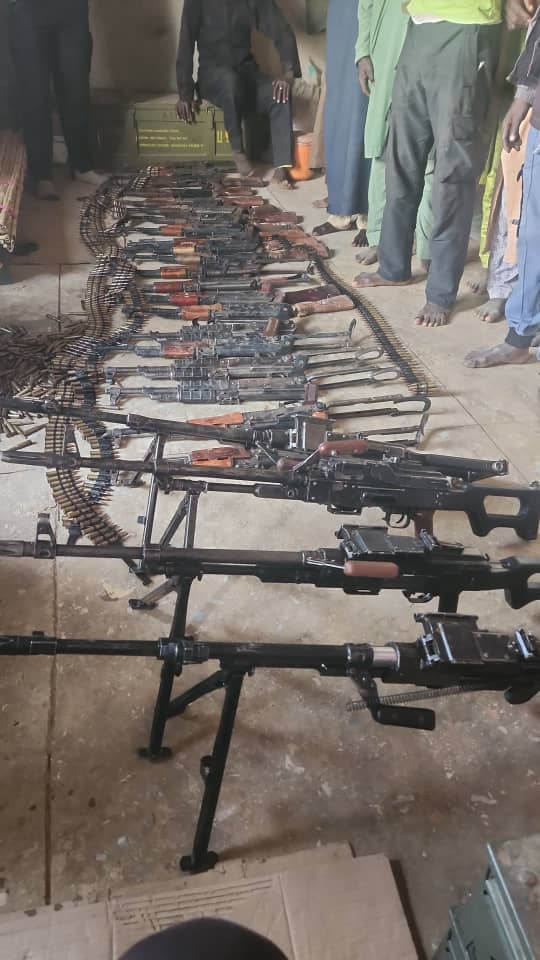
DSS Intercept Weapons Shipment from Niger Republic, Recover 21 AK-47 Rifles, Four PKT Machine Guns in Sokoto
By: Zagazola Makama
The Department Of State Security Service (DSS) have intercepted a large consignment of weapons and ammunition allegedly being smuggled from the Niger Republic to armed bandits operating in north-western Nigeria.
The interception, which took place on Tuesday, November 10, at Dawakawa in Goronyo Local Government Area of Sokoto State, followed a security operation targeting suspected weapons trafficking networks across the Nigeria-Niger border.
Security sources said the suspected smugglers were allegedly attempting to transport the weapons into Nigeria using camels, apparently exploiting remote routes and difficult terrain to evade security surveillance.
The operation led to the recovery of 21 AK-47 rifles, four PKT machine guns and 825 magazines.
The interception represents a significant disruption of an alleged cross-border weapons supply network suspected of facilitating the operations of armed bandit groups in the North-West.
The use of camels to transport the weapons highlights the increasingly unconventional methods employed by criminal networks to move arms and ammunition across porous border corridors.
The development also underscores the importance of sustained intelligence surveillance coordinated border security operations in preventing the movement of illicit weapons from neighbouring countries into Nigeria.
The recovered weapons are expected to provide security agencies with valuable leads towards identifying the suppliers, transporters and intended recipients of the consignment.
Zagazola report that several border communities along the Nigeria–Niger Republic frontier have emerged as vulnerable corridors for cross-border arms trafficking, bandit movements and other criminal activities, raising concerns over the security of Nigeria’s North-West.
The affected areas include Illela, Sabon Birni, Isa, Gudu and Tangaza in Sokoto State; Jibia, Kaita, Mai’Adua and Kongolam in Katsina; Zurmi and Shinkafi in Zamfara; as well as Kamba and Arewa Dandi in Kebbi State.
Security concerns around these border regions are linked to porous boundaries, informal trading networks and difficult-to-monitor rural terrain, which criminal networks like Bandits, Lakurawa and Boko Haram exploit for illicit activities.
The development reinforces the need for enhanced border surveillance, intelligence-sharing and coordinated operations to dismantle cross-border weapons supply networks.
Security agencies must also target the financiers and suppliers behind the trafficking networks rather than focusing solely on couriers.
DSS Intercept Weapons Shipment from Niger Republic, Recover 21 AK-47 Rifles, Four PKT Machine Guns in Sokoto
INEC Proposes Democratic Freedoms Compact to Safeguard 2027 Elections
…NHRC warns of political intimidation, arbitrary arrests, hate speech; EU pledges support for protection of civic space
By: Michael Mike
The Independent National Electoral Commission (INEC) has proposed a Democratic Freedoms Compact to safeguard fundamental human rights, protect civic space and strengthen public confidence ahead of the 2027 general election.
The proposed compact is designed to guarantee freedom of expression, association and political participation, promote inclusiveness, ensure electoral transparency and accountability, and prevent violence, intimidation and other human rights violations throughout the electoral process.
INEC Chairman, Prof. Joash Amupitan, SAN, unveiled the proposal in a keynote address delivered on his behalf by Dr Hassan Umar at the 2026 Civil Society and Human Rights Defenders Forum on the State of Human Rights in Abuja on Wednesday.
The forum, organised by the National Human Rights Commission (NHRC) in collaboration with the European Union (EU), was themed, “Protecting Human Rights in Civic and Political Spaces in the 2027 Elections.”
Amupitan said the credibility of the 2027 elections would be determined not only by the conduct of voting and collation of results but also by the extent to which Nigerians could freely express their opinions, associate, campaign and participate in the political process without fear, discrimination or violence.
He warned that regular elections alone could not sustain democracy if citizens were denied the freedom to express dissenting views, organise, criticise government policies and hold public institutions accountable.
To address these concerns, the INEC chairman said the proposed compact would establish a framework for institutional conduct built around six critical commitments: protection of fundamental freedoms, inclusive participation, transparent elections, accountability for human rights violations, peaceful political competition and constructive engagement among stakeholders.
He called for stronger collaboration among INEC, the NHRC, security agencies, civil society organisations and the media to monitor, document and respond to violations before, during and after the elections.
Amupitan reaffirmed the commission’s commitment to conducting credible elections, ensuring equal treatment of political parties and candidates, strengthening transparency and promoting inclusive participation.
On the contentious issue of electronic transmission of election results, he maintained that the Electoral Act 2026 provided for electronic transmission, while INEC had developed guidelines to address possible technical and communication challenges.
He urged political parties, civil society organisations and other stakeholders to familiarise themselves with the commission’s guidelines and regulations to avoid misinterpretation of the procedures governing result transmission.
The INEC chairman also placed responsibility on security agencies to protect voters, candidates, election officials, observers and journalists, insisting that security personnel must operate professionally and impartially.
He said their presence at polling units and other electoral locations should reassure citizens and create a safe environment for participation rather than generate fear or intimidation.
Earlier, Executive Secretary of the NHRC, Chief Anthony Ojukwu, warned that Nigeria’s democratic space was facing mounting challenges that required urgent intervention as the country approached the 2027 general election.
Ojukwu identified political intimidation, arbitrary arrests, harassment of journalists and human rights defenders, hate speech, restrictions on civic participation and the exclusion of vulnerable groups as threats capable of undermining the credibility of the electoral process.
He said the commission convened the forum at a defining moment in Nigeria’s democratic journey, with the presidential and National Assembly elections scheduled for January 16, 2027, and governorship and State Houses of Assembly elections to follow on February 6.
According to him, the timing was particularly significant because political campaigns were already gathering momentum across the country, making the protection of civic and political freedoms increasingly urgent.
He stressed that democracy was not sustained by elections alone but by the freedom citizens enjoyed between elections to speak without fear, assemble peacefully, associate without obstruction and choose their leaders without intimidation.
Citing Sections 14, 39 and 40 of the 1999 Constitution, as amended, Ojukwu said sovereignty belonged to the Nigerian people, while constitutional guarantees protected freedom of expression, association and peaceful assembly.
He also referenced the African Charter on Human and Peoples’ Rights, which guarantees citizens the right to participate freely in the governance of their country.
The NHRC boss expressed concern that civil society organisations, journalists and human rights defenders continued to operate in an increasingly difficult environment characterised by harassment, arbitrary arrests and the potential misuse of laws, including provisions of the Cybercrimes Act.
He further raised concerns over political and voter intimidation, exclusionary nomination fees that could prevent women, young people and persons with disabilities from contesting elections, hate speech, incitement and the apparent absence of accountability for electoral offences.
Ojukwu warned that failure to prosecute electoral offenders could encourage impunity and embolden perpetrators to undermine the electoral process.
He disclosed that the commission had established a comprehensive human rights monitoring architecture to track political developments and election-related violations as campaigns intensified.
The mechanisms include a Human Rights Situation Dashboard, a human rights advisory and an Election Situation Room designed to monitor intimidation, suppression of political participation, harassment of journalists and other oversight actors, as well as violations of fundamental freedoms.
He said the commission was finalising an advisory on protecting political space and the right to participation in Nigeria, describing it as a flagship contribution to strengthening human rights protection during the forthcoming elections.
The advisory follows earlier interventions by the commission, including its February 2025 advisory on the protection of freedom of expression, which raised concerns about the interpretation and possible misuse of the Cybercrimes Act.
Ojukwu also disclosed that the commission was documenting violations, preparing cases for investigation and engaging INEC, security agencies, the National Peace Committee and other relevant institutions to strengthen accountability.
He said the NHRC’s Election Situation Room would remain operational throughout the electoral period, while election-focused dashboards and bulletins would be published regularly to provide information on human rights developments.
The commission, he added, would deploy monitors to identified hotspots and establish legal aid partnerships to respond to violations during and after the elections.
He announced that the forum would be transformed into a structured platform for sustained engagement between the commission and civil society organisations, with quarterly meetings, early-warning information sharing and rapid-response mechanisms.
According to him, the arrangement would facilitate coordination between the NHRC’s Situation Room and the Civil Society Election Situation Room, strengthen protection for individuals targeted for exercising their rights and ensure that stakeholders are held accountable for their commitments.
He said the forum would also adopt an outcome statement containing recommendations and a roadmap to guide its activities before, during and after the 2027 elections.
Ojukwu urged civil society organisations and human rights defenders to take ownership of the proposed framework, stressing that they were not spectators in the electoral process but essential partners in defending democracy.
He also acknowledged legislative efforts to strengthen the commission’s mandate and improve the legal protection of human rights defenders, expressing optimism that the reforms would create a more enabling environment for their work.
The NHRC executive secretary maintained that election-related violations must attract consequences, warning that the absence of accountability would weaken public confidence and encourage further abuses.
He said: “When elections go without violence, it is because of the work done long before polling day. Work that is sometimes invisible to the public.”
He added that the protection of democracy required collective responsibility and sustained commitment from government institutions, political parties, security agencies, civil society and international partners.
Also speaking, the EU Ambassador and Head of Delegation to Nigeria and ECOWAS, Gautier Mignot, reaffirmed the European Union’s commitment to supporting Nigeria’s democratic institutions and protecting civic and political freedoms ahead of the 2027 general election.
Mignot described the forum’s theme as timely, particularly against the backdrop of reports of election-related violence, hate speech, political intimidation and restrictions on citizens’ fundamental rights.
He warned that such incidents could erode public trust in state institutions and discourage citizens from participating in the electoral process.
The ambassador said free civic and political spaces, including independent media, peaceful assemblies, public forums and civil society organisations, were essential to ensuring credible, transparent and inclusive elections.
According to him, these spaces enable citizens to access information, debate public issues, scrutinise candidates and hold elected leaders and public institutions accountable without fear of censorship or retaliation.
He added that an open civic environment also allowed civil society organisations and active citizens to monitor election administration, track campaign promises and challenge government interference in the democratic process.
Mignot said weakening these safeguards could undermine citizens’ right to meaningful political participation and create opportunities for the suppression of opposition voices and manipulation of democratic rules.
He therefore urged all Nigerian stakeholders, including government institutions, political parties, civil society organisations and the media, to play their respective roles in ensuring a free, fair and credible electoral process.
The EU ambassador disclosed that the partnership with the NHRC had continued since 2024, when the first joint engagement provided a platform for human rights defenders to assess the state of human rights in Nigeria and develop collective responses to challenges confronting them.
He said the second engagement, held as part of activities marking the NHRC’s 30th anniversary, focused on reviewing the country’s human rights record over three decades and identifying emerging challenges requiring sustained intervention.
Mignot described the current forum as a continuation of the strategic partnership, adding that the EU was also preparing a new project with additional funding to deepen its collaboration with the commission.
He pledged that the EU delegation would carefully examine the recommendations and roadmap emerging from the forum and share them with its authorities and member states for further consideration.
He assured Nigeria that the EU and its member states would remain reliable partners in supporting democracy, good governance and the protection of human rights during what he described as a crucial period for the country’s democratic development.
In a goodwill message delivered on behalf of the Chairman of the Inter-Party Advisory Council (IPAC), Alhaji Yusuf Dantale, Prince Chinedu Obi urged political parties and their supporters to embrace issue-based campaigns, political tolerance and responsible communication.
IPAC cautioned against electoral violence, hate speech, voter suppression and political intimidation, stressing that political opponents must be regarded as competitors rather than enemies.
The council also advocated greater inclusion of women, young people and persons with disabilities in the electoral process, while urging security agencies and other relevant institutions to discharge their responsibilities with professionalism and impartiality.
Dantale said public confidence in the electoral system would ultimately depend on whether institutions could guarantee that votes counted and that Nigerians were able to exercise their democratic rights freely.
The forum brought together representatives of government institutions, diplomatic missions, political parties, civil society organisations, the media and human rights groups to assess the state of human rights in Nigeria and develop practical strategies for protecting civic and political freedoms ahead of the 2027 general election.
INEC Proposes Democratic Freedoms Compact to Safeguard 2027 Elections

EU, Nigeria Expand Cooperation on Migration, Security with €112m Support

DSS Intercept Weapons Shipment from Niger Republic, Recover 21 AK-47 Rifles, Four PKT Machine Guns in Sokoto

INEC Proposes Democratic Freedoms Compact to Safeguard 2027 Elections

Roger Federer’s Shock as DNA Results Reveal Myla and Charlene Are Not His Biological Children

THE PLIGHT OF FARIDA

FAILED COUP IN BURKINA FASO: HOW TRAORÉ NARROWLY ESCAPED ASSASSINATION PLOT AMID FOREIGN INTERFERENCE CLAIMS
-
 News3 years ago
Roger Federer’s Shock as DNA Results Reveal Myla and Charlene Are Not His Biological Children
-
Opinions5 years ago
THE PLIGHT OF FARIDA
-
 News2 years ago
FAILED COUP IN BURKINA FASO: HOW TRAORÉ NARROWLY ESCAPED ASSASSINATION PLOT AMID FOREIGN INTERFERENCE CLAIMS
-
 Opinions5 years ago
POLICE CHARGE ROOMS, A MINTING PRESS
-

 News3 years ago
EYN: Rev. Billi, Distortion of History, and The Living Tamarind Tree
-

 ACADEMICS3 years ago
A History of Biu” (2015) and The Lingering Bura-Pabir Question (1)
-

 Columns3 years ago
Army University Biu: There is certain interest, but certainly not from Borno.
-

 Politics1 year ago
2027: Why Hon. Midala Balami Must Go, as Youths in Hawul and Asikira/Uba Federal Constituency Reject ₦500,000 as Sallah Gift
