News
80 militants surrender arms, embrace amnesty in Cross River

80 militants surrender arms, embrace amnesty in Cross River
By: Zagazola Makama
No fewer than 80 militants operating in the creeks of Akpabuyo Local Government Area of Cross River State have voluntarily surrendered their arms and embraced the state government’s peace and reintegration Amnesty framework.
The militants came out in large numbers from the creeks on Friday at Atimbo Rear Area under Operation OKWOK, within the Area of Responsibility of Headquarters 13 Brigade, Nigerian Army and is already being described by as a strategic breakthrough in the fight against coastal militancy and maritime crime in southern Cross River.


Security sources told Zagazola Makama that the surrender was the outcome of months of sustained military pressure combined with discreet dialogue involving community leaders, government officials and security agencies.
Two militant camps dismantled themselves in one coordinated move. The first camp, headed by ThankGod Ebikontei, popularly known as Ayibanuagha, presented 39 fighters. Four additional members, officials said, are expected to report in the coming days.
The second camp, commanded by John Isaac, alias Akpokolo, brought forward 41 fighters. His group, widely known along the waterways as the Akpokolo Marine Forces or “Border Boys,” had controlled large stretches of creeks linking Cross River to neighbouring coastal corridors.
Ten more of his fighters are also expected to join the amnesty process. In total, 80 militants formally stepped out of the creeks and into a state-supervised disarmament and rehabilitation programme.
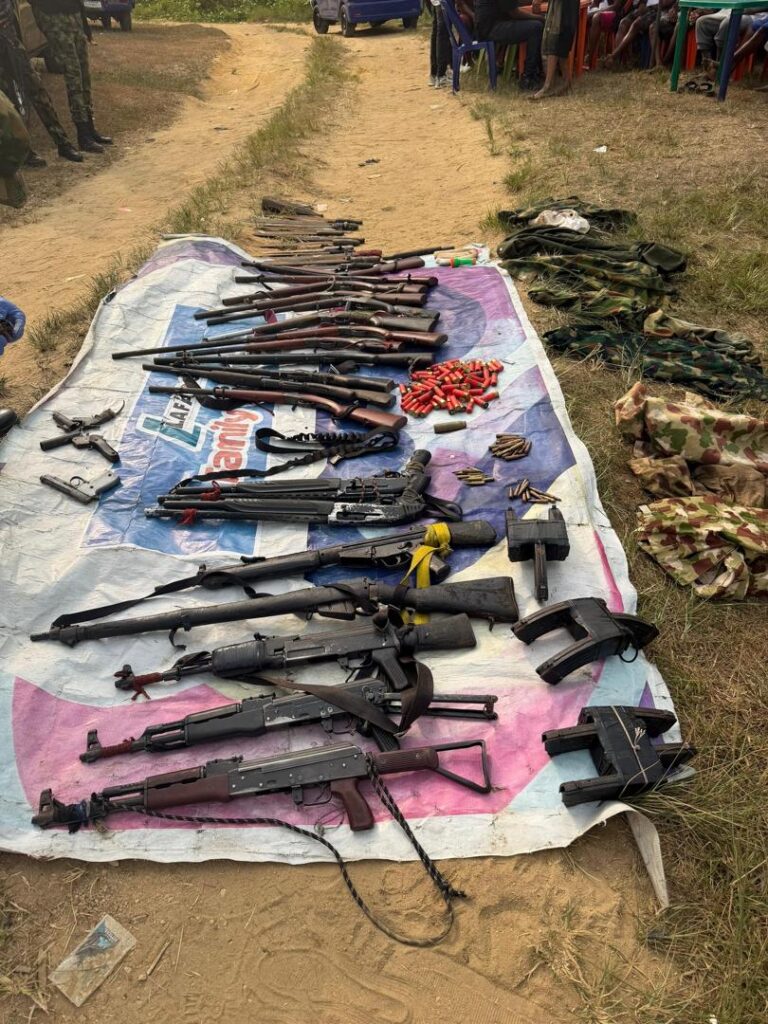
The disarmament was not symbolic. A significant cache of weapons, equipment and operational assets was voluntarily handed over, illustrating the firepower the groups once commanded.
The sources said that items surrendered included AK-47 rifles, pump-action guns, a Mark 4 rifle, a G3 rifle, multiple single-barrel guns, magazines, speedboats, high-powered boat engines, locally fabricated pistols and assorted military kits.
Of particular concern to security officials was the surrender of an explosive charge and live ammunition, which draw to the attention of the destructive capacity the groups had at their disposal. Also surrendered were machetes, camouflage clothing, tactical vests, knee and elbow guards, and communication tools, all of which painted a picture of organised armed groups rather than loosely structured criminal gangs.

For the Nigerian Army, the scale and quality of the surrendered items confirmed that the amnesty was reaching core actors, not just foot soldiers.
Brig.-Gen. P.O. Alimikhena, Commander of 13 Brigade, Nigerian Army, described the development as a “confidence-building milestone” that validates the military’s dual-track strategy.
“This voluntary surrender shows that consistent operations, combined with constructive dialogue and strong collaboration with the Cross River State Government and other security agencies, can deliver peace,” Alimikhena said.
“We will continue to secure the environment while supporting lawful initiatives that reintegrate repentant youths and ensure lasting stability.”he said.
Military sources said the success in Akpabuyo followed intensified patrols, improved intelligence flow and engagement with local power structures in creek communities.
After the formal disarmament, the former militants were handed over to the Cross River State Government’s Rapid Response Team.
They are currently undergoing profiling by the Department of State Services (DSS) at Muka Sam Hotel in Ikot Ansa, Calabar.
The exercise is designed to verify identities, assess security risks and determine eligibility for rehabilitation, skills training and reintegration support. Officials said the profiling phase is crucial to ensuring that only genuine repentant militants benefit from the programme and that criminal elements do not exploit the amnesty.
Akpabuyo Local Government Area sits along a strategic maritime corridor that links Cross River’s inland communities to coastal and cross-border trading routes. For years, militancy in the area has affected fishing, boat transport, palm produce trade and cross-border commerce with Cameroon.
Sea robbery, illegal taxation of fishermen, extortion and violent turf battles turned the creeks into zones of fear. The collective withdrawal of two major camps in one day is therefore both a psychological and operational shift. It sends a signal that militancy is no longer the dominant survival strategy for youths in the area.
The Nigerian Army credited the success of the Akpabuyo amnesty to what it called “effective civil-military collaboration,” singling out the Cross River State Government under Gov. Bassey Edet Otu for sustained political backing, coordination and logistical support.
Sources said the state government’s willingness to invest in dialogue, rehabilitation and youth empowerment made the option of peace more attractive than continued life in the creeks.
Beyond the powerful images of surrendered weapons and surrendered men, officials insist the hardest phase lies ahead. Reintegration, monitoring and economic re-engagement will determine whether the peace holds or unravels.
Headquarters 13 Brigade has reaffirmed its commitment to consolidating the gains, warning that while the door to peace remains open, security forces will maintain pressure against any group that chooses violence over dialogue.
They has urged the public to continue providing timely and credible information to security agencies, stressing that the breakthrough in Akpabuyo is not an endpoint, but the foundation for a safer and more stable Cross River State.
80 militants surrender arms, embrace amnesty in Cross River