
News
80 militants surrender arms, embrace amnesty in Cross River

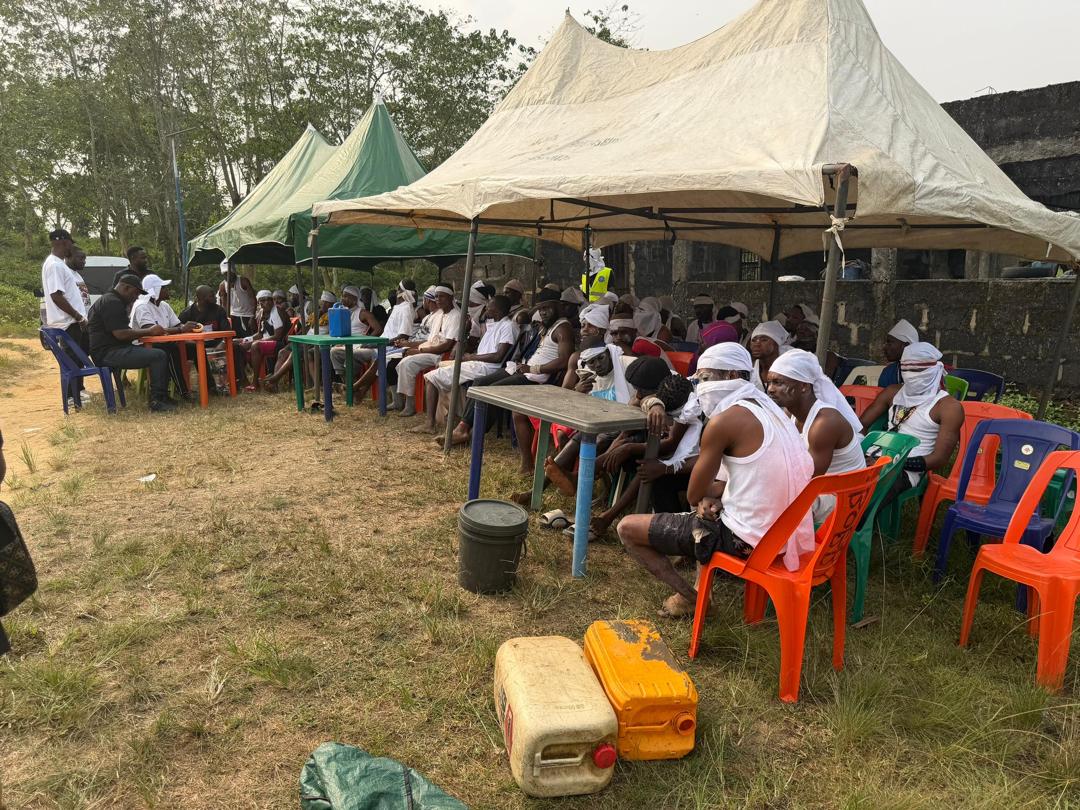
80 militants surrender arms, embrace amnesty in Cross River
By: Zagazola Makama
No fewer than 80 militants operating in the creeks of Akpabuyo Local Government Area of Cross River State have voluntarily surrendered their arms and embraced the state government’s peace and reintegration Amnesty framework.
The militants came out in large numbers from the creeks on Friday at Atimbo Rear Area under Operation OKWOK, within the Area of Responsibility of Headquarters 13 Brigade, Nigerian Army and is already being described by as a strategic breakthrough in the fight against coastal militancy and maritime crime in southern Cross River.

Security sources told Zagazola Makama that the surrender was the outcome of months of sustained military pressure combined with discreet dialogue involving community leaders, government officials and security agencies.
Two militant camps dismantled themselves in one coordinated move. The first camp, headed by ThankGod Ebikontei, popularly known as Ayibanuagha, presented 39 fighters. Four additional members, officials said, are expected to report in the coming days.
The second camp, commanded by John Isaac, alias Akpokolo, brought forward 41 fighters. His group, widely known along the waterways as the Akpokolo Marine Forces or “Border Boys,” had controlled large stretches of creeks linking Cross River to neighbouring coastal corridors.
Ten more of his fighters are also expected to join the amnesty process. In total, 80 militants formally stepped out of the creeks and into a state-supervised disarmament and rehabilitation programme.
The disarmament was not symbolic. A significant cache of weapons, equipment and operational assets was voluntarily handed over, illustrating the firepower the groups once commanded.
The sources said that items surrendered included AK-47 rifles, pump-action guns, a Mark 4 rifle, a G3 rifle, multiple single-barrel guns, magazines, speedboats, high-powered boat engines, locally fabricated pistols and assorted military kits.
Of particular concern to security officials was the surrender of an explosive charge and live ammunition, which draw to the attention of the destructive capacity the groups had at their disposal. Also surrendered were machetes, camouflage clothing, tactical vests, knee and elbow guards, and communication tools, all of which painted a picture of organised armed groups rather than loosely structured criminal gangs.

For the Nigerian Army, the scale and quality of the surrendered items confirmed that the amnesty was reaching core actors, not just foot soldiers.
Brig.-Gen. P.O. Alimikhena, Commander of 13 Brigade, Nigerian Army, described the development as a “confidence-building milestone” that validates the military’s dual-track strategy.
“This voluntary surrender shows that consistent operations, combined with constructive dialogue and strong collaboration with the Cross River State Government and other security agencies, can deliver peace,” Alimikhena said.
“We will continue to secure the environment while supporting lawful initiatives that reintegrate repentant youths and ensure lasting stability.”he said.
Military sources said the success in Akpabuyo followed intensified patrols, improved intelligence flow and engagement with local power structures in creek communities.
After the formal disarmament, the former militants were handed over to the Cross River State Government’s Rapid Response Team.
They are currently undergoing profiling by the Department of State Services (DSS) at Muka Sam Hotel in Ikot Ansa, Calabar.
The exercise is designed to verify identities, assess security risks and determine eligibility for rehabilitation, skills training and reintegration support. Officials said the profiling phase is crucial to ensuring that only genuine repentant militants benefit from the programme and that criminal elements do not exploit the amnesty.
Akpabuyo Local Government Area sits along a strategic maritime corridor that links Cross River’s inland communities to coastal and cross-border trading routes. For years, militancy in the area has affected fishing, boat transport, palm produce trade and cross-border commerce with Cameroon.
Sea robbery, illegal taxation of fishermen, extortion and violent turf battles turned the creeks into zones of fear. The collective withdrawal of two major camps in one day is therefore both a psychological and operational shift. It sends a signal that militancy is no longer the dominant survival strategy for youths in the area.
The Nigerian Army credited the success of the Akpabuyo amnesty to what it called “effective civil-military collaboration,” singling out the Cross River State Government under Gov. Bassey Edet Otu for sustained political backing, coordination and logistical support.
Sources said the state government’s willingness to invest in dialogue, rehabilitation and youth empowerment made the option of peace more attractive than continued life in the creeks.
Beyond the powerful images of surrendered weapons and surrendered men, officials insist the hardest phase lies ahead. Reintegration, monitoring and economic re-engagement will determine whether the peace holds or unravels.
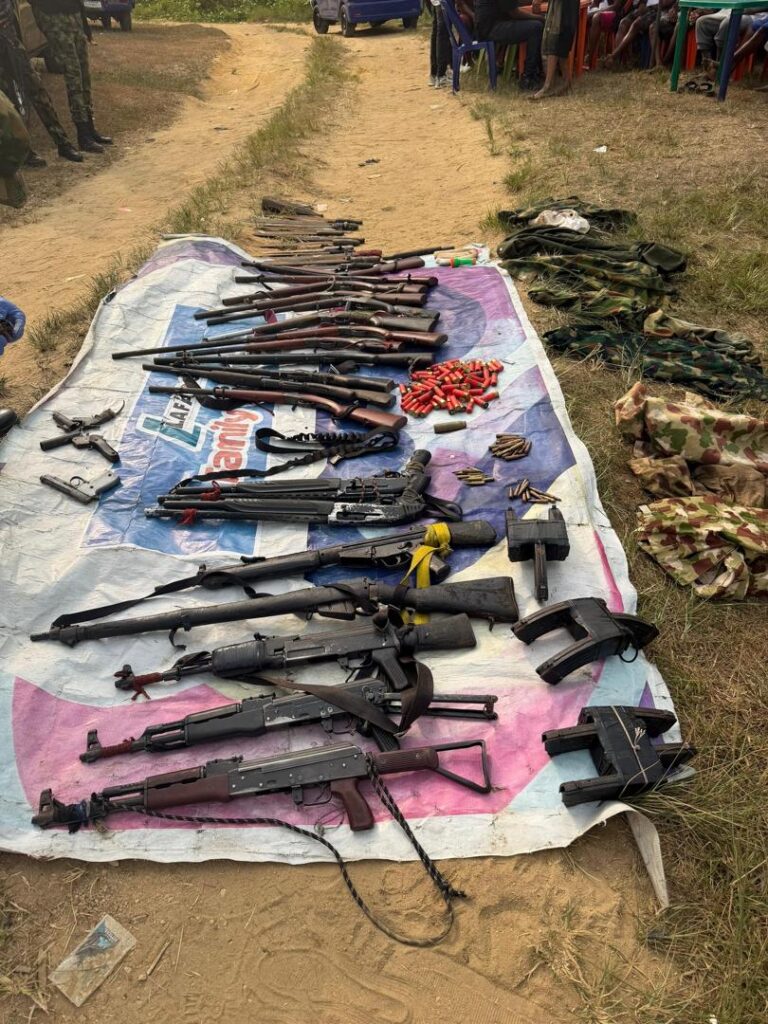
Headquarters 13 Brigade has reaffirmed its commitment to consolidating the gains, warning that while the door to peace remains open, security forces will maintain pressure against any group that chooses violence over dialogue.
They has urged the public to continue providing timely and credible information to security agencies, stressing that the breakthrough in Akpabuyo is not an endpoint, but the foundation for a safer and more stable Cross River State.
80 militants surrender arms, embrace amnesty in Cross River



Suspected Fulani bandits Kill Vigilante Member in Plateau, Flee as Troops Arrive
By Zagazola Makama
Suspected kidnappers have killed a 28-year-old member of a vigilante group, identified as Goyok Jamok, at Magi Mbar village in Bokkos Local Government Area of Plateau State.
Security sources told Zagazola Makama that the incident occurred at about 7:30 a.m. on Oct. 10, when troops of Sector 5, Operation Enduring Peace (OPEP), deployed at Mbar, responded to a report of an attack on the vigilante member.
On arrival at the scene, the troops discovered that Jamok had been shot dead by the suspected kidnappers.
The sources said the assailants abandoned their mission and fled upon sighting the approaching troops.
The victim’s relatives subsequently evacuated his remains for burial.
The sources added that efforts were ongoing to track down and apprehend the fleeing suspects.
Suspected Fulani bandits Kill Vigilante Member in Plateau, Flee as Troops Arrive

Suspected herders Destroy Large Portion of Cabbage Farm in Plateau
By Zagazola Makama
Troops of Operation Enduring Peace (OPEP) have confirmed the destruction of a large portion of a cabbage farm by persons suspected to be herders at Rakum village, Ropp District, Barkin Ladi Local Government Area of Plateau State.
Security sources told Zagazola Makama that the incident was reported at about 9:45 a.m. on Oct. 10, prompting troops of Sector 4, OPEP, to respond to the scene.
On arrival, the troops confirmed that the perpetrators had used a cutlass to cut down a large portion of the cabbage farm before fleeing the area.
The suspects had escaped before the arrival of the troops.
Efforts are ongoing to track down and apprehend the perpetrators for appropriate action.
The incident adds to concerns over the destruction of agricultural produce and the impact of criminal activities on farmers’ livelihoods in the affected area.
Suspected herders Destroy Large Portion of Cabbage Farm in Plateau

NDLEA Rearrests 83-Year-Old Woman for Drug Trafficking, Seizes 2.8 Tonnes of Cannabis
…South African Woman Arrested with 32.74kg Cannabis at PH Airport
By: Michael Mike
An 83-year-old woman previously convicted for drug trafficking has been arrested again with methamphetamine and Colorado, as the National Drug Law Enforcement Agency (NDLEA) records major drug seizures across several states, including the arrest of a South African woman with 32.74 kilogrammes of cannabis at Port Harcourt airport.
The octogenarian, Uloma Uchechi Sunday, was arrested last Wednesday at her residence in Ite-Uzo, Umuaguma, Obingwa Local Government Area of Abia State, with quantities of methamphetamine and Colorado, a synthetic cannabinoid, allegedly tied around her waist with a wrapper.
The NDLEA spokesman, Femi Babafemi in a statement on Sunday said the octogenarian arrest followed intelligence indicating that she operated a drug joint allegedly patronised by criminal elements terrorising the community.

Sunday had previously been arrested on May 17, 2025, alongside her 32-year-old daughter, Chisom Uchechi, at the same residence. The agency said they were found with 50 grammes of methamphetamine, 522 grammes of skunk, 260 grammes of fresh cannabis leaves and 12 grammes of tramadol.
Both women pleaded guilty and were sentenced to 12 months’ imprisonment or a fine of N200,000 each. They paid the fines and were released.
According to the NDLEA, the older woman subsequently returned to the drug trade and allegedly established a drug joint at her residence.
In a separate operation, operatives of the agency, working with the Nigeria Customs Service, arrested a South African national, Gebashe Sithandiwe Jessie, at the Port Harcourt International Airport, Omagwa, Rivers State, with 30 parcels of Thai Loud, a cannabis strain weighing 32.74 kilogrammes.
The suspect, who arrived from Thailand through Doha aboard a Qatar Airways flight, allegedly concealed the drugs in two travelling bags. The agency said she admitted to previously trafficking drugs through other African countries and attempting to expand her route to Port Harcourt.

The arrests formed part of a series of interdiction operations in which the NDLEA recovered large consignments of illicit drugs at airports, along highways and in residential locations across Lagos, Taraba, Kano, Kaduna, Edo, Cross River, Ondo and Plateau states.
At the Murtala Muhammed International Airport, Lagos, operatives intercepted 354,000 tablets of tapentadol, each reportedly dosed at 250mg, weighing 307.2 kilogrammes.
The shipment, comprising nine cartons from Pakistan aboard a Royal Air Maroc flight, had been placed under surveillance after arriving on September 29. A joint examination last Tuesday uncovered the consignment.
In another operation at the airport, officers recovered 70 parcels of Colorado weighing 75.9 kilogrammes from six Ghana-Must-Go bags in a consolidated cargo shipment from the United Kingdom.
The agency said a clearing agent, John Edrah, 54, was arrested on September 30. Other suspects subsequently arrested were Taofiq Ajibola, 54, an Uber driver; Adetunji Adebayo; and Kazeem Dosunmu, 48, a clothing trader.
Ajibola allegedly disclosed that the drugs had been sent by a UK-based associate, Lukman Sa’idu, while Dosunmu reportedly identified another UK-based individual, Yusuf, as the source of his consignment.
In Cross River State, NDLEA operatives raided Iyala Nkun village in Ikom Local Government Area on October 4, arresting Adama Inuwa, 46, and recovering 181 bags of cannabis weighing 1,100 kilogrammes, alongside 17.15 kilogrammes of cannabis seeds.

In Edo State, officers intercepted a black Toyota Camry at Otuo, Owan East Local Government Area last Monday. The vehicle was allegedly conveying 1,049 blocks of compressed cannabis weighing 702.83 kilogrammes.
Three suspects — Monday Orji, 52; Monday Lawal, 40; and Precious Uduegele, 20 — were arrested in connection with the seizure.
Another suspect, Ojugo Mercy, 26, was arrested at Asoro, off Sakponba Road, Benin City, with 989 grammes of Loud, 13 grammes of Colorado and 83 grammes of methamphetamine.
In Ondo State, operatives traced 21-year-old Happy Endurance to a hideout in the Shasha area of Akure last Monday, recovering 29 bags of cannabis weighing 290 kilogrammes.
On the same day, another raid at an apartment in Oba-Ile, Akure, led to the arrest of Tunde Adebayo, 42, with 35 bags of cannabis weighing 351 kilogrammes.
In Taraba State, two suspects, Abdulrasheed Mohamed, 31, and Abubakar Saidu, 37, were arrested at Chanchanji village in Wukari Local Government Area last Friday, with 166,200 tablets of tramadol, each reportedly dosed at 225mg and weighing 107 kilogrammes.
A separate stop-and-search operation along the Kano-Maiduguri Road in Kano State on the same day led to the arrest of Yahaya Musa, 32, with 24,990 capsules of tramadol, 50,000 tablets of diazepam and 22,000 tablets of Exol-5.
In Kaduna State, operatives patrolling the Zaria-Kaduna Expressway arrested Mohammed Musa, 29, with 31 jumbo bags and 775 blocks of skunk weighing a combined 1,027 kilogrammes.
At Orile, Lagos, another suspect, Musbau Balogun Adekunle, was arrested last Tuesday with 32.51 kilogrammes of skunk and 52.65 kilogrammes of its seeds, bringing the total seizure to 85.16 kilogrammes.
Meanwhile, a raid on the residence of Christian Uju, 45, at Rukuba Road, Jos, Plateau State, last Thursday resulted in the recovery of methamphetamine, firearms and ammunition.
The agency said officers seized 47 grammes of methamphetamine, two pump-action rifles, one locally made gun, 199 live cartridges, five rounds of 7.62mm ammunition and one round of 9mm ammunition.
Beyond the seizures, the NDLEA said its commands and formations sustained public enlightenment campaigns under its War Against Drug Abuse initiative, targeting students, worshippers, workers and communities across the country.
The NDLEA Chairman and Chief Executive Officer, Brig. Gen. Buba Marwa (retd.), commended officers and men of the Lagos, Murtala Muhammed International Airport, Port Harcourt International Airport, Taraba, Kano, Kaduna, Edo, Cross River, Ondo and Plateau commands for what he described as professional and intelligence-driven operations.
Marwa urged personnel nationwide to sustain the agency’s balanced approach to drug control, combining enforcement with preventive education and public sensitisation.
NDLEA Rearrests 83-Year-Old Woman for Drug Trafficking, Seizes 2.8 Tonnes of Cannabis

Four cows shot by Berom Militia in targeted attack Dorowa Babuje, Plateau

Suspected Fulani bandits Kill Vigilante Member in Plateau, Flee as Troops Arrive

Suspected herders Destroy Large Portion of Cabbage Farm in Plateau

Roger Federer’s Shock as DNA Results Reveal Myla and Charlene Are Not His Biological Children

THE PLIGHT OF FARIDA

FAILED COUP IN BURKINA FASO: HOW TRAORÉ NARROWLY ESCAPED ASSASSINATION PLOT AMID FOREIGN INTERFERENCE CLAIMS
-
 News3 years ago
Roger Federer’s Shock as DNA Results Reveal Myla and Charlene Are Not His Biological Children
-
Opinions5 years ago
THE PLIGHT OF FARIDA
-
 News1 year ago
FAILED COUP IN BURKINA FASO: HOW TRAORÉ NARROWLY ESCAPED ASSASSINATION PLOT AMID FOREIGN INTERFERENCE CLAIMS
-

 News3 years ago
EYN: Rev. Billi, Distortion of History, and The Living Tamarind Tree
-
 Opinions5 years ago
POLICE CHARGE ROOMS, A MINTING PRESS
-

 ACADEMICS3 years ago
A History of Biu” (2015) and The Lingering Bura-Pabir Question (1)
-

 Columns3 years ago
Army University Biu: There is certain interest, but certainly not from Borno.
-

 Politics1 year ago
2027: Why Hon. Midala Balami Must Go, as Youths in Hawul and Asikira/Uba Federal Constituency Reject ₦500,000 as Sallah Gift
