
News
FG to Establish National Land Commission… Put in Place Model Mortgage Foreclosure Law

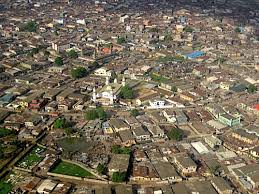
FG to Establish National Land Commission
… Put in Place Model Mortgage Foreclosure Law
By: Michael Mike
The Federal Government has announced plan to establish a National Land Commission, even as it revealed that works are on to put in place a Model Mortgage Foreclosure Law.
The Minister of Housing and Urban Development, Arc. Ahmed Dangari disclosed this on Tuesday at the ongoing 6th Nigeria Diaspora Investment Summit, NDIS in Abuja
The summit which has as theme, “New Vistas, New Aspirations, New Visions: The Diaspora and National Development is put to gather NDIS in conjucntion with Nigerians in Diaspora Commission (NIDCOM).
Dangiwa, in his remarks at the Summit, said the Land Commission when established will outline clear implementation guideline for the land Use Act.
The Minister said: “We are working to establish a National Land Commission. Part of their work will be to outline clear implementation guidelines for the Land Use Act to chart a new path of effective land administration in the country.”
He revealed that: “Last week I met with the leadership of the Presidential Technical Committee on Land Reforms, Prof. Peter Adeniyi, where I committed to incorporating the comprehensive work, they have done over 14-years in our land reform strategy.
“As the renowned land reform scholar said, experience shows that a nation can never develop if it does not conduct land reform. This will be done under the Renewed Hope Action Plan for Housing.”
Dangari further explained: “Notable part of our housing sector reforms that is of particular interest to the Diaspora interested in investing in the housing and real estate sector is land reforms. What we envision is a streamlined land administration that cuts through the bureaucratic bottlenecks and systemic inefficiencies to ensure cost effective and efficient access to land for both individuals and investors in our country.
“Currently, we have a situation where the Land Use Act, which was enacted in 1978 has no complementary institution set up alongside it to provide the necessary framework, guidelines, and regulations for operationalizing it. Under the Renewed Hope Agenda of His Excellency, President Bola Ahmed Tinubu, GCFR, we aim to fix this systemic anomaly”.
The Minister also revealed that government is working towards having a uniformed mortgage system.
He said: “The second is the nationwide adoption of the Model Mortgage Foreclosure Law. The Model Mortgage Foreclosure Law (MMFL) provides contemporary provisions on the creation, registration, and enforcement of mortgages, along with remedies like foreclosure and the enforcement of mortgages on real properties and related purposes in Nigeria.
“As of date, the Model Mortgage Foreclosure Law (MMFL) has been passed in only four (4) states, including Lagos, Kaduna, Ekiti, and Nasarawa States. We aim to drive its passage in all the states of the federation as part of our efforts to ensure that investments in the housing and mortgage sector are protected.”
He hinted of government’s plan towards “boosting local manufacturing of building materials,” adding that: “Nigeria’s shortfall in the supply of quality housing stock presents a good opportunity for investors.”
He said: “To drive this, we aim to create an enabling environment for private sector players to produce building materials locally to lower cost, create jobs, grow the local economy, and ultimately ensure inclusive growth.
“To do this we are planning to establish six (6) manufacturing hubs – one in each of the six (6) geo-political zones in the country. The hubs will be provided with relevant facilities, including access roads, electricity, fit for purpose housing and relevant linkages for manufacturers to site their firms and operate. We are also proposing relevant incentives that will make it more profitable and rewarding for the private sector to manufacture building materials locally. “
The Minister who also launched the Diapsora Housing Mortgage Loan, assured Nigerians in Diaspora that the government is willing to support them to own houses in the country.
He said: “And as a Ministry, we are willing to support Diaspora initiatives in the housing and urban development space as well as encourage partnerships with the Diaspora towards making a change in the housing and urban development narrative of our dear country.
“It is important for me state that when we think about the Diaspora, we are not only thinking of them as sources of finance to develop our country, but we also see them as Nigerians, who though abroad, are desirous of owning homes in Nigeria. “
The Diaspora Housing Mortgage Scheme, he explained “is designed to enable Nigerians living overseas participate in the National Housing Fund (NHF) Scheme so they can access up to N50million to own their homes in Nigeria. Participants can access the loan via a National Housing Fund (NHF) loan, Rent-to-Own or the Individual Construction loan window.
“The terms are affordable and best market rates. This includes a single-digit interest rate of 9%, and a payback period of up to 10 years.
“As part of the initiative, the Federal Mortgage Bank of Nigeria will facilitate the construction of affordable housing units in major cities that meets the specifications of Nigerians in Diaspora.
“I want to say that the FMBN is not the only agency under the Ministry of Housing and Urban Development that is delving into catering to the housing needs of the Diaspora.
“The Federal Housing Authority (FHA)is also involved as part of the Ministry’s sector wide effort to cater to the Diaspora. They have undertaken to develop the Diaspora City Project under a Public Private Partnership comprising the FHA, The Nigerians in Diaspora Commission (NIDCOM) the Federal Capital Territory (FCT) and the private sector. The Project is situated in Maitama 2, with over 675 hectares of land. The FCT administration has committed to opening the road and providing the relevant infrastructure. The Diaspora City project is designed to have bungalows, semi-and detached duplexes, and mansions to reflect its inclusive essence.
“So, today, I want to say that I am excited to be the Minister of Housing and Urban Development to launch the Diaspora Mortgage Scheme, which I initiated as the MD/CE of the Federal Mortgage Bank of Nigeria on this auspicious occasion. Indeed, I consider it a positive twist of fate and “I want to use this opportunity to urge Nigerians in the diaspora to seize the opportunity the Scheme affords them to actualize their dreams of owning affordable homes in Nigeria.
“Our overall goal is to ensure that as our brothers and sisters’ sojourn abroad, they also have a decent shelter over here in Nigeria to call their home.”
On the country’s mortgage system, he said, “I am aware that the Mortgage scheme is set to be formally launched in the United Kingdom, Canada, and the United States soon, and it is my hope that the diaspora community would take full advantage of this opportunity and massively subscribe to reap its short and long-term benefits.”
The Minister equally assured the Diasporans of government commitment to sustaining necessary partnership with all relevant stakeholders.
“As I conclude my speech, I would like to assure you of the Federal Ministry of Housing and Urban Development’s commitment to sustaining the necessary collaborations, partnerships, and engagements with all relevant Stakeholders in the Housing and Urban Development sector, as we all work together towards ensuring the success of the Diaspora Housing Mortgage scheme, providing affordable housing, and ensuring sustainable urban development for Nigerians.”
Meanwhile, the Chairman/CEO of Nigerians in Diaspora Commission(NIDCOM), Hon. Abike Dabiri-Erewa, has urged Nigerians in Diaspora to catch in on the current opportunities by investing in the country, insisting that now is the best time to invest in Nigeria.
She said: “My dear guests seated here and online, I assure you that this is an exciting time to be doing business in Nigeria,and this Summit is a step in making investment and growth a reality, because as Nigerians both at home and in the Diaspora, we should always be conscious of the fact that Home is Home, and no one can develop Nigeria ike Nigerians.”
Dabiri-Erewa said in the quest of the Federal Government to go far in repositioning the economy, there was a need to partner with the Diaspora in achieving these goals.
She said: “His Excellency, President Bola Ahmed Tinubu who has just returned from attending the Saudi-Africa Summit made efforts to underscore Nigeria’s commitment to attracting more Diaspora direct investment and expand business partnerships, which are strongly reinforced by the administration’s ongoing domestic economic reforms.
“The summit is very appropriate because it creates innovative platforms of partnerships, between the Government and the Diaspora, in attracting investment into local businesses and thus enhancing Diaspora Direct Investment in the country,” she added.
FG to Establish National Land Commission
… Put in Place Model Mortgage Foreclosure Law


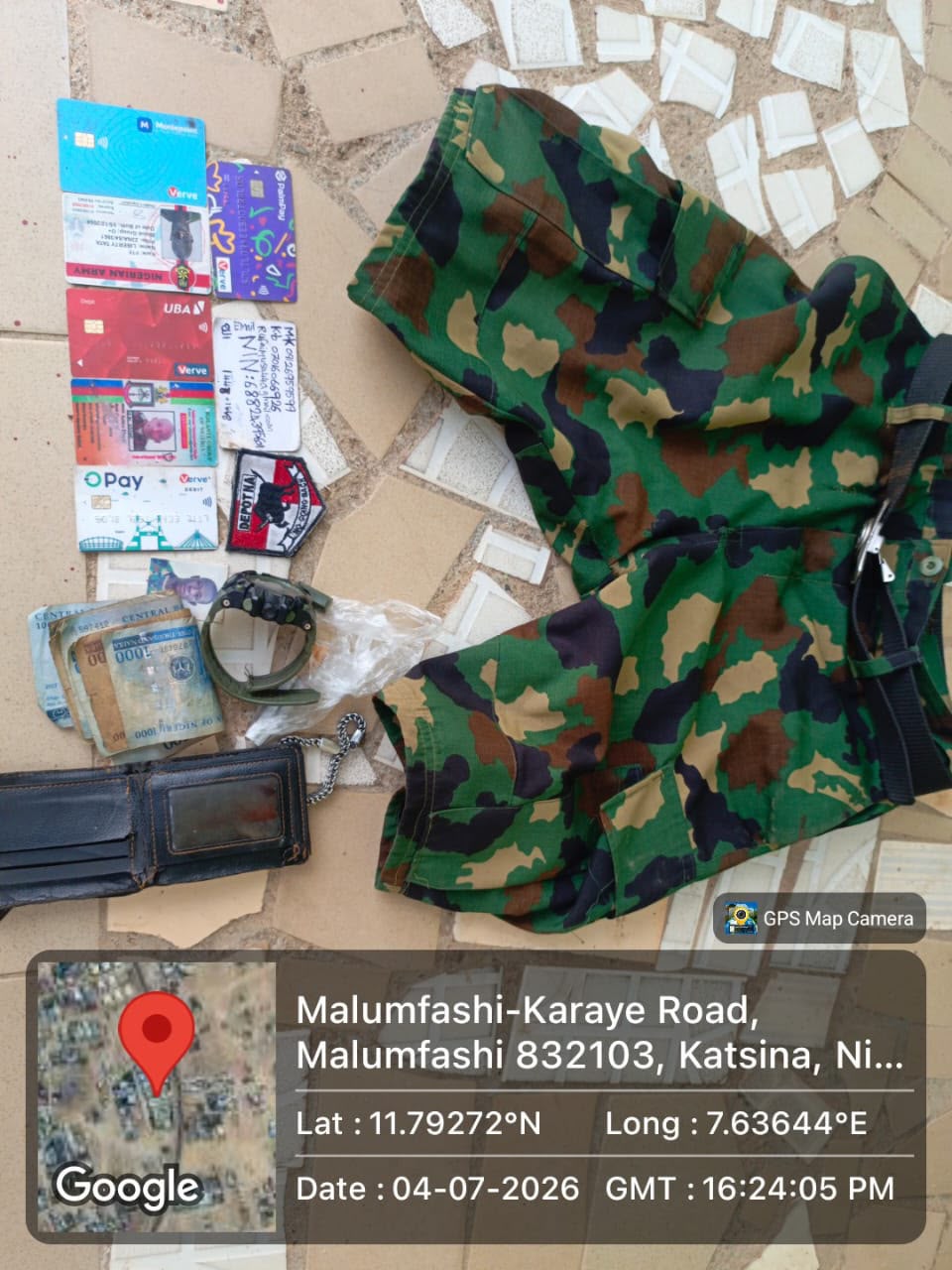
Troops Arrest Suspected Military Impostor in Katsina
By Zagazola Makama
Troops of 17 Brigade have arrested a suspected military impostor during a fighting patrol in Malumfashi Local Government Area.
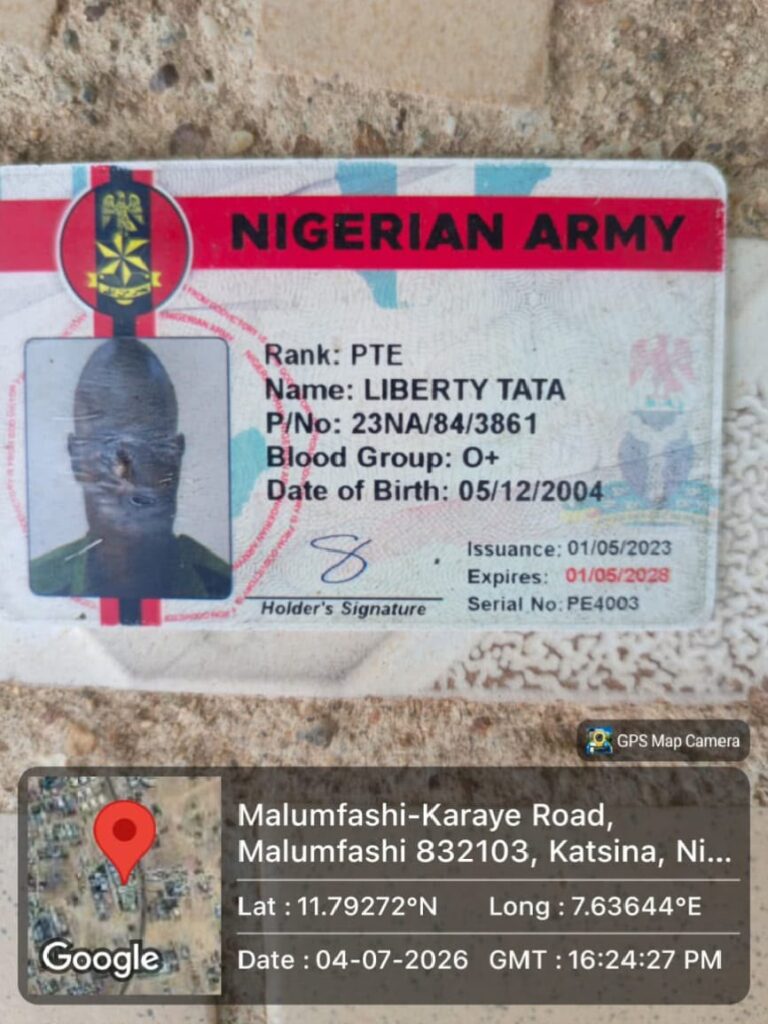
Security sources told Zagazola Makama that the suspect was apprehended at about 1:30 p.m. on July 4 by troops deployed at the Forward Operating Base (FOB) Malumfashi while conducting routine patrols within Malumfashi town.

According to the sources, the suspect was intercepted while wearing a woodland camouflage three-quarter short, raising suspicion among the troops.
A search conducted on the suspect led to the recovery of a fake Nigerian Army identity card, four Automated Teller Machine (ATM) cards, one woodland camouflage three-quarter short, a wristwatch and the sum of ₦17,000.
The suspect and the recovered exhibits are currently in military custody pending further investigation.
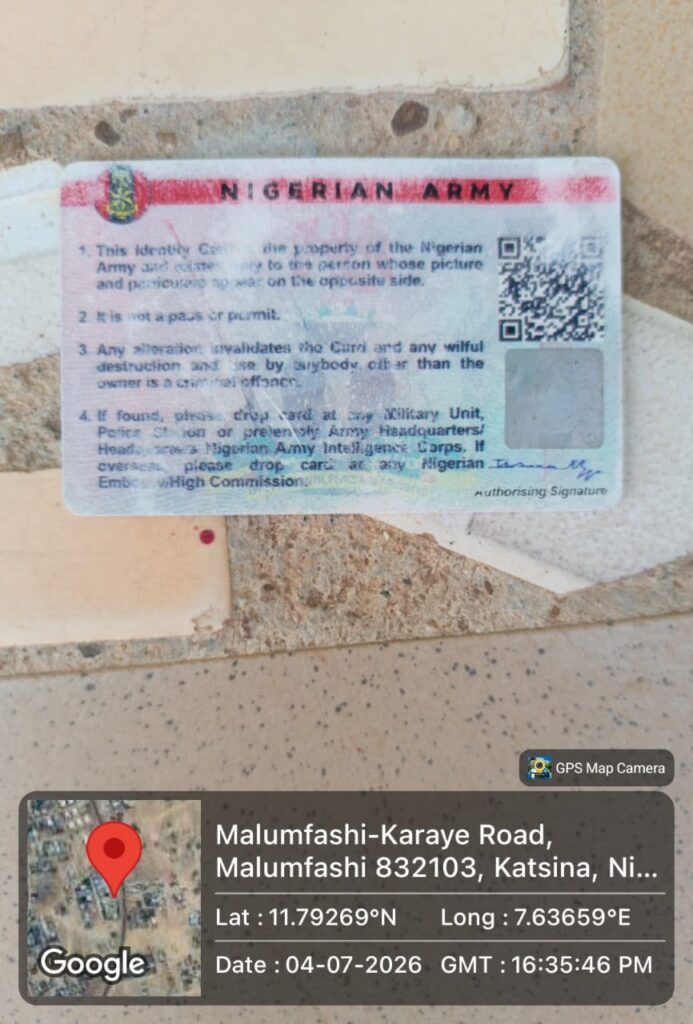
Military sources said the arrest forms part of ongoing efforts to curb impersonation of security personnel and other criminal activities within the area.
Troops Arrest Suspected Military Impostor in Katsina
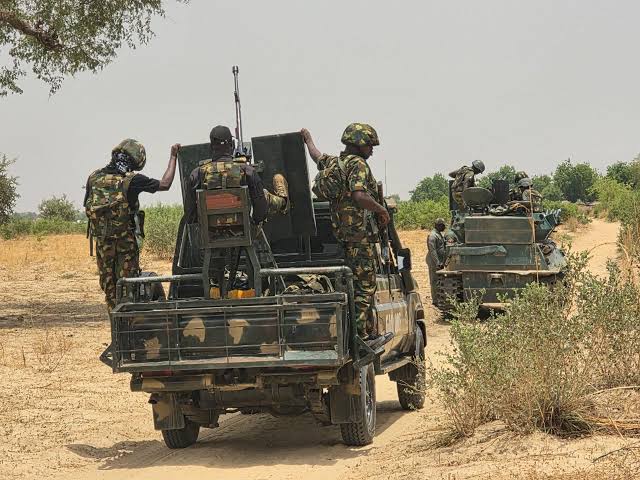
Troops Recover 50 Rustled Cattle, Repel Suspected Rustlers in Kaduna
By Zagazola Makama
Troops deployed at the Forward Operating Base (FOB) Kankomi have recovered 50 rustled cattle after repelling suspected cattle rustlers during an ambush operation in Chikun Local Government Area.
Security sources told Zagazola Makama that the troops responded to a distress call at about 9:55 a.m. on July 4 over the activities of suspected rustlers at Ungwan Gontu community.
According to the sources, the troops swiftly laid an ambush and made contact with the fleeing suspects, forcing them to abandon the stolen livestock and escape into the surrounding area.
During the operation, the troops recovered 50 rustled cattle, which were subsequently identified and handed over to their rightful owner.
Military sources said efforts are ongoing to track down the fleeing suspects as security operations continue to combat cattle rustling and other criminal activities across Kaduna State.
Troops Recover 50 Rustled Cattle, Repel Suspected Rustlers in Kaduna
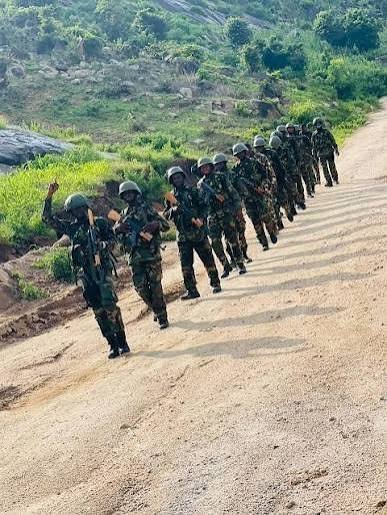
Troops Arrest Suspected Terrorist in Kogi, Suspect Confesses to Group Membership
By Zagazola Makama
Troops of 12 Brigade, in collaboration with Office of the National Security Adviser (ONSA) Hybrid Forces, have arrested a suspected terrorist during an operation in Lokoja Local Government Area.
Security sources told Zagazola Makama that the troops responded at about 1:00 p.m. on July 4 to reports of a confrontation between local residents and a suspected terrorist at a Ruga settlement behind Obajana community.
According to the sources, the troops swiftly intervened and arrested one suspect at the scene.
During preliminary interrogation, the suspect reportedly confessed to being a member of a terrorist group led by an individual identified as Haruna, which allegedly operates within the Okene general area.
The suspect is currently in military custody and is undergoing further investigation to establish the extent of his involvement and identify other members of the group.
Military sources said the arrest forms part of ongoing security operations aimed at dismantling terrorist and criminal networks across Kogi State.
Troops Arrest Suspected Terrorist in Kogi, Suspect Confesses to Group Membership

Troops Arrest Suspected Military Impostor in Katsina

Troops Recover 50 Rustled Cattle, Repel Suspected Rustlers in Kaduna

Troops Arrest Suspected Terrorist in Kogi, Suspect Confesses to Group Membership

Roger Federer’s Shock as DNA Results Reveal Myla and Charlene Are Not His Biological Children

THE PLIGHT OF FARIDA

FAILED COUP IN BURKINA FASO: HOW TRAORÉ NARROWLY ESCAPED ASSASSINATION PLOT AMID FOREIGN INTERFERENCE CLAIMS
-
 News2 years ago
Roger Federer’s Shock as DNA Results Reveal Myla and Charlene Are Not His Biological Children
-
Opinions4 years ago
THE PLIGHT OF FARIDA
-
 News1 year ago
FAILED COUP IN BURKINA FASO: HOW TRAORÉ NARROWLY ESCAPED ASSASSINATION PLOT AMID FOREIGN INTERFERENCE CLAIMS
-

 News2 years ago
EYN: Rev. Billi, Distortion of History, and The Living Tamarind Tree
-
 Opinions5 years ago
POLICE CHARGE ROOMS, A MINTING PRESS
-

 ACADEMICS2 years ago
A History of Biu” (2015) and The Lingering Bura-Pabir Question (1)
-

 Columns2 years ago
Army University Biu: There is certain interest, but certainly not from Borno.
-

 Politics1 year ago
2027: Why Hon. Midala Balami Must Go, as Youths in Hawul and Asikira/Uba Federal Constituency Reject ₦500,000 as Sallah Gift
