
News
Zulum Advocates Youth Empowerment, Skills Acquisition, and Scholarships to End Youth Restiveness

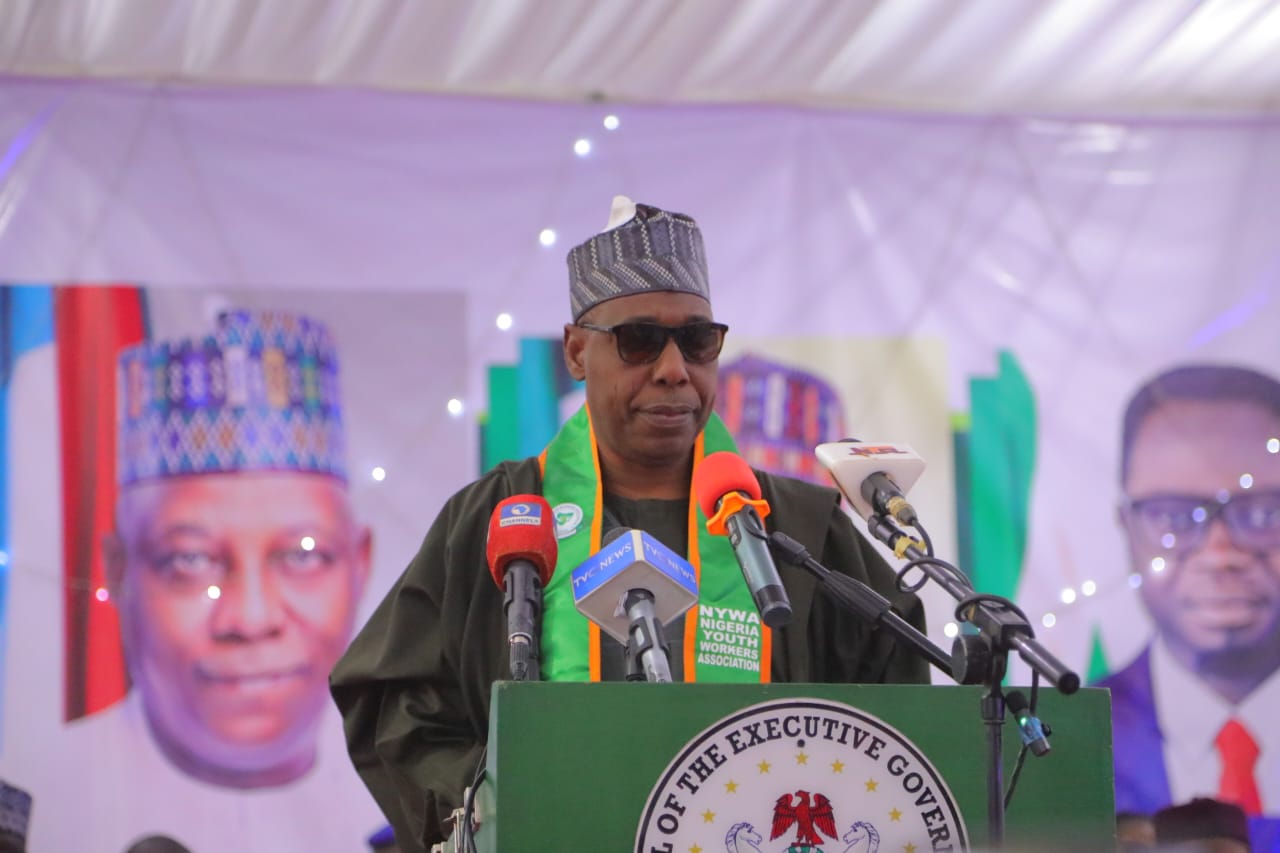
Zulum Advocates Youth Empowerment, Skills Acquisition, and Scholarships to End Youth Restiveness
By: Our Reporter
Borno State Governor, Professor Babagana Umara Zulum, has called for the implementation of robust skills acquisition programmes, enhanced educational opportunities and scholarship schemes as strategic measures to combat youth restiveness and unemployment in society.
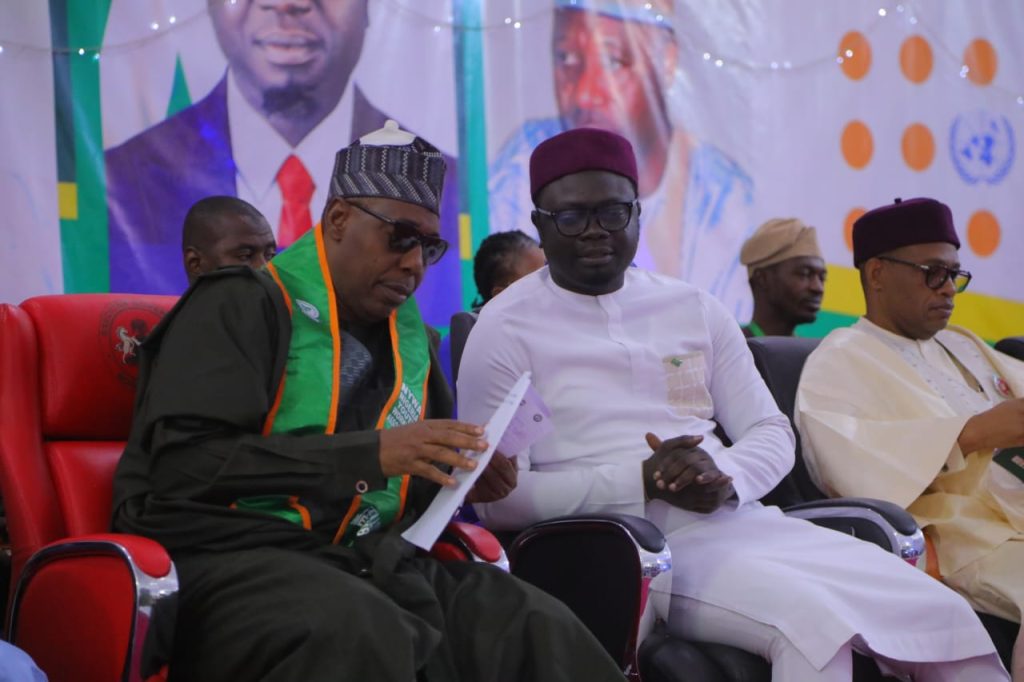
Speaking at the 7th National Council on Youths Meeting (NCYM) held at the Multi-Purpose Hall of the Government House in Maiduguri on Thursday, Governor Zulum emphasized the need for governments to prioritize youth development. He described the youth as “future leaders” who require adequate support to fulfill their potentials.
Themed “Transforming and Repositioning the Nigerian Youth to Thrive and Catalyze Economic Development,” the meeting provided a platform for dialogue, innovation, and collaboration aimed at advancing youth development in Nigeria.
Governor Zulum, the Chief Host of the event, expressed pride in Borno State’s role in hosting the significant gathering.
He highlighted his administration’s unwavering commitment to youth empowerment since assuming office in 2019, despite the challenges posed by the prolonged Boko Haram insurgency.
Governor Zulum also underscored the immense potential of Nigeria’s youth population, noting that recent statistics reveal that 70% of the country’s population is under the age of 30. “This demographic is a significant asset, offering the potential for a highly productive economy in the near future,” he remarked.
He noted that since inception into office in 2019 to date, the present administration which has been battling with over a decade old Boko Haram crisis has been very committed to supporting youths through implementation of various initiatives aimed at empowering the youths, which include; provision of vocational training skills programmes, education, scholarships, distribution of Keke Napep, electric motor vehicles, establishing mechanical village at Molai and other entrepreneurship support programmes across the 27 local government areas of the state.
“In our society, the youths have faced numerous challenges, ranging from economic uncertainties, educational barriers and insufficient opportunities among many others.
“However, it is inspiring to see how many of our young people are stepping up, driving change and becoming the architects of their destinies and our tomorrow.”
“It is on record that youths in Borno have greatly contributed to peace and security and the overall socio-economic development of the state. The emergence of the Civilian Joint Task Force (CJTF) has brought a great
respite to the security architecture of the state.
“Borno indeed has reclaimed its glorious position of Home of Peace and Hospitality. So please feel at home and enjoy the centuries long hospitality of the good people of Borno State.
“As a government, we recognize that our youth are the backbone of our society and it is our responsibility to provide you with all the necessary support and resources to thrive and develop to your full potentials.
“We believe that investing in our youths is investing in our future and we are committed to creating opportunities for you to grow and be successful”, the governor stated.
He therefore commended the Federal Minister of Youth and Sports Development (FMYD), Mr. Ayodele Olawande, Borno Commissioner for Youths, Sports and Poverty Alleviation, Hon. Saina Buba, and all other stakeholders for choosing Borno as venue of the meeting, even as he urged participants to feel free and brainstorm critically towards complementing efforts of the government in revamping the future of youths in society.
In his address, the Minister of Youth Development, Ayodele Olawande, expressed deep appreciation to Borno State government for hosting the NCYM.
“This meeting reflects President Bola Ahmed Tinubu’s collective commitment in advancing the interest of Nigerian Youths in line with his Renewed Hope Agenda,” Olawande said.
He called on other state governors to emulate and follow the good steps of Governor Zulum in revamping the future of youths for the best.
Commissioner for Youths, Sports and Poverty Alleviation, Hon. Saina Buba highlights the importance of youth in national development.
He said Governor Zulum, who has passion for the youths, has spent billions of naira in establishing 17 skills acquisition centres, sponsored thousands of indigenous students on scholarship in various tertiary institutions within and outside the country, with empowerment and jobs creation for the teeming and vulnerable youth groups across the state.
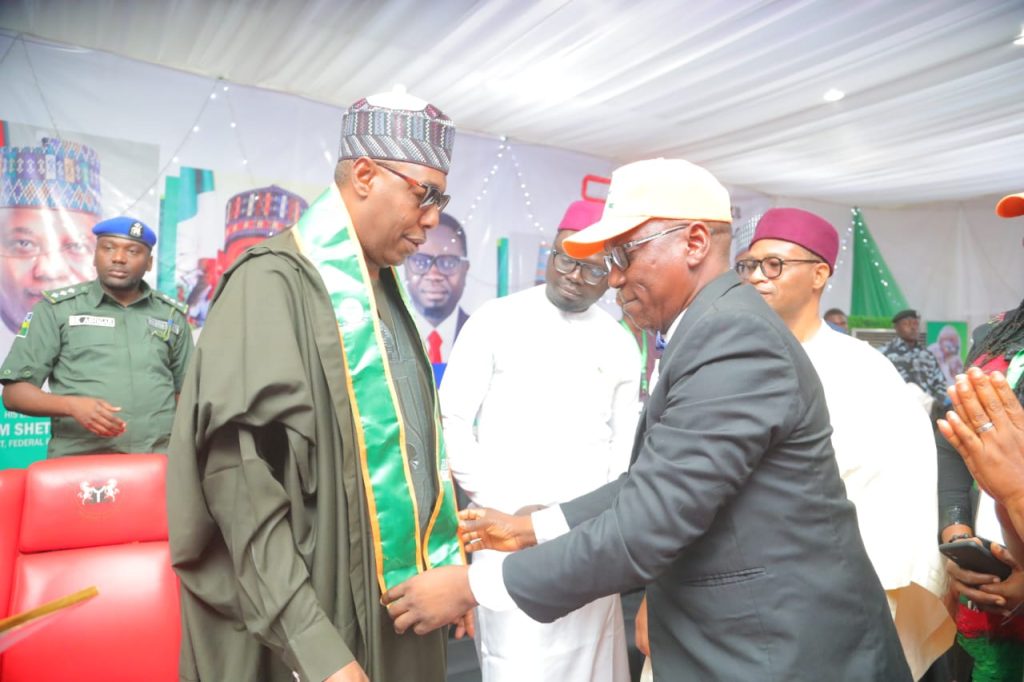
During the event, the National Youth Workers Association (NYWA) decorated Governor Babagana Zulum with fellowship award and renamed its national headquarters after the governor.
Zulum Advocates Youth Empowerment, Skills Acquisition, and Scholarships to End Youth Restiveness


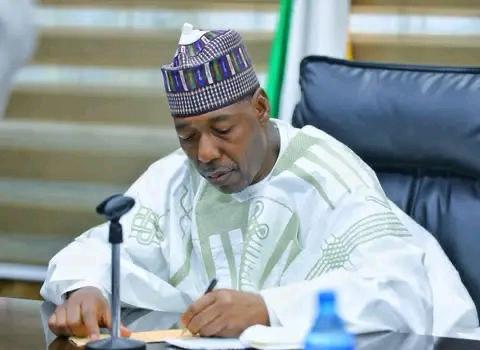
Zulum Appoints Engr Peter Samuel as General Manager BOSAMA
By: Our Reporter
Borno State Governor, Professor Babagana Umara Zulum, has approved the appointment of Engr Peter Samuel, MNSE, MNIAE, as the General Manager of Borno State Agricultural Mechanization Authority (BOSAMA).
In a statement by the Special Adviser to the Governor on Media, Dauda Iliya, the appointment was based on Engr Samuel’s outstanding professional competence, proven track record, and experience in agricultural engineering and mechanization.
The statement noted that Engr Samuel possesses the requisite qualifications, technical expertise and leadership capacity required to reposition BOSAMA in line with Governor Zulum’s agricultural transformation agenda.
The newly appointed General Manager is an Agricultural Engineer with academic, professional, administrative, and practical experience in agricultural mechanization, farm power and machinery, irrigation engineering, and agricultural infrastructure development.
He holds a Master of Engineering (M.Eng.) in Farm Power and Machinery from Joseph Sarwuan Tarka University, Makurdi (formerly the Federal University of Agriculture, Makurdi), a Postgraduate Diploma in Farm Management and Production Economics from Nasarawa State University, and a Bachelor of Engineering (B.Eng.) in Agricultural and Environmental Resources Engineering from the University of Maiduguri.
Engr Samuel has distinguished himself through years of meritorious service in teaching, research, agricultural engineering practice, and project implementation. He currently serves as a Lecturer in Farm Power and Machinery at Ramat Polytechnic, Maiduguri.
Over the years, he has held several strategic leadership positions, including General Manager of a commercial agricultural enterprise, Project Coordinator, Programme Coordinator, and Consultant on numerous agricultural development interventions implemented by reputable national and international organisations.
He is a member of the Nigerian Society of Engineers (NSE) and the Nigerian Institution of Agricultural Engineers (NIAE).
Governor Babagana Zulum congratulated the new General Manager on his appointment and urged him to deploy his wealth of knowledge, technical expertise, and experience in agricultural mechanization to strengthen the operations of BOSAMA
Zulum Appoints Engr Peter Samuel as General Manager BOSAMA
Troops Arrest Suspected Military Impostor in Katsina
By Zagazola Makama
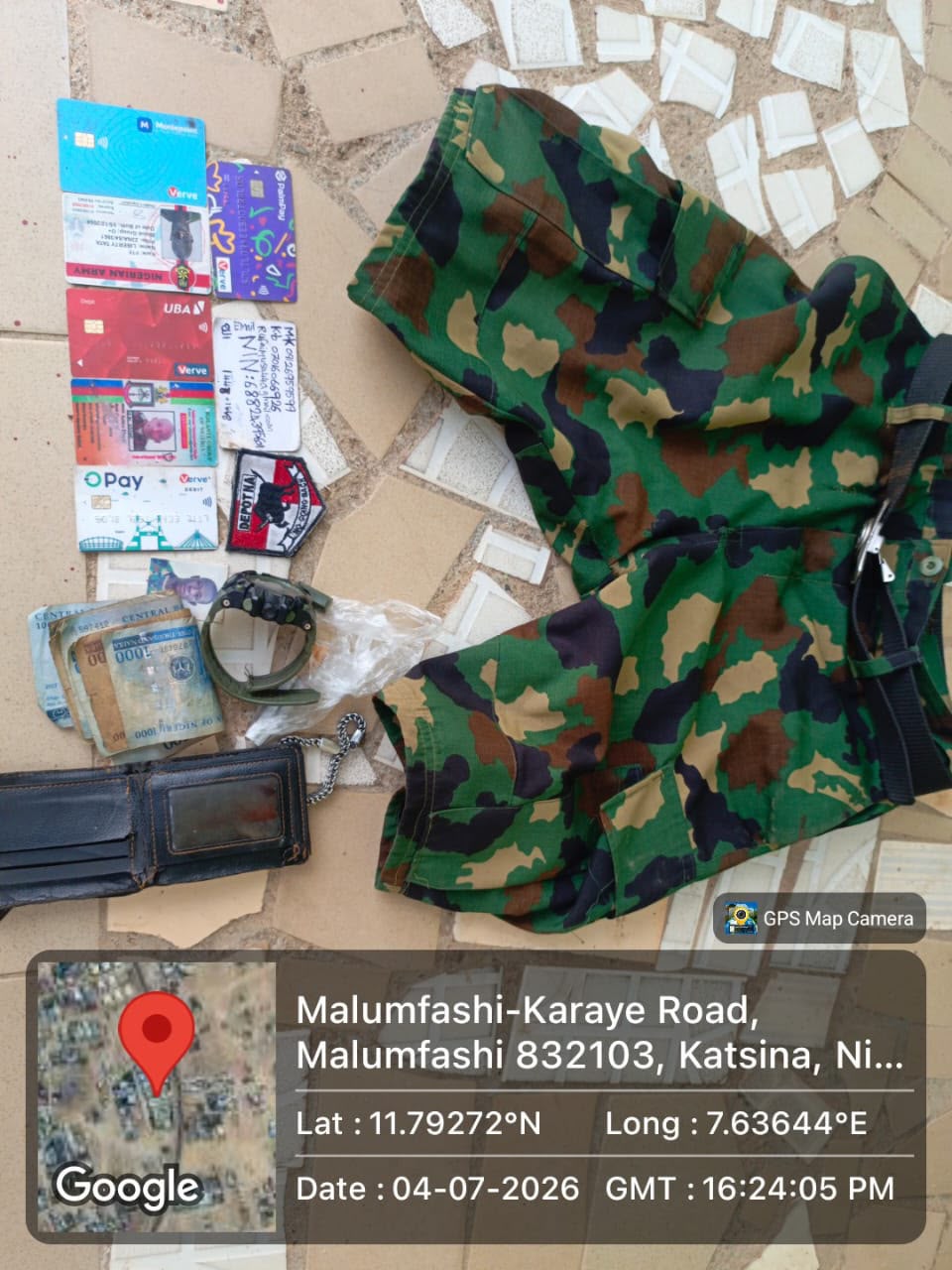
Troops of 17 Brigade have arrested a suspected military impostor during a fighting patrol in Malumfashi Local Government Area.
Security sources told Zagazola Makama that the suspect was apprehended at about 1:30 p.m. on July 4 by troops deployed at the Forward Operating Base (FOB) Malumfashi while conducting routine patrols within Malumfashi town.

According to the sources, the suspect was intercepted while wearing a woodland camouflage three-quarter short, raising suspicion among the troops.
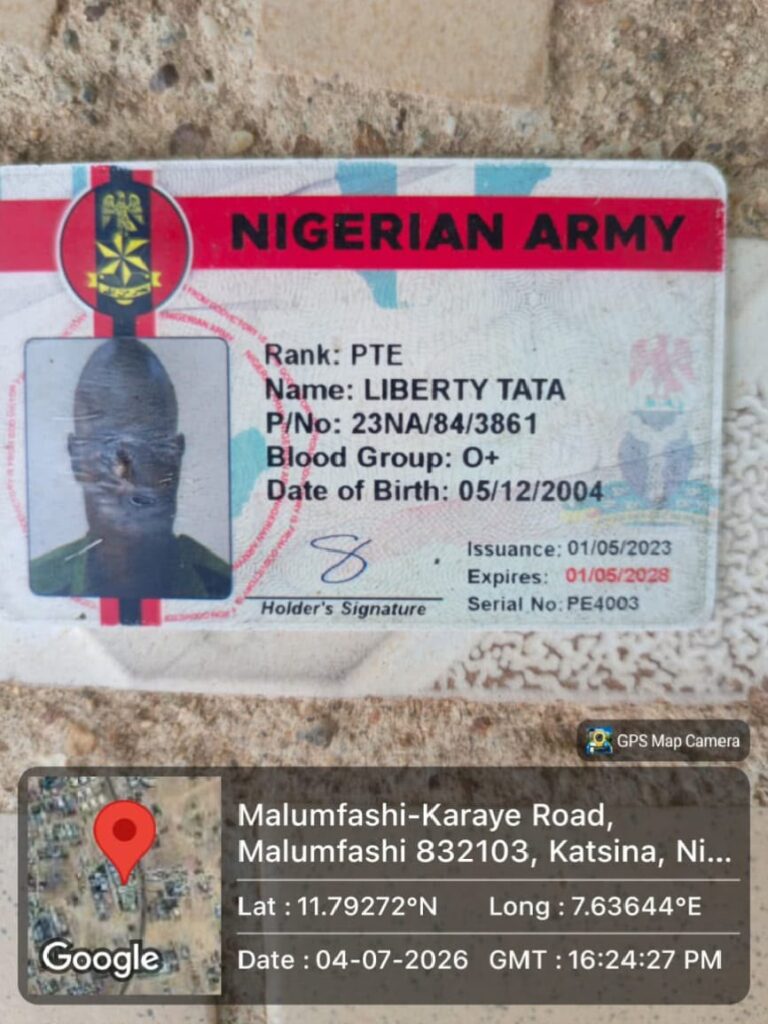
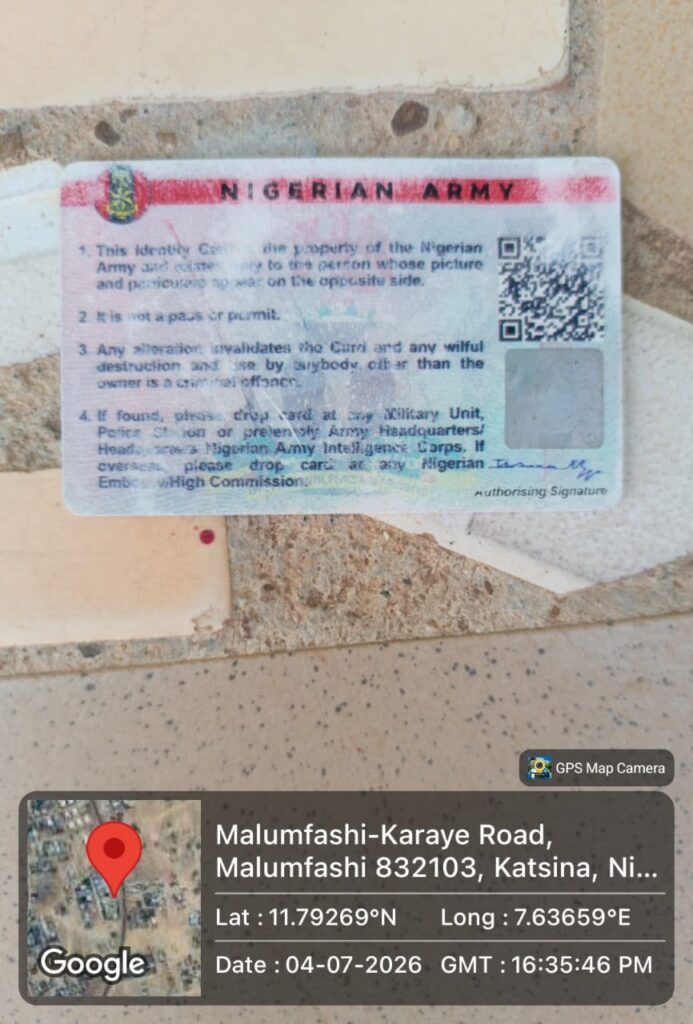
A search conducted on the suspect led to the recovery of a fake Nigerian Army identity card, four Automated Teller Machine (ATM) cards, one woodland camouflage three-quarter short, a wristwatch and the sum of ₦17,000.
The suspect and the recovered exhibits are currently in military custody pending further investigation.
Military sources said the arrest forms part of ongoing efforts to curb impersonation of security personnel and other criminal activities within the area.
Troops Arrest Suspected Military Impostor in Katsina
Troops Recover 50 Rustled Cattle, Repel Suspected Rustlers in Kaduna
By Zagazola Makama
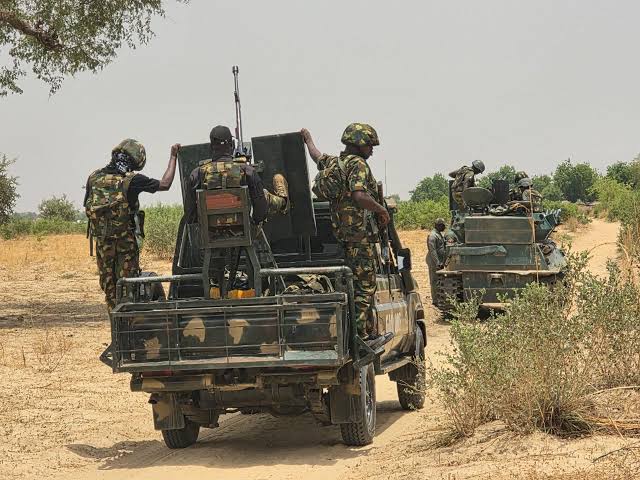
Troops deployed at the Forward Operating Base (FOB) Kankomi have recovered 50 rustled cattle after repelling suspected cattle rustlers during an ambush operation in Chikun Local Government Area.
Security sources told Zagazola Makama that the troops responded to a distress call at about 9:55 a.m. on July 4 over the activities of suspected rustlers at Ungwan Gontu community.
According to the sources, the troops swiftly laid an ambush and made contact with the fleeing suspects, forcing them to abandon the stolen livestock and escape into the surrounding area.
During the operation, the troops recovered 50 rustled cattle, which were subsequently identified and handed over to their rightful owner.
Military sources said efforts are ongoing to track down the fleeing suspects as security operations continue to combat cattle rustling and other criminal activities across Kaduna State.
Troops Recover 50 Rustled Cattle, Repel Suspected Rustlers in Kaduna

Zulum Appoints Engr Peter Samuel as General Manager BOSAMA

DSS Frees Cardiac Surgeon Martin Aghaji on Bail Over Alleged Economic Crime

Troops Arrest Suspected Military Impostor in Katsina

Roger Federer’s Shock as DNA Results Reveal Myla and Charlene Are Not His Biological Children

THE PLIGHT OF FARIDA

FAILED COUP IN BURKINA FASO: HOW TRAORÉ NARROWLY ESCAPED ASSASSINATION PLOT AMID FOREIGN INTERFERENCE CLAIMS
-
 News2 years ago
Roger Federer’s Shock as DNA Results Reveal Myla and Charlene Are Not His Biological Children
-
Opinions4 years ago
THE PLIGHT OF FARIDA
-
 News1 year ago
FAILED COUP IN BURKINA FASO: HOW TRAORÉ NARROWLY ESCAPED ASSASSINATION PLOT AMID FOREIGN INTERFERENCE CLAIMS
-

 News2 years ago
EYN: Rev. Billi, Distortion of History, and The Living Tamarind Tree
-
 Opinions5 years ago
POLICE CHARGE ROOMS, A MINTING PRESS
-

 ACADEMICS2 years ago
A History of Biu” (2015) and The Lingering Bura-Pabir Question (1)
-

 Columns2 years ago
Army University Biu: There is certain interest, but certainly not from Borno.
-

 Politics1 year ago
2027: Why Hon. Midala Balami Must Go, as Youths in Hawul and Asikira/Uba Federal Constituency Reject ₦500,000 as Sallah Gift
