
News
How ground pressure, air power are reshaping the war against banditry in Nigeria’s North-West

How ground pressure, air power are reshaping the war against banditry in Nigeria’s North-West
By Zagazola Makama
The opening days of 2026 have laid bare a defining reality of Nigeria’s North-West security landscape: the war against banditry is no longer episodic or localised, but a fluid, intelligence-driven contest unfolding simultaneously across multiple states, terrains and threat vectors.
From Katsina to Niger, Kano and Zamfara, a chain of interlinked incidents reveals both the growing effectiveness of air power and intelligence-led ground operations, and the stubborn adaptability of armed criminal networks determined to survive under pressure.
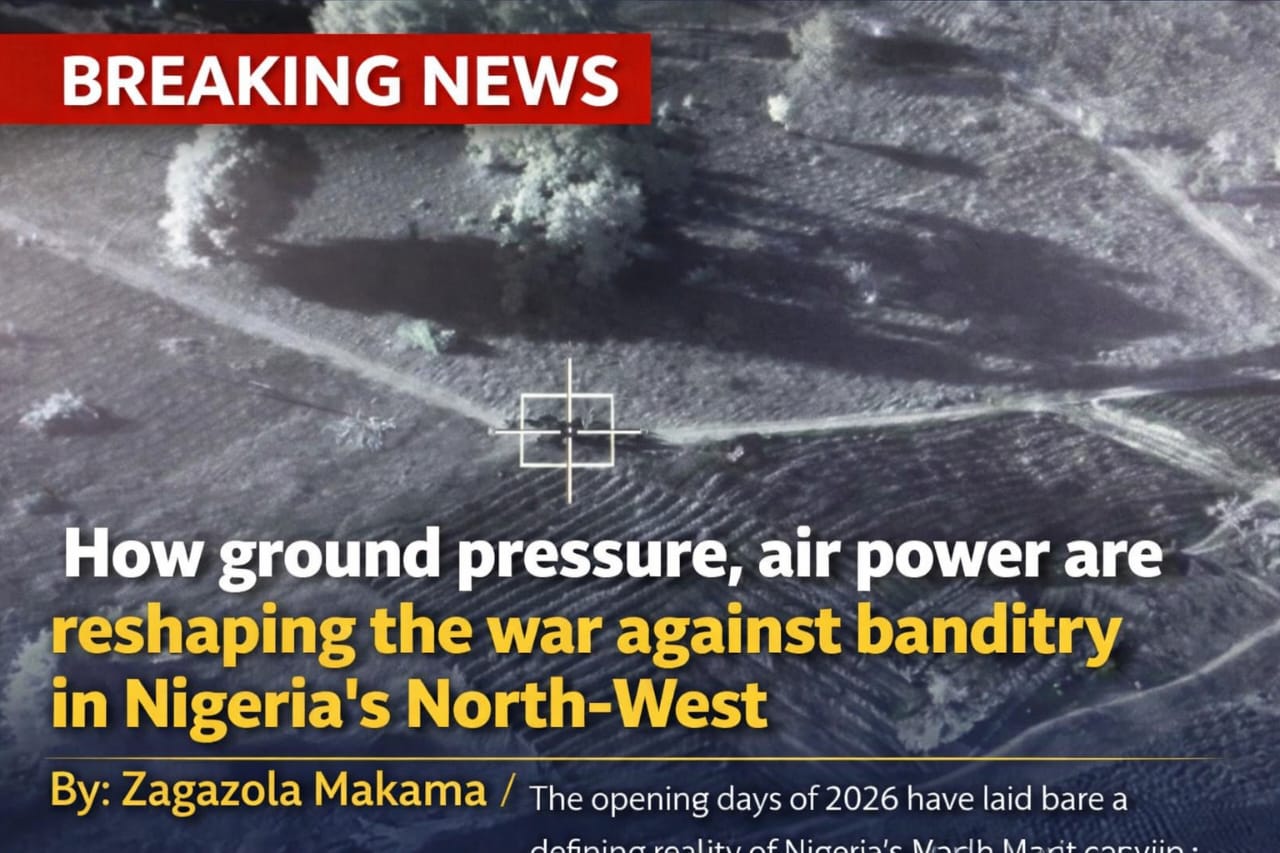
At the core of the evolving campaign is the decisive Nigerian Air Force (NAF) offensive under Operation FANSAN YANMA in Katsina State. Sustained Intelligence, Surveillance and Reconnaissance (ISR) enabled air assets to track the movement of about 50 motorcycles suspected to be ferrying armed bandits along a known infiltration corridor. When a large cluster converged in the Matazu axis, the convergence point was designated and struck with precision. Zagazola later obtained a video footage of the strike with dozens of bandits scattered and burnt beyond recognition.
The impact went beyond the immediate neutralisation of several bandits. By breaking a massed movement likely intended for an attack, redeployment or logistics transfer, the strike achieved a critical operational effect: fragmentation. In contemporary bandit warfare, where speed, numbers and surprise are force multipliers, denying criminals the ability to assemble is often as decisive as killing them outright.
Post-strike behaviour reinforced this assessment. Surviving elements scattered in disarray, disrupting coordination and degrading momentum. This pattern track, fix, strike, fragment increasingly defines the counter terrorism campaign in the North-West Operation FANSAN YANMA.
Yet the Katsina airstrike cannot be viewed in isolation. While bandit formations were being degraded from the air, armed groups continued probing vulnerabilities across the wider North-West corridor.
In Niger State’s Borgu axis, dozens of armed men on motorcycles attacked and set parts of a security outpost ablaze before fleeing. Although no casualties were recorded and no weapons lost, the incident carried symbolic weight. It illustrated the persistence of bandit and insurgent-linked elements in targeting state authority, particularly in remote, border-adjacent communities where response times are tested.
That same transnational dynamic was evident in the crash of a NAF drone on farmland in Kontagora. The drone, reportedly on an operational mission, pointed to the intensity and geographic spread of aerial surveillance and strike efforts. While no casualties were recorded, the incident illustrated the risks inherent in sustained high-tempo ISR operations across vast and rugged terrain.
On the ground, bandit violence continues to exact a human and economic toll. In Katsina’s Malumfashi axis, suspected bandits attacked Naino village, killing two residents and injuring six others. Joint security deployments, medical evacuation and blocking operations followed, but the incident reinforced a grim truth: even as air power constrains large-scale movements, smaller cells retain the ability to strike villages with lethal effect.
Similarly, in Katsina border communities near the Niger Republic, bandits rustled cattle and injured residents who attempted to resist them. Livestock theft remains central to the bandit economy, a source of funding, food and leverage over rural populations.
Further south in Kano State, attacks in Shanono and Tsanyawa LGAs revealed another layer of the conflict. In Farin-Fuwa village, bandits engaged responding forces in a gun battle that claimed the life of a soldier. In Tsanyawa, cattle rustlers struck and escaped before security teams arrived. These incidents show how bandit groups oscillate between direct confrontation and economic sabotage, depending on opportunity and resistance.
Zamfara State continues to illustrate the most complex end of the spectrum. In Bukuyyum LGA, armed bandits and elements of the outlawed YANSAKAI group carried out fatal attacks, including the killing of a civilian inside a mosque and the murder of local hunters along rural routes.
At the same time, swift intervention by security forces in another incident prevented the abduction of civilians, drawing attention to the difference timely intelligence and rapid response can make. Ongoing operations by the troops of Operation FANSAN YANMA in the Bukuyyum–Mada axis now focus on tracking fleeing elements, dominating forest corridors and recovering looted arms.
Taken together, these incidents reveal a theatre in transition rather than resolution. Bandit groups are increasingly constrained in their ability to move in large, coordinated formations, largely due to ISR-driven air operations. Yet they remain capable of opportunistic attacks, arson, targeted killings and cattle rustling, particularly in rural and border communities.
The response, correspondingly, is becoming more intelligence-centric. ISR now underpins both air interdiction and ground manoeuvre. Blocking operations, area domination and follow-on patrols increasingly complement strikes from the air, creating cumulative pressure that limits regrouping.
What is unfolding in the North-West is not a single decisive battle, but a campaign of attrition. Air power disrupts, dislocates and degrades. Ground actions deny escape, recover weapons and reassure communities.
Yet, the challenge remains far from over. Bandit networks are fluid, opportunistic and deeply embedded in difficult terrain. Sustaining pressure, maintaining ISR superiority and denying escape routes will be critical in preventing regrouping and retaliatory attacks.
The strategic lesson is clear: sustained dominance requires continuity. Tactical victories, no matter how precise, must be followed by relentless monitoring, cross-state coordination and disruption of the economic lifelines that sustain banditry.
As 2026 unfolds, early indicators suggest that when intelligence leads and force follows decisively, criminal networks pay a heavy price. The challenge ahead lies in sustaining this momentum long enough to convert battlefield success into lasting stability for communities across Katsina, Niger, Kano, Zamfara and the wider North-West region.
Zagazola Makama is a Counter Insurgency Expert and Security Analyst in the Lake Chad region.
How ground pressure, air power are reshaping the war against banditry in Nigeria’s North-West


Troops Arrest Suspected Military Impostor in Katsina
By Zagazola Makama
Troops of 17 Brigade have arrested a suspected military impostor during a fighting patrol in Malumfashi Local Government Area.
Security sources told Zagazola Makama that the suspect was apprehended at about 1:30 p.m. on July 4 by troops deployed at the Forward Operating Base (FOB) Malumfashi while conducting routine patrols within Malumfashi town.

According to the sources, the suspect was intercepted while wearing a woodland camouflage three-quarter short, raising suspicion among the troops.
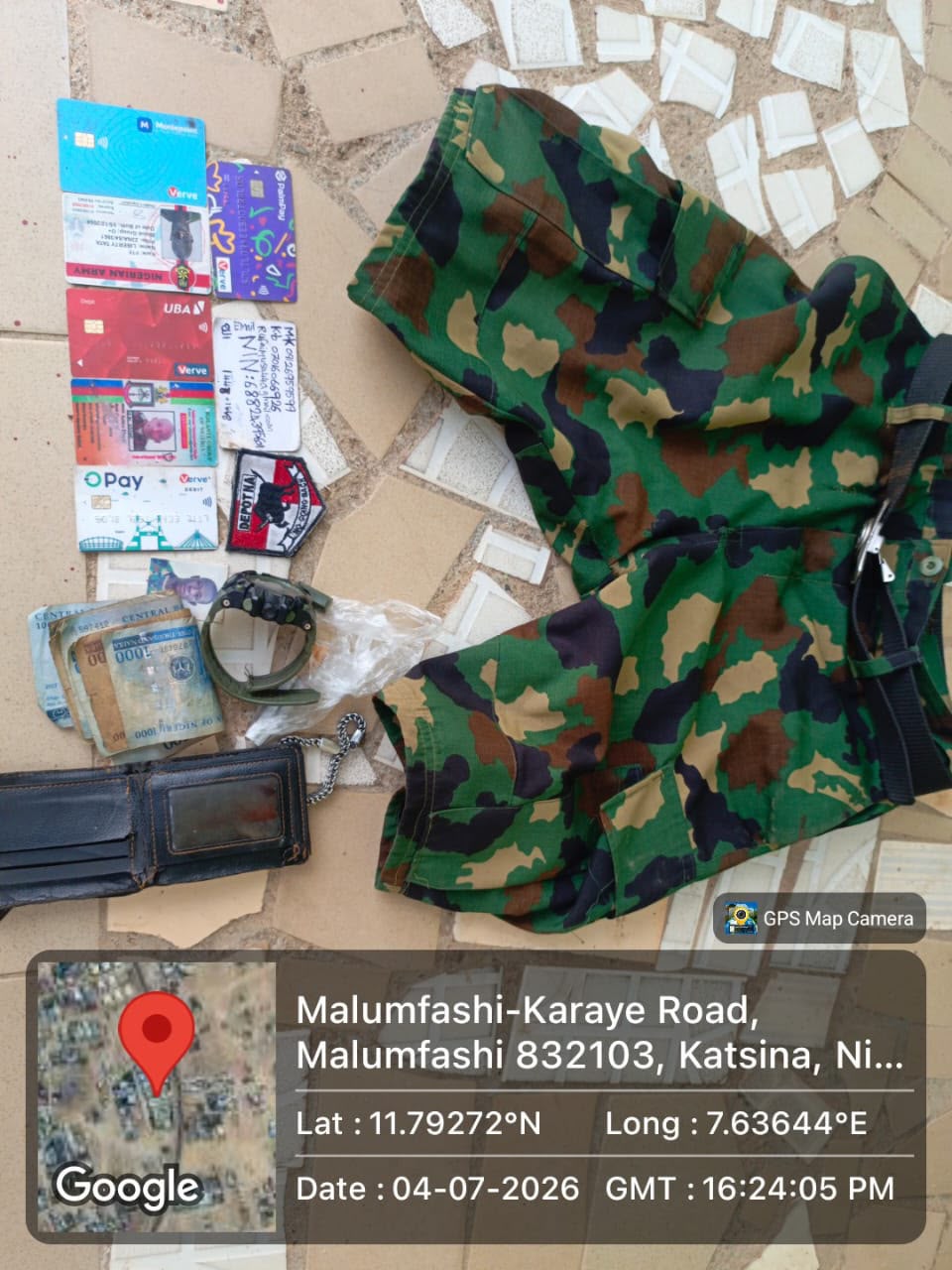
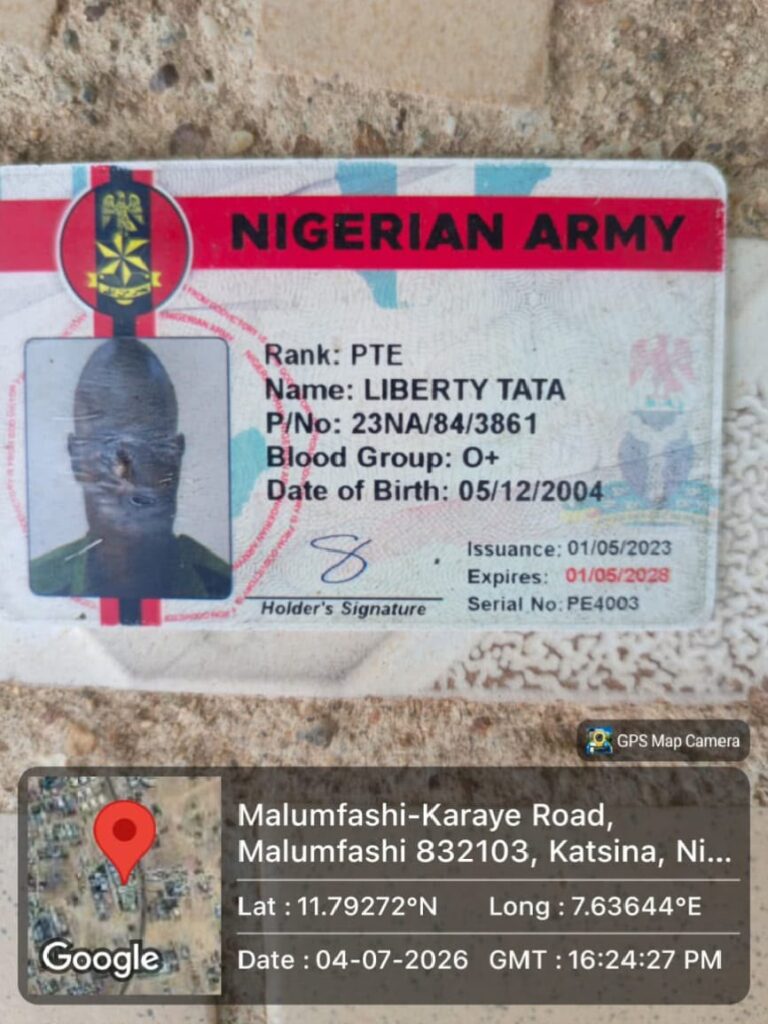
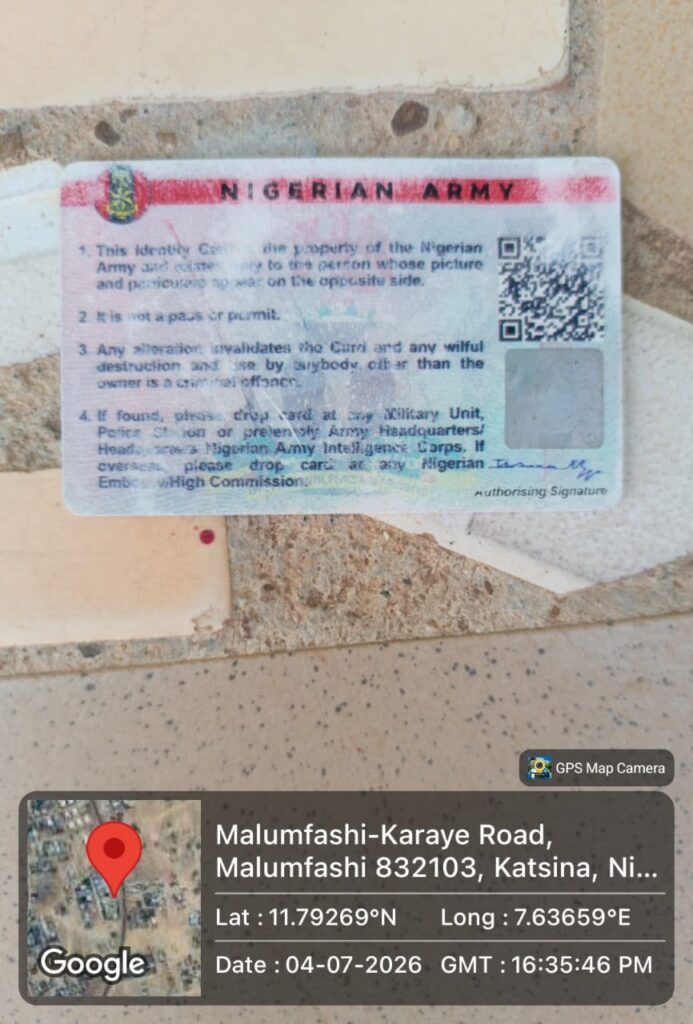
A search conducted on the suspect led to the recovery of a fake Nigerian Army identity card, four Automated Teller Machine (ATM) cards, one woodland camouflage three-quarter short, a wristwatch and the sum of ₦17,000.
The suspect and the recovered exhibits are currently in military custody pending further investigation.
Military sources said the arrest forms part of ongoing efforts to curb impersonation of security personnel and other criminal activities within the area.
Troops Arrest Suspected Military Impostor in Katsina
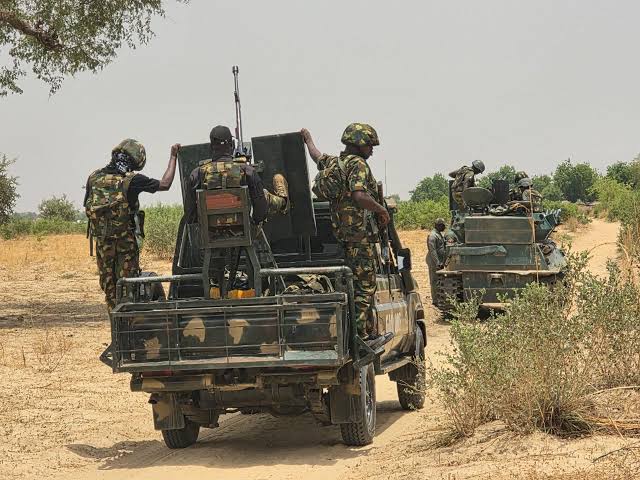
Troops Recover 50 Rustled Cattle, Repel Suspected Rustlers in Kaduna
By Zagazola Makama
Troops deployed at the Forward Operating Base (FOB) Kankomi have recovered 50 rustled cattle after repelling suspected cattle rustlers during an ambush operation in Chikun Local Government Area.
Security sources told Zagazola Makama that the troops responded to a distress call at about 9:55 a.m. on July 4 over the activities of suspected rustlers at Ungwan Gontu community.
According to the sources, the troops swiftly laid an ambush and made contact with the fleeing suspects, forcing them to abandon the stolen livestock and escape into the surrounding area.
During the operation, the troops recovered 50 rustled cattle, which were subsequently identified and handed over to their rightful owner.
Military sources said efforts are ongoing to track down the fleeing suspects as security operations continue to combat cattle rustling and other criminal activities across Kaduna State.
Troops Recover 50 Rustled Cattle, Repel Suspected Rustlers in Kaduna
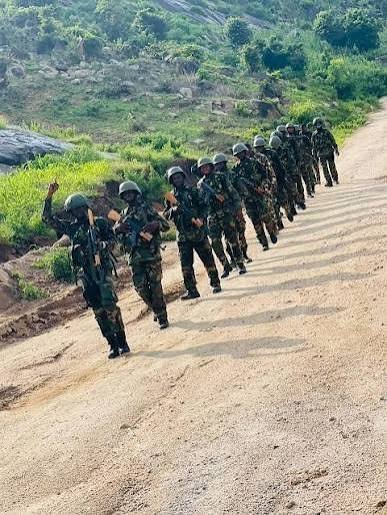
Troops Arrest Suspected Terrorist in Kogi, Suspect Confesses to Group Membership
By Zagazola Makama
Troops of 12 Brigade, in collaboration with Office of the National Security Adviser (ONSA) Hybrid Forces, have arrested a suspected terrorist during an operation in Lokoja Local Government Area.
Security sources told Zagazola Makama that the troops responded at about 1:00 p.m. on July 4 to reports of a confrontation between local residents and a suspected terrorist at a Ruga settlement behind Obajana community.
According to the sources, the troops swiftly intervened and arrested one suspect at the scene.
During preliminary interrogation, the suspect reportedly confessed to being a member of a terrorist group led by an individual identified as Haruna, which allegedly operates within the Okene general area.
The suspect is currently in military custody and is undergoing further investigation to establish the extent of his involvement and identify other members of the group.
Military sources said the arrest forms part of ongoing security operations aimed at dismantling terrorist and criminal networks across Kogi State.
Troops Arrest Suspected Terrorist in Kogi, Suspect Confesses to Group Membership

Troops Arrest Suspected Military Impostor in Katsina

Troops Recover 50 Rustled Cattle, Repel Suspected Rustlers in Kaduna

Troops Arrest Suspected Terrorist in Kogi, Suspect Confesses to Group Membership

Roger Federer’s Shock as DNA Results Reveal Myla and Charlene Are Not His Biological Children

THE PLIGHT OF FARIDA

FAILED COUP IN BURKINA FASO: HOW TRAORÉ NARROWLY ESCAPED ASSASSINATION PLOT AMID FOREIGN INTERFERENCE CLAIMS
-
 News2 years ago
Roger Federer’s Shock as DNA Results Reveal Myla and Charlene Are Not His Biological Children
-
Opinions4 years ago
THE PLIGHT OF FARIDA
-
 News1 year ago
FAILED COUP IN BURKINA FASO: HOW TRAORÉ NARROWLY ESCAPED ASSASSINATION PLOT AMID FOREIGN INTERFERENCE CLAIMS
-

 News2 years ago
EYN: Rev. Billi, Distortion of History, and The Living Tamarind Tree
-
 Opinions5 years ago
POLICE CHARGE ROOMS, A MINTING PRESS
-

 ACADEMICS2 years ago
A History of Biu” (2015) and The Lingering Bura-Pabir Question (1)
-

 Columns2 years ago
Army University Biu: There is certain interest, but certainly not from Borno.
-

 Politics1 year ago
2027: Why Hon. Midala Balami Must Go, as Youths in Hawul and Asikira/Uba Federal Constituency Reject ₦500,000 as Sallah Gift
