
Politics
PCC: Malam Bashir’s pace, determination, and commitment to repositioning the Commission


PCC: Malam Bashir’s pace, determination, and commitment to repositioning the Commission
By: Dr. James Bwala
The Public Complaints Commission (PCC) is at a pivotal point in its history as it approaches its 51st anniversary celebration on Thursday, October 15, 2026. Established to provide citizens with an avenue for seeking redress against administrative injustice, abuse of office, unfair treatment, and poor service delivery, the Commission has remained a significant institution in Nigeria’s democratic development. However, like every public organization, the PCC has experienced periods of difficulty, internal tension, and institutional uncertainty.
According to the Federal Commissioner representing Borno State, Hon. Yusuf Adamu, the Commission is now witnessing a major transformation under the leadership of its Hon. Chief Commissioner, Malam Bashir Abubakar. Adamu’s assessment carries special significance due to his personal experience. Having served during an earlier term as Federal Commissioner and returned for a second term, he has observed the Commission under different leadership circumstances. His account presents a compelling argument that mature, experienced, and people-oriented leadership can make a decisive difference in the performance and stability of a public institution.
Reflecting on the final phase of his first tenure, Hon. Adamu recalled a disturbing period in which the relationship among the staff union, state commissioners, and the leadership of the Commission deteriorated considerably. The situation, he explained, was characterized by disagreements, demonstrations, threats to down tools, and a general atmosphere of mistrust. Rather than working together toward the fulfillment of the Commission’s mandate, important stakeholders had become embroiled in conflict.
Such a situation is damaging to any organization, but it is particularly harmful to an institution whose primary responsibility is to protect citizens from injustice and maladministration. Fairness, mutual respect, consultation, and accountability must guide an agency established to promote fairness. When staff and leadership are in constant confrontation, the consequences inevitably extend beyond the organization. Administrative processes become slower, morale declines, and members of the public who depend on the institution may be denied timely assistance.
It was against this background that the return of Hon. Yusuf Adamu to the Commission coincided with the emergence of Malam Bashir Abubakar as Hon. Chief Commissioner. Adamu said the difference has been clear. He described the new leadership as a blessing to the PCC and emphasized that the progress recorded so far reflects the value of placing a mature and seasoned administrator at the head of an important government institution.
Leadership in a public organization requires more than occupying an office. It demands the ability to listen, understand competing interests, manage disagreements, inspire confidence, and translate institutional goals into practical results. It also requires patience and emotional intelligence. A leader who understands the importance of consultation is more likely to build cooperation, while a leader who appreciates the needs of workers can create an environment in which employees are motivated to give their best.
According to Hon. Adamu, Malam Bashir Abubakar has demonstrated these qualities since assuming office. One of the most notable improvements, he said, is the provision of essential materials and resources to state commissioners. This development has enabled commissioners to perform their duties more effectively and has strengthened their capacity to serve the public. Without the tools necessary to carry out official responsibilities, even the most committed public servant will struggle to produce meaningful results.
The importance of this intervention cannot be overstated. State commissioners are central to the operations of the PCC across the country. They engage with complainants, investigate cases, interact with government institutions, and represent the Commission within their respective jurisdictions. Their effectiveness depends not only on personal dedication but also on institutional support. By ensuring that commissioners have access to the materials required for their work, the current leadership has shown that administrative efficiency is not merely a slogan but a practical responsibility.
Hon. Adamu further observed that staff members are now happier and more confident because of the changes introduced under Malam Bashir Abubakar. This renewed morale is one of the strongest indicators of institutional recovery. Employees who feel valued and supported are more likely to approach their duties with commitment and dignity. They are also more willing to take responsibility, contribute ideas, and defend the reputation of the organization.
Staff welfare is not a luxury in public administration. It is a critical component of productivity and organizational stability. Workers who are constantly anxious about their future, neglected in the workplace, or treated without respect may become discouraged and disengaged. By contrast, an organization that gives its staff hope and a sense of belonging creates the conditions for better service delivery.
Adamu’s comments suggest that Malam Bashir Abubakar has begun to restore that sense of hope within the PCC. He noted that the future of staff now appears more secure and that employees are better positioned to carry out their responsibilities with pride. Although the Chief Commissioner is still working to fulfill all the promises made to the staff and the Commission, Adamu maintained that the achievements recorded so far speak loudly about the kind of leadership currently in place.
This point deserves emphasis. No leader can solve every institutional problem overnight. Public agencies often face complex challenges involving funding, personnel, infrastructure, policy, and public expectations. What matters is the direction of leadership, the seriousness of its intentions, and the consistency of its actions. A leader who recognizes existing problems and takes practical steps toward solving them deserves encouragement and support.
The progress at the PCC should therefore be understood as an ongoing process rather than a completed project. The Commission still has important work to do in improving its structures, strengthening its investigative procedures, enhancing public awareness, and ensuring that complaints are handled promptly and fairly. However, the restoration of trust among staff, commissioners, and management provides a strong foundation for addressing these challenges.
Hon. Adamu is optimistic that the Commission will soon rank among the most respected government agencies in Nigeria. His confidence is based on what he describes as Malam Bashir’s pace, determination, and commitment to repositioning the institution. The goal, he explained, is for the PCC to stand shoulder to shoulder with other leading government agencies and for its employees to stop looking elsewhere when comparing institutional standards.
This ambition is both reasonable and necessary. The Public Complaints Commission performs a unique constitutional and democratic function. It serves as an avenue through which ordinary citizens can challenge administrative wrongdoing without necessarily resorting to lengthy and expensive litigation. It also helps government institutions identify weaknesses in their operations and encourages better standards of public service.
For the PCC to fulfill this role effectively, it must itself be strong, independent, professional, and properly equipped. Its staff must have confidence in the leadership, while citizens must trust that their complaints will be taken seriously. The Commission must also continue to build partnerships with ministries, departments, agencies, state governments, civil society organizations, and the media. These relationships can enhance public awareness and encourage government institutions to respond more responsibly to complaints.
The leadership style described by Hon. Adamu offers a useful lesson for public administration in Nigeria. Institutions do not become successful simply because they are created by law. They succeed when their leaders combine vision with competence, authority with humility, and ambition with a genuine concern for people. A mature administrator understands that an organization’s greatest asset is its people and that institutional progress must include both improved performance and improved working conditions.
Malam Bashir’s reported achievements also demonstrate the importance of continuity. Meaningful reform often requires time. An incoming leader may begin a process of change, but sustainable transformation depends on the opportunity to consolidate reforms and implement long-term plans. This explains Hon. Adamu’s confidence that, if Malam Bashir serves another term, the PCC could become an even stronger and more attractive institution.
His prediction that workers will no longer regard agencies such as the Central Bank of Nigeria, the Nigerian National Petroleum Corporation, or other prominent government institutions as better alternatives reflects a larger aspiration: the creation of a public service in which every agency offers dignity, career growth, professional fulfillment, and a sense of purpose. While such a transformation will require continued effort, it is a goal worth pursuing.
As the PCC approaches its 51st anniversary, the Commission should celebrate not only its history but also the promise of its future. The anniversary provides an opportunity to recognize past contributions, evaluate present realities, and renew commitment to the citizens it was created to serve. It is also an occasion to acknowledge the importance of effective leadership in determining whether an institution stagnates or advances.
The testimony of Hon. Yusuf Adamu is therefore more than a personal commendation of Malam Bashir Abubakar. It is an affirmation that the PCC is experiencing a period of renewal in the renewed hope agenda of President Bola Ahmed Tinubu and the vice president, Kashim Shettima, led administration. The improved relationship among management, commissioners, staff, and the union suggests that the Commission is gradually moving away from confrontation and toward cooperation. The provision of work materials, attention to staff welfare, and commitment to institutional development are all signs of a leadership determined to produce results.
Nevertheless, the gains already made must be protected and expanded. The leadership should continue to engage staff and commissioners openly, communicate clearly, and maintain fairness in decision-making. Promises should be followed by measurable action, while achievements should be supported by transparent systems that will outlast individual officeholders. In this way, the progress attributed to Malam Bashir Abubakar can become a lasting institutional culture rather than a temporary phase.
The Nigerian public deserves a Public Complaints Commission that is responsive, efficient, independent, and credible. Citizens who approach the Commission should feel confident that they will be heard and treated fairly. Public servants should also work in an environment that recognizes their value and equips them to perform effectively. These objectives are connected: a well-managed and motivated workforce is better able to protect the rights and interests of citizens.
The PCC has come a long way, but it is also moving toward a greater future. Under Malam Bashir’s leadership, and with the cooperation of state commissioners, staff, unions, and other stakeholders, the Commission can become one of Nigeria’s most respected public institutions. As Hon. Yusuf Adamu has noted, the changes already recorded provide strong evidence of what determined and experienced leadership can achieve.
- James Bwala, PhD, writes from Abuja.
- PCC: Malam Bashir’s pace, determination, and commitment to repositioning the Commission






Tinubu vows to rescue abducted Askira-Uba schoolchildren, assures Borno of lasting peace
…President lauds Zulum’s restoration drive, commissions Maiduguri conference centre, female NYSC lodge amid rousing APC rally
By: Michael Mike
President Bola Ahmed Tinubu on Wednesday assured residents of Borno State that the abducted schoolchildren in Askira-Uba Local Government Area would be rescued, pledging renewed efforts to restore lasting peace and security in the North-East.
Tinubu gave the assurance in Maiduguri amid a rousing welcome by thousands of All Progressives Congress (APC) supporters and admirers who thronged the El-Kanemi Warriors Sports Centre and major streets of the state capital for the party’s rally.

The President said security agencies, the military and intelligence operatives were working to secure the release of the abducted children, assuring families and residents that the victims would be brought home.
“They abducted children of Askira Uba. They are there with our prayers, with our armed forces and intelligence. We will rescue them. We will rescue them, insha’Allah,” Tinubu said.
He paid tribute to the armed forces for their sacrifices in confronting insurgency and terrorism, saying soldiers had endured harsh conditions in the bush, under the sun and in the rain, risking their lives to secure Borno, particularly Maiduguri.
“We will achieve that peace. Terrorism will go,” he declared, expressing confidence that sustained military and security efforts would eventually defeat insurgency.
Tinubu also urged terrorists and bandits to abandon violence and surrender their weapons, calling on them to seize the opportunity to renounce criminality and embrace peace.

The President’s visit coincided with the commissioning of development projects executed by the Borno State Government, including the Maiduguri International Conference Centre and a special hostel for female members of the National Youth Service Corps (NYSC).
Tinubu praised Governor Babagana Umara Zulum for his reconstruction, rehabilitation and development efforts, describing the governor’s work as a restoration of hope in a state ravaged by years of insurgency.
“Well done for the Borno restoration, restoring our hope, believing that stability will bring development. You are doing a great job,” the President said.
Describing his visit as a homecoming, Tinubu said he felt among family members, thanking the people of Borno for their support for the APC and his administration.
“To be here, I feel I’ve come home to a family reunion. It is great to be back in Borno,” he said.
He commended Zulum for bringing hope back to residents through investments in infrastructure and development, while expressing appreciation to Vice-President Kashim Shettima and the people of the state for their political support.
Tinubu also acknowledged the contributions of APC National Chairman, Professor Nentawe Yilwatda; the campaign Director-General; the Speaker of the House of Representatives; Deputy Senate President; former Borno governor, Senator Ali Modu Sheriff; Senator Mohammed Ali Ndume; Hon. Betara and other party leaders.
He urged residents to support the APC at all levels of government, from the Presidency to the state legislature.
Earlier, Vice-President Kashim Shettima commended the people of Borno for the massive turnout and enthusiastic reception accorded the President, describing the gathering as a demonstration of the state’s solidarity with the APC.
Shettima said the party was determined to secure electoral victories across all six states of the North-East, urging party members and stakeholders to sustain their mobilisation efforts.
Maiduguri was decorated with billboards bearing images of Tinubu, Shettima, Zulum and other APC leaders, while banners, party flags and campaign songs transformed major streets into a carnival-like atmosphere ahead of the rally.
The event was attended by First Lady, Senator Oluremi Tinubu; Vice-President Shettima and his wife, Hajiya Nana Kashim Shettima; Speaker of the House of Representatives; Deputy Senate President; Governor Zulum; governors of Gombe, Yobe, Adamawa, Nasarawa, Zamfara, Taraba and Imo states; APC national executives; members of the National Assembly; wives of governors and other dignitaries.
The rally’s highlight was the presentation of flags by the APC national chairman to gubernatorial candidates of the six North-East states, signalling the party’s preparations for the forthcoming electoral contests.
Tinubu vows to rescue abducted Askira-Uba schoolchildren, assures Borno of lasting peace
Politics
Tinubu receives triumphant welcome in Maiduguri, vows to rescue abducted Lassa, Mussa schoolchildren

Tinubu receives triumphant welcome in Maiduguri, vows to rescue abducted Lassa, Mussa schoolchildren
…Lauds Zulum, commissions Maiduguri conference centre, female NYSC lodge
By: Our Reporter
President Bola Ahmed Tinubu has assured the people of Borno State of improved security and pledged that the abducted children of Askira Uba would be rescued.
Maiduguri was agog on Wednesday as thousands of APC supporters and admirers of President Bola Ahmed Tinubu thronged the El-Kanemi Warriors Sports Centre and streets of Maiduguri for the party’s presidential campaign rally.

Billboards of the president, Vice President Kashim Shettima, Governor Babagana Umara Zulum and other party leaders, together with banners and APC flags, lined major streets. At the same time, campaign songs filled the air as the president arrived.
Addressing the mammoth crowd, the president said the government and the security agencies were working assiduously to free the victims of the Lassa and Mussa school abduction.

“They abducted children of Askira Uba. They are there with our prayers, with our armed forces and intelligence. We will rescue them. We will rescue them, insha’Allah,” he said.
On the wider security situation, President Tinubu paid tribute to the armed forces. He said they had “been in the bush, in the sun, in the rain” and “put their life on the line for Borno, particularly Maiduguri, to have peace and for us.”
“We will achieve that peace. Terrorism will go,” he declared.
He also urged insurgents and bandits to abandon violence. “They have the opportunity now to lay down their arms, to lay down all arms and surrender all weapons. Change from the character of terrorism and banditry,” the President said.
Meanwhile, during his address, Vice President Kashim Shettima commended the people of Borno for the rousing welcome they gave President Bola Ahmed Tinubu.

Senator Shettima also lauded all stakeholders for rallying around the APC, stressing that the All Progressives Congress is determined to sweep all six states in the northeast region.
….Tinubu lauds Zulum, commissions Maiduguri conference centre, female NYSC lodge
President Bola Ahmed Tinubu has praised Governor Babagana Umara Zulum’s reconstruction efforts and described his visit to Borno State as a homecoming.
He thanked the people of the state for supporting the All Progressives Congress (APC).
President Tinubu lauded Governor Zulum for what he called the “Borno restoration.” “Well done for the Borno restoration, restoring our hope, believing that stability will bring development. You are doing a great job,” he said.
The president said: “To be here, I feel I’ve come home to a family reunion. It is great to be back in Borno.”
President Tinubu said he had earlier commissioned a special hostel for the NYSC women’s group and the Maiduguri International Conference Centre. “You are bringing hope back to the people. Babagana Umara Zulum, thank you very much. We commend your efforts,” he said.
He also saluted his running mate, Vice President Kashim Shettima, and credited the people of Borno for the party’s progress. “Without the support of Borno people, we wouldn’t have gotten this far. Thank you,” he said.
The president also thanked the party chairman, Professor Nentawe Yilwatda; the Director-General of the campaign; the Speaker; the Deputy Senate President; former Governor Senator Ali Modu Sheriff; Senator Mohammed Ali Ndume; Hon. Betara; and the governors present.
He called on the people of the state to vote for APC at all levels, from the Presidency to the state assembly.
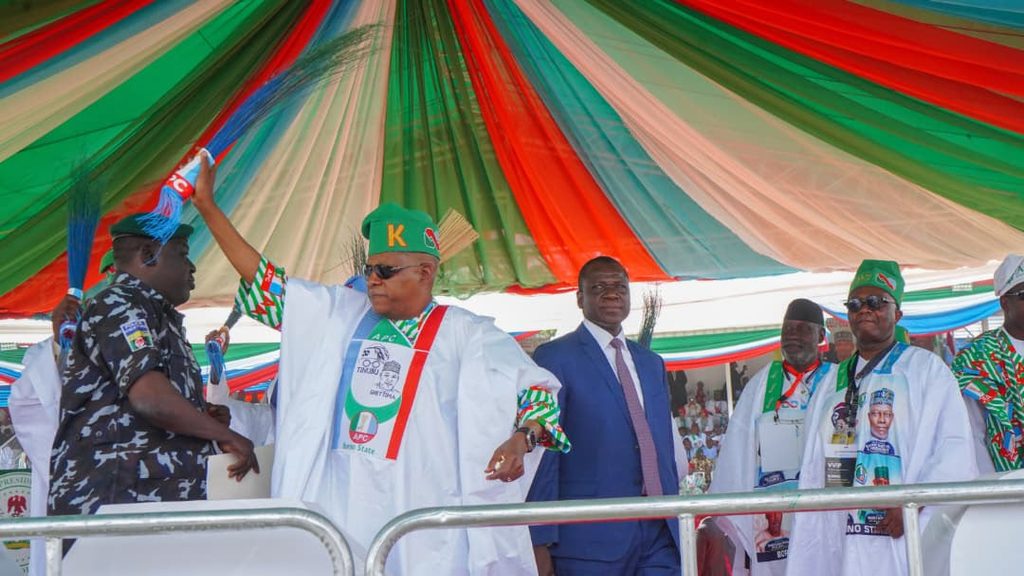
The rally was attended by the Wife of the President, Senator Oluremi Tinubu; Vice President, Senator Kashim Shettima and his wife, Hajiya Nana Kashim Shettima; Speaker of the House of Representatives; Deputy Senate President; Borno State Governor, Professor Babagana Umara Zulum; and Governors of Gombe, Yobe, Adamawa, Nasarawa; Zamfara, Taraba, Imo; APC National Chairman and other Party Executives; Director General, APC Presidential Campaign Council; members of the National Assembly; wives of Governors, and other dignitaries
The highlight of the rally was the presentation of flags to the gubernatorial candidates of the six states in the region by the national chairman.
Tinubu receives triumphant welcome in Maiduguri, vows to rescue abducted Lassa, Mussa schoolchildren
Politics
Engr. Mustapha Gubio: The APC Flag, the Political Signals and a New Chapter in Borno State’s Leadership Conversation


Engr. Mustapha Gubio: The APC Flag, the Political Signals and a New Chapter in Borno State’s Leadership Conversation
By: Dr James Bwala
At the El-Kanemi Warriors Stadium in Maiduguri, history was written in an atmosphere filled with excitement, solidarity, and renewed hope. The massive gathering of supporters, the deafening cheers, the colourful displays, and the vibrant energy that characterised the All Progressives Congress (APC) presidential campaign rally demonstrated the strong political enthusiasm of the people of Borno State. The occasion became even more significant when Engr. Mustapha Gubio received the APC flag as the party’s candidate for the governorship of Borno State.
The event was not merely a political ceremony. It was a public declaration of confidence in a candidate regarded by many as capable of providing purposeful, inclusive, and development-orientated leadership. In the presence of President and Commander-in-Chief, Asiwaju Bola Ahmed Tinubu; the Vice President, Senator Kashim Shettima; the Governor of Borno State, Professor Babagana Umara Zulum; and other leaders of the party, Engr. Gubio’s emergence represented a new chapter in Borno’s political journey. It signalled the party’s determination to consolidate progress, strengthen unity, and build a more prosperous future for the state.
The reception was accorded to Engr. Gubio at the rally reflected more than partisan loyalty. It expressed the aspirations of citizens who desire a government that understands their challenges and is committed to addressing them with competence, courage, and compassion. His candidacy provides an opportunity for Borno State to advance a leadership agenda founded on security, economic recovery, human development, infrastructure, and social cohesion.
Borno State has endured difficult years. The impact of insecurity has affected communities, families, schools, farms, businesses, and public institutions. Although significant progress has been achieved in restoring peace and rebuilding affected areas, much work remains to be done. The state needs a leader who can preserve the gains already made while introducing innovative strategies to address emerging challenges. Engr. Mustapha Gubio’s candidacy is persuasive because it offers the possibility of continuity with improvement—a leadership approach that respects existing achievements but is not afraid to pursue new solutions.
The administration of Governor Babagana Umara Zulum has earned recognition for its efforts in reconstruction, rehabilitation, resettlement, education, healthcare, and infrastructure. The governor’s commitment to the welfare of displaced individuals and vulnerable communities has helped restore confidence in government. However, the scale of the challenges facing Borno requires sustained leadership beyond a single administration. The next governor must build upon ongoing programs, protect public investments, and ensure that development reaches every local government area.
Engr. Gubio is positioned to provide this continuity while bringing his own vision and energy to governance. His acceptance of the APC flag at such a historic gathering symbolises his readiness to shoulder the responsibility of leading the state. The flag is not simply a party emblem; it represents the trust of the party leadership, the expectations of millions of citizens, and the obligation to serve with integrity. By receiving it, Engr. Gubio accepted a mandate that must be fulfilled through action, accountability, and respect for the people.
One of the most compelling reasons to support Engr. Gubio is the need for leadership that places security at the centre of development. Without peace, agriculture cannot thrive, children cannot learn properly, businesses cannot expand, and communities cannot plan confidently for the future. Borno requires a governor who will work closely with the federal government, security agencies, traditional institutions, community leaders, and local stakeholders to strengthen security and prevent the return of violence.
Security must also be understood beyond military operations. It includes employment, education, justice, social inclusion, and opportunities for young people. A young person with access to quality education, vocational training, and decent employment is less vulnerable to recruitment by criminal or extremist groups. Therefore, a comprehensive security agenda under Engr. Gubio should combine effective intelligence and law enforcement with investments in human capital and economic opportunity.
Agriculture should be another central pillar of the proposed administration. Borno possesses vast agricultural potential, yet many farmers have faced displacement, insecurity, inadequate inputs, poor storage facilities, and limited access to markets. A government led by Engr. Gubio should support farmers with improved seeds, modern equipment, irrigation, extension services, affordable credit, and guaranteed market access. The goal should not only be food production but also the development of agricultural value chains that create jobs and generate wealth.
The recovery of Borno’s economy depends largely on empowering small and medium-sized enterprises. Local traders, artisans, transport operators, women entrepreneurs, and young innovators need policies that reduce the burden of doing business. Access to affordable finance, business training, digital tools, and reliable infrastructure can help transform informal economic activity into sustainable enterprises. Engr. Gubio should therefore promote an economic environment in which citizens are encouraged to produce, invest, innovate, and create employment.
Education must also receive urgent attention. The future of Borno depends on the quality of learning available to its children and young people. The state needs well-equipped schools, qualified teachers, safe learning environments, science and technology programmes, and expanded opportunities for technical and vocational education. Special attention should be given to girls, displaced children, children with disabilities, and learners in rural communities.
A forward-looking administration should also expand partnerships with universities, research institutions, private organisations, and international development agencies. Such partnerships can support teacher training, digital learning, entrepreneurship, healthcare education, and skills development. Engr. Gubio’s leadership should make education a practical instrument for rebuilding society and preparing young people for a changing economy.
Healthcare is equally important. Communities affected by conflict and poverty often suffer from inadequate medical facilities, shortages of health workers, maternal health challenges, and limited access to essential drugs. The state requires stronger primary healthcare centres, mobile medical services for hard-to-reach areas, improved maternal and child health programmes, and better emergency response systems. A healthy population is more productive, more resilient, and better able to participate in development.
Infrastructure development will also determine the success of the next administration. Roads, water supply, electricity, drainage systems, housing, and telecommunications are essential to the wellbeing of citizens and the growth of businesses. Reconstruction must be guided by careful planning, environmental responsibility, and fairness. Rural communities should not be neglected in favour of urban centres. Development should connect villages, towns, and cities while ensuring that public projects are durable and beneficial to the people.
Engr. Gubio’s candidacy also carries the promise of inclusive governance. Borno State is diverse in its communities, cultures, professions, and political interests. Effective leadership must therefore unite rather than divide. The government should create platforms through which traditional rulers, religious leaders, women, youth, civil society organisations, professional associations, and persons with disabilities can contribute to policymaking.
Women and young people deserve particular attention. Women are central to the stability and economic life of families, yet they frequently face limited access to finance, education, political representation, and employment. A responsible administration should support women-owned enterprises, maternal health, girls’ education, and participation in public decision-making. Young people, meanwhile, should be treated not only as beneficiaries of government programmes but also as partners in governance and innovation.
The support displayed at the El-Kanemi Warriors Stadium imposes a moral responsibility on Engr. Gubio and the APC. Political enthusiasm must be transformed into measurable performance. Citizens are increasingly aware of their rights and expectations. They want transparent budgets, responsible public spending, accessible leaders, and clear explanations of government decisions. The incoming administration must establish strong institutions, publish development plans, monitor projects, and encourage citizens to participate in evaluating public programmes.
The APC leadership, from President Bola Ahmed Tinubu and Vice President Kashim Shettima to Governor Babagana Umara Zulum and other party stakeholders, has demonstrated confidence in Engr. Gubio by entrusting him with the party’s flag. That confidence should be matched by continued support, especially in the areas of security, infrastructure, reconstruction, and economic development. Borno State cannot be isolated from national development efforts; it must remain an important partner in the federal government’s agenda.
The rally in Maiduguri salutes Mr President and therefore represents both celebration and commitment. It celebrated the emergence of Engr. Mustapha Gubio as the APC candidate, but it also reminded him of the enormous responsibility ahead. The cheers of supporters were a call for service. The colourful displays were expressions of hope. The presence of national and state leaders was a demonstration of political solidarity. Together, these elements formed a powerful mandate for purposeful leadership to come in 2027.
Borno State needs a governor who will listen carefully, plan intelligently, act decisively, and remain accountable. It needs a leader who understands that public office is a trust, not a privilege; that power must be used to improve lives; and that development must reach ordinary citizens. Engr. Mustapha Gubio has the opportunity to present himself as that leader.
As the APC looks toward the next political phase, the people of Borno State should evaluate candidates according to their competence, character, experience, vision, and commitment to peace and development. On these grounds, Engr. Gubio’s candidacy deserves serious consideration and broad support. His emergence provides an opportunity to consolidate the progress of the present administration while opening a new era of innovation, inclusion, and prosperity.
The message from the El-Kanemi Warriors Stadium was also very clear: the people of Borno State have declared their support for President Tinubu and Vice President Kashim Shettima. Borno is ready for leadership that will protect its people, rebuild its communities, empower its youth, strengthen its economy, and unite its citizens. With the support of the APC, the guidance of President Tinubu, the partnership of Vice President Shettima, the contributions of Governor Zulum, and the trust of the people, Engr. Mustapha Gubio is the next man in Borno state; newspapers will struggle for space to ink his achievements in the new era, which comes in 2027.
- James Bwala, PhD, writes from Maiduguri.
Engr. Mustapha Gubio: The APC Flag, the Political Signals and a New Chapter in Borno State’s Leadership Conversation

30 HIGH-PROFILE CORRUPTION CASES EXPOSE JUSTICE SYSTEM FAILURES, STALLING ACCOUNTABILITY

Bura Day on the Plateau: When Cultural Heritage Draws the Line
Shosa: 2026 Reunion, Achievements, Challenges, and the Way Forward

Roger Federer’s Shock as DNA Results Reveal Myla and Charlene Are Not His Biological Children

THE PLIGHT OF FARIDA

FAILED COUP IN BURKINA FASO: HOW TRAORÉ NARROWLY ESCAPED ASSASSINATION PLOT AMID FOREIGN INTERFERENCE CLAIMS
-
 News3 years ago
Roger Federer’s Shock as DNA Results Reveal Myla and Charlene Are Not His Biological Children
-
Opinions5 years ago
THE PLIGHT OF FARIDA
-
 News2 years ago
FAILED COUP IN BURKINA FASO: HOW TRAORÉ NARROWLY ESCAPED ASSASSINATION PLOT AMID FOREIGN INTERFERENCE CLAIMS
-
 Opinions5 years ago
POLICE CHARGE ROOMS, A MINTING PRESS
-

 News3 years ago
EYN: Rev. Billi, Distortion of History, and The Living Tamarind Tree
-

 ACADEMICS3 years ago
A History of Biu” (2015) and The Lingering Bura-Pabir Question (1)
-

 Columns3 years ago
Army University Biu: There is certain interest, but certainly not from Borno.
-

 Politics1 year ago
2027: Why Hon. Midala Balami Must Go, as Youths in Hawul and Asikira/Uba Federal Constituency Reject ₦500,000 as Sallah Gift
