
News
Accessing healthcare: An arduous journey for pregnant women in northwest Nigeria

Accessing healthcare: An arduous journey for pregnant women in northwest Nigeria
By: Michael Mike
In the bustling emergency ward of Jahun General Hospital’s maternity department, the rhythm of activity beats with urgency and determination, like a pulse in the air. In this hospital, Médecins Sans Frontières (MSF) collaborates with the Jigawa state Ministry of Health to provide comprehensive emergency obstetrics and newborn care and fistula care. Since commencing services in 2008, MSF teams have assisted 90,000 deliveries.
Nigeria is the third country in the world, after South Sudan and Chad, where a woman is most likely to die giving birth, according to the World Health Organisation. With an average of more than 1,000 maternal deaths per 100,000 live births each year, Nigeria is far from the global target for 2030 of less than 70 maternal deaths per 100,000 live births, as set under the UN Sustainable Development Goals.
Maternal mortality rates far exceed the country average in northern Nigeria, where more than half of the country’s estimated 200 million people live. In Jigawa state, the most significant factor is the limited access pregnant women have to antenatal care and delivery care for complications in childbirth, which frequently occur.
Unity Enuebuke, MSF Nursing Activity Manager, has been working in Jahun General Hospital for more than 10 years. “We see a lot of women with serious complications, with the most common ones being anaemia, haemorrhage and eclampsia,” she explains. The high number of patients means the maternity wards are often fully occupied, if not over capacity. Unity says, “We regularly have up to two women sharing a bed, and depending on the type of complications we see, things can escalate very quickly.”
Ramatu
Ramatu, a mother of two, suffered life-threatening eclampsia—seizures due to high blood pressure—when she delivered her first baby in Jahun hospital. This is her second time here, overcoming the considerable distance from home. “I live five hours away from Jahun General Hospital. There is no hospital where I live, and the closest one does not open at night,” she explains. In Jigawa state, many of the estimated 749 primary healthcare centres do not have the drugs, healthcare workers and medical equipment to serve the thousands of women of childbearing age, despite efforts from public health authorities, the current healthcare infrastructure does not come close to meeting the needs of the population.
This dire situation leaves pregnant women who want to attend a healthcare facility with limited choices such as giving birth at home, and if complications arise, embarking on a treacherous journey to try to reach one that is functioning.
It is also not enough that healthcare facilities are available, they must also be affordable. The economic reality in this region, worsened by soaring inflation rates, makes it difficult for people to afford hospital fees, drugs or even transportation to health facilities.
The result is that women become hesitant to go to the hospital, preferring to give birth at home with the help of more affordable traditional birth attendants, hence increasing the risk of experiencing complications.
Khadijah
Women have given birth at home for centuries, but mother’s and baby’s survival can hinge on preparing and planning for managing complications, which may also occur without warning. In Jigawa state, health professionals and facility-based delivery rates remain low with up to around 80% of deliveries occurring at home.
Nurse Unity says, “Most times, family members don’t bring the mother to the hospital until they see that the baby is not coming out and the mother herself is having seizures.”
Khadijah, a 58-year-old traditional birth attendant in Aujara community, Jigawa state, understands the value of hospital care if she can’t manage a complication, but has experienced women’s hesitation firsthand. “Some women take my advice when I say they should go to the hospital, while some refuse to go to the hospital because they say that they are used to giving birth at home.”
In many communities in Jigawa state, pregnant women often require permission from their husband or mothers-in-law to visit hospital. This practice is compounded by a trend of early marriage, at an age when women are not fully informed about pregnancy and are not physically ready to carry a child.
Khadijah explains that for some, “it is their husbands that prevent them from going to the hospital. Some men don’t see the relevance of antenatal care, while others don’t want another man to treat their wives.”
1.
What needs to be done?
To tackle maternal mortality, a multitude of factors must be addressed. State authorities and international organisations must scale up their activities and increase funding to healthcare in the region, ensuring that budget allocations for primary healthcare centres are properly utilised and thorough planning and strict implementation processes are in place. In 2023, MSF teams assisted 15,754 deliveries, performed 1,911 caesarean sections and completed 43,785 antenatal consultations. Yet, it is still a drop in the ocean when looking at the needs of women in Jigawa state.
Primary healthcare facilities, which are often the first point where pregnant women seek healthcare, need to be equipped with trained personnel, equipment and resources to manage childbirth-related complications. “Eighty two percent of the cases we receive at Jahun General Hospital are complicated cases that could have been prevented at the primary healthcare level.” says Abdulwahab Mohamed, MSF medical coordinator. “Women, especially those of childbearing age, also have to be informed about their health and wellbeing through health empowerment programmes led by state authorities or other health stakeholders”.
Pregnant women must be encouraged to go for antenatal care where they can be informed about their pregnancy journey and what to expect. Efforts must be made to mitigate cultural practices that hinder women from seeking care in medical facilities. Women should be allowed agency and given freedom to make decisions for their health.
MSF supports the Jigawa state Ministry of Health in providing comprehensive emergency obstetrics and newborn care. Our support started with vesicovaginal fistula repair in 2008, however, the project evolved into a 161-bed facility to care for pregnant women and newborns experiencing complications. MSF teams also provide maternal and neonatal healthcare in the states of Kano, Benue, Cross River, Zamfara and will open a large maternity hospital in Maiduguri in June 2024.
Accessing healthcare: An arduous journey for pregnant women in northwest Nigeria


Troops Arrest Suspected Military Impostor in Katsina
By Zagazola Makama
Troops of 17 Brigade have arrested a suspected military impostor during a fighting patrol in Malumfashi Local Government Area.
Security sources told Zagazola Makama that the suspect was apprehended at about 1:30 p.m. on July 4 by troops deployed at the Forward Operating Base (FOB) Malumfashi while conducting routine patrols within Malumfashi town.
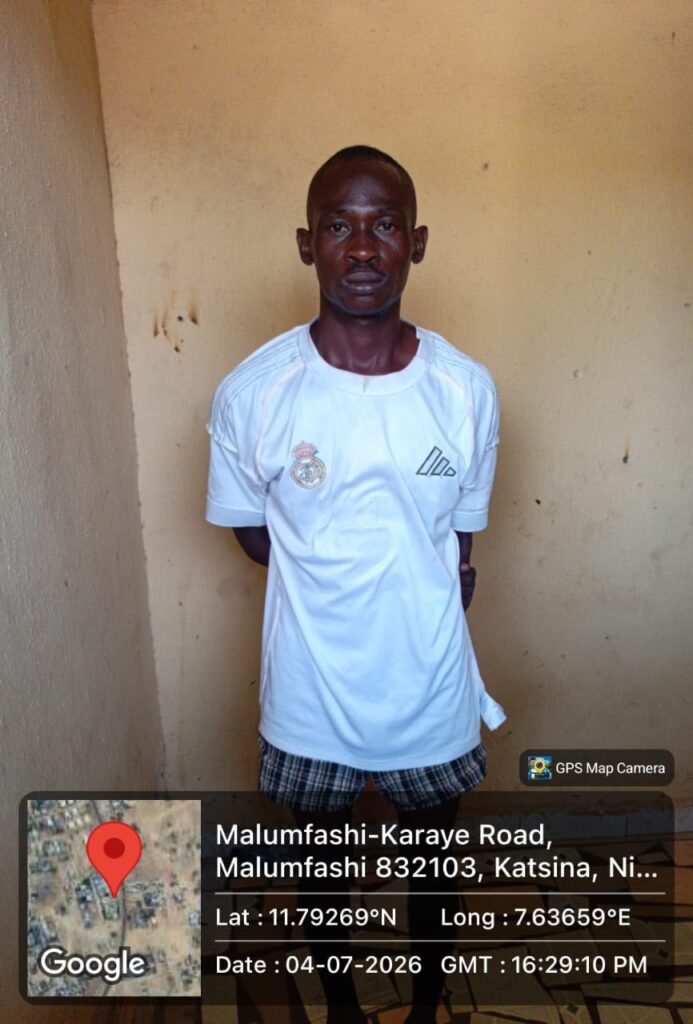
According to the sources, the suspect was intercepted while wearing a woodland camouflage three-quarter short, raising suspicion among the troops.
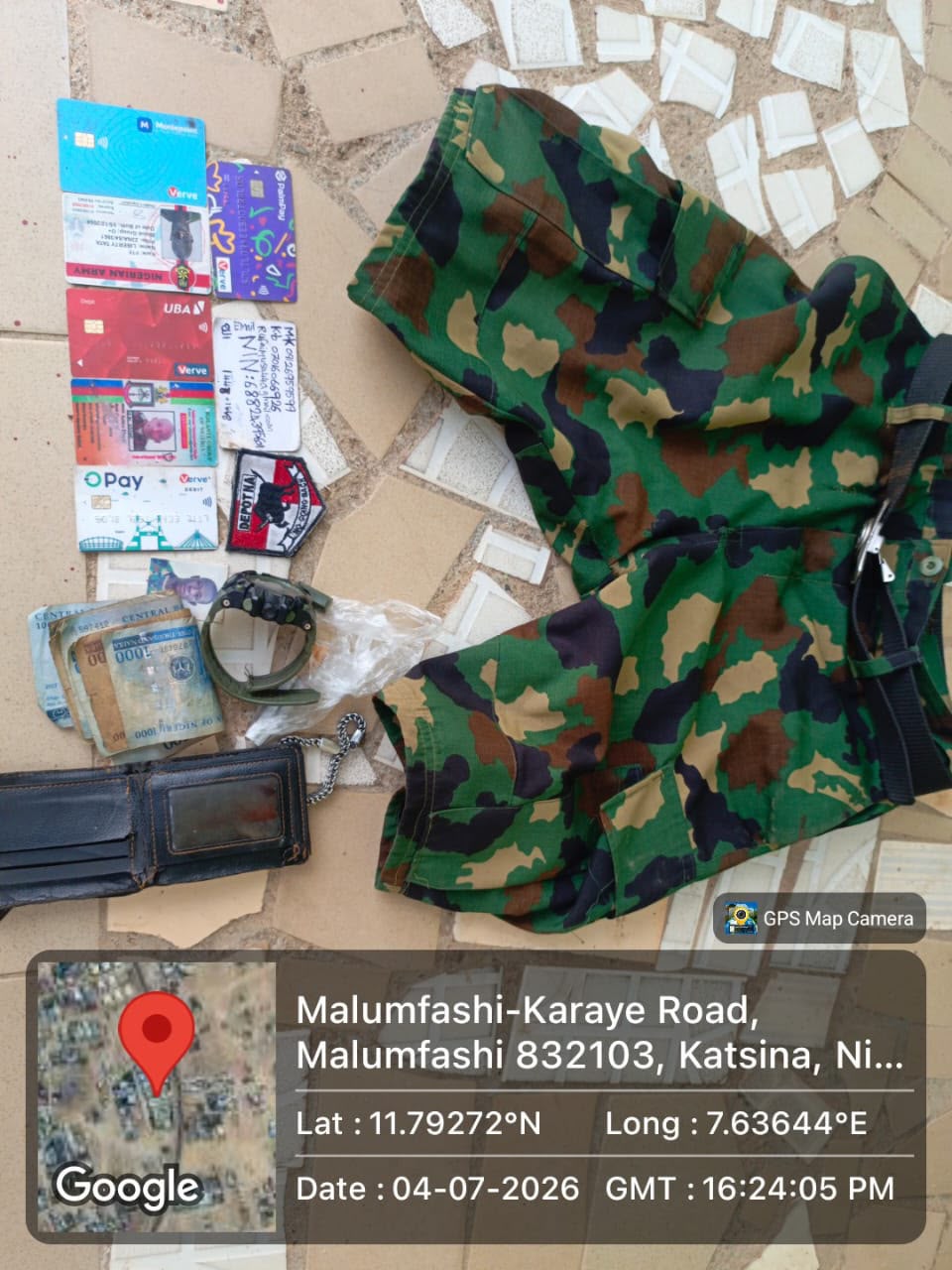
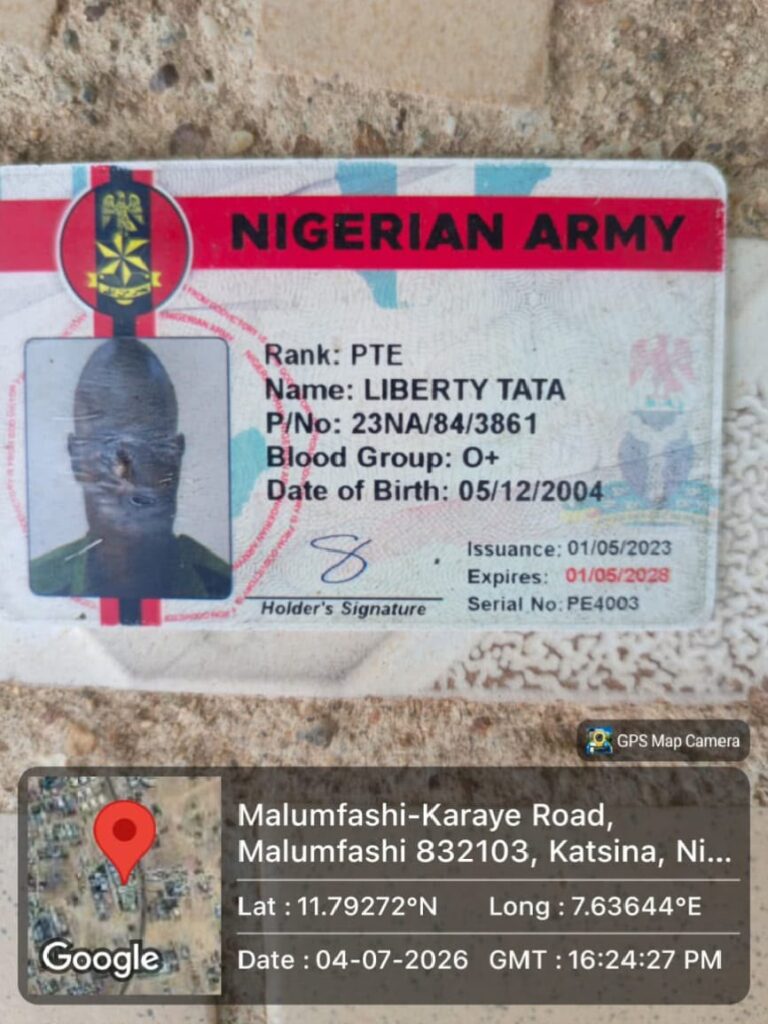
A search conducted on the suspect led to the recovery of a fake Nigerian Army identity card, four Automated Teller Machine (ATM) cards, one woodland camouflage three-quarter short, a wristwatch and the sum of ₦17,000.
The suspect and the recovered exhibits are currently in military custody pending further investigation.
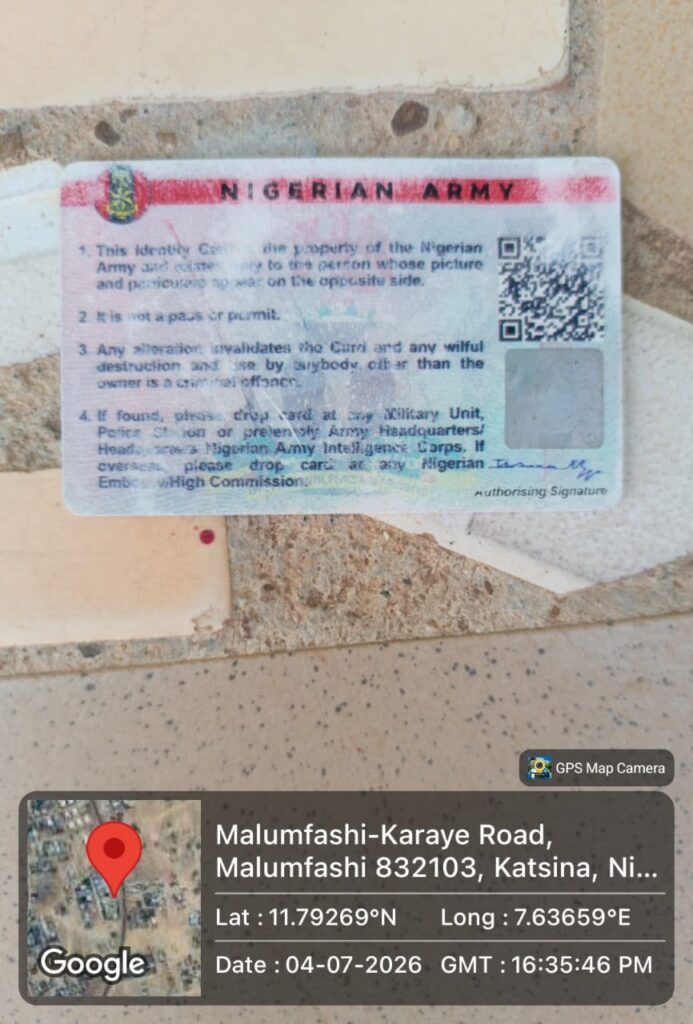
Military sources said the arrest forms part of ongoing efforts to curb impersonation of security personnel and other criminal activities within the area.
Troops Arrest Suspected Military Impostor in Katsina
Troops Recover 50 Rustled Cattle, Repel Suspected Rustlers in Kaduna
By Zagazola Makama
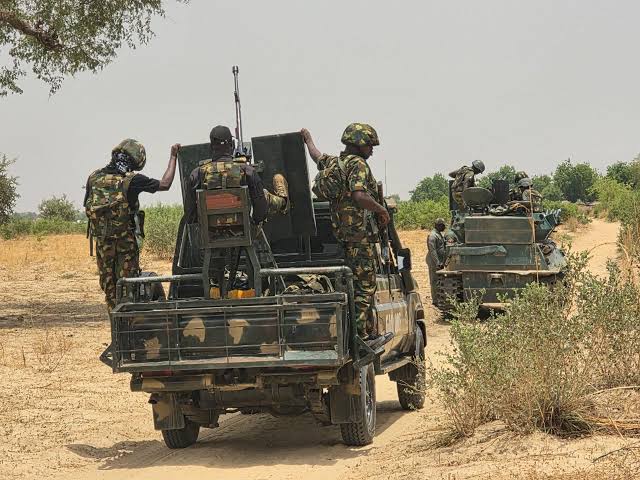
Troops deployed at the Forward Operating Base (FOB) Kankomi have recovered 50 rustled cattle after repelling suspected cattle rustlers during an ambush operation in Chikun Local Government Area.
Security sources told Zagazola Makama that the troops responded to a distress call at about 9:55 a.m. on July 4 over the activities of suspected rustlers at Ungwan Gontu community.
According to the sources, the troops swiftly laid an ambush and made contact with the fleeing suspects, forcing them to abandon the stolen livestock and escape into the surrounding area.
During the operation, the troops recovered 50 rustled cattle, which were subsequently identified and handed over to their rightful owner.
Military sources said efforts are ongoing to track down the fleeing suspects as security operations continue to combat cattle rustling and other criminal activities across Kaduna State.
Troops Recover 50 Rustled Cattle, Repel Suspected Rustlers in Kaduna
Troops Arrest Suspected Terrorist in Kogi, Suspect Confesses to Group Membership
By Zagazola Makama
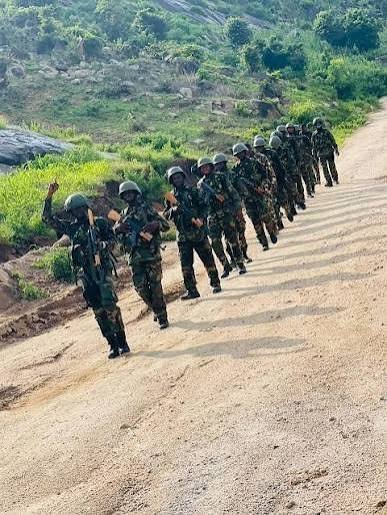
Troops of 12 Brigade, in collaboration with Office of the National Security Adviser (ONSA) Hybrid Forces, have arrested a suspected terrorist during an operation in Lokoja Local Government Area.
Security sources told Zagazola Makama that the troops responded at about 1:00 p.m. on July 4 to reports of a confrontation between local residents and a suspected terrorist at a Ruga settlement behind Obajana community.
According to the sources, the troops swiftly intervened and arrested one suspect at the scene.
During preliminary interrogation, the suspect reportedly confessed to being a member of a terrorist group led by an individual identified as Haruna, which allegedly operates within the Okene general area.
The suspect is currently in military custody and is undergoing further investigation to establish the extent of his involvement and identify other members of the group.
Military sources said the arrest forms part of ongoing security operations aimed at dismantling terrorist and criminal networks across Kogi State.
Troops Arrest Suspected Terrorist in Kogi, Suspect Confesses to Group Membership

Troops Arrest Suspected Military Impostor in Katsina

Troops Recover 50 Rustled Cattle, Repel Suspected Rustlers in Kaduna

Troops Arrest Suspected Terrorist in Kogi, Suspect Confesses to Group Membership

Roger Federer’s Shock as DNA Results Reveal Myla and Charlene Are Not His Biological Children

THE PLIGHT OF FARIDA

FAILED COUP IN BURKINA FASO: HOW TRAORÉ NARROWLY ESCAPED ASSASSINATION PLOT AMID FOREIGN INTERFERENCE CLAIMS
-
 News2 years ago
Roger Federer’s Shock as DNA Results Reveal Myla and Charlene Are Not His Biological Children
-
Opinions4 years ago
THE PLIGHT OF FARIDA
-
 News1 year ago
FAILED COUP IN BURKINA FASO: HOW TRAORÉ NARROWLY ESCAPED ASSASSINATION PLOT AMID FOREIGN INTERFERENCE CLAIMS
-

 News2 years ago
EYN: Rev. Billi, Distortion of History, and The Living Tamarind Tree
-
 Opinions5 years ago
POLICE CHARGE ROOMS, A MINTING PRESS
-

 ACADEMICS2 years ago
A History of Biu” (2015) and The Lingering Bura-Pabir Question (1)
-

 Columns2 years ago
Army University Biu: There is certain interest, but certainly not from Borno.
-

 Politics1 year ago
2027: Why Hon. Midala Balami Must Go, as Youths in Hawul and Asikira/Uba Federal Constituency Reject ₦500,000 as Sallah Gift
