
News
At World Food Prize Dialogue: AfDB, Partners Vote Additional $1bn To Fund Nigeria’s SAPZs In 24 States

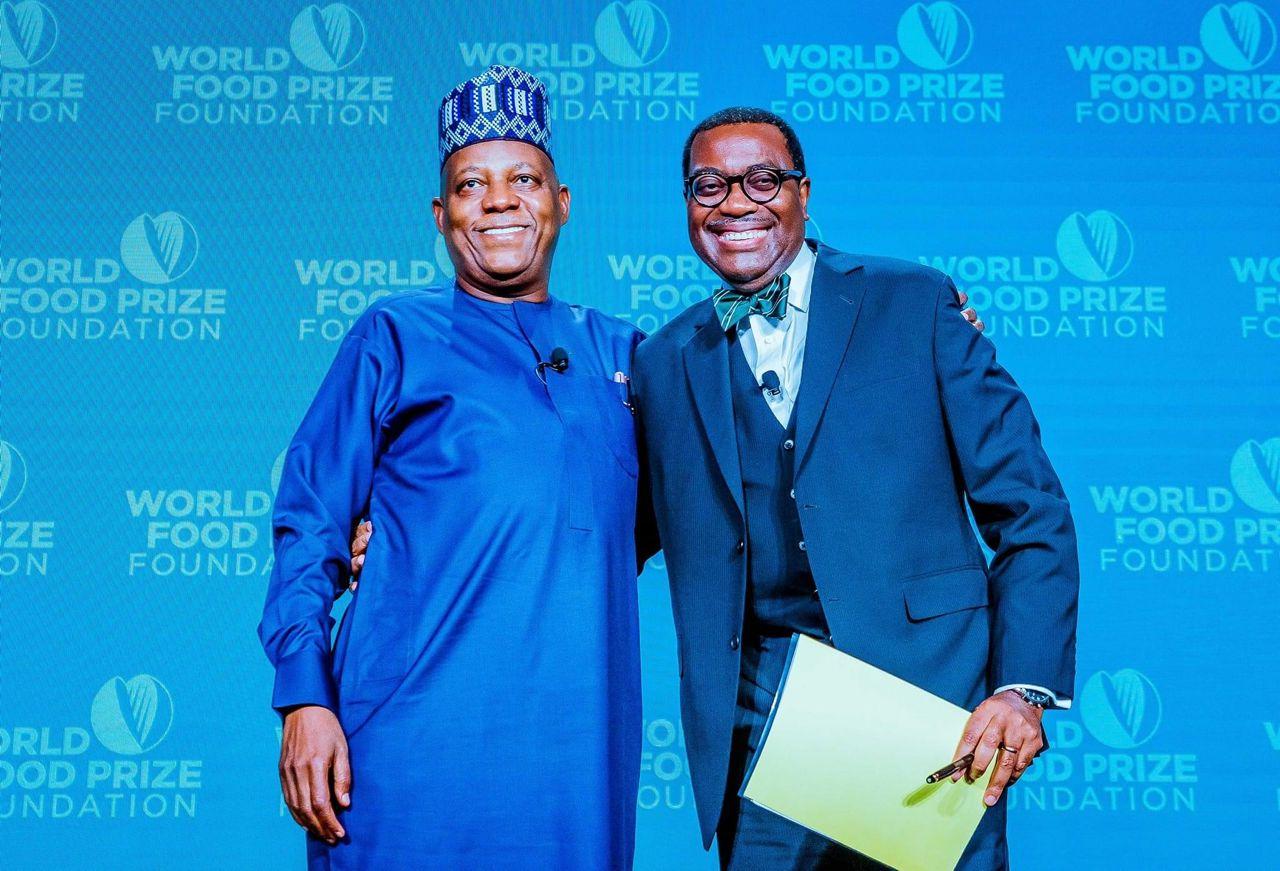
At World Food Prize Dialogue: AfDB, Partners Vote Additional $1bn To Fund Nigeria’s SAPZs In 24 States
By: Our Reporter
It was yet another bountiful harvest for the President Bola Ahmed Tinubu administration in its investment drive, as the African Development Bank (AfDB), Islamic Development Bank (IDB) and the International Fund for Agricultural Development hinted on Thursday that they have voted $1 billion to further deliver special agro-industrial processing zones in 24 States of Nigeria.
This is in addition to an initial $520 million voted by the development partners for the development of eight special agro-industrial processing zones in Nigeria.
President of African Development Bank Group, Dr. Akinwumi A. Adesina, disclosed this at the Norman Borlaug International Dialogue, World Food Prize 2023, in Des Moines, Iowa, United States of America.
Vice President Kashim Shettima, who is attending the event in pursuance of the food security and diversification policy of the Tinubu administration, had on Wednesday delivered his keynote address at the ongoing Dialogue.
Delivering his own speech titled, “From Dakar to Des Moines,” Dr. Adesina noted that the decision to pump such huge funds into Nigeria’s agribusiness was part of the resolve to develop Special Agro-Industrial Processing Zones (SAPZs) in 13 countries.
Explaining that it was the core of the food and agriculture delivery compacts from the Dakar 2 Summit held earlier this year in Dakar, Senegal, the AfDB President said, “We are investing heavily in the development of SAPZs to support the development of agricultural value chains, food processing and value addition, enabling infrastructure and logistics to promote local, regional, and international trade in food.
“The African Development Bank Group is investing $853 million in the development of the Special Agro-Industrial Processing Zones, and it has mobilized additional co-financing of $661 million, for a total commitment of $1.5 billion. We are deploying effective partnerships at scale. We are currently implementing 25 Special Agro-industrial Processing Zones in 13 countries.
“For example, the African Development Bank, Islamic Development Bank, and the International Fund for Agricultural Development provided $520 million for the development of 8 special agro-industrial processing zones in Nigeria. The second phase of the program aims to mobilize an additional $1 billion to deliver special agro-industrial processing zones in 24 States of Nigeria”.
Dr. Adesina regretted that while much progress had “been made in African agriculture, 283 million people still go to bed hungry in Africa, about a third of the 828 million people that suffer hunger globally.”
He however described the Norman Borlaug International Dialogue World Food Prize 2023, as a “journey and narrative of how we are combining the power of science, technology, policies, and politics to ensure that Africa fully unlocks its agricultural potential, and feeds itself, with pride.”
The AfDB President thanked Vice President Kashim Shettima, and the President of Ethiopia, Sahle-Work Zewde, for participating in the global event, saying their presence is an indication “that Africa has the political will and is fully ready to tackle food insecurity and make hunger history” on the continent.
Also speaking during the fire-side chat with the AfDB President, Dr Akinwunmi Adesina, Vice President Kashim Shettima who spoke on the Tinubu administration’s initiatives for food security said the quality of present leadership in Nigeria and the rest of Africa will drive transformation in agriculture and other sectors.
According to him, “a nation falls or rises fundamentally due to the quality of its leadership. Right now Africa is blessed with quite a handful of quality leaders that have the drive, passion and skills set to redefine the meaning and concept of modern leadership.
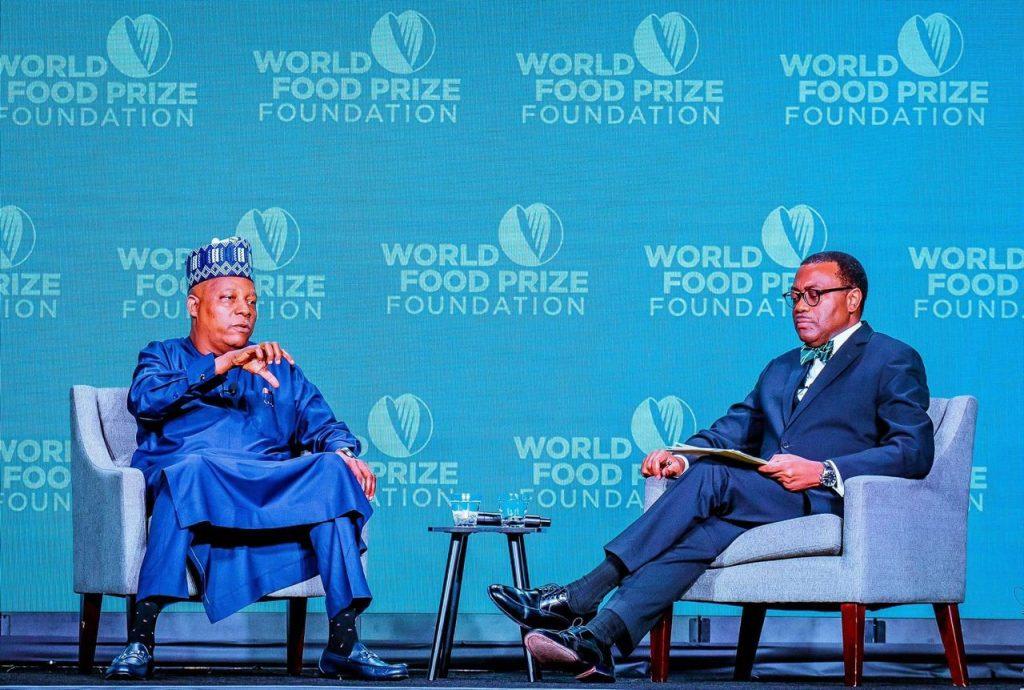
“Bola Ahmed Tinubu, my boss, is a good example, Macky Sall of Senegal and of course, Abdel Fattah El-Sisi of Egypt are doing wonderfully well, just to mention a few of the African leaders that are distinguishing themselves in leadership.
“I want to assure this gathering of investors and stakeholders in the agricultural sector that my boss, President Bola Ahmed Tinubu is a quintessential 21st century modern African leader who is determined to redefine the meaning and concept of modern leadership.
“Be rest assured that there will be a sea change in the fortunes of the Nigerian nation and by extention the African continent in the next couple of years because Nigeria is an anchor nation,” the VP added.
On wheat production, Sen. Shettima said “our target towards wheat production in Nigeria is to achieve 50% self sufficiency in the next 3 cycles. It is inconceivable that we are the second largest wheat importer in the world.
“Luckily, we have already procured the heat tolerant variety of wheat seeds and we are going to drive that process by supporting the farmers with the heat tolerant variety, agricultural extention services, fertilizer and also hope to increase the irrigation areas to 1 million hectares in the next cropping cycle.
“We need to produce about 2.4 million tonnes of wheat grains in Nigeria. We are going to reach out to our farmers through small irrigation schemes and through digitalisation. All the actors in the value chain will be sufficiently taken care of through innovative finance, partial credit guarantees and crop insurance,” the VP emphasized.
For rice production, the VP said the major challenge for Nigeria is the insufficiency of paddy rice. He noted that Nigeria has adequate milling capacity but “we need to produce 3 to 4 million tonnes of paddy rice to meet our requirement of about 2.5 million tonnes per annum. We have 75 million hectares of arable land and most of it suited for rice cultivation.”
He added that “we will provide our farmers with certified seeds, fertilzer, extension services, the digitlization of services, inputs, finance and market information. Our target is to achieve self sufficiency in rice latest by 2027.”
The VP also spoke about the Special Agro-Industrial Processing Zones (SAPZs), reiterating the Tinubu administration’s commitment to providing an enabling environment for investors in the zones.
He said government would create an SAPZ development authority that will operate like a one-stop shop where regulatory and associated issues will be addressed.
At World Food Prize Dialogue: AfDB, Partners Vote Additional $1bn To Fund Nigeria’s SAPZs In 24 States


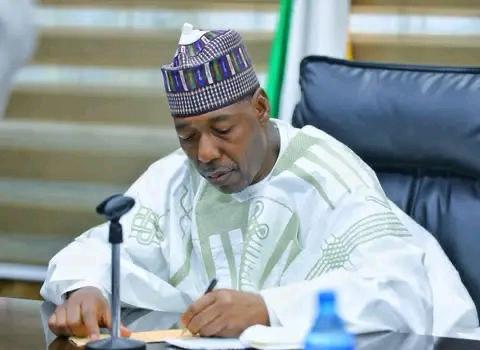
Zulum Appoints Engr Peter Samuel as General Manager BOSAMA
By: Our Reporter
Borno State Governor, Professor Babagana Umara Zulum, has approved the appointment of Engr Peter Samuel, MNSE, MNIAE, as the General Manager of Borno State Agricultural Mechanization Authority (BOSAMA).
In a statement by the Special Adviser to the Governor on Media, Dauda Iliya, the appointment was based on Engr Samuel’s outstanding professional competence, proven track record, and experience in agricultural engineering and mechanization.
The statement noted that Engr Samuel possesses the requisite qualifications, technical expertise and leadership capacity required to reposition BOSAMA in line with Governor Zulum’s agricultural transformation agenda.
The newly appointed General Manager is an Agricultural Engineer with academic, professional, administrative, and practical experience in agricultural mechanization, farm power and machinery, irrigation engineering, and agricultural infrastructure development.
He holds a Master of Engineering (M.Eng.) in Farm Power and Machinery from Joseph Sarwuan Tarka University, Makurdi (formerly the Federal University of Agriculture, Makurdi), a Postgraduate Diploma in Farm Management and Production Economics from Nasarawa State University, and a Bachelor of Engineering (B.Eng.) in Agricultural and Environmental Resources Engineering from the University of Maiduguri.
Engr Samuel has distinguished himself through years of meritorious service in teaching, research, agricultural engineering practice, and project implementation. He currently serves as a Lecturer in Farm Power and Machinery at Ramat Polytechnic, Maiduguri.
Over the years, he has held several strategic leadership positions, including General Manager of a commercial agricultural enterprise, Project Coordinator, Programme Coordinator, and Consultant on numerous agricultural development interventions implemented by reputable national and international organisations.
He is a member of the Nigerian Society of Engineers (NSE) and the Nigerian Institution of Agricultural Engineers (NIAE).
Governor Babagana Zulum congratulated the new General Manager on his appointment and urged him to deploy his wealth of knowledge, technical expertise, and experience in agricultural mechanization to strengthen the operations of BOSAMA
Zulum Appoints Engr Peter Samuel as General Manager BOSAMA
Troops Arrest Suspected Military Impostor in Katsina
By Zagazola Makama
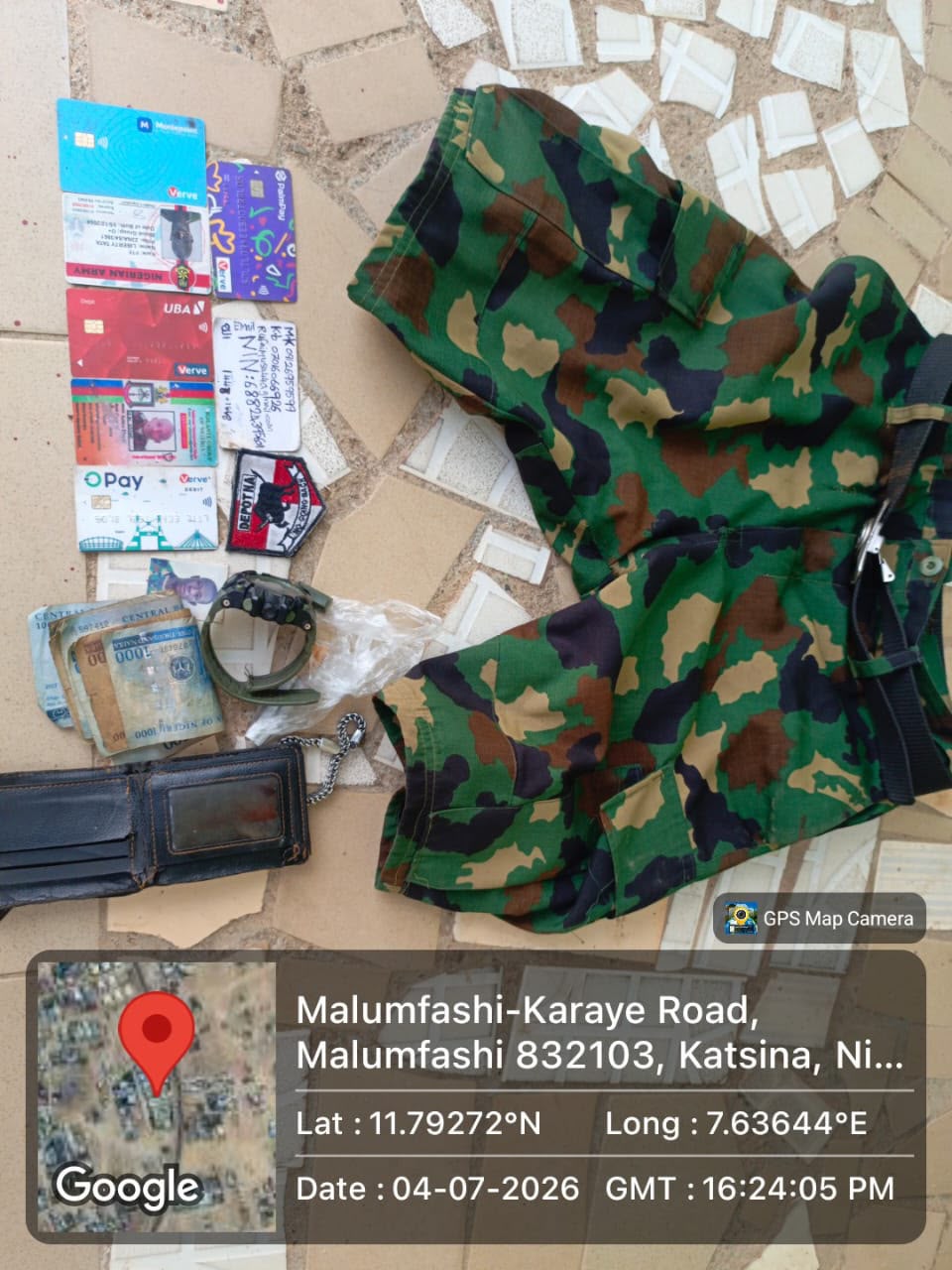
Troops of 17 Brigade have arrested a suspected military impostor during a fighting patrol in Malumfashi Local Government Area.
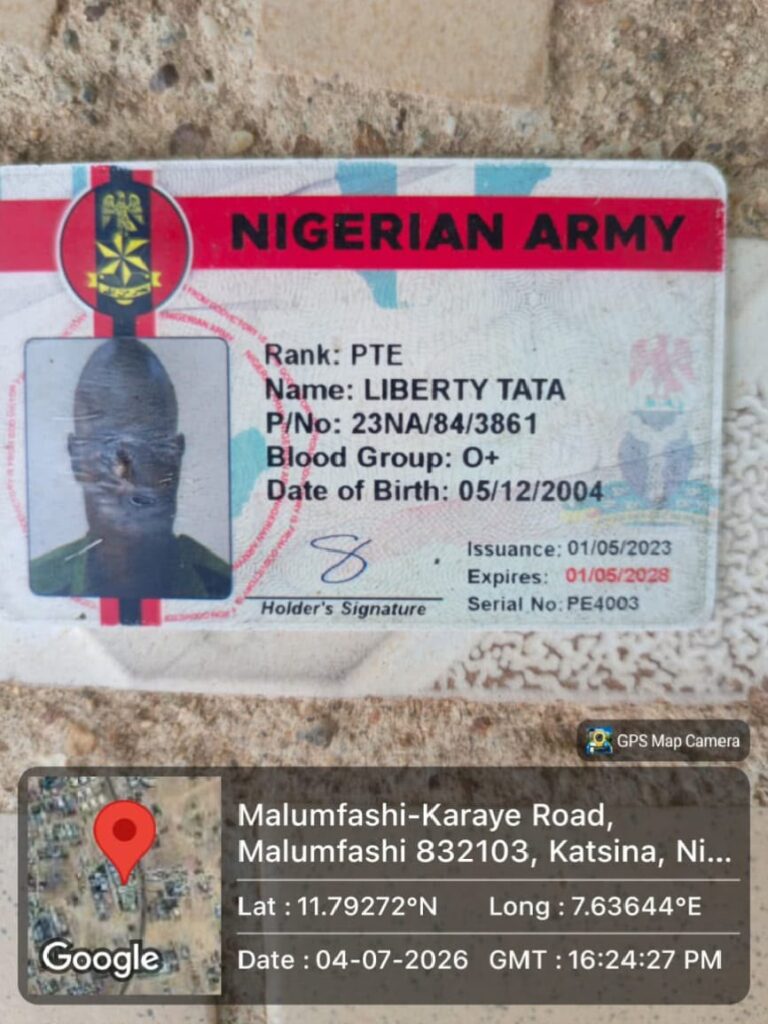
Security sources told Zagazola Makama that the suspect was apprehended at about 1:30 p.m. on July 4 by troops deployed at the Forward Operating Base (FOB) Malumfashi while conducting routine patrols within Malumfashi town.
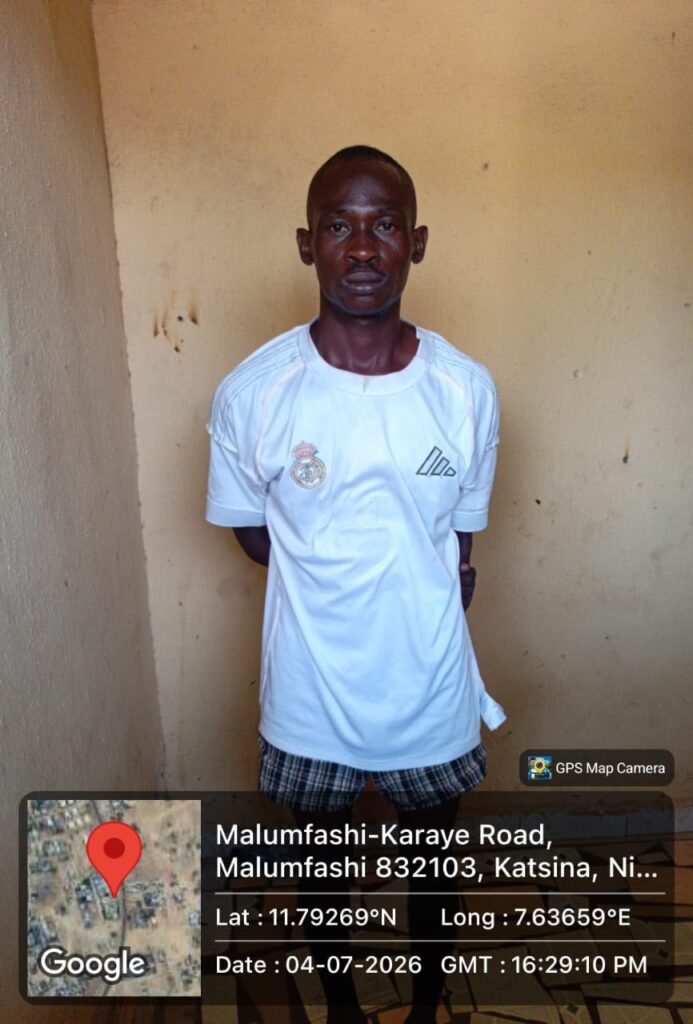
According to the sources, the suspect was intercepted while wearing a woodland camouflage three-quarter short, raising suspicion among the troops.
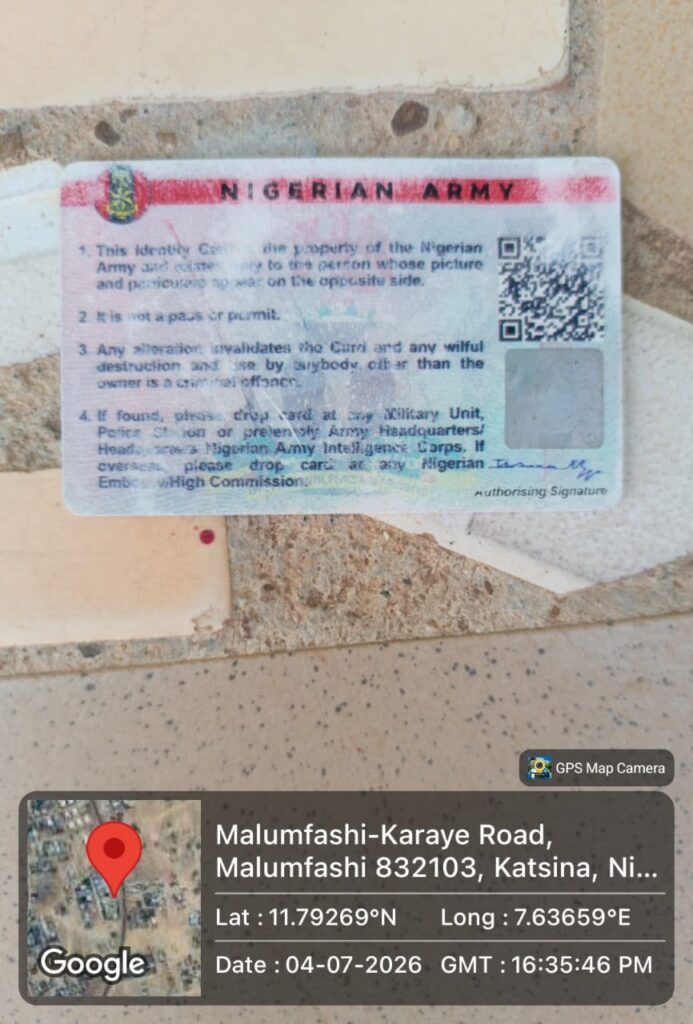
A search conducted on the suspect led to the recovery of a fake Nigerian Army identity card, four Automated Teller Machine (ATM) cards, one woodland camouflage three-quarter short, a wristwatch and the sum of ₦17,000.
The suspect and the recovered exhibits are currently in military custody pending further investigation.
Military sources said the arrest forms part of ongoing efforts to curb impersonation of security personnel and other criminal activities within the area.
Troops Arrest Suspected Military Impostor in Katsina
Troops Recover 50 Rustled Cattle, Repel Suspected Rustlers in Kaduna
By Zagazola Makama
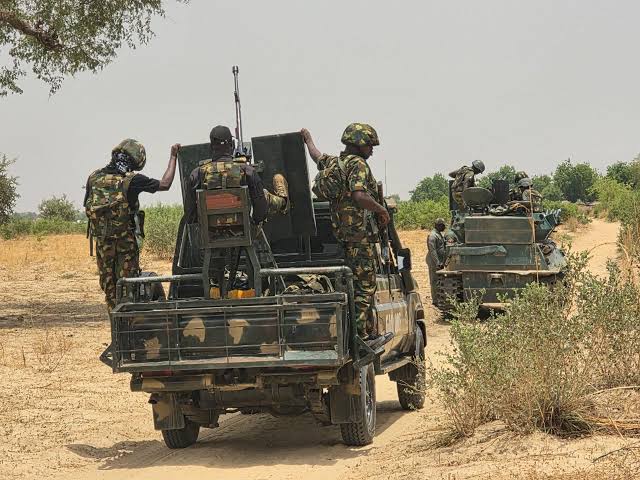
Troops deployed at the Forward Operating Base (FOB) Kankomi have recovered 50 rustled cattle after repelling suspected cattle rustlers during an ambush operation in Chikun Local Government Area.
Security sources told Zagazola Makama that the troops responded to a distress call at about 9:55 a.m. on July 4 over the activities of suspected rustlers at Ungwan Gontu community.
According to the sources, the troops swiftly laid an ambush and made contact with the fleeing suspects, forcing them to abandon the stolen livestock and escape into the surrounding area.
During the operation, the troops recovered 50 rustled cattle, which were subsequently identified and handed over to their rightful owner.
Military sources said efforts are ongoing to track down the fleeing suspects as security operations continue to combat cattle rustling and other criminal activities across Kaduna State.
Troops Recover 50 Rustled Cattle, Repel Suspected Rustlers in Kaduna

Zulum Appoints Engr Peter Samuel as General Manager BOSAMA

DSS Frees Cardiac Surgeon Martin Aghaji on Bail Over Alleged Economic Crime

Troops Arrest Suspected Military Impostor in Katsina

Roger Federer’s Shock as DNA Results Reveal Myla and Charlene Are Not His Biological Children

THE PLIGHT OF FARIDA

FAILED COUP IN BURKINA FASO: HOW TRAORÉ NARROWLY ESCAPED ASSASSINATION PLOT AMID FOREIGN INTERFERENCE CLAIMS
-
 News2 years ago
Roger Federer’s Shock as DNA Results Reveal Myla and Charlene Are Not His Biological Children
-
Opinions4 years ago
THE PLIGHT OF FARIDA
-
 News1 year ago
FAILED COUP IN BURKINA FASO: HOW TRAORÉ NARROWLY ESCAPED ASSASSINATION PLOT AMID FOREIGN INTERFERENCE CLAIMS
-

 News2 years ago
EYN: Rev. Billi, Distortion of History, and The Living Tamarind Tree
-
 Opinions5 years ago
POLICE CHARGE ROOMS, A MINTING PRESS
-

 ACADEMICS2 years ago
A History of Biu” (2015) and The Lingering Bura-Pabir Question (1)
-

 Columns2 years ago
Army University Biu: There is certain interest, but certainly not from Borno.
-

 Politics1 year ago
2027: Why Hon. Midala Balami Must Go, as Youths in Hawul and Asikira/Uba Federal Constituency Reject ₦500,000 as Sallah Gift
