
News
Bakeni Commiserates with NUJ and Zulum over the demise of Isa Gusau

Bakeni Commiserates with NUJ and Zulum over the demise of Isa Gusau
By: Bodunrin Kayode
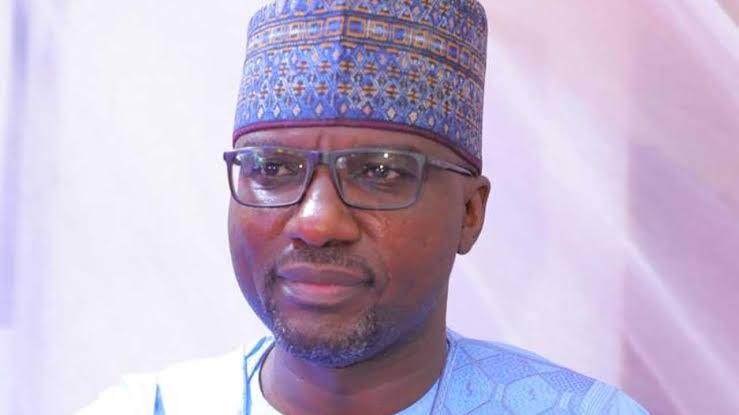
Borno state Chairman Christian Association of Nigeria CAN Bishop John Bakeni has commiserated with the Nigerian Union of Journalists NUJ over the death of Isa Gusau who died in an Indian hospital recently.
He also sympathized with the Governor of the state Prof Babagana Zulum whom Gusau served till his death due to a protracted illness.
Addressing a news conference in Maiduguri, the Auxiliary Bishop said that the entire Christian community sympathized with the government over the loss of such a resourceful journalist.
” I want on behalf of the entire Christian Community in Borno State to commiserate with the Executive Governor and indeed the Government and the entire people of Borno State over the demise of his Media Aid and Strategist, Mallam Isa Gusau, who passed on Thursday, the 11th of January, 2024.
” I wish to also condole you the members of the 4th estate for the loss of one of you. May God grant him peaceful rest and console all those who mourn him.” he said.
Responding to some very strong allegations in the mills against Zulum on his treatments of Christians, the Auxillary Bishop maintained that CAN was not a pressure group or a partisan party but a peaceful association that goes about its activities in a lawful manner.
To him:”CAN is a religious Association, CAN is not a political party and is non-partisan. CAN is not a pressure group. It is a law-abiding Association. It is an Association that works for the unity of Christians and building a peaceful and harmonious society working hand-in-hand with other religious bodies, Government and all relevant stake holders.
“The values that hold us together are Love, Peace and Justice for all. We preach peace, we uphold peace and we work for peace. And that is why we are living in peace with our Muslim brothers and sisters in Borno State.
” in terms of our relationship with the Government, let me say that CAN and the Christian community have a good and cordial relationship with the Government of the day. The Government of Prof. Babagana Umara Zullum has done a lot for us and is still doing more in the following areas:
“Has continued the rehabilitation and reconstruction of churches that were destroyed by the Boko Haram insurgency especially in Southern Borno. This was started by our current Vice President, Kashim Shettima, during his tenure; and His Excellency, Prof Babagana Umara Zullum has continued in that line.
“Sponsorship of Christians for pilgrimage to the Holy Land every year. In fact, the Executive Secretary and coordinator of the Christian Pilgrim has just returned from a pre-visit of the pilgrimage sites in preparation for the 2023/2024 main pilgrimage.
“Reaching out to the Christian community with gifts and cash donations at Christmas and Easter periods. Palliatives are also given to our Christian Women and Widows by the Wives of the Vice President, Her Excellency Nana Kashim and the Governor, Her Excellency, Dr. Falmata Umara Zullum.
“Sponsoring the transportation of our brothers and sisters from the South-South, South East and West during festive seasons.
” Appointment of our Christian sons and daughters in his cabinet.
“After so many years of advocacy, the current Government has started the recruitment of Christian teachers to teach the Christian religion in public schools and many more.”
Bakeni noted that all his claims are real and verifiable adding that in spite of all the good results from the interaction with the government there are still challenges and they do hope to continue to work hard to get over them.
” That is not to say that Christians have no challenges in Borno State; of course we have. We therefore, want to have more access for better results through dialogue and constructive engagement with the Government and other relevant stakeholders.
” We know very well where we are coming from and where we are in terms of the security challenges. We have all tested and experienced the ugly side of violence and destruction and we will not want to go back to that era.
” We love our Governor, we respect our Governor, and we appreciate the relentless and selfless services and sacrifices of our Governor in restoring peace and bringing development to our State.
” As such, CAN will continue to support the Government of the day and will continue to work with the Government towards sustaining the peace that we are already enjoying due to the hard work, commitment, and responsible leadership of our Governor.”
Obviously responding to the recent statements of Rev Dikwa Kallamu over the alleged maltreatment of Christians in the state, the CAN chair went on:” We distance ourselves from any act of violence and provocation. Whatever is written on Social media or any other media outlet, is not from CAN.
” My principle as the Chairman of CAN in Borno State at this time is that what Dialogue cannot give you, Violence and confrontation cannot give you either.”
On the progress being made by the military in protecting the nation’s democracy, he went on: ” With deep sense of gratitude and appreciation, we salute the courage and the sacrifices of our Armed Forces. For those who have paid the supreme price in the course of their service to their fatherland, may God reward them with eternal life in his kingdom.”
Below is the full details of the press release in which Rev Dikwa accused the Borno State government of completely marginalizing Christians in the state.
PRESS RELEASE ON THE TRUE POSITION OF THE CHRISTIANS IN BORNO STATE UNDER GOVERNOR BABAGANA UMARA ZULLUM.
30TH DECEMBER, 2023
The press released on 20 December on the marginalization of the Christian community in Borno State by Governor Zullum was not refuted by either him nor any government officials in the state which affirmed the truth except his wife that called out few widows to share rice a day after for Christmas purposefully for the media to carry it. The only way they refuted was to send thugs after my life like Barrister Bashir Maidugu who called me and put a threat to my life and civilians joint task Force (CJTF) who met me on the road and harassed me but as usual God Almighty saved me to continue exposing the truth.
Let the public court judge, How can a professor and a Governor show tribalism, sectionalism and ethnic segregation like Professor Zulum of Borno State? How many are from Southern Borno and how many are Christians among these political appointments?
PUBLIC ANNOUNCEMENT
Appointment of Special Advicers to Borno State Governor
The Executive Governor of Borno State, His Excellency Prof Babaganagana Umara Zulum has graciously approved the appointment of the following Special Advisers:
- Alhaji Ali Makinta Jere
- Idrissa L Kemdey
- Tijjani Goni Mohammed
- Hon Ibrahim Haruna Biu
- Hon Tukur Digira
- Engr Kori Shettima
- Hauwa M Musa
- Hon Abubakar Tijjani
- Hon Garba Saje
- Hon Kester C Oguali
- Hon Alao Hassan
- Alhaji Audu Maaji
- Hon Abba Jato Bama
- Hon Abba Saje Mohd Nur
- Engr Musa Gashigar
- Hon Abba Nguru
- Hon Bukar Dalatu
- Hon Idrisa Jidda
- Shettima Bukar Kulima (Marte)
- Hon Kaka Adam Mustapha
- Shettima Lawan Maina
- Dr Abubakar Hassan
- Modu Ali Gana Dikwa
- Sheikh Modu Mustapha
- Abba Kawu Shehu Abubakar
- Hon Musa Abbas
- Alhaji Musa Gwamma
- Baba Ali Haruna Kukawa
- Abdullahi Mohd Nganzai
Amongst all of the appointees of 29, only
Hon Kester C Oguali is a Christian from the Eastern Nigeria, an Igbo by tribe.
In the threat by the political thugs like Barrister Bashir Maidugu of the Vice president’s crew, he categorically said only four local government in the state have Christian indigenes which are blatant lies from the pit of hell. I’m kanuri by tribe from Maiduguri the state capital and a Christian amongst many kanuri Christians. Going by the Barrister Bashir Maidugu, I ll now ask, have the indigenous Christian from the southern Borno State relocated to the igbo land (Eastern Nigeria) to get a slot from the 29 appointment or still the marginalization?
We condemned on a strong term this total excluding of Christians in the governor’s appointment and Hon Kester C Oguali is not representing any Christians in the state but political strategy to show the world he’s in love with even Christians in the south but marginalized his main duties of inclusive governance.
Let me talk little for now about the LGA Chairman primaries in the State, a Christian dominated area like Chibok has 7 contestants in which 4 are Christians and 3 are Muslims. He disqualified the four Christians and told the 3 Muslims to choose one among themselves, in Askira Uba, the contestants have the highest a Christian with 14 votes followed by a Muslim with 7votes however, Zullum imposed the Muslim candidate with 7 and dropped the Christian with 14, can someone define marginalization for me in different actions than these?
REV. KALLAMU MUSA ALI DIKWA
Director, General Center for Justice on Religious And Ethnicity in Nigeria
Bakeni Commiserates with NUJ and Zulum over the demise of Isa Gusau


NHRC Calls for Reforms in Correctional Centres, Cites Systemic Bias
By: Michael Mike
The Executive Secretary of the National Human Rights Commission (NHRC), Dr. Tony Ojukwu has called on stakeholders to reflect on the values that Nelson Mandela embodied, including justice, dignity, equality, and compassion, as the world commemorates World Mandela Day.
Dr. Ojukwu made this call in a statement on the eve of the commemoration, noting that Mandela’s legacy serves as a powerful reminder of the need to promote and protect human rights, particularly in Nigeria’s correctional centers.
According to him, the current state of Nigeria’s correctional centres, which are overcrowded, under-resourced, and lack basic sanitation and healthcare, reflects a failure of infrastructure, justice, and humanity.
He lamented that thousands of citizens are held in pre-trial detention for years due to poverty and lack of access to justice, while the rich have greater access to quality legal defense and bail, perpetuating systemic bias.
The NHRC Executive Secretary urged the Nigerian government, judicial authorities, private sector, and civil society to prioritize comprehensive reforms in detention facilities and correctional centers, including improving conditions, investing in alternatives to pre-trial detention, ensuring speedy trials, and upholding the rights of inmates.
Ojukwu emphasized the need to tackle the root causes of incarceration, such as poverty, unemployment, and lack of access to justice, in order to build a society that values the dignity and human rights of all individuals, regardless of their socio-economic status.
Nelson Mandela Day is celebrated annually on the 18th of July.
NHRC Calls for Reforms in Correctional Centres, Cites Systemic Bias
Ondo State Government Signs MOU with Backbone Infrastructure for 500,000 BPD Oil Refinery
By: Michael Mike
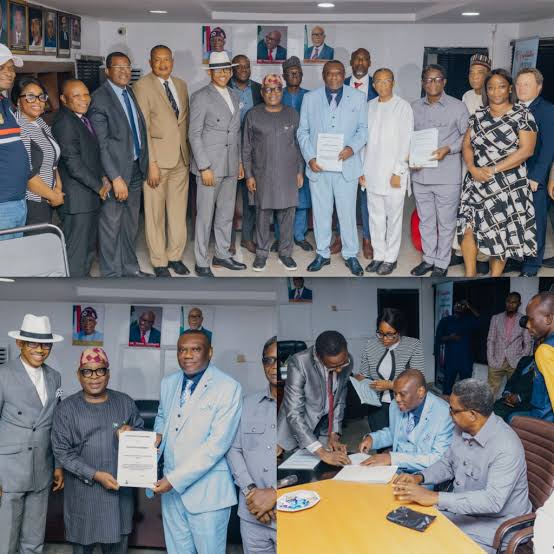
The Ondo State Government has signed a Memorandum of Understanding (MOU) with Backbone Infrastructure Limited for the establishment of a 500,000 barrels per day oil refinery and development of free trade zone in Igbotiri, Ilaje Local Government Area of the state.
The signing ceremony took place at the Governor’s office in Akure.
The Secretary to the State Government, Dr. Taiwo Fasoranti represented the Governor, Dr. Lucky Aiyedatiwa at the ceremony.
He described the proposed investment as timely and strategic, assuring the investors of a peaceful and business-friendly environment.
He emphasized that the project would boost the state’s economy, create meaningful job opportunities, and reduce crime.
In his remarks on behalf of Backbone Infrastructure, the Vice President, Legal & Corporate services, Barrister Wale Adekola expressed appreciation to the Ondo State Government for the opportunity to partner in the infrastructure development of the State and assured of his company’s commitment to ensure successful delivery of the two projects.
Similarly, the Managing Director / Chief Executive of Backbone Infrastructure Nigeria Limited, Engr. Henry Owonka, revealed that the two projects would be accompanied by basic infrastructure such as roads, terminal storage tanks, and other facilities that will change the landscape of the State.
According to the MOU breakdown on the Refinery, Backbone Infrastructure Limited will hold 65% equity, while the Ondo State Government will hold 20% and the Nigerian National Petroleum Corporation Limited (NNPCL) will hold 15% stake.
Meanwhile, the investors have expressed confidence in the leadership and vision of the Aiyedatiwa-led administration, citing the clarity of purpose and support they have received as the reason for choosing Ondo State as their investment destination.
The state government equally pledged its support for the project, which is expected to transform the state’s economy and create jobs.
Present at the signing of the MOU were the Secretary to the State Government, Dr. Taiwo Fasoranti. Attorney General and commissioner for Justice, Kayode Ajulo, SAN , the ONDIPA Team while the Backbone team was led by Dr. Steve Dike, a member of the Board of Directors representing the Chairman, Senator Ken Nnamani, Managing Director/CEO Engr. Henry Owonka, the Vice President, Legal & Corporate Services, other members of the management team from the Backbone infrastructure limited among other top government functionaries.
Ondo State Government Signs MOU with Backbone Infrastructure for 500,000 BPD Oil Refinery
News
Police arrest notorious gunrunners in Benue, recover rocket launcher, AK-47 rifles, thousands of ammunition
Police arrest notorious gunrunners in Benue, recover rocket launcher, AK-47 rifles, thousands of ammunition
By: Zagazola Makama
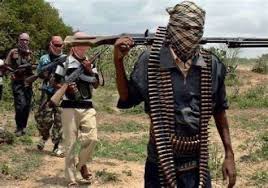
Operatives of the Force Intelligence Department–Intelligence Response Team (FID–IRT) have arrested two notorious arms traffickers and recovered a cache of deadly weapons in Abinsi town, Guma Local Government Area of Benue State.
Sources from the Benue State Police Command confirmed the development Thursday, describing the arrest as a major breakthrough in ongoing efforts to curb the proliferation of illegal arms fueling insecurity in the North-Central region.
According to the sources, the suspects led by one Adikwu Ikwulono, a known illegal arms dealer were apprehended on Wednesday following credible intelligence.
Recovered from the suspects were one rocket launcher, five AK-47 rifles, and thousands of rounds of 7.62mm live ammunition.
Police say preliminary investigations revealed that the arms were being assembled for delivery to a gang of armed herders and bandits operating around the Benue–Nasarawa border, with plans to launch coordinated attacks on several communities in Benue State.
“The suspects are currently undergoing intensive interrogation with the FID, while efforts are ongoing to apprehend other members of the arms-smuggling syndicate,” the police sources said.
Police arrest notorious gunrunners in Benue, recover rocket launcher, AK-47 rifles, thousands of ammunition

NHRC Calls for Reforms in Correctional Centres, Cites Systemic Bias

Ondo State Government Signs MOU with Backbone Infrastructure for 500,000 BPD Oil Refinery

Troops intensify operations against terrorists in North East, arrest logistics suppliers, recover weapons

Roger Federer’s Shock as DNA Results Reveal Myla and Charlene Are Not His Biological Children

THE PLIGHT OF FARIDA

POLICE CHARGE ROOMS, A MINTING PRESS
-
 News1 year ago
Roger Federer’s Shock as DNA Results Reveal Myla and Charlene Are Not His Biological Children
-
Opinions3 years ago
THE PLIGHT OF FARIDA
-
Opinions4 years ago
POLICE CHARGE ROOMS, A MINTING PRESS
-

 News1 year ago
EYN: Rev. Billi, Distortion of History, and The Living Tamarind Tree
-

 Columns1 year ago
Army University Biu: There is certain interest, but certainly not from Borno.
-

 ACADEMICS1 year ago
A History of Biu” (2015) and The Lingering Bura-Pabir Question (1)
-

 Opinions1 year ago
Tinubu,Shettima: The epidemic of economic, insecurity in Nigeria
-

 Politics1 month ago
2027: Why Hon. Midala Balami Must Go, as Youths in Hawul and Asikira/Uba Federal Constituency Reject ₦500,000 as Sallah Gift
