
News
Border Security: NIS Command and Control Centre Comes Alive with Induction of 123 Officers

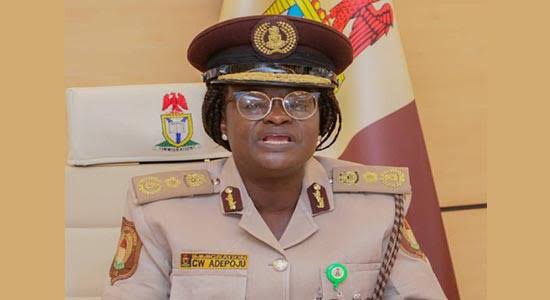
Border Security: NIS Command and Control Centre Comes Alive with Induction of 123 Officers
By: Michael Mike
In order to enhance the nation’s security and checkmate the threat of porous border, the Federal Government on Monday inducted 123 officers into the Command and Control Centre facility at the Headquarters of the Nigeria Immigration Service (NIS) for border control, security and governance.
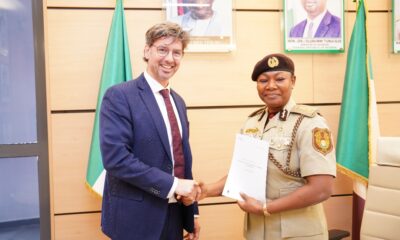
The Minister of Interior, Hon. Olubunmi Tunji-Ojo, assisted by the Comptroller-General of the Nigeria Immigration Service, Mrs. Kemi Nanna Nandap inducted the officers at the NIS Headquarters in Abuja.
Speaking at the event, Tunji-Ojo said the infrastructures and facilities inside the Centre have been fully integrated with International Police (Interpol) and other security outfits across the world to do pre-profiling of passengers and pick up persons of interests anywhere in the world.
He said: “Persons of interest would be picked up anywhere even before they board their planes to Nigeria because the facilities here have capacity and capability of pre-profiling passengers.@
The Minister, while revealing that President Bola Tinubu would soon commissioned the newly completed electronic passengers gates (e-gates) at the Airports in Lagos and Abuja, said the Command and Control Centre would operate 24/7 to monitor land, maritime and air borders of the country.
He noted that Nigeria is deprived of the luxury that other countries in Africa have as its geographical location that places it around 10 countries in the Sahel region and the Gulf of Guinea in the south where about 5 million barrels of crude oil is produced per day, makes it imperative for the borders to be well guided.
The Minister said with the commencement of operation of the Centre, the Nigeria Immigration Service has gone beyond procurement of travelling documents for its citizens, but now fully integrated into the security architecture of Nigeria to play a dominant role.
Tunji Ojo said: “The NIS is now a crucial component of the National Security Architecture of Nigeria. We have here, the NIS that is determined to implement its responsibility. Nigeria Security now depends on you especially with the infrastructures and facilities in place at the Command and Control Centre.
“These facilities provide data on Advanced Passenger Information System (APIS). It means nobody should come to Nigeria without pre-profiling them. So we have this facility for irregular migration and real time analysis on passenger movements.
“I am prepared to give my best to Nigeria to ensure that the system works effectively and efficiently. I urge you as the first set of officers to man these facilities across the country to give your best as well.
“There will be zero tolerance for error. And we have arranged the system in a way that fatigue would not set in on the officers that would be on shifts at every point so that they would do their jobs seamlessly. “
On her part, the Comptroller-General of Immigration Service, CGIS, Nandap said about 253 officers were selected for special training regarding the manning of the infrastructures at the Command and Control Centre, noting that the first set of 123 officers were representatives of various commands across Nigeria.
Nandap, who described the induction as a special day in the history of the NIS, said the officers who scaled through the first stage of the training would move to the next stage which involved data analysis and travel plans.
She said the Advanced Passenger Information System, APIS, would enable the NIS pull data from different sources to track down persons of interests and check mate possible threats against the country.
Border Security: NIS Command and Control Centre Comes Alive with Induction of 123 Officers



Troops recover command-wire IED along Maiduguri–Damasak road, avert potential attack
By Zagazola Makama
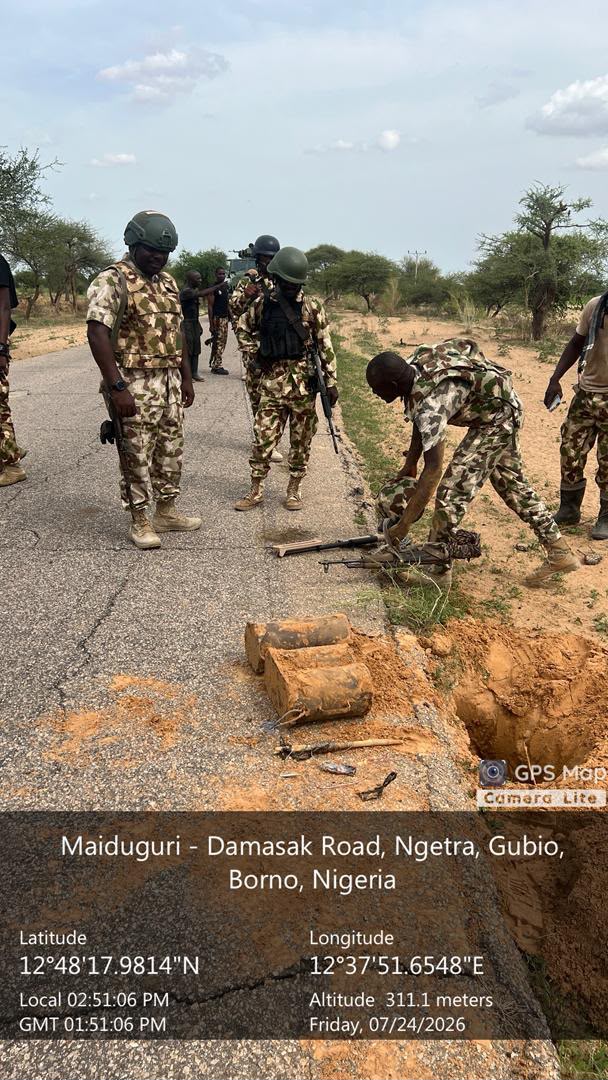
Troops of the Nigerian Army have recovered a command-wire improvised explosive device (IED) buried along a road in Kanguri village, Borno State, preventing what could have been another deadly terrorist attack.
Sources told Zagazola Makama that the device was discovered at about 3:00 p.m. on July 24 by troops of 149 Battalion while escorting a team from the Mine Risk Group (MRG), Maiduguri, on a mission to recover two trucks damaged in an earlier IED explosion by Boko Haram terrorists on July 4.
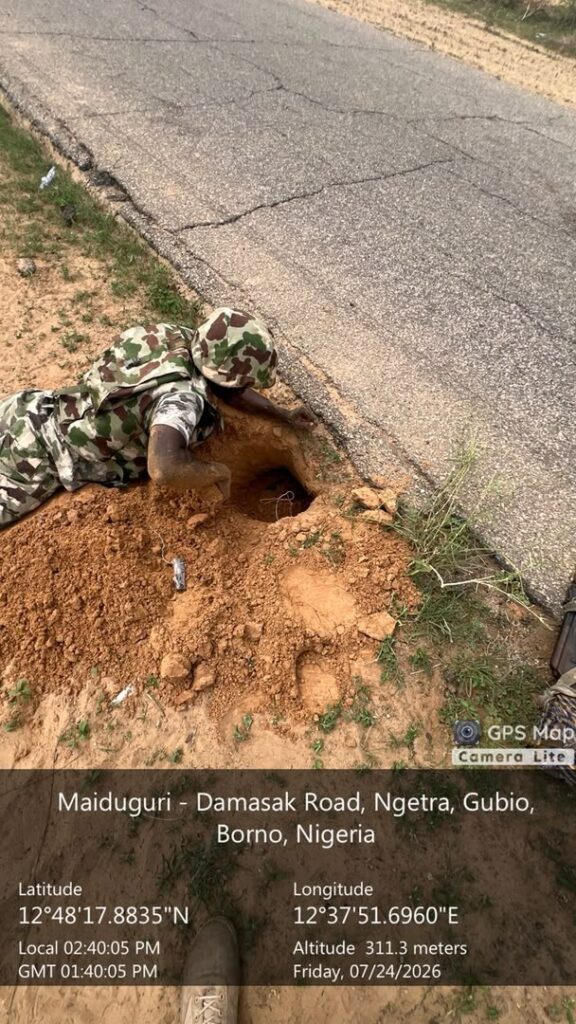
The command-wire IED was found concealed beneath the road at Kanguri village in Guzamala Local Government Area.
Following the discovery, the Explosive Ordnance Disposal (EOD) team of 149 Battalion safely recovered the explosive device without incident.
No casualties or damage to military equipment were recorded, while the escort and recovery mission was still ongoing at the time of filing this report.
Military sources said the recovery underscores the persistent threat posed by terrorist-planted roadside explosives in parts of the North East, even as troops continue clearance and route security operations to safeguard military movements and civilian traffic.
Troops recover command-wire IED along Maiduguri–Damasak road, avert potential attack
News
EMVC, Federal Polytechnic Offa Partner to Drive Indigenous Electric Vehicle Production, Skills Development

EMVC, Federal Polytechnic Offa Partner to Drive Indigenous Electric Vehicle Production, Skills Development
By: Michael Mike
Nigeria’s push to develop a homegrown electric vehicle industry has received a major boost as Electric Motor Vehicle Company (EMVC) and the Federal Polytechnic Offa, Kwara State, signed a landmark partnership aimed at accelerating indigenous electric vehicle production, battery technology research and technical skills development.
The agreement, described as the first collaboration of its kind between a Nigerian indigenous electric vehicle manufacturer and a polytechnic, is expected to bridge the gap between industry and academia while strengthening local capacity across the country’s automotive value chain.
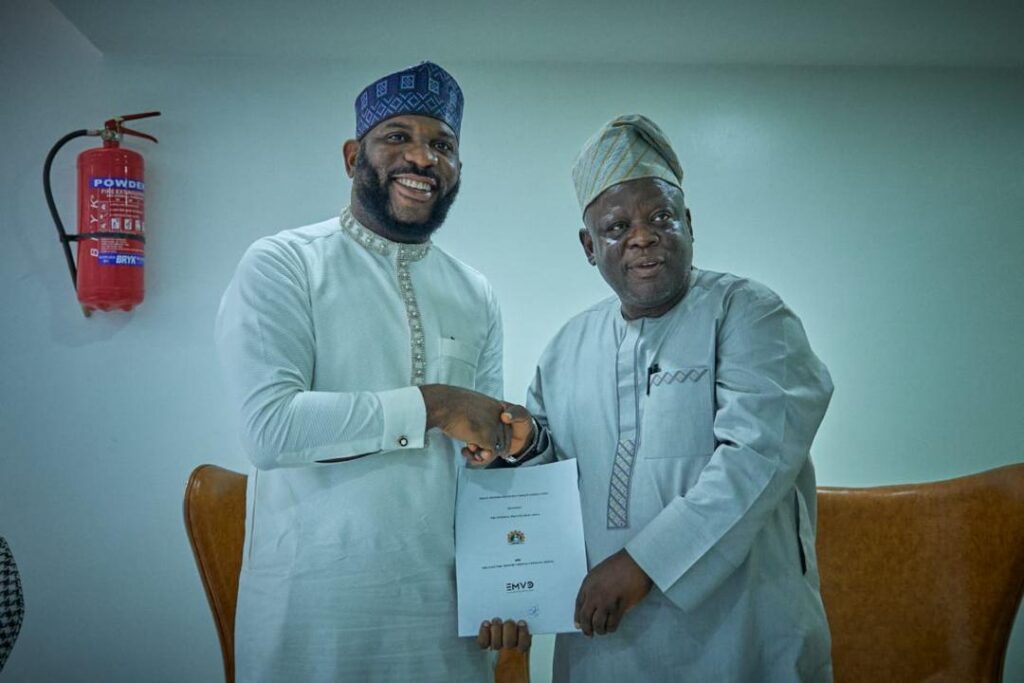
Under the partnership, both institutions will jointly develop market-ready electric vehicles tailored to Nigerian and African road conditions, collaborate on battery technology research, including battery cell assembly and battery management systems, and promote the local sourcing of components.
The initiative will also provide structured training for students of the Federal Polytechnic Offa in electric vehicle design, assembly, battery systems and after-sales maintenance, while enabling both organisations to share laboratories, workshops, technical resources and research facilities.
Beyond the immediate collaboration, EMVC and the polytechnic outlined ambitious plans to establish a Centre of Excellence in Electric Mobility on the campus, develop specialised curricula and certification programmes in electric vehicle engineering, battery technology and renewable energy systems, and create internship and apprenticeship opportunities for students.
Other proposed areas of collaboration include faculty exchange programmes, joint research publications, patent development, entrepreneurship support for student innovators, deployment of electric vehicle charging infrastructure on campus, local fabrication of vehicle components, joint applications for research grants and community awareness campaigns to promote electric mobility across Kwara State and the North Central region.

Speaking on the significance of the partnership, EMVC Chief Executive Officer, Prince Mustapha Mona Audu, said the future of Nigeria’s electric vehicle industry depends not only on manufacturing capacity but also on developing the human capital needed to sustain it.
“This collaboration reflects EMVC’s belief that building a genuine electric vehicle industry in Nigeria requires more than manufacturing capacity; it requires a deliberate investment in people and knowledge. Partnering with Federal Polytechnic Offa allows us to develop vehicles and battery technology suited to our environment while training the next generation of Nigerian engineers and technicians who will sustain this industry long into the future,” he said.
The Rector of the Federal Polytechnic Offa, Dr. Kadiri Kamoru Oluwatoyin, described the partnership as a strategic step towards aligning technical education with the practical demands of Nigeria’s emerging clean energy and mobility sector, noting that it would expose students to real-world engineering, manufacturing and innovation.
Industry observers say the collaboration comes at a time when Nigeria is seeking to diversify its economy, reduce dependence on fossil fuels and build domestic manufacturing capacity in line with the global transition to cleaner transportation.
EMVC, a Nigerian-owned company, is currently focused on the design, assembly and manufacturing of electric vehicles suited to African conditions. Its operations cover two- and three-wheel electric vehicles, battery assembly and charging infrastructure, with plans to expand into four-wheel vehicle assembly as part of its broader vision of positioning Nigeria and Africa as producers, rather than merely consumers, of clean mobility technologies.
EMVC, Federal Polytechnic Offa Partner to Drive Indigenous Electric Vehicle Production, Skills Development
News
Rainy Season, Difficult Terrain Now Biggest Challenge as Terrorists Retreat into Remote Forests — Theatre Commander
Rainy Season, Difficult Terrain Now Biggest Challenge as Terrorists Retreat into Remote Forests — Theatre Commander
By Zagazola Makama
The Theatre Commander, Joint Task Force North West, Operation FANSAN YAMMA (JTF NW OPFY), Major General W.B. Idris, has said that sustained military offensives have forced terrorists and armed bandits away from major highways into remote forests and isolated rural communities, where difficult terrain and the rainy season have become the principal operational challenges confronting security forces.
Major General Idris made the disclosure on Thursday during an interactive session with defence correspondents at the Headquarters of Operation FANSAN YAMMA in Gusau, Zamfara State, while responding to questions on the security situation across the North-West and the continued attacks on farming communities despite the military’s sustained operations.
The Theatre Commander explained that months of aggressive kinetic operations, intelligence-led raids and area domination patrols have significantly degraded terrorist capabilities along major road corridors, compelling criminal groups to alter their operational tactics.
According to him, the military now exercises effective control over most strategic highways and major transportation routes across the theatre, denying terrorists the freedom to operate openly as they once did.
“Our troops have dominated virtually all the major roads across the theatre. Trunk A and Trunk B roads are well secured through sustained military presence, patrols and offensive operations,” he said.
He noted that between January and April 2026, Operation FANSAN YAMMA consistently recorded significant operational successes on a weekly basis, including the recovery of weapons and the neutralisation of terrorists, forcing armed groups to abandon their traditional areas of operation.
“During that period, we recorded an average weekly recovery of about five weapons and the neutralisation of at least ten terrorists. The sustained pressure has forced them to modify their tactics and avoid direct confrontation with our troops,” he added.
Major General Idris said the terrorists have increasingly withdrawn into remote forests, rocky terrain and isolated settlements where they exploit the vast geographical landscape to evade military patrols.
Rather than attacking motorists on major highways, he explained, the criminals now target vulnerable farmers and rural communities located deep within the hinterland, creating the false impression that security forces are absent from those areas.
“They have realised that the major roads are no longer safe for them. They now move deep into the hinterland, where they attack isolated farmers and vulnerable communities. When such incidents occur, it sometimes creates the impression that security forces are not present, whereas the reality is that these attacks happen in extremely remote locations,” he said.
The commander observed that the current rainy season has further complicated military operations because the difficult terrain restricts the movement of heavy combat vehicles into remote areas where terrorists now seek refuge.
He explained that the Nigerian Army’s operational vehicles, including five-tonne, seven-tonne and ten-tonne tactical vehicles, are designed for demanding military tasks but face mobility challenges on waterlogged rural roads and soft terrain during periods of heavy rainfall.
“Our operational vehicles are heavy military platforms. During the rainy season, movement becomes extremely difficult because the terrain becomes soft and inaccessible. These are not vehicles that can easily traverse flooded or muddy routes leading into remote forests,” he explained.
According to the Theatre Commander, the operational limitations imposed by weather are not restricted to ground forces alone.
He said adverse weather conditions also affect aerial operations by limiting visibility and reducing the effectiveness of surveillance and air support missions, particularly during periods of heavy rainfall and thunderstorms.
“We rely significantly on air support for operations in difficult terrain. However, weather conditions during the rainy season can also limit aerial operations. Nevertheless, we continue to adapt and maximise every available opportunity to sustain pressure on terrorist groups,” he noted.
Despite the seasonal challenges, Major General Idris assured Nigerians that Operation FANSAN YAMMA remains fully committed to maintaining the momentum of ongoing operations and pursuing terrorists wherever they attempt to establish safe havens.
“We are not relenting in our efforts. We shall continue to pursue terrorists wherever they are hiding, irrespective of the terrain or weather conditions,” he said.
The commander stressed that the command has adjusted its operational strategy to respond to the changing tactics adopted by terrorist groups.
He disclosed that increased reliance is now being placed on intelligence-driven operations, aerial surveillance, long-range patrols and modern technology to detect terrorist movements in forests and difficult terrain that are less accessible to conventional ground forces.
Major General Idris also highlighted the importance of unmanned aerial systems and aircraft in monitoring remote locations, noting that the command is expanding the use of technology to deny terrorists the freedom to regroup or launch attacks on farming communities.
He urged the public to appreciate the realities of military operations during the rainy season, explaining that the vast operational environment and changing tactics employed by terrorists require continuous adaptation rather than static deployment.
According to him, isolated attacks in remote villages should not be interpreted as a loss of military control but rather as evidence that sustained pressure has displaced terrorists from major population centres and strategic road networks.
“The terrorists have been denied the ability to operate freely on our highways. What we are witnessing now is their desperate attempt to exploit isolated communities and vulnerable farmers in remote locations. We are responding by adapting our operational approach to ensure they are denied even those remaining spaces,” he said.
The Theatre Commander reaffirmed that the Joint Task Force would continue to intensify long-range patrols, improve intelligence gathering, expand aerial surveillance and sustain offensive operations throughout the rainy season to protect farming communities and prevent terrorists from exploiting difficult terrain.
He added that the command remains focused on restoring normalcy across the North-West by maintaining relentless pressure on terrorist enclaves until they are completely dismantled, while assuring residents that every available operational resource is being deployed to safeguard lives, livelihoods and critical infrastructure across the theatre.
Rainy Season, Difficult Terrain Now Biggest Challenge as Terrorists Retreat into Remote Forests — Theatre Commander

Troops recover command-wire IED along Maiduguri–Damasak road, avert potential attack

Nigeria Turns to Its Global Medical Army as Tinubu, NiDCOM Launch New Drive to Rescue Healthcare Sector

EMVC, Federal Polytechnic Offa Partner to Drive Indigenous Electric Vehicle Production, Skills Development

Roger Federer’s Shock as DNA Results Reveal Myla and Charlene Are Not His Biological Children

THE PLIGHT OF FARIDA

FAILED COUP IN BURKINA FASO: HOW TRAORÉ NARROWLY ESCAPED ASSASSINATION PLOT AMID FOREIGN INTERFERENCE CLAIMS
-
 News2 years ago
Roger Federer’s Shock as DNA Results Reveal Myla and Charlene Are Not His Biological Children
-
Opinions4 years ago
THE PLIGHT OF FARIDA
-
 News1 year ago
FAILED COUP IN BURKINA FASO: HOW TRAORÉ NARROWLY ESCAPED ASSASSINATION PLOT AMID FOREIGN INTERFERENCE CLAIMS
-

 News2 years ago
EYN: Rev. Billi, Distortion of History, and The Living Tamarind Tree
-
 Opinions5 years ago
POLICE CHARGE ROOMS, A MINTING PRESS
-

 ACADEMICS2 years ago
A History of Biu” (2015) and The Lingering Bura-Pabir Question (1)
-

 Columns2 years ago
Army University Biu: There is certain interest, but certainly not from Borno.
-

 Politics1 year ago
2027: Why Hon. Midala Balami Must Go, as Youths in Hawul and Asikira/Uba Federal Constituency Reject ₦500,000 as Sallah Gift
