News
Borno Emir Says Tax Reform Bill Worst Than Boko Haram, Backs Ndume ,Zulum On Rejection
By Melvin Uche
The Emir of Askira, Alhaji Mohammed Mustapha Askirama has said that the proposed tax reform bill by President Bola Ahmed Tinubu would be worst than Boko Haram insurgency which has impoverished the people of Northeast if passed by the National Assembly and assented by the President.
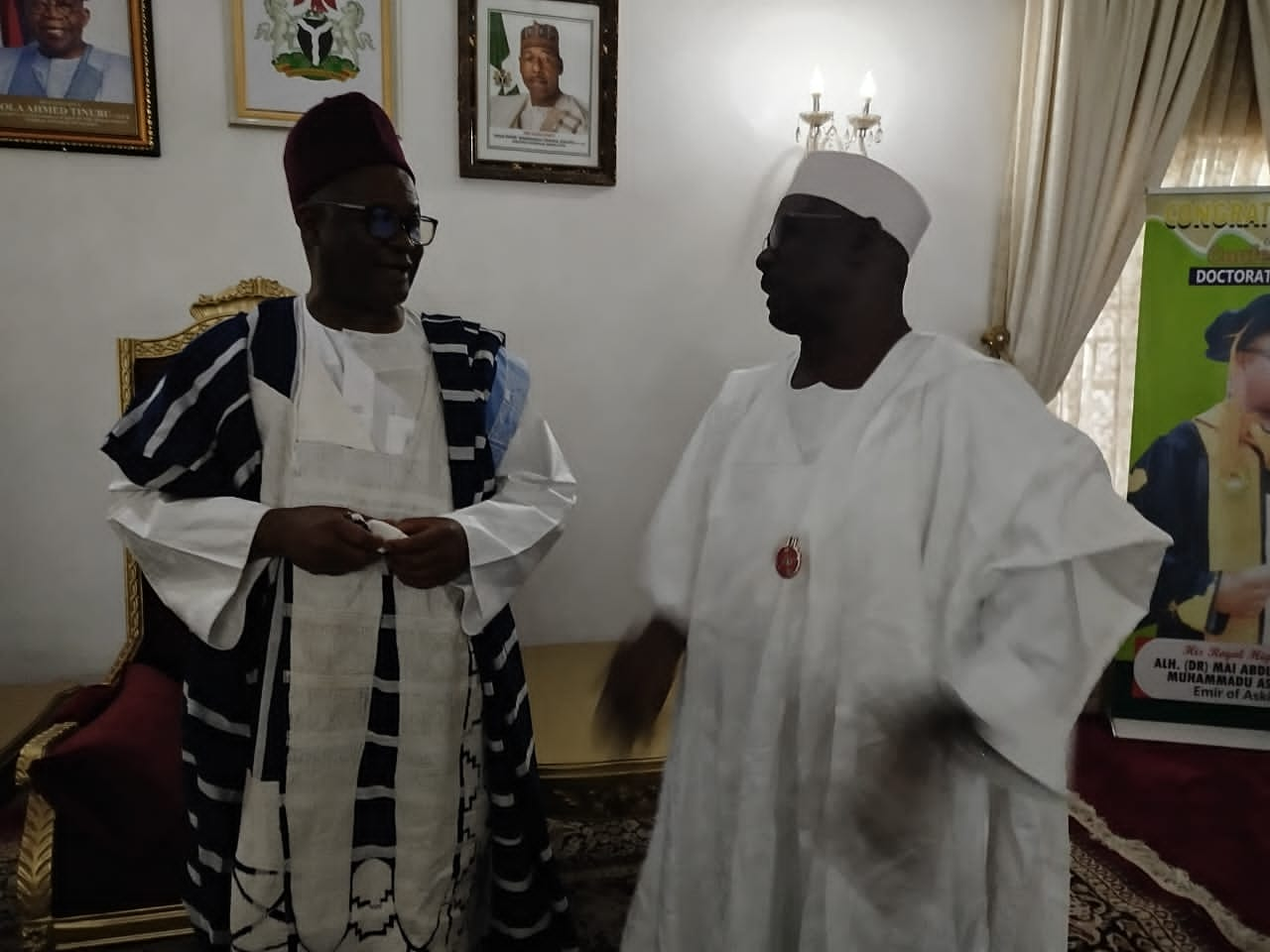
The Emir who stated this while hosting the Senator representing southern Borno senatorial district at the senate , Sen. Ali Ndume at his palace at the weekend during the Senator’s constituency tour of the senatorial district ,commended the lawmaker, and Borno State Governor, Babagana Umara Zulum for rejecting the bill, and defending the course of the poor masses.
He noted that the State Governor and lawmaker stance on the tax reform bill depicts their love for the cause of the common man.
The monarch also lamented the serial attacks carried out by Boko Haram terrorists in the recent time in his dormain, and called on President Tinubu and the Nigerian military to expedite action and end the Killings of innocent residents of Askira and surrounding communities.
Alhaji Askirama equally lamented the backwardness of the youths in Askira- Uba local government on education and called on the federal government to establish a higher institution such as a polytechnic in Askira to bridge the education gap in the council, and nearby local government areas, and further appealed to the federal government to deploy more troops in the area to halt the persistent attacks in the areas by the terrorists.
He appreciated the Senator’s gesture of touring the senatorial district and commended his quality representation to the people ,and assured him of support of his people in his activities.
Responding , Senator Ndume told the monarch, Alhaji Mohammed Askirama, that he was in his domain to keep the people and the youths abreast of the present economic hardship bedevilling the country, reiterating that the only way out of it is for the people to return to agriculture.
He urged youths and people of the senatorial district to embrace agricultural and business activities to beat looming food crisis and rising cost of living bedeveiling the people of the country.
Ndume said amid the global economic crunch, the only escape from hunger is for the people to engage in massive farming than relying on government and salaries, noting that the present minimum wage of N70,000 can’t afford a bag of rice sold for over N100,000, as well as a bag of beans that goes for N200,000.
He reminded the people that prior to the coming of the present administration, a litre of fuel was sold for N200, but has risen to N1200, while US dollars exchange rate to Naira, which stood at N600 then is now exchanged for N1600, hence he called on the people to switch to agriculture and trading to defeat the raging economic hardship.
Ndume, who began his constituency visit with Gwoza, charged the youths who were assembled at the Emir of Gwoza’s palace to take responsibility for security in the area and expose Boko Haram collaborators in their midst.
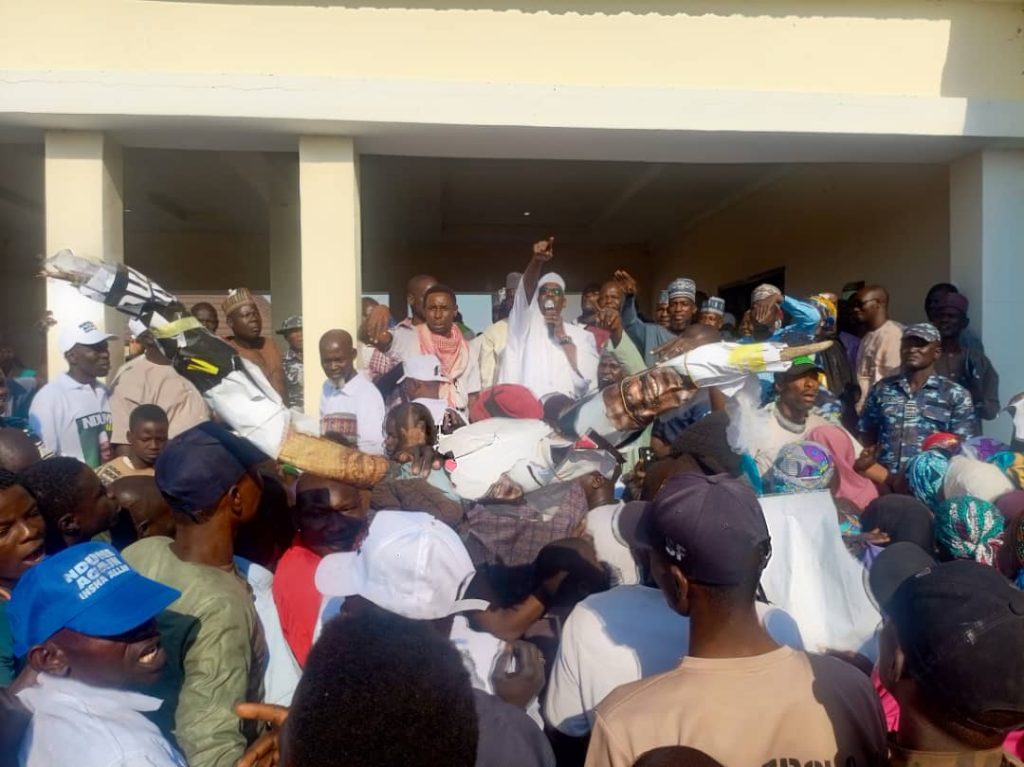
He noted that the terrorists could not have found their way to carry out attacks in some of the communities in Gwoza and other areas of southern Borno without informants, who are giving information to the terrorists, and urged the youths to deal with such collaborators before handing them over to the security agencies.
The senator commended the youths and residents of Gwoza for their resilience despite the activities of the terrorists in some areas of the local government area, and assured them that government is doing everything possible to ensure absolute return of peace in the areas for effective development.
He commended the state governor, Babagana Zulum, for resettling eleven communities previously displaced by Boko Haram terrorists in the Gwoza local government. He added that the governor is working hard to resettle the Ashigarsya, Hambagda, Wala, and Yamtake communities of the council.
At the emir of Uba palace, Senator Ndume urged youths in southern Borno to as well embrace education, saying that the certificate obtained could be useful, even while the youths engage in other activities, such as agriculture or vocational skills to augment their livelihoods.
Responding, the emir of Uba, Alhaji Ismaila Manza, thanked God for bringing Senator Ndume safely to his domain and commended him for all the good work he has been doing for the people.
He appealed to the people of his domain to embrace agriculture and business as advised by the senator for prosperity and self sustainability, and appealed to government to train youths in the area on vocational skills and business.
Senator Ndume who also visited Damboa and Chibok local government areas as part of tour of his district also warned the youths against collaboration with Boko Haram terrorists and noted that the terrorists are succeeding in their atrocities because some of the residents of the areas are providing information to the terrorists.
He noted that some female residents of the Gwoza local government area are even taking food condiments to the terrorists under the guise of going to farm ,hence he called for change of attitude from such character.
He said the collaboration with the terrorists is the reason some pockets of attacks are still being carried out in four local government areas of southern Borno such as Gwoza, Damboa, Askira-Uba and some part of Biu.
Borno Emir Says Tax Reform Bill Worst Than Boko Haram, Backs Ndume ,Zulum On Rejection
News
Cuba Slams New US Sanctions as ‘Economic Warfare,’ Warns of Deepening Humanitarian Crisis
By: Michael Mike
The government of Cuba has accused the United States of escalating economic warfare against the island nation following a sweeping new executive order and fresh sanctions that Havana says could worsen an already severe humanitarian and economic crisis.
In a strongly worded statement issued Thursday in Havana, Cuba’s Ministry of Foreign Affairs condemned the May 1, 2026 Executive Order signed by the White House, describing it as one of the harshest measures imposed against the communist nation in decades.
The Cuban government also denounced a subsequent decision by the United States Treasury Department on May 7 to place Cuban conglomerate Gaesa and mining company MoaNickel S.A. on the List of Specially Designated Nationals, effectively cutting them off from the American financial system and exposing foreign businesses dealing with them to possible secondary sanctions.
Havana described the move as a “ruthless act of economic aggression” aimed at tightening the long-standing United States blockade against Cuba and isolating the country from global trade and financial networks.
According to Cuban authorities, the latest measures threaten to deepen the island’s economic hardship at a time when the country is already battling chronic shortages of fuel, food, medicine and foreign exchange.
The Foreign Ministry argued that the sanctions go beyond bilateral relations between Washington and Havana by attempting to punish foreign companies, banks and governments that maintain economic ties with Cuba.
“The sovereign right of all states that have or wish to maintain economic, commercial and financial relations with Cuba is being explicitly attacked,” the statement declared.
Cuba accused senior United States officials, particularly the Secretary of State, of using intimidation and political pressure to force the international community into compliance with the blockade policy.
The statement further alleged that the new measures were intended to provoke economic collapse and social unrest within Cuba.
Havana warned that worsening economic pressure could create conditions for instability and potentially serve as justification for more aggressive actions against the island.
The Cuban government also accused Washington of attempting to manufacture a humanitarian crisis capable of triggering political upheaval.
The latest confrontation marks another sharp downturn in relations between the two Cold War-era adversaries whose ties have fluctuated between cautious engagement and hostility over the last six decades.
The United States first imposed trade restrictions on Cuba in the early 1960s following the Cuban Revolution led by Fidel Castro and the subsequent nationalisation of American-owned assets on the island. Relations deteriorated rapidly after Cuba aligned itself with the former Soviet Union during the Cold War.
In 1962, Washington formalised a broad economic embargo against Cuba, arguing that the measures were necessary to pressure Havana toward democratic reforms and respect for human rights.
Over the decades, the sanctions evolved into one of the world’s longest-running economic blockade regimes, affecting trade, banking, investment and travel.
Although there were signs of rapprochement during the administration of former President Barack Obama — including the restoration of diplomatic relations and the easing of some restrictions — many sanctions were later reinstated and expanded under subsequent administrations.
In recent years, Cuba has faced mounting economic difficulties caused by declining tourism revenues, inflation, fuel shortages and limited access to international credit markets.
The Cuban government has consistently blamed the United States embargo for worsening living conditions on the island, while Washington maintains that Havana’s centrally controlled political and economic system is primarily responsible for the country’s struggles.
The renewed sanctions are expected to intensify debates within the international community, where many countries and global organisations have repeatedly called for an end to the embargo.
For more than 30 consecutive years, the United Nations General Assembly has overwhelmingly voted in favour of resolutions urging the United States to lift its economic blockade against Cuba, describing the measures as harmful to ordinary citizens and contrary to international law.
Despite the growing pressure, both governments remain firmly entrenched in their positions, raising fears that tensions between Havana and Washington may continue to escalate in the coming months.
Cuba Slams New US Sanctions as ‘Economic Warfare,’ Warns of Deepening Humanitarian Crisis
News
NSCDC Smashes Interstate Car Theft Network, Arrests Syndicate Members Linked to Over 160 Stolen Vehicles
By: Michael Mike
Operatives of the Commandant General’s Special Intelligence Squad (CG’SIS) of the Nigeria Security and Civil Defence Corps have dismantled a sophisticated interstate car-snatching syndicate allegedly responsible for stealing and trafficking vehicles across several states, arresting multiple suspects and recovering stolen automobiles and dismantled vehicle parts.
The operation, described by security officials as one of the most significant breakthroughs against organised vehicle theft networks in recent months, followed intelligence reports linking the syndicate to coordinated car-snatching activities spanning the Federal Capital Territory, Nasarawa State, Kaduna State, Benue State, Kogi State and Plateau State.
The crackdown was ordered by the Commandant General of the NSCDC, Ahmed Audi, following what the Corps described as rising concerns over the activities of organised criminal groups targeting motorists and vehicle owners on interstate routes.

According to a statement issued by the NSCDC National Headquarters in Abuja on Friday, operatives of the CG’SIS acted on credible intelligence provided by informants and launched a coordinated operation that led to the arrest of key members of the syndicate.
According to the spokesman of NSCDC, Afolabi Babawale, those arrested include Hassan Bukar; Adam Musa, popularly known as Yellow; Ibrahim Haruna, alias Biggie; Adamu Mohammed; Sahal Abdullahi Aliyu; and Abubakar Yusuf, while several other members of the network are said to be on the run.
According to him, investigations by the Corps revealed that the syndicate allegedly specialised in stealing vehicles and supplying them to scrap dealers and vehicle spare parts merchants who dismantled the automobiles to destroy identifying traces and frustrate recovery efforts by owners and security agencies.
The NSCDC said the criminal network had developed a coordinated system for laundering proceeds from the illegal trade through cash payments and Point of Sale transactions in a bid to evade detection.
Commander of the CG’SIS, Commandant Apollo Dandaura, disclosed that five shops located within the Zuba Scrap Market in Abuja had been sealed as part of the ongoing investigation.
He further revealed that operatives recovered an already dismantled Toyota Camry allegedly sold for ₦1.15 million.
Dandaura said the operation exposed an extensive criminal supply chain involving vehicle thieves, middlemen, scrap dealers and buyers spread across several states.
According to him, the NSCDC remains determined to dismantle criminal syndicates threatening public safety and economic stability across the country.
“The Commandant General has directed that investigations be intensified to ensure every member of this network is tracked down and prosecuted,” he said.
One of the major breakthroughs in the investigation came from the interrogation of a suspect identified as Abdulsalam Isa, who allegedly confessed to serving as a courier and facilitator for a fleeing suspect, Ismail Haruna, also known as “Malam na TK.”
Investigators alleged that Isa admitted collecting stolen vehicles from suppliers operating in different parts of the country, including Gwagwalada and Ugwako.
The suspect reportedly disclosed that during the Ramadan period this year, he accompanied Ismail Haruna to Sauka over disputes relating to unpaid proceeds from stolen vehicle transactions involving another suspect identified as Dangwari.
According to the NSCDC, Isa further confessed that Haruna repeatedly instructed him to receive stolen vehicles at strategic locations including Sauka Bridge, Airport Bridge and Zuba Bridge.
Operatives eventually arrested Isa at Zuba Bridge while allegedly attempting to take delivery of another stolen vehicle.
The Corps also disclosed that financial records obtained during the investigation allegedly revealed consistent transactions between Isa and Ismail Haruna, strengthening claims that the suspects operated a coordinated payment structure for stolen vehicles.
Investigators said the evidence gathered so far established a prima facie case against the suspects for offences bordering on criminal conspiracy, theft, belonging to a gang of brigands, dishonestly receiving stolen property and concealment of stolen property under relevant provisions of the Penal Code.
The NSCDC alleged that Hassan Bukar, one of the principal suspects, was arrested in Keffi on April 3, 2026, with a stolen Toyota Corolla.
During interrogation, Bukar allegedly confessed to involvement in the theft and trafficking of more than 160 vehicles since 2014.
Investigators claimed he acted as a major link between vehicle thieves and buyers across the network and allegedly sold a stolen white Toyota Corolla LE to another syndicate member known as Dangwari for ₦900,000, with payments traced to his account.
Another suspect, Adam Musa, alias Yellow, was accused of participating in the purchase and resale of stolen vehicles for at least two years.
The NSCDC alleged that vehicles linked to his operations included a Honda Civic, Toyota RAV4, Toyota Camry and Toyota Sienna.
Musa was also accused of criminal breach of trust involving a vehicle allegedly entrusted to him for sale.
Similarly, investigators alleged that Adamu Mohammed operated as an intermediary and workshop owner who facilitated the disposal of stolen vehicles without documentation while retaining commissions from the transactions.
Another suspect, Sahal Aliyu Abdullahi, was accused of purchasing and dismantling stolen vehicles, including a Toyota Camry recovered during the operation.
Security analysts say the operation highlights the growing sophistication of organised vehicle theft syndicates operating across Nigeria and the increasing involvement of scrap markets and illegal spare parts dealers in the disposal of stolen automobiles.
The NSCDC said efforts were ongoing to apprehend fleeing suspects and dismantle the wider criminal network behind the interstate car theft ring.
NSCDC Smashes Interstate Car Theft Network, Arrests Syndicate Members Linked to Over 160 Stolen Vehicles
News
EU Reaffirms Support for Nigeria’s 2027 Elections
By: Michael Mike
The European Union has reaffirmed its commitment to supporting Nigeria’s democratic process ahead of the 2027 general elections, stressing that its role would remain focused on technical assistance, institutional strengthening and capacity building rather than interference in the country’s internal affairs.
Speaking during activities marking the 2026 Europe Day in Abuja, the EU Ambassador to Nigeria and ECOWAS, Gautier Mignot
said the union would continue to support democratic governance initiatives involving key electoral stakeholders, including the Independent National Electoral Commission (INEC), civil society organisations, political parties, the National Assembly and the media.
The envoy said the EU had consistently supported democracy and electoral reforms in Nigeria through its Support to Democratic Governance programme, aimed at improving the credibility and transparency of elections.
According to the ambassador, preparations for the 2027 polls would build on recommendations made by previous EU Election Observation Missions and expert reports submitted after earlier elections.
“We will continue doing what we have been doing consistently, which is trying to reinforce capacities, trying to help reforms and improve the system little by little over the years,” the envoy stated.
Responding to concerns raised by journalists over electoral violence, low voter turnout and the non-implementation of recommendations from previous election observers, the ambassador insisted that the responsibility for conducting credible elections ultimately rests with Nigerian authorities.
“I think your question has to be directed to Nigerian authorities in charge of organising elections. It is a sovereign responsibility of Nigerian authorities,” the envoy said.
The ambassador stressed that the EU was not in Nigeria to impose sanctions, issue “yellow cards or red cards,” or dictate the country’s political direction, but rather to support ongoing reforms where requested.
The envoy also disclosed that the EU’s intervention would not primarily involve direct funding of elections but would focus more on technical assistance, institutional support and training for electoral stakeholders.
On media participation, the ambassador noted that journalists remained an important component of the EU’s democratic governance support framework and would continue to benefit from engagement programmes under the initiative.
The envoy, however, said it was still too early to outline specific activities or financial commitments for the 2027 elections.
Concerns over Nigeria’s democratic future and fears of a possible drift toward a one-party state were also raised during the interaction, but the ambassador maintained that assessing Nigeria’s political direction remained the responsibility of Nigerians themselves.
The EU representative added that a follow-up mission on recommendations from the 2023 elections had already been conducted, while attention was now focused on further implementation of electoral reforms and strengthening public confidence in the electoral system.
EU Reaffirms Support for Nigeria’s 2027 Elections
-
News2 years agoRoger Federer’s Shock as DNA Results Reveal Myla and Charlene Are Not His Biological Children

-
Opinions4 years agoTHE PLIGHT OF FARIDA
-
News1 year agoFAILED COUP IN BURKINA FASO: HOW TRAORÉ NARROWLY ESCAPED ASSASSINATION PLOT AMID FOREIGN INTERFERENCE CLAIMS
-

News2 years agoEYN: Rev. Billi, Distortion of History, and The Living Tamarind Tree
-

Opinions4 years agoPOLICE CHARGE ROOMS, A MINTING PRESS
-

ACADEMICS2 years agoA History of Biu” (2015) and The Lingering Bura-Pabir Question (1)
-

Columns2 years agoArmy University Biu: There is certain interest, but certainly not from Borno.
-

Opinions2 years agoTinubu,Shettima: The epidemic of economic, insecurity in Nigeria