
Uncategorized
China: Africa’s Most Reliable Companionon Africa’s Path to Development

China: Africa’s Most Reliable Companion
on Africa’s Path to Development
By: Our Reporter
Development is an inalienable right of all countries, not a privilege of a few. Recently, Chinese Premier Li Qiang solemnly declared at the High-level Meeting on the Global Development Initiative hosted by China at the United Nations Headquarters that China as a responsible major developing country, will not seek new special and differential treatment in current and future negotiations at the WTO. This is a proactive step that China takes in support of the multilateral trading system, and a significant move to implement the Global Development Initiative and Global Governance Initiative.
The tariff wars initiated by the United States have seriously undermined global trade and economic order, posing serious challenges to the development of all countries, especially in the Global South. As the world’s second-largest economy, China actively defends the legitimate rights and interests of developing countries, firmly upholds the multilateral trading system, so that it can better focus on development issues and help bridge the development gap between the Global North and South. As the largest developing country and the continent with the highest concentration of developing countries in the world respectively, China and Africa are both vital members of the Global South. China is willing to work with Africa to effectively implement the Global Development Initiative and to be the most reliable companion on Africa’s path to development.
China practices the principle of inclusive and universal benefits through an open market, expanding vast space for Africa’s development. A universally beneficial and inclusive economic globalization is vital for developing countries. Some developed countries are unwilling to fulfill their commitments on development financing and have even withdrawn funding from international development institutions.
At the Forum on China–Africa Cooperation Beijing Summit held last September, President Xi Jinping announced zero tariff treatment on products with 100% tariff lines for all least developed countries having diplomatic relations with China, including 33 African countries. In June this year, China extended the zero-tariff treatment to cover 100% of tariff lines for all 53 African countries that have diplomatic ties with China. From January to July 2025, China’s imports from Africa’s least developed countries reached 39.66 billion USD, with a year-on-year increase of 10.2%.
The facts prove that China’s proactive unilateral market opening measures will strongly drive the industrial development, promote employment growth and accelerate poverty reduction in Africa.
China shares advanced and practical technology to strengthen the core support for Africa’s innovative development. In a context where global technological barriers are increasingly prominent and key resources are concentrated in a few developed countries and multinational tech giants, “Intelligent Manufacturing in China” has enriched global supply, making previously inaccessible technology available.
At the AI Action Summit held in Paris in February, China signed the Statement on Inclusive and Sustainable Artificial Intelligence for People and the Planet together with other 60 countries and international organizations. Represented by Deepseek, Chinese AI models have broken the monopoly of Western tech giants through open-source modes, initiating an “AI democratizatio” process.
The supply of China’s advanced and practical technology promotes bridging the digital and artificial intelligence gaps, further empowering African industries and people, providing transformative power to Africa’s leapfrog development.
China provides green transition solutions to support a long-term future for Africa’s sustainable development. Possessing the world’s richest green resources such as solar and wind power, Africa remains one of the most vulnerable regions to climate change. China actively shares green transition solutions with Africa. The Blue Line built by a Chinese company provides green and convenient public transportation to Lagos residents. Major projects built by Chinese enterprises, such as Morocco’s Noor III and II Concentrated Solar Power Project and South Africa’s De Aar Wind Power Project, have illuminated millions of homes across Africa and lit the path to sustainable development. China’s new energy vehicles are rapidly entering the African market, offering new options to improve urban air quality.
China’s green development solutions have helped Africa avoid the old path of “polluting first, cleanup later” at the early stage of its industrialization, paving the way toward a more resilient and sustainable future.
China supplies quality and affordable products to firmly support African livelihoods. From home appliances and clothing that improve the quality of life, to smartphones and base station equipment ensuring communication, as well as machinery and transport equipment supporting infrastructure development, “Made in China” is becoming deeply and comprehensively integrated into the daily lives of the African people.
These Chinese products meet Africans’ pursuit of better life while effectively reducing the cost of improving livelihoods and industrial development, providing a foundation for meeting basic needs and improving life quality, thus injecting sustained momentum into Africa’s economic and social development.
In his speech on the African Union Day, H.E. Mahmoud Ali Youssouf, Chairperson of the African Union Commission, called for building an Africa where every African can thrive in dignity and hope. China firmly believes that global prosperity and stability cannot be achieved when the rich get richer and the poor poorer. Regardless of international uncertainties, China will uphold the UN-centered international system, stick to multilateralism and free trade, strive to build an open world economy, and provide robust support for Africa’s development as a true friend walking hand in hand on Africa’s path to development .
China: Africa’s Most Reliable Companion
on Africa’s Path to Development


Uncategorized
NIMC, NIPOST Integrate Identity, Digital Address Systems to Revolutionise Public Service Delivery
NIMC, NIPOST Integrate Identity, Digital Address Systems to Revolutionise Public Service Delivery
By: Michael Mike
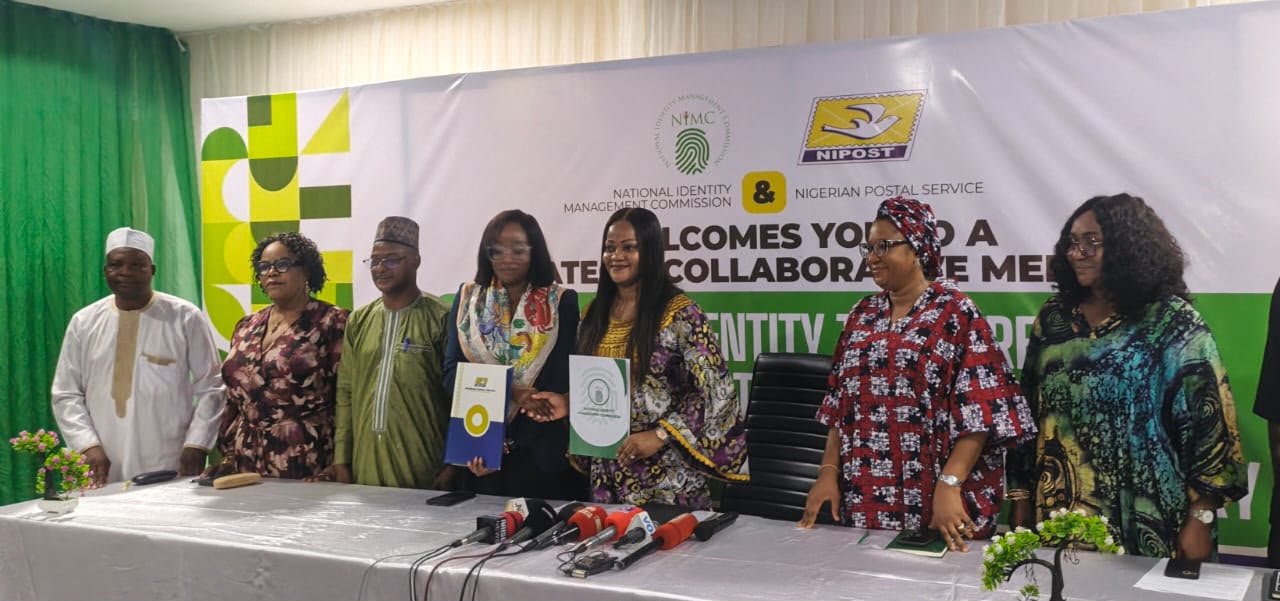
The National Identity Management Commission (NIMC) and the Nigerian Postal Service (NIPOST) have launched a landmark initiative to integrate Nigeria’s National Identification Number (NIN) database with the country’s digital postcode system, a move expected to significantly transform public service delivery, strengthen digital governance and accelerate economic inclusion.
The collaboration, unveiled in Abuja, will allow Nigerians to verify their addresses and retrieve official digital postcodes through the NINAuth platform, effectively linking verified identity with authenticated location information on a single trusted digital infrastructure.
The initiative is expected to enhance the efficiency of government interventions, improve emergency response, facilitate financial inclusion, strengthen logistics and e-commerce operations, and provide more accurate data for national planning.
Director-General and Chief Executive Officer of NIMC, Engr. (Dr.) Abisoye Coker-Odusote, described the partnership as a major milestone in Nigeria’s digital transformation, saying it goes beyond inter-agency cooperation to establish the foundation for an integrated digital public infrastructure.
She disclosed that the recently enacted NIMC Act 2026 has significantly expanded the Commission’s mandate, making it the custodian of Nigeria’s Digital Public Infrastructure (DPI) for identity and the Root Certification Authority for the National Public Key Infrastructure (PKI).
According to her, the legislation provides the legal and technological framework for secure digital identity, electronic authentication, digital signatures and trusted online transactions across government and the private sector.
She, however, stressed that identity without location cannot deliver a fully digital economy.
“The National Identification Number tells us who a person is, while the National Postcode System tells us where that person can be reached. Bringing both together creates the trusted digital foundation required for efficient governance and inclusive economic development,” she said.
Coker-Odusote revealed that technical teams from both agencies had already completed the integration of postcode retrieval into the NINAuth platform, enabling citizens to seamlessly verify both their identity and address.
She noted that the integration aligns with the Federal Government’s digital transformation agenda by promoting interoperability across public institutions and delivering faster, safer and more efficient services to Nigerians.
She also described NIPOST as a critical partner whose nationwide addressing infrastructure would help extend digital services to every part of the country.
The NIMC chief added that the initiative supports President Bola Ahmed Tinubu’s Renewed Hope Agenda by deepening digital innovation, improving public service delivery and expanding economic opportunities.
In her remarks, Postmaster General and Chief Executive Officer of NIPOST, Omotola Odeyemi, said the collaboration represents a strategic investment in Nigeria’s foundational infrastructure.
She observed that every modern economy depends on two critical capabilities—knowing who people are and knowing where they are—and said integrating digital identity with a national postcode system would significantly improve governance, logistics, emergency response, commerce and access to government services.
Odeyemi said NIPOST is undergoing a major transformation from a traditional postal operator into a modern digital infrastructure institution that connects citizens, businesses and communities.
She identified the National Digital Postcode Initiative as one of the agency’s flagship reforms, noting that postal administrations around the world now play strategic roles in digital inclusion, e-commerce and national addressing systems.
According to her, NIPOST’s extensive nationwide presence and statutory mandate place it in a unique position to provide a reliable national addressing framework capable of supporting Nigeria’s digital economy.
She assured Nigerians that the implementation of the integrated platform would comply with the highest standards of data protection, cybersecurity and institutional accountability.
The partnership comes as the Federal Government intensifies efforts to build a robust Digital Public Infrastructure that enables secure identity verification, seamless access to public services and greater efficiency across sectors, with digital identity and verified location increasingly recognised as critical pillars of modern governance and economic development.
NIMC, NIPOST Integrate Identity, Digital Address Systems to Revolutionise Public Service Delivery
Uncategorized
Troops foil suspected terrorist supply chain, arrest Chadian woman with drugs in Borno
Troops foil suspected terrorist supply chain, arrest Chadian woman with drugs in Borno
By: Zagazola Makama
Troops of Operation HADIN KAI have disrupted a suspected terrorist logistics network with the arrest of a Chadian woman allegedly transporting illicit drugs and alcoholic beverages to insurgents operating in the Lake Chad region.
The arrest was made by troops of Sector 3 of the Joint Task Force North East during an intelligence-driven operation along the Maiduguri–Monguno highway on Thursday.
According to a statement issued by the Acting Military Information Officer, Headquarters Joint Task Force (North East), Capt. Mohammed Goni, the suspect was intercepted while travelling towards Kwatan Doron Baga in Kukawa Local Government Area of Borno.
He identified the suspect as Mrs Rachael Samuel, 48, a citizen of the Republic of Chad from Kelo in Chari-Baguirmi Province.
“The operation followed actionable intelligence on suspected movements of logistics intended for terrorist elements within the Lake Chad Islands,” the statement said.
Items recovered from the suspect included seven compressed bundles of suspected cannabis sativa weighing approximately 30 kilogrammes, two 10-litre containers of hydromercuric chloride, popularly known as “Suck and Die,” one carton containing 48 bottles of dry gin and 61 bottles of herbal alcoholic beverages.
The troops also recovered a mobile phone, two Automated Teller Machine (ATM) cards, personal belongings and cash from the suspect.
Military authorities said the suspect had been taken into custody, while the exhibits would be handed over to the relevant law enforcement agency for detailed investigation and prosecution.
The statement said the operation represented another breakthrough in ongoing efforts to dismantle the supply networks sustaining terrorist groups in the North East.
It explained that intelligence reports had shown that terrorist fighters often relied on illicit drugs and intoxicants to enhance endurance, suppress fear and support their violent activities.
The Theatre Command praised the troops for their professionalism and vigilance, reiterating its commitment to intensifying operations against terrorists and those providing them with logistics and other forms of support.
It also appealed to residents to continue cooperating with security agencies by providing credible and timely information that could assist ongoing counter-terrorism operations across the region.
Troops foil suspected terrorist supply chain, arrest Chadian woman with drugs in Borno
Army, NDLEA Arrest Three Suspected Drug Suppliers Linked to Terrorists in Katsina
By Zagazola Makama
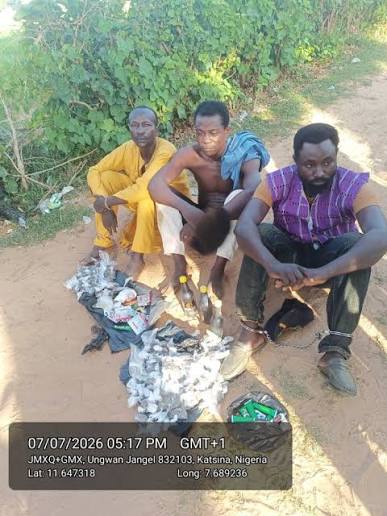
Troops of the Nigerian Army in collaboration with the National Drug Law Enforcement Agency (National Drug Law Enforcement Agency) have arrested three suspected drug peddlers allegedly supplying illicit substances to terrorists and other criminal elements in Katsina State.
Security sources told Zagazola Makama that the joint operation was conducted at about 5:15 p.m. on Tuesday by troops of the Forward Operating Base (FOB) Malumfashi deployed at Kafur, alongside operatives of the NDLEA Area Command, Malumfashi.
The operation targeted Kagara village in Kafur Local Government Area, where the security team raided suspected drug distribution points.
According to the sources, three suspects identified as Mohammed Lawan, 34, Muhawiya Haruna, 40, and Junadata Usman, 40, were arrested during the operation.
Items recovered from the suspects included substances suspected to be cannabis sativa, quantities of tramadol capsules, pregabalin, diazepam, Extol-5 tablets, rubber solution, and “Suck and Die” spirit.
The sources said preliminary investigations indicated that the suspects were allegedly involved in supplying hard drugs and other intoxicating substances to terrorists and criminal elements operating within Kafur and neighbouring communities.
The arrested suspects, along with the recovered exhibits, have been handed over to the NDLEA Area Command in Malumfashi for further investigation and possible prosecution.
The operation is part of ongoing efforts by security agencies to disrupt the logistics and supply networks supporting terrorism and other forms of criminality across Katsina State.
Army, NDLEA Arrest Three Suspected Drug Suppliers Linked to Terrorists in Katsina

NIMC, NIPOST Integrate Identity, Digital Address Systems to Revolutionise Public Service Delivery

Troops foil multiple ISWAP infiltration attempts in Maiduguri, Buratai axis

Troops foil suspected terrorist supply chain, arrest Chadian woman with drugs in Borno

Roger Federer’s Shock as DNA Results Reveal Myla and Charlene Are Not His Biological Children

THE PLIGHT OF FARIDA

FAILED COUP IN BURKINA FASO: HOW TRAORÉ NARROWLY ESCAPED ASSASSINATION PLOT AMID FOREIGN INTERFERENCE CLAIMS
-
 News2 years ago
Roger Federer’s Shock as DNA Results Reveal Myla and Charlene Are Not His Biological Children
-
Opinions4 years ago
THE PLIGHT OF FARIDA
-
 News1 year ago
FAILED COUP IN BURKINA FASO: HOW TRAORÉ NARROWLY ESCAPED ASSASSINATION PLOT AMID FOREIGN INTERFERENCE CLAIMS
-

 News2 years ago
EYN: Rev. Billi, Distortion of History, and The Living Tamarind Tree
-
 Opinions5 years ago
POLICE CHARGE ROOMS, A MINTING PRESS
-

 ACADEMICS2 years ago
A History of Biu” (2015) and The Lingering Bura-Pabir Question (1)
-

 Columns2 years ago
Army University Biu: There is certain interest, but certainly not from Borno.
-

 Politics1 year ago
2027: Why Hon. Midala Balami Must Go, as Youths in Hawul and Asikira/Uba Federal Constituency Reject ₦500,000 as Sallah Gift
