
News
Council of European Union’s Africa Working Group Begins 4-day Visit to Nigeria

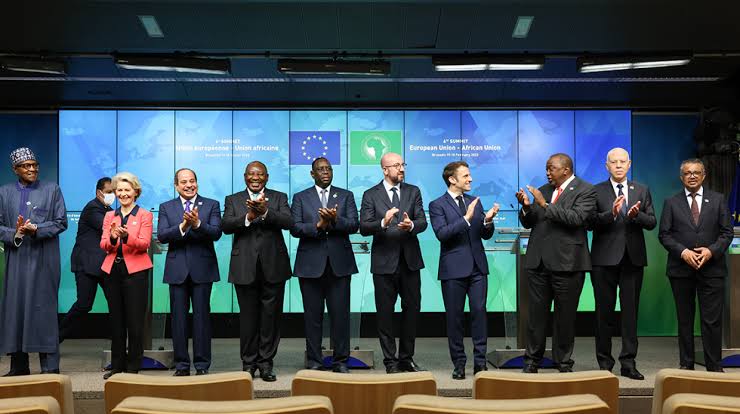
Council of European Union’s Africa Working Group Begins 4-day Visit to Nigeria
By: Michael Mike
Members of the Council of European Union’s Africa Working Party (COAFR) have arrived in Abuja to begin a four-day working visit to the country.
During the visit taking place from 26-29 February 2024, the COAFR members will engage with Nigerian authorities, government agencies, civil society groups, regional and international organisations and private sector actors in Abuja and in Lagos.
According to a statement on Sunday by the European Union in Nigeria, the Africa Working Party (COAFR) is mandated with the supervision and management of EU external policy towards the 46 countries of the sub-Saharan Africa, the African Union and other sub-regional organisations, including ECOWAS.
The Africa Working Party (COAFR) is composed of representatives of all 27 EU Member States, chaired by a permanent member of the European External Action Service (EEAS), and assisted by representatives of the Commission and the General Secretariat of the Council. It works under the auspices of the European Union’s Foreign Affairs Council (FAC), itself composed of the Ministers of Foreign Affairs, Defense and/or development of the 27 Member States of the European Union.
The statement said in Abuja, the visiting COAFR members will meet with key Federal Government ministries and agencies starting from the Ministry of Foreign Affairs, the Office of the National Security Adviser, the Ministry of Budget and Economic Planning, among others.
They will also have an interactive session with the ECOWAS Commission on regional developments and integration processes.
In Lagos, the COAFR is expected to meet with the Governor Babajide Sanwo-Olu, the Consuls General of EU Member States, and the leadership of the European Business Chamber (EuroCham) Nigeria.
They will also visit several EU-funded projects in the state featuring digital and innovation, critical infrastructure and connectivity and migration. Deliberations during the meetings will centre on further boosting EU-Nigeria partnership.
The Africa Working Party’s (COAFR) visits to African countries aim at promoting direct contact, mutual information exchange and feedback between the political and foreign policy organs of the European Union and their African counterparts. They play an important role on taking stock of state and non-state actors views, perspectives, aspirations and expectations regarding their partnership with the European Union, its closest neighbour and its sister continent.
The team will commence a similar visit to the neighbouring Republic of Benin at the end of its current mission in Nigeria.
According to the statement, this is the group’s first-ever working visit to Nigeria, noting that in addition to the representatives of 17 EU Member States also officials from EU institutions, are expected to be in the team.
The statement further revealed that this year’s working visit will be the eleventh visit of the COAFR to the African continent, and the third visit to West Africa – following earlier visits to Senegal and Burkina Faso (2015) and Ivory Coast and Ghana (2019).
It said more than ever before, several top EU officials have visited Nigeria in recent years and months, underlining the importance the EU accords its partnership with the country.
Last October, the EU’s Commissioner for International Partnership, Ms. Jutta Urpilainen, her counterpart for Energy, Ms. Kadri Simson, led other top officials to participate in the EU-Nigeria Strategic Dialogue Meeting held Abuja. The Deputy Secretary General of the European External Action Service (EEAS), Ms Helena Konig, and the Managing Director, Africa at the EEAS, Ms. Rita Laranjinha, were also in the country shortly before then, following the visits in 2022 of European Commission’s Executive Vice President Margrethe Vestager in February 2022, EU and Member States Maritime Security Coordinators in April 2022 and senior officials of the European Commission in charge of Energy and Home Affairs.
is mandated with the supervision and management of EU external policy towards the 46 countries of the sub-Saharan Africa, the African Union and other sub-regional organisations, including ECOWAS.
The Africa Working Party (COAFR) is composed of representatives of all 27 EU Member States, chaired by a permanent member of the European External Action Service (EEAS), and assisted by representatives of the Commission and the General Secretariat of the Council. It works under the auspices of the European Union’s Foreign Affairs Council (FAC), itself composed of the Ministers of Foreign Affairs, Defense and/or development of the 27 Member States of the European Union.
In Abuja, the visiting COAFR members will meet with key Federal Government ministries and agencies starting from the Ministry of Foreign Affairs, the Office of the National Security Adviser, the Ministry of Budget and Economic Planning, among others. They will also have an interactive session with the ECOWAS Commission on regional developments and integration processes.
In Lagos, the COAFR is expected to meet with the Governor Babajide Sanwo-Olu, the Consuls General of EU Member States, and the leadership of the European Business Chamber (EuroCham) Nigeria.
They will also visit several EU-funded projects in the state featuring digital and innovation, critical infrastructure and connectivity and migration. Deliberations during the meetings will centre on further boosting EU-Nigeria partnership.
The Africa Working Party’s (COAFR) visits to African countries aim at promoting direct contact, mutual information exchange and feedback between the political and foreign policy organs of the European Union and their African counterparts. They play an important role on taking stock of state and non-state actors views, perspectives, aspirations and expectations regarding their partnership with the European Union, its closest neighbour and its sister continent. The team will commence a similar visit to the neighbouring Republic of Benin at the end of its current mission in Nigeria.
This is the group’s first-ever working visit to Nigeria. In addition to the representatives of 17 EU Member States also officials from EU institutions, are expected to be in the team. This year’s working visit will be the eleventh visit of the COAFR to the African continent, and the third visit to West Africa – following earlier visits to Senegal and Burkina Faso (2015) and Ivory Coast and Ghana (2019).
More than ever before, several top EU officials have visited Nigeria in recent years and months, underlining the importance the EU accords its partnership with the country. Last October, the EU’s Commissioner for International Partnership, Ms. Jutta Urpilainen, her counterpart for Energy, Ms. Kadri Simson, led other top officials to participate in the EU-Nigeria Strategic Dialogue Meeting held Abuja. The Deputy Secretary General of the European External Action Service (EEAS), Ms Helena Konig, and the Managing Director, Africa at the EEAS, Ms. Rita Laranjinha, were also in the country shortly before then, following the visits in 2022 of European Commission’s Executive Vice President Margrethe Vestager in February 2022, EU and Member States Maritime Security Coordinators in April 2022 and senior officials of the European Commission in charge of Energy and Home Affairs.
Council of European Union’s Africa Working Group Begins 4-day Visit to Nigeria


Nigeria’s Budget Should Build Lives, Not Fund Luxury – ActionAid
By: Michael Mike
ActionAid Nigeria has called on the Federal Government and state governments to redirect public spending from what it described as “prestige projects” and excessive government luxuries to investments that directly improve the lives of Nigerians, saying the country’s limited resources should be deployed to sectors with the greatest social impact.
The organisation made the call on Sunday while reacting to President Bola Tinubu’s recent directive to state governors to stop constructing unnecessary flyovers in areas without traffic congestion and instead focus on projects that address the needs of citizens.
In a statement signed by its Country Director, Dr. Andrew Mamedu, ActionAid Nigeria said the President’s comments should spark a broader national debate on public finance and the need to prioritise people-centred development over projects driven by political visibility.
According to the organisation, while infrastructure remains important, Nigeria’s challenge lies in a pattern of public expenditure that often favours prestige over citizens’ welfare.
It noted that with millions of Nigerians grappling with economic hardship, every naira of public funds should deliver measurable benefits.
ActionAid therefore urged governments at all levels to review spending on projects and activities it considers to have limited public value, including unnecessary prestige projects, luxury acquisitions, oversized official delegations, excessive local and foreign travel, and discretionary expenditures that lack transparency and accountability.
The organisation cited figures from the Budget Office of the Federation showing that President Tinubu and Vice President Kashim Shettima are proposed to receive a combined ₦9.36 billion in the 2026 budget for local travel, foreign travel, food and refreshments.
It, however, observed that the allocation does not necessarily represent the total cost of official trips, noting that expenses for accompanying officials and operational support are often captured separately in the budgets of other government agencies.
ActionAid argued that reducing the proposed allocation by half would free about ₦4.68 billion, which could be redirected to critical public services.
It estimated that such savings could finance approximately 62 three-classroom school blocks, 208 solar-powered boreholes and five fully equipped primary healthcare centres, based on recently published government project costs.
Mamedu said Nigeria’s budget should reflect the country’s development priorities rather than government extravagance.
“This is not merely a question of reducing expenditure; it is about changing national priorities. Every unnecessary luxury purchase represents classrooms that were never built. Every unjustifiable trip represents medicines that never reached a primary healthcare centre.
“Every unaccounted security vote represents communities that continue to live in fear without knowing how public resources intended for their protection were spent. Every prestige project that fails to address citizens’ needs represents another missed opportunity to reduce poverty and inequality. Public budgets are moral documents. They reveal whose interests governments choose to protect,” he said.
The organisation maintained that Nigeria’s development challenge is not the absence of resources but the choices governments make in allocating them.
It called on federal and state governments to prioritise spending on quality education, primary healthcare, water and sanitation, food security, climate resilience and social protection.
ActionAid also urged authorities to reduce the cost of governance by cutting unnecessary official travel, luxury purchases and oversized government delegations, while strengthening transparency and accountability in discretionary public spending, including security-related expenditure without compromising national security.
The organisation further advocated that infrastructure projects should be selected based on evidence, community needs and measurable development outcomes rather than political considerations, while calling for greater citizen participation in budget planning, implementation and monitoring.
It stressed that the true measure of governance is not the number of monuments erected but the number of lives transformed through improved education, healthcare, safe water, decent livelihoods and opportunities for citizens.
Nigeria’s Budget Should Build Lives, Not Fund Luxury – ActionAid
News
Internal Rift Deepens in ISWAP as Leader Detains Four Shura Council Members Over Alleged Dissent

Internal Rift Deepens in ISWAP as Leader Detains Four Shura Council Members Over Alleged Dissent
By: Zagazola Makama
A fresh wave of internal distrust has reportedly engulfed the leadership of the Islamic State West Africa Province (ISWAP) in the Lake Chad Basin, following the arrest and detention of four senior members of the group’s influential Shura Council by its overall leader in the area, Ba Shuwa.
Zagazola Makama gathered from credible intelligence sources that the arrests were ordered after the group’s internal intelligence unit, known as the Amniyya, concluded a prolonged surveillance operation on the four senior figures.
According to the sources, the detained leaders were accused of repeatedly listening to what ISWAP leadership described as “subversive” audio messages believed to have originated from Nigerian military psychological operations targeting insurgents in the Lake Chad region.
Those arrested were identified as Mallam Burin, a widely respected Qaid (field commander) with considerable influence among fighters operating around the Lake Chad islands; Babakura Wanjam, a prominent ISWAP cleric known for providing ideological guidance to members; as well as Abu Huraira and Mallam Ari Kara, both senior members of the group’s Shura Council.
Security sources said the arrests have triggered anxiety and uncertainty within ISWAP’s ranks, particularly because those detained are regarded as trusted members of the organisation’s senior decision-making body.
The development is being viewed as one of the clearest signs yet of growing suspicion and internal fractures within the terrorist group’s leadership structure.
“The detention of influential commanders and religious figures by their own leader reflects an atmosphere of deep mistrust within the organisation. It suggests that Ba Shuwa is increasingly concerned about possible ideological drift, dissent or covert influence among even his closest associates,” a security source familiar with the development said.
The extremist organisations often become vulnerable when internal loyalty is questioned, as prolonged suspicion can undermine operational planning, weaken command cohesion and erode fighters’ confidence in their leadership.
The latest incident comes amid sustained military pressure by Nigerian and regional forces against ISWAP strongholds in the Lake Chad Basin, where intelligence-driven operations and psychological campaigns have continued to target the group’s command structure and rank-and-file members.
It was believed such sustained pressure has increasingly forced the group into defensive internal security measures, including tighter surveillance of its own members and frequent investigations into suspected disloyalty.
Sources disclosed that the current development is being closely monitored by security agencies, which consider the apparent leadership crisis an opportunity to further weaken the terrorist organisation through intelligence exploitation and psychological operations.
According to the sources, efforts are ongoing to establish the exact location where the four detained leaders are being held, assess the reaction of other ISWAP commanders, and monitor Ba Shuwa’s next moves.
Sources say that if the reported divisions continue to widen, they could contribute to reduced morale among fighters, disrupt command and control, encourage defections and potentially accelerate fragmentation within the organisation.
Internal Rift Deepens in ISWAP as Leader Detains Four Shura Council Members Over Alleged Dissent

Dauda Soroye Adegbenro ICT Polytechnic mourns as night marauders kill one student.
By: Our Reporter
Dauda Soroye ICT Polytechnic community was thrown into mourning recently when three students were said to have been shot by night marauders who visited the Eruku community of Itori Ogun state recently.
The deadly visit left one of the female students dead on the spot while two others were rushed to the federal medical center Abeokuta with bullet wounds for treatment.
This dastardly attack forced the students of the Polytechnic to cordon the Lagos-Abeokuta Expressway, on Tuesday to protest the killing of the female colleague name withheld during the sad armed robbery attack.
Eye witnesses hinted that the deceased was a Higher National Diploma (HND) two student in the Department of Marketing who was due to write her final examinations this week.
The institution located in the heart of Ewekoro Council area of ogun state has been witnessing similar robbery attacks, with students calling on the political and traditional leaders of the area to come to their aid by rising up to their plight.
The angry students had blocked their highway, causing traffic congestion thereby grounding commercial activities and making commuters and motorists stranded for hours.
For now another female student, whose ear was injured by bullets and a male colleague of theirs who was equally shot are now said to be receiving treatment at the Federal Medical Centre (FMC), Idi-Aba Abeokuta.
The National Association of Nigerian Students (NANS) had through its Secretary-General, Oladimeji Uthman, maintained that the incident underscored the worsening security challenges confronting students across Ogun State and the country.
The umbrella student Union described the attack on the student hostel area as “heart-wrenching and a direct assault on the harbingers of the future of Nigeria’s educational system.
While extending condolences to the family of the deceased and the entire student community, the group urged Governor Dapo Abiodun to fortify schools in collaboration with security agencies, institutional managements, traditional rulers, student leaders and local governments.
Dauda Soroye Adegbenro ICT Polytechnic mourns as night marauders kill one student.

NDLEA Intercepts Cocaine Hidden in Mortar, Backpack Bound for China, Italy; Arrests Suspected Drug Dealers Nationwide

ECOWAS Chief Bids Benin Farewell with Unity Message on 66th Independence Anniversary

Nigeria’s Budget Should Build Lives, Not Fund Luxury – ActionAid

Roger Federer’s Shock as DNA Results Reveal Myla and Charlene Are Not His Biological Children

THE PLIGHT OF FARIDA

FAILED COUP IN BURKINA FASO: HOW TRAORÉ NARROWLY ESCAPED ASSASSINATION PLOT AMID FOREIGN INTERFERENCE CLAIMS
-
 News2 years ago
Roger Federer’s Shock as DNA Results Reveal Myla and Charlene Are Not His Biological Children
-
Opinions4 years ago
THE PLIGHT OF FARIDA
-
 News1 year ago
FAILED COUP IN BURKINA FASO: HOW TRAORÉ NARROWLY ESCAPED ASSASSINATION PLOT AMID FOREIGN INTERFERENCE CLAIMS
-

 News2 years ago
EYN: Rev. Billi, Distortion of History, and The Living Tamarind Tree
-
 Opinions5 years ago
POLICE CHARGE ROOMS, A MINTING PRESS
-

 ACADEMICS2 years ago
A History of Biu” (2015) and The Lingering Bura-Pabir Question (1)
-

 Columns2 years ago
Army University Biu: There is certain interest, but certainly not from Borno.
-

 Politics1 year ago
2027: Why Hon. Midala Balami Must Go, as Youths in Hawul and Asikira/Uba Federal Constituency Reject ₦500,000 as Sallah Gift
