
News
Cuba Wants Bilateral Relations Strengthened With Nigeria

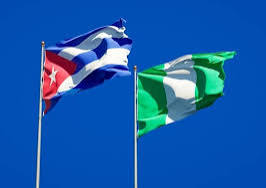
Cuba Wants Bilateral Relations Strengthened With Nigeria
By: Michael Mike
The government of Cuba has expressed interest to strengthen bilateral relations with Nigeria.
Cuban Ambassador to Nigeria, Miriam Morales Palmero expressed the interest of her country at the weekend in Abuja during the celebration of the 50th Anniversary of Bilateral Relations between Cuba and Nigeria and the Day of Cuban Culture.
Palmero who also revealed that no fewer than 400 Nigerian students are currently in different Cuban universities studying mainly medical sciences, said Cuba is not only seeking to maintain but also enhance and develop the ties created 50 years ago.
The envoy also revealed that both countries have signed series of Memorandum of Understanding across some key sectors.
She said: “During these 50 years, we have worked in our bilateral relations not only to maintain but also enhance and develop the ties created. At the economic and commercial level, there has been an increase in the level of exchanges during the last two years, expanding the possibilities and opportunities for business and investments. The signing of agreements, Memoranda, and letters of intent in sectors such as health, education, Science and Technology, Agriculture, Sports, Culture and Energy, and the exchange of pharmaceutical and biotechnology products deserve special mention.
“The exchange between the private sectors is expanding and new opportunities and possibilities of cooperation are being opened.
“I would like to reiterate to the government and people of Nigeria, Cuba’s interest in continuing to strengthen our bilateral economic and commercial relations.
“I would like to reiterate to the government and people of Nigeria, Cuba’s interest in continuing to strengthen our bilateral economic and commercial relations.”
On exchanges, the envoy said “Special mention should be made of the training of more than 400 Nigerian students in different Cuban universities, mainly in medical sciences, which reinforces the fact that our ties are based on mutual solidarity.
She added that: “We have made progress in the exchange of experiences in working with political parties, youth organizations and the civil society.”
She also said “at the the international arena, both countries have maintained a fluid relationship of mutual cooperation, based on respect between nations.”
The envoy appreciated Nigeria’s “vote in favor of the elimination of the economic, commercial and financial blockade unjustly imposed by the United States against our country.”
She equally commended former President Olusegun Obasanjo for his recent letter to President Biden requesting that Cuba be removed from the spurious list of countries that sponsor terrorism.
She also applauded Nobel Laureate,
Prof. Wole Soyinka “for his permanent support and also for being among the many friends who signed the letter from writer Ignacio Ramonet, also addressed to the American President with the same objective, to denounce the inclusion of Cuba on that list which seeks to economically suffocate 11 million Cubans and create through these pressure mechanisms the false criterion of a situation supposedly created by the management of our revolutionary government.
She said: “We thank the solidarity movement with Cuba in Nigeria, the trade union organizations NLC and TUC for their permanent support and accompaniment in all the campaigns and struggles in defense of the rights of Cuba.
“We thank Nigerians who have always supported us so that the legacy of our ancestors is not lost.”
On her part, Director of Regions, Ambassador Janet Olisa, representing the Minister of Foreign Affairs, Ambassador Yusuf Tuggar, said the relationship between both countries is based on shared values.
Olisa also commended the Cuban government for its support, stating that: “The spirit of cooperation and friendship definitely is what defines our national bilateral relations over the years. We reflect on our shared values, the journey we have made so far, the huge progress that has been we have gained throughout the years, and we must thank the Cuban Government and people for the warm welcome for our students over the years.
“We have such a very strong alumni that have studied especially in the field of medicine over the years and language, like my husband will say he speaks Spanish today because of the Cuban government, free education for diplomats who serve in Havana.
“This is part of the warm reception we as Nigerians have always received in Cuba, and because of that, our relationship, the resilience and the determination that we have in order to pursue this around the world justice, ensuring that human rights is a fundamental right for everyone to be able to benefit from democratic practices and for what is good for each Country, economic growth is not left out.
“We are hoping that in the next 50 years, our business community will thrive. We’ll have more interaction in that aspect.”
Cuba Wants Bilateral Relations Strengthened With Nigeria


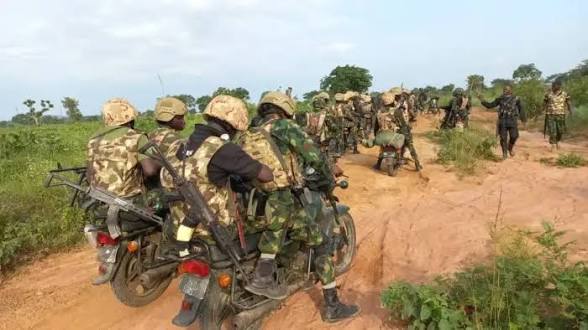
Troops rescue three abducted victims, recover ammunition in Borno
By: Zagazola Makama
Troops of Operation Hadin Kai have rescued three abducted civilians and recovered ammunition during an operation in Bama Local Government Area of Borno State.
Security sources said the operation was carried out at about 10:00 a.m. on March 30 by troops of 202 Battalion in collaboration with volunteer forces at BOCOBS.
According to the sources, the troops responded to credible intelligence indicating that suspected members of the Islamic State West Africa Province and Boko Haram had abducted three locals in the area.
The sources said the troops made contact with the insurgents and successfully rescued all three victims during the operation.
Items recovered from the scene include one AK-47 rifle magazine loaded with 30 rounds of 7.62mm special ammunition.
The sources added that the rescued victims are safe, while troops have continued to dominate the general area to prevent further incidents.
They said the operation is part of sustained efforts to protect civilians and dismantle terrorist activities across the North-East theatre.
Troops rescue three abducted victims, recover ammunition in Borno
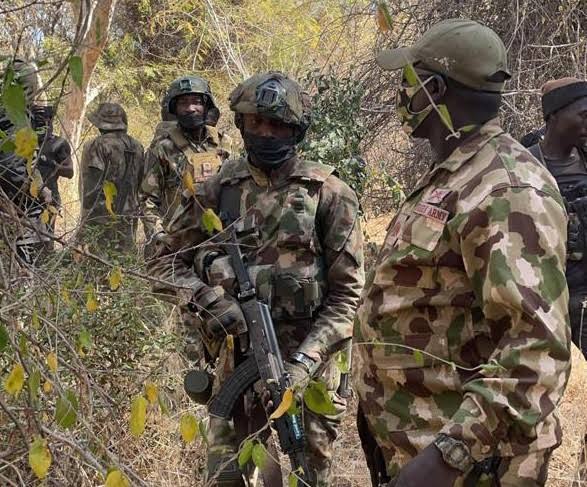
Troops repel terrorist attack in Yobe
By: Zagazola Makama
Troops of Operation Hadin Kai have repelled an attack by suspected members of the Islamic State West Africa Province and Boko Haram on a Forward Operating Base in Yunusari Local Government Area of Yobe State.
Security sources said the incident occurred at about 10:05 p.m. on March 30 at Forward Operating Base Bukarti.
According to the sources, the terrorists launched an attack on the troops’ position, prompting a fierce engagement during which the troops successfully repelled the assailants.
During the encounter, one soldier sustained injuries and has since been stabilised and is responding to treatment.
The sources added that the attackers carted away a gun truck mounted with a QJC gun, a Civilian Joint Task Force vehicle, two motorcycles, a PKT machine gun and a Baofeng radio.
They said troops have continued to maintain operational presence in the area, while efforts are ongoing to recover the stolen equipment and further degrade the capabilities of the insurgents.
Troops repel terrorist attack in Yobe
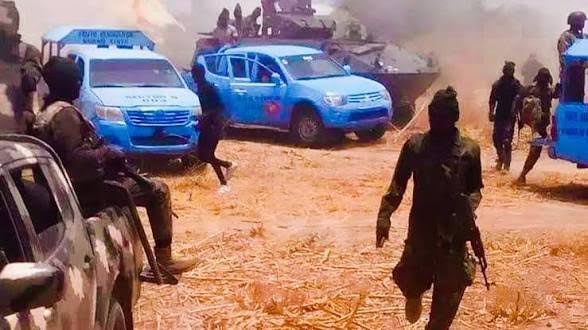
CJTF member accidentally shot by colleague in Borno
By: Zagazola Makama
A member of the Civilian Joint Task Force (CJTF) has been injured in an accidental shooting incident in Biu Local Government Area of Borno State.
Security sources said the incident occurred at about 3:50 a.m. on March 31 at the location of 162 Amphibious Battalion in Mandara-Girau.
According to the sources, the CJTF member was on duty when he was mistakenly shot in the left leg by a colleague.
The victim was immediately evacuated to the battalion’s medical facility, where he is currently receiving treatment.
Sources said the injured personnel are responding to treatment, while further details surrounding the incident are being awaited.
CJTF member accidentally shot by colleague in Borno

Troops arrest two suspected terrorist collaborators in Pulka

Troops rescue three abducted victims, recover ammunition in Borno

Troops repel terrorist attack in Yobe

Roger Federer’s Shock as DNA Results Reveal Myla and Charlene Are Not His Biological Children

THE PLIGHT OF FARIDA

FAILED COUP IN BURKINA FASO: HOW TRAORÉ NARROWLY ESCAPED ASSASSINATION PLOT AMID FOREIGN INTERFERENCE CLAIMS
-
 News2 years ago
Roger Federer’s Shock as DNA Results Reveal Myla and Charlene Are Not His Biological Children
-
Opinions4 years ago
THE PLIGHT OF FARIDA
-
 News12 months ago
FAILED COUP IN BURKINA FASO: HOW TRAORÉ NARROWLY ESCAPED ASSASSINATION PLOT AMID FOREIGN INTERFERENCE CLAIMS
-

 News2 years ago
EYN: Rev. Billi, Distortion of History, and The Living Tamarind Tree
-
 Opinions4 years ago
POLICE CHARGE ROOMS, A MINTING PRESS
-

 ACADEMICS2 years ago
A History of Biu” (2015) and The Lingering Bura-Pabir Question (1)
-

 Columns2 years ago
Army University Biu: There is certain interest, but certainly not from Borno.
-

 Opinions2 years ago
Tinubu,Shettima: The epidemic of economic, insecurity in Nigeria
