
News
Elites are also guilty of increasing zero dose prevalence in Borno state

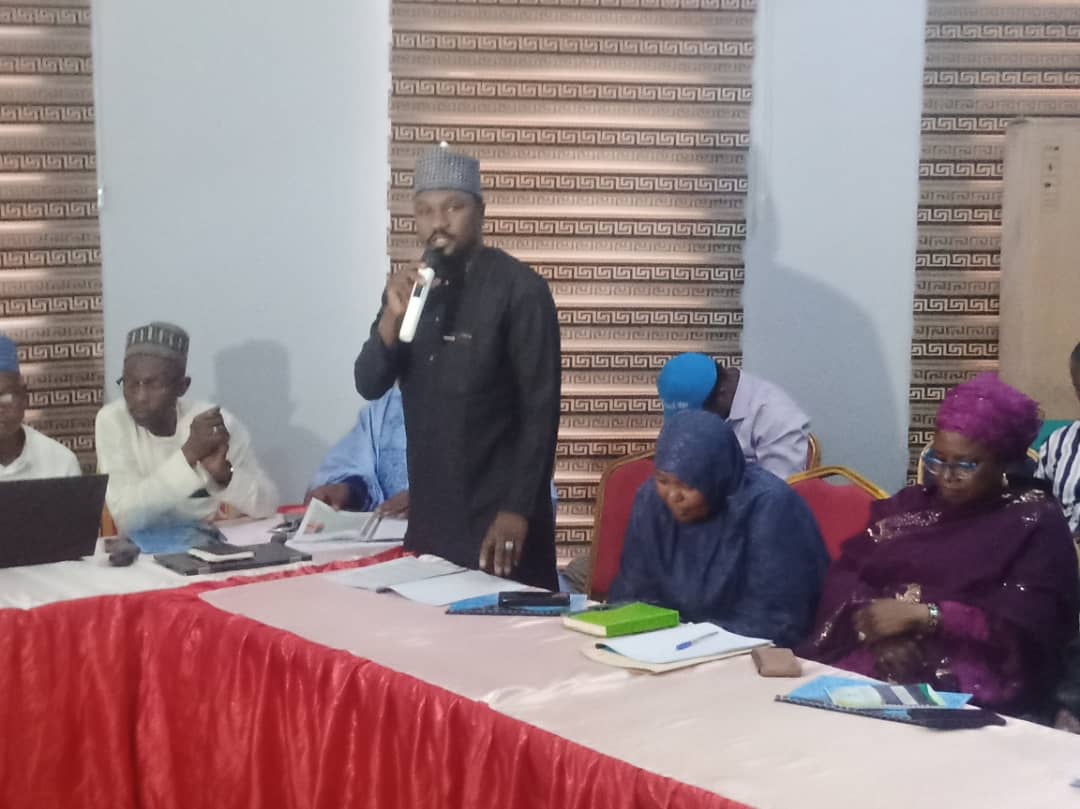
Elites are also guilty of increasing zero dose prevalence in Borno state
By: Bodunrin Kayode
The Director of Public and Community Health in the Borno State Primary Healthcare Development Agency (BSPHDA) Dr Mala Abdulwahab has said that security challenges contribute to the high prevalence of zero dose.
Dr Mala regretted that a lot of the “zero-doses” of immunization being recorded in Borno state comes from the lingering level of insecurity plaguing the state adding that a reduction of the prevalence would take place only if these insecurity gaps are closed.
Dr Mala made these assertions during a review meeting of the Borno state annual score card for immunization accountability 2024 as put together by the Committee of Practice (COP) and the Africa Health Budget Network (AHBN) which held in maiduguri recently.
He said that the lingering insurgency in the state has definitely put a clog in the wheels of a lot of progress which should have been made in the reduction of the zero dose when it comes to immunization adding that it is the hope of the COP that this primary challenge would soon be a thing of the past.
Speaking on further challenges working against health workers during zero dose immunization, Dr Mala regretted that a lot of residents actually assume that because elites are expected to have some form of education, resistance or carelessness will not emanate from them or even core insiders in the medical profession.
Mala’s sadness on this issue stems from the fact that a large chunk of some medical personnel in Borno state are not helping to attack the rising prevalence of the zero dose cases in the state, because they equally take the campaign for granted depriving their kids from having the relevant vaccines as at when due.
The Director of public and community health revealed that Borno state contributes a whopping 60 percent of the measles prevalence in the country adding that something urgently must be done by health workers and educators to reverse this unsatisfactory trend within the sector.
The Director Community health posited that theses kids who are yet to start their regimes of the vaccines especially penta 1,2 and 3 are equally contributing to the embarrassing statistics being reeled out from within the system.
“There is really no reason why we must be having zero-dose cases up till now within this part of the country. It is very unfortunate that this preventable occurrences keep coming up in spite of our efforts.
“Some of the zero-does do come from the elites in the country while some are compromised by prevailing security challenges especially around the state capital areas and some other parts of the state too. But we must keep trying.
” Let me tell you how we used to handle difficult fulani people in the bush, we go with our veterinary doctors and by using the veterinarians they talk to the fulani people to fall in line in terms of taking the vaccines. They see their cattle getting better and their kids too.
” However, it is regrettable that some medical practitioners are not allowing their kids to be immunized against the six killer diseases. This should never be allowed to thrive within the on coming immunization campaigns.
“And this is why I am calling on all of us here to pay relevant visits to VIPs, stakeholders and influencers to ensure that the civil society, media and others are carried along to reduce zero-doses to the nearest minimum.
“For immunity to be maintained, we need to work on the 65 percent coverage of immunization in the state to something better. We must make better progress in the pending campaigns.
” I also urge that advocacies should be done in large numbers to ensure effectiveness. Community leaders will take you more serious when you go in large numbers to make your points heard” Said Mala.
The Director called on field representatives to make deliberate efforts to ensure they anchor their advocacies with the traditional rulers of each domain like the Shehu of Borno in the state capital to make the expected progress.
Also present in the review session, Peace Ambassador, Ahmed Shehu assured the round table of stakeholders that their convergence will close a lot of gaps on the entire vaccination architecture in the state.
He assured that Musamman like him will do their best to ensure that the zero-dose prevalence becomes a thing of the past as they forge ahead in the 2025 campaigns.
Also speaking, Dr Musa Melton, a senior field coordinator of the African Field Epidemiology Network (AFENET) in Borno state noted that the exercise was meant to open the remaining vestiges of existing challenges caused by the zero dose and dealing with them decisively from the coming campaigns to be mounted by the community of practice (COP).
He however noted that the last review of actualities on ground was not all that gloomy because epidemiological statistics indicated that the number of zero-doses have actually reduced in the state and the entire country.
Melton commended Dr Aminu Magashi the founder of the Africa health network for bringing the vital budgetary issues to the fore adding that with the new push to bringing down the number of zero-doses in the state and the willingness of the state govt led by Prof Babagana Zulum to spend more on health, there is good news at the horizon.
Dr Melton stated that measles has however dropped drastically in the state and the entire country from last year’s statistics to this year’s adding that they will soon celebrate the end of the zero-dose prevalence as the campaigns intensifies.
UNICEF immunization officer and representative in the round table Bashir Elegbede frowned at dishonest immunization officers adding that inspectors will be in the field for the next campaign to hunt down such people and reduce such misbehaving practitioners contributing to the zero dose.
He warned that everyone will answer his or her fathers name this time around as business as usual will never be tolerated from anyone.
Present at the occasion were stake holders from within the state and some from outside like Dr Aminu Magashi who is the global convener of the community of practice (COP) on accountability and social action on health and a member of the global action plan for SDG 3 advocacy group.
A child in contemporary Nigeria is said to be out of the zero-dose prevalence when such a child had been subjected to BCG, OPV O, Hepatitis BO all at birth.
Within six weeks the same child should have taken Pentavalent 1, PCV 1, OPV1, IPV1, and ROTA 1 while at 10 weeks, Pentavalent 2, PCV2, OPV2 and ROTA 2.
At 14 weeks a child is expected to have taken Pentavalent 3, PVC 3, OPV 3, IPV2 and Rota 3.
At five months the malaria vaccine should be infused while at six months the vitamin A 1st dose even as the malaria vaccine is followed at seven months.
By nine months one’s baby should be done with measles first dose, yellow fever, Meningitis vaccine and vitamin A second dose even as the measles second dose and malaria vaccine are administered at 15 months.
Updated data received from the COP indicated that by 9 Years, children should be ready for the human Papilloma virus vaccine and that should make them good to go by world standards to avoid zero-doses.
This is the contemporary ideal and expectations for all children as laid down by the national primary health agency of Nigeria.
Elites are also guilty of increasing zero dose prevalence in Borno state



Galadima Commends Military, Security Agencies Over Rescue of 18 Kidnap Victims in Ibi
By Zagazola Makama
The Peoples Democratic Party (PDP) House of Representatives candidate for Wukari/Ibi Federal Constituency, TPL Mukhtar Usman Galadima, has commended the Nigerian military, other security agencies and the Federal Government for the successful rescue of 18 kidnapped victims in Ibi Local Government Area of Taraba State.
Galadima, reacting to reports of the rescue, described the operation as a significant demonstration of the commitment of the security forces to protecting lives and restoring peace in communities affected by criminal activities. He particularly applauded the troops of Sector 3 deployed in Ibi for responding swiftly to reports of kidnapping activities at Kwatan Bajji in the early hours of August 18, leading to the recovery of the victims.
The PDP candidate said the successful operation should reassure residents of Wukari/Ibi Federal Constituency that security forces remain committed to confronting criminal elements and protecting communities. He urged the rescued victims and their families to remain hopeful while calling on security agencies to sustain and intensify operations in vulnerable communities across the constituency and Taraba State.
Galadima, however, stressed the need for stronger inter-agency cooperation and improved intelligence-sharing among the military, police and other security and intelligence agencies. He said security operations would become more effective when relevant agencies work closely together to identify threats, track criminal networks and disrupt their activities before they are able to carry out attacks.
He also called for stronger legislation and institutional support to enhance the operational and intelligence-gathering capabilities of the Armed Forces and other security agencies. According to him, the objective should not only be to respond to kidnapping and other violent crimes after they occur, but to develop the capacity to anticipate and prevent such incidents long before they happen.
The Wukari/Ibi candidate said improved legislation, better intelligence infrastructure, modern surveillance capabilities and sustained support for security personnel would strengthen the ability of the nation’s security architecture to respond to emerging threats. He noted that protecting rural communities requires a proactive security strategy capable of detecting criminal movements and networks before they pose a danger to residents.
Galadima equally appealed to residents of Wukari/Ibi Federal Constituency to see themselves as partners in the fight against insecurity. He urged community leaders, traditional institutions, youths and residents to maintain close cooperation with security agencies and provide timely and credible information whenever they notice suspicious movements or activities.
He cautioned residents against withholding useful information out of fear or reluctance, stressing that early reporting can make the difference between preventing a crime and responding to its consequences. He also urged security agencies to protect the confidentiality of credible informants and strengthen community-based intelligence networks.
While commending the Federal Government for supporting ongoing security operations, Galadima said sustained investment in the welfare, equipment, intelligence and operational capacity of security personnel remains essential to achieving lasting peace.
He expressed optimism that with stronger collaboration between security agencies and local communities, improved legislation and greater government support, kidnapping and other forms of criminality can be significantly reduced across Wukari, Ibi and other vulnerable parts of Taraba State.
The candidate congratulated the 18 rescued victims and their families, and urged security forces not to relent until all criminal elements operating in the area are identified and brought to justice.
Galadima Commends Military, Security Agencies Over Rescue of 18 Kidnap Victims in Ibi
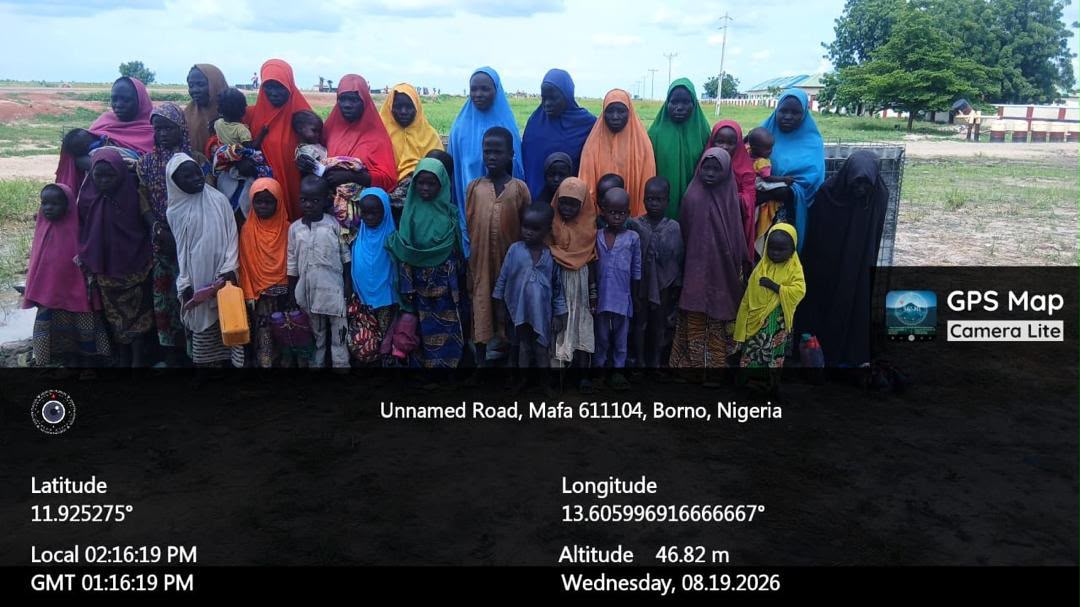
Troops Arrest Five Suspected Terrorist Logistics Suppliers in Borno
By Zagazola Makama
MAIDUGURI — Troops of the Nigerian Army, in collaboration with members of the Civilian Joint Task Force (CJTF), have arrested five female suspected terrorist logistics suppliers in Ngurusoye village, Borno State.
The suspects were intercepted at about 6:48 p.m. on Aug. 17 by troops of 151 Task Force Battalion deployed in the area, following intelligence on their activities.
The suspects were identified as Falmata Jibrin, 53; Hajja Zaragon, 50; Falmata Ali, 50; Inagana Modu, 30; and Falmata Abubakar, 13.
Security sources told Zagazola Makama that troops recovered various items from the suspects, including 65 packs of sweet candies, 117 packs of biscuits and 167 sachets of Dangote salt, among other assorted provisions.
The suspects and recovered items have been handed over to 21 Special Anti-Banditry Mobile Police Regiment (21 SAB MOPOL) for further investigation and necessary action.
The arrests form part of ongoing intelligence-led operations by troops under Operation HADIN KAI and Operation DESERT SANITY V to disrupt terrorist logistics networks and deny insurgents access to food, supplies and other materials needed to sustain their activities.
Security sources said the overall situation across the theatre remained calm but unpredictable, while troops continued to maintain satisfactory morale and operational readiness.
Troops Arrest Five Suspected Terrorist Logistics Suppliers in Borno
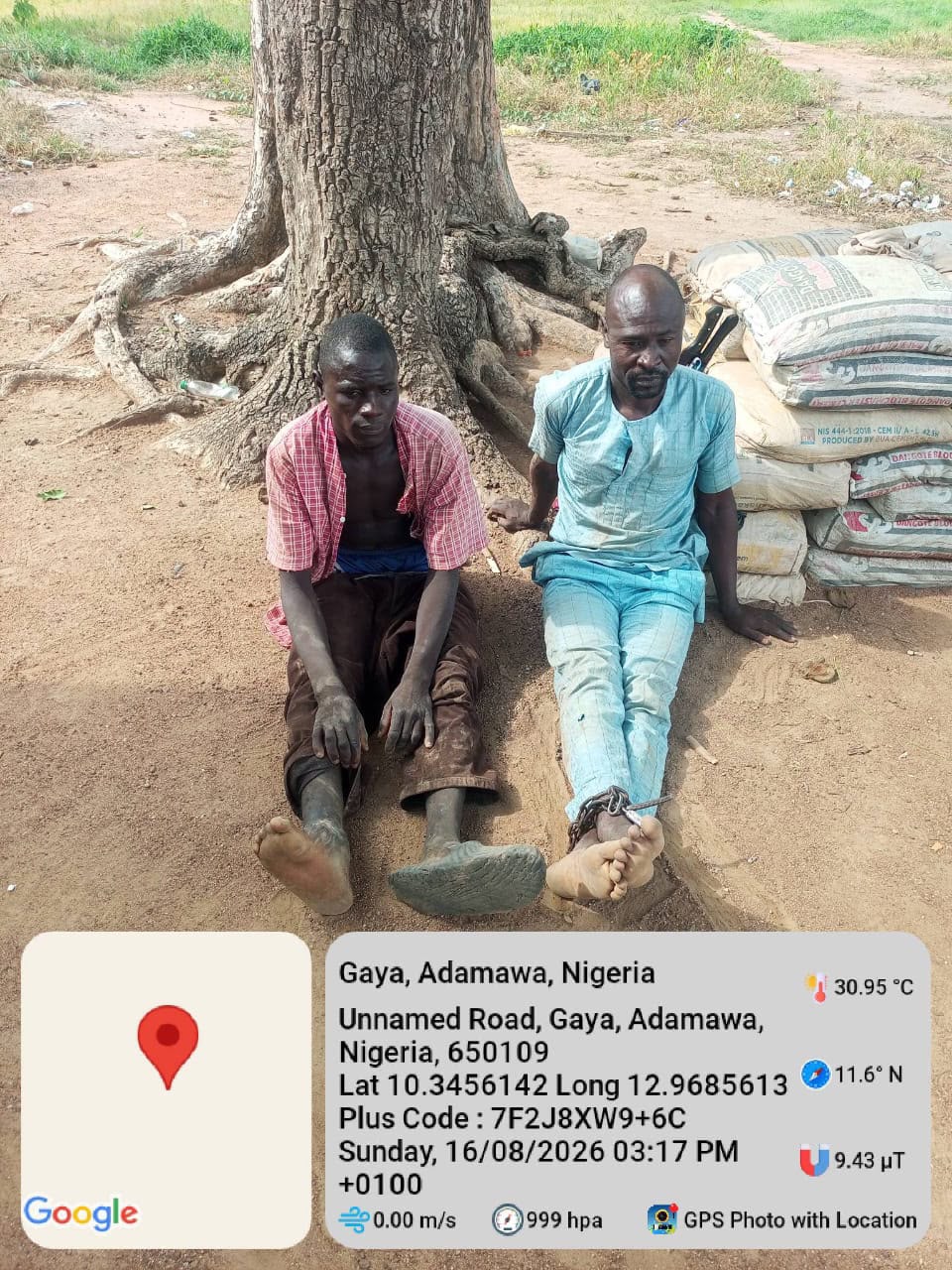
Troops Arrest Two Suspected Terrorists, Recover Weapons in Adamawa
By Zagazola Makama
Troops of Operation HADIN KAI, in collaboration with local hunters, have arrested two suspected terrorists and recovered weapons during an intelligence-led operation in Hong Local Government Area of Adamawa State.
The operation was conducted at about 10:15 a.m. on Aug. 16, by troops of B Company, 232 Battalion, Garaha, working with hunters.
The suspects were identified as Hyema Luka, 20, and Hyellaki Manasse, 47.
According to security sources, the operation followed credible intelligence that led troops to the suspects and their associates in the area.
Preliminary investigation revealed that Luka had sustained a gunshot wound to his right foot during an attack in Yau village, near Garaha, Hong LGA, on Dec. 24, 2025.
Further investigation reportedly led to the arrest of Manasse, who was allegedly treating the injured suspect at Bilamari village in Hong Local Government Area.
During preliminary questioning, Luka claimed that he was forcibly abducted by terrorists while working on his farm at Lamba village in Hong LGA sometime in 2025.
He reportedly told investigators that he was subsequently compelled to fight alongside the terrorist group.
Security sources said Luka escaped from the terrorist camp during the night of Aug. 14, 2026, before his eventual arrest.
Items recovered from the suspects include one mobile phone, one SIM card, two bows and arrows, one locally made sword and four locally fabricated firearms.
The suspects are currently in the custody of 232 Battalion for further investigation.
The latest operation forms part of sustained intelligence-led efforts by troops under Operation HADIN KAI and Operation DESERT SANITY V to identify and dismantle terrorist networks operating across the North East.
Security sources said the situation across the theatre remained calm but unpredictable, while troops continued to maintain high operational readiness across their areas of responsibility.
Troops Arrest Two Suspected Terrorists, Recover Weapons in Adamawa

Galadima Commends Military, Security Agencies Over Rescue of 18 Kidnap Victims in Ibi

Troops Arrest Five Suspected Terrorist Logistics Suppliers in Borno

Troops Arrest Two Suspected Terrorists, Recover Weapons in Adamawa

Roger Federer’s Shock as DNA Results Reveal Myla and Charlene Are Not His Biological Children

THE PLIGHT OF FARIDA

FAILED COUP IN BURKINA FASO: HOW TRAORÉ NARROWLY ESCAPED ASSASSINATION PLOT AMID FOREIGN INTERFERENCE CLAIMS
-
 News2 years ago
Roger Federer’s Shock as DNA Results Reveal Myla and Charlene Are Not His Biological Children
-
Opinions5 years ago
THE PLIGHT OF FARIDA
-
 News1 year ago
FAILED COUP IN BURKINA FASO: HOW TRAORÉ NARROWLY ESCAPED ASSASSINATION PLOT AMID FOREIGN INTERFERENCE CLAIMS
-

 News2 years ago
EYN: Rev. Billi, Distortion of History, and The Living Tamarind Tree
-
 Opinions5 years ago
POLICE CHARGE ROOMS, A MINTING PRESS
-

 ACADEMICS2 years ago
A History of Biu” (2015) and The Lingering Bura-Pabir Question (1)
-

 Columns2 years ago
Army University Biu: There is certain interest, but certainly not from Borno.
-

 Politics1 year ago
2027: Why Hon. Midala Balami Must Go, as Youths in Hawul and Asikira/Uba Federal Constituency Reject ₦500,000 as Sallah Gift
