
News
Niger’s Withdrawal from MNJTF: A Looming Security Catastrophe

Niger’s Withdrawal from MNJTF: A Looming Security Catastrophe
By Zagazola Makama
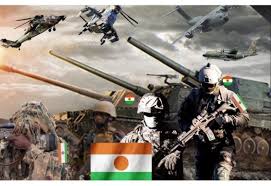
As of March 30, 2025, Niger’s formal withdrawal from the Multinational Joint Task Force (MNJTF) has sent shockwaves through the security landscape of the Lake Chad Basin, raising alarms over the potential for increased instability and violence in the region. This decision, orchestrated by Niger’s ruling junta, not only destabilizes the existing counterterrorism framework but also poses grave implications for Niger itself, alongside its neighbors, Nigeria and Chad.
Niger’s exit from the MNJTF has left a significant security vacuum, particularly along its northeastern border with Nigeria. The loss of Sector 4, previously secured by Nigerien forces, creates an urgent vulnerability that could enable insurgent groups to exploit the weakened defenses. The porous border has long been a weak link in counterinsurgency efforts, and without Niger’s military presence, Boko Haram and ISWAP may find fertile ground to establish new operational bases, smuggle arms, and launch cross-border assaults.
Military sources in Maiduguri have already indicated heightened risks for border towns like Damasak and Goskeru, which have historically been targets of Boko Haram incursions. The absence of Nigerien forces, who previously acted as a buffer, significantly escalates the threat level, making these areas prime targets for renewed terrorist activity.
The implications of Niger’s withdrawal extend beyond border security; it exacerbates internal military strains and economic challenges. The Nigerien military, already stretched thin, will now face increased pressure to manage security on its own territory while simultaneously combating rising insurgent threats. This scenario could lead to a diversion of resources away from critical internal security operations, leaving the nation vulnerable to insurgent resurgence.
Moreover, the economic ramifications of this withdrawal cannot be understated. As Niger grapples with the fallout from increased violence, the strain on its already fragile economy will intensify. Humanitarian crises may worsen as displaced persons flood into Niger from neighboring conflict zones, further burdening relief efforts and straining resources.
Chad, a key player in the MNJTF, now faces additional pressures as it grapples with Niger’s exit. The Chadian military, already engaged in combating insurgents along its western front, must now contend with increased threats from Boko Haram factions operating in the Lake Chad islands. The diversion of military resources to address these new challenges could expose vulnerabilities in Chad’s other security operations, potentially destabilizing the entire region.
The logistical and coordination challenges posed by Niger’s withdrawal cannot be overlooked. Chad’s reliance on cross-border military coordination with Niger for intelligence-sharing and troop movements is now compromised, complicating its counterterrorism efforts. As military planners in N’Djamena scramble to adapt, the risk of operational failures looms large.
Niger’s withdrawal from the MNJTF signals a broader geopolitical realignment in the Sahel, raising concerns about its potential pivot toward new security partnerships, particularly with Russia. The junta’s distancing from Western allies and expulsion of French forces may pave the way for closer military cooperation with Moscow. This shift could further complicate regional counterterrorism efforts, as Niger deepens ties with Russian-backed mercenary groups, mirroring trends seen in Mali and Burkina Faso.
Such a realignment could jeopardize existing intelligence sharing frameworks and counterterrorism coordination among Niger, Nigeria, and Chad. The specter of increased Russian influence in the region adds another layer of complexity to an already volatile security landscape.
A Call to Action: Urgent Measures Needed
In light of these developments, it is imperative for Niger and its neighbors to take swift and decisive action to mitigate the looming security crisis. The remaining MNJTF members Nigeria and Chad must urgently restructure their military strategies to address the vacuum left by Niger’s withdrawal. This includes redistributing troops to bolster border defenses, deploying advanced surveillance technologies, and enhancing diplomatic efforts to maintain intelligence-sharing channels. If possible fill in the vacuum left by Niger Republic.
Failure to act decisively could allow insurgents to capitalize on the disruption, leading to a resurgence of violence that threatens not only Niger but the entire Lake Chad Basin. Already there has been massive recruitment by JNIM and increase presence of Lakurawa within the Nigerien borders.
The stakes have never been higher, and the time for action is now. Without effective measures to counter the rising tide of insecurity, the region risks slipping into a state of chaos, reversing years of progress against Boko Haram and ISWAP.
Conclusion
Niger’s withdrawal from the MNJTF marks a critical juncture in the fight against terrorism in the Lake Chad Basin. The implications for Niger are profound, as the nation faces the dual challenges of securing its borders and managing internal stability amidst rising insurgent threats. As regional leaders grapple with these challenges, the urgency for a cohesive and collaborative response has never been more pressing. Failure to fill the void left by Niger’s exit could plunge the region into deeper insecurity, with devastating consequences for millions.
Zagazola Makama is a Counter Insurgency Expert and Security Analyst in the Lake Chad Region
Niger’s Withdrawal from MNJTF: A Looming Security Catastrophe



Galadima Commends Military, Security Agencies Over Rescue of 18 Kidnap Victims in Ibi
By Zagazola Makama
The Peoples Democratic Party (PDP) House of Representatives candidate for Wukari/Ibi Federal Constituency, TPL Mukhtar Usman Galadima, has commended the Nigerian military, other security agencies and the Federal Government for the successful rescue of 18 kidnapped victims in Ibi Local Government Area of Taraba State.
Galadima, reacting to reports of the rescue, described the operation as a significant demonstration of the commitment of the security forces to protecting lives and restoring peace in communities affected by criminal activities. He particularly applauded the troops of Sector 3 deployed in Ibi for responding swiftly to reports of kidnapping activities at Kwatan Bajji in the early hours of August 18, leading to the recovery of the victims.
The PDP candidate said the successful operation should reassure residents of Wukari/Ibi Federal Constituency that security forces remain committed to confronting criminal elements and protecting communities. He urged the rescued victims and their families to remain hopeful while calling on security agencies to sustain and intensify operations in vulnerable communities across the constituency and Taraba State.
Galadima, however, stressed the need for stronger inter-agency cooperation and improved intelligence-sharing among the military, police and other security and intelligence agencies. He said security operations would become more effective when relevant agencies work closely together to identify threats, track criminal networks and disrupt their activities before they are able to carry out attacks.
He also called for stronger legislation and institutional support to enhance the operational and intelligence-gathering capabilities of the Armed Forces and other security agencies. According to him, the objective should not only be to respond to kidnapping and other violent crimes after they occur, but to develop the capacity to anticipate and prevent such incidents long before they happen.
The Wukari/Ibi candidate said improved legislation, better intelligence infrastructure, modern surveillance capabilities and sustained support for security personnel would strengthen the ability of the nation’s security architecture to respond to emerging threats. He noted that protecting rural communities requires a proactive security strategy capable of detecting criminal movements and networks before they pose a danger to residents.
Galadima equally appealed to residents of Wukari/Ibi Federal Constituency to see themselves as partners in the fight against insecurity. He urged community leaders, traditional institutions, youths and residents to maintain close cooperation with security agencies and provide timely and credible information whenever they notice suspicious movements or activities.
He cautioned residents against withholding useful information out of fear or reluctance, stressing that early reporting can make the difference between preventing a crime and responding to its consequences. He also urged security agencies to protect the confidentiality of credible informants and strengthen community-based intelligence networks.
While commending the Federal Government for supporting ongoing security operations, Galadima said sustained investment in the welfare, equipment, intelligence and operational capacity of security personnel remains essential to achieving lasting peace.
He expressed optimism that with stronger collaboration between security agencies and local communities, improved legislation and greater government support, kidnapping and other forms of criminality can be significantly reduced across Wukari, Ibi and other vulnerable parts of Taraba State.
The candidate congratulated the 18 rescued victims and their families, and urged security forces not to relent until all criminal elements operating in the area are identified and brought to justice.
Galadima Commends Military, Security Agencies Over Rescue of 18 Kidnap Victims in Ibi
Troops Arrest Five Suspected Terrorist Logistics Suppliers in Borno
By Zagazola Makama
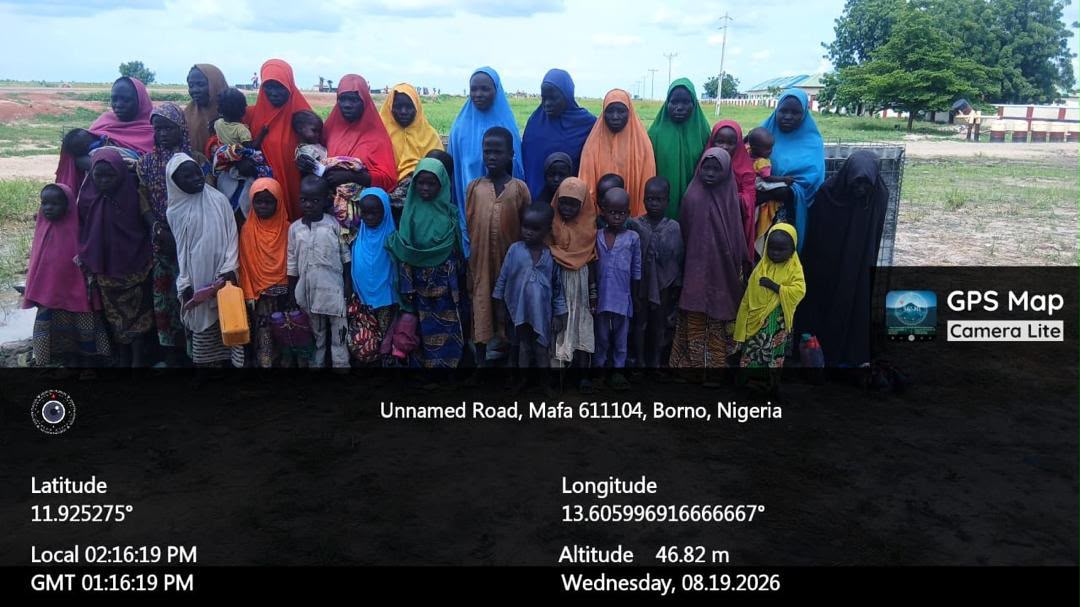
MAIDUGURI — Troops of the Nigerian Army, in collaboration with members of the Civilian Joint Task Force (CJTF), have arrested five female suspected terrorist logistics suppliers in Ngurusoye village, Borno State.
The suspects were intercepted at about 6:48 p.m. on Aug. 17 by troops of 151 Task Force Battalion deployed in the area, following intelligence on their activities.
The suspects were identified as Falmata Jibrin, 53; Hajja Zaragon, 50; Falmata Ali, 50; Inagana Modu, 30; and Falmata Abubakar, 13.
Security sources told Zagazola Makama that troops recovered various items from the suspects, including 65 packs of sweet candies, 117 packs of biscuits and 167 sachets of Dangote salt, among other assorted provisions.
The suspects and recovered items have been handed over to 21 Special Anti-Banditry Mobile Police Regiment (21 SAB MOPOL) for further investigation and necessary action.
The arrests form part of ongoing intelligence-led operations by troops under Operation HADIN KAI and Operation DESERT SANITY V to disrupt terrorist logistics networks and deny insurgents access to food, supplies and other materials needed to sustain their activities.
Security sources said the overall situation across the theatre remained calm but unpredictable, while troops continued to maintain satisfactory morale and operational readiness.
Troops Arrest Five Suspected Terrorist Logistics Suppliers in Borno
Troops Arrest Two Suspected Terrorists, Recover Weapons in Adamawa
By Zagazola Makama
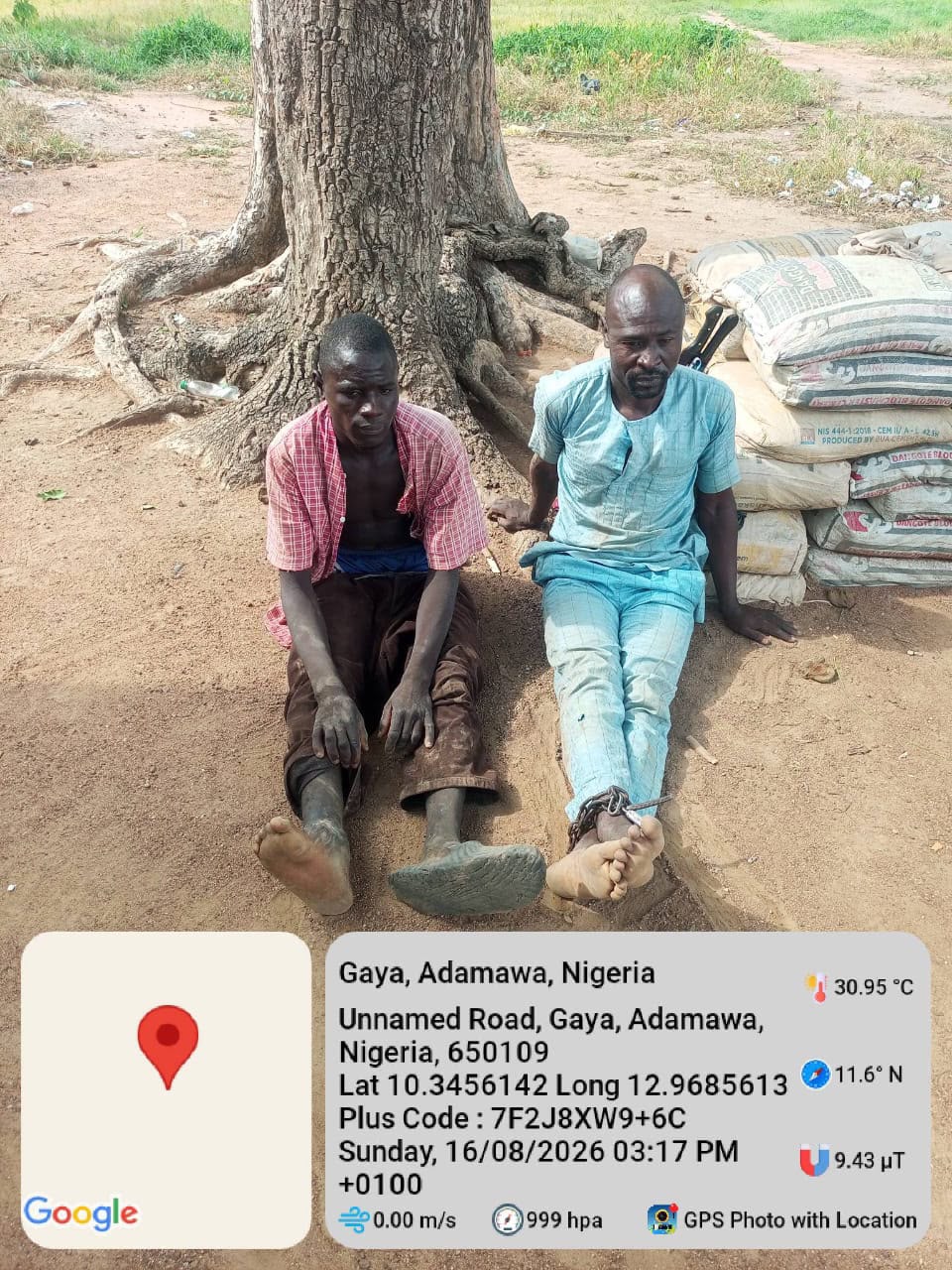
Troops of Operation HADIN KAI, in collaboration with local hunters, have arrested two suspected terrorists and recovered weapons during an intelligence-led operation in Hong Local Government Area of Adamawa State.
The operation was conducted at about 10:15 a.m. on Aug. 16, by troops of B Company, 232 Battalion, Garaha, working with hunters.
The suspects were identified as Hyema Luka, 20, and Hyellaki Manasse, 47.
According to security sources, the operation followed credible intelligence that led troops to the suspects and their associates in the area.
Preliminary investigation revealed that Luka had sustained a gunshot wound to his right foot during an attack in Yau village, near Garaha, Hong LGA, on Dec. 24, 2025.
Further investigation reportedly led to the arrest of Manasse, who was allegedly treating the injured suspect at Bilamari village in Hong Local Government Area.
During preliminary questioning, Luka claimed that he was forcibly abducted by terrorists while working on his farm at Lamba village in Hong LGA sometime in 2025.
He reportedly told investigators that he was subsequently compelled to fight alongside the terrorist group.
Security sources said Luka escaped from the terrorist camp during the night of Aug. 14, 2026, before his eventual arrest.
Items recovered from the suspects include one mobile phone, one SIM card, two bows and arrows, one locally made sword and four locally fabricated firearms.
The suspects are currently in the custody of 232 Battalion for further investigation.
The latest operation forms part of sustained intelligence-led efforts by troops under Operation HADIN KAI and Operation DESERT SANITY V to identify and dismantle terrorist networks operating across the North East.
Security sources said the situation across the theatre remained calm but unpredictable, while troops continued to maintain high operational readiness across their areas of responsibility.
Troops Arrest Two Suspected Terrorists, Recover Weapons in Adamawa

Galadima Commends Military, Security Agencies Over Rescue of 18 Kidnap Victims in Ibi

Troops Arrest Five Suspected Terrorist Logistics Suppliers in Borno

Troops Arrest Two Suspected Terrorists, Recover Weapons in Adamawa

Roger Federer’s Shock as DNA Results Reveal Myla and Charlene Are Not His Biological Children

THE PLIGHT OF FARIDA

FAILED COUP IN BURKINA FASO: HOW TRAORÉ NARROWLY ESCAPED ASSASSINATION PLOT AMID FOREIGN INTERFERENCE CLAIMS
-
 News2 years ago
Roger Federer’s Shock as DNA Results Reveal Myla and Charlene Are Not His Biological Children
-
Opinions5 years ago
THE PLIGHT OF FARIDA
-
 News1 year ago
FAILED COUP IN BURKINA FASO: HOW TRAORÉ NARROWLY ESCAPED ASSASSINATION PLOT AMID FOREIGN INTERFERENCE CLAIMS
-

 News2 years ago
EYN: Rev. Billi, Distortion of History, and The Living Tamarind Tree
-
 Opinions5 years ago
POLICE CHARGE ROOMS, A MINTING PRESS
-

 ACADEMICS2 years ago
A History of Biu” (2015) and The Lingering Bura-Pabir Question (1)
-

 Columns2 years ago
Army University Biu: There is certain interest, but certainly not from Borno.
-

 Politics1 year ago
2027: Why Hon. Midala Balami Must Go, as Youths in Hawul and Asikira/Uba Federal Constituency Reject ₦500,000 as Sallah Gift
