
News
FG Orders NSCDC to Take Over Protection of Transmission Lines

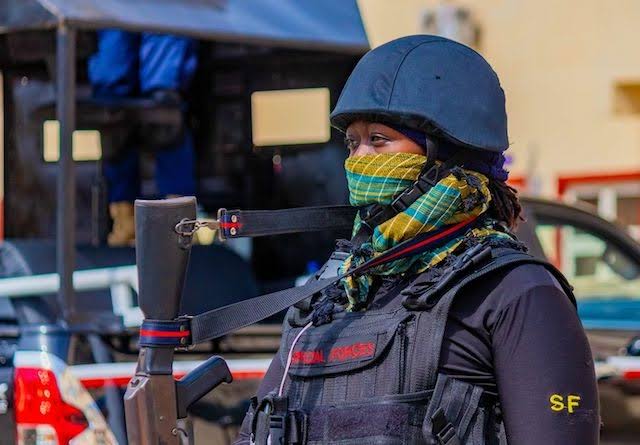
FG Orders NSCDC to Take Over Protection of Transmission Lines
By: Michael Mike
The Federal Government has ordered the Nigerian Security and Civil Defence Corps (NSCDC), to take over the protection of transmission lines and towers across the nation.
The Minister of Interior, Hon. Olubunmi Tunjo-Ojo gave the order on Friday during the passing-out parade of the 2nd batch of mining marshals of NSCDC in Abuja, decrying that: “It is not acceptable for a country to spend billions on power infrastructure for it to be vandalized.”
The Minister while expressing deep concern over the constant vandalism of transmission lines, towers and transformers, described the oft-repeated vandalism of critical national assets as economic sabotage which must be nipped in the bud.
Tunji-Ojo added that: “I will speak with my brother, the Minister of power, the rate of vandalism , the rate of destruction of our critical infrastructure in the sector and a lot of sabotage going on with our transmission lines, our generation points and all the rest has to be looked into.
“It is your job to make sure that no critical asset of government is destroyed and we are ready and I believe NSCDC is up to the task.
“The next time I come here, I want to see my Power Rangers, I mean people that will protect our distribution lines, people that will protect our Gencos people that will protect every power sector. it’s not reasonable, it’s not acceptable for the for a country like Nigeria to spend billions of dollars on power infrastructure all for it to be vandalized no country grows or develops without the power sector so NSCDC it is time for you to play your part.
“In terms of the power sector we will take this sector by sector. I have decided that the solution towards you accomplishing your mandate is sectorization of your responsibility.”
Tunji-Ojo also assured Nigerians that the country would do everything it takes to win the war against illegal miners.
He said: “Today, I can tell you the revenue from the solid mineral sector is not where it used to be, it has improved. The security in terms of our mines has improved and of course Nigeria is a big country therefore, we need to train more, we need to deploy more personnel into making sure that all our mines and all critical assets of Nigeria are well protected.
“We have seen that there is no solution to our problems that Nigerians cannot prefer yes we’ve not yet won the war but we know we will win the war.”
On his part, the Minister of Solid Minerals Development, Dr Dele Alake acknowledged that the revenue in the mineral sector has improved after the introduction of NSCDC Mining Marshals.
Alake, who was represented by the Permanent Secretary in the ministry, Dr Mary Ogbe, however warned miners to formalise their operations or face the law.
He said that the illegal operations of the miners have continued to cause land degradation.
In his remarks, the Commandant General of NSCDC, Dr Ahmed Audi lamented that the nation’s security especially the mining sector is being threatened by the nefarious activities of illegal miners, bandits, kidnappers, terrorists, among others, noting that this has led to a major setback in the development of the country’s otherwise very lucrative mining sector that is very critical to the country’s socio-economic development.
Audi said: “There is no gainsaying the fact that Nigeria is blessed with abundance of mineral resources which if properly tapped and managed, could significantly boost Nigeria’s revenue base which represents another giant stride towards stabilising the economy.”
He noted that adequate security measures towards strengthening security and safeguarding our collective patrimony needs to be put in place, while insisting that there is need for a robust policy guideline backed by legislation, for a robust regulatory measures to combat and criminalise illegal mining.
The CG explained that this measure will no doubt attract and encourage genuine investors (both indigenous and foreign) to the mining industry.
On the new mining marshals, he said: “I am of the firm believe that this intensive training has sufficiently equipped the participants with the requisite skills and knowledge to discharge their duties diligently and professionally. Let me at this juncture remind today’s graduands of the expectations of Government and to charge you all to maintain a high sense of professionalism, integrity, discipline, civility, humility, and level headedness and to ensure that knowledge gained in the course of the training is effectively utilized to fortify security at all mining sites across the country.
“You are also expected to imbibe the spirit of patriotism, absolute loyalty and to eschew acts or unethical conduct capable of dragging the image of the Corps in the mud as anyone found wanting will be appropriately sanctioned. Furthermore, you are to shun any act of unhealthy rivalry with other Security Agencies but rather regard yourselves as partners in the wheel of progress and development of this great Nation.”
FG Orders NSCDC to Take Over Protection of Transmission Lines


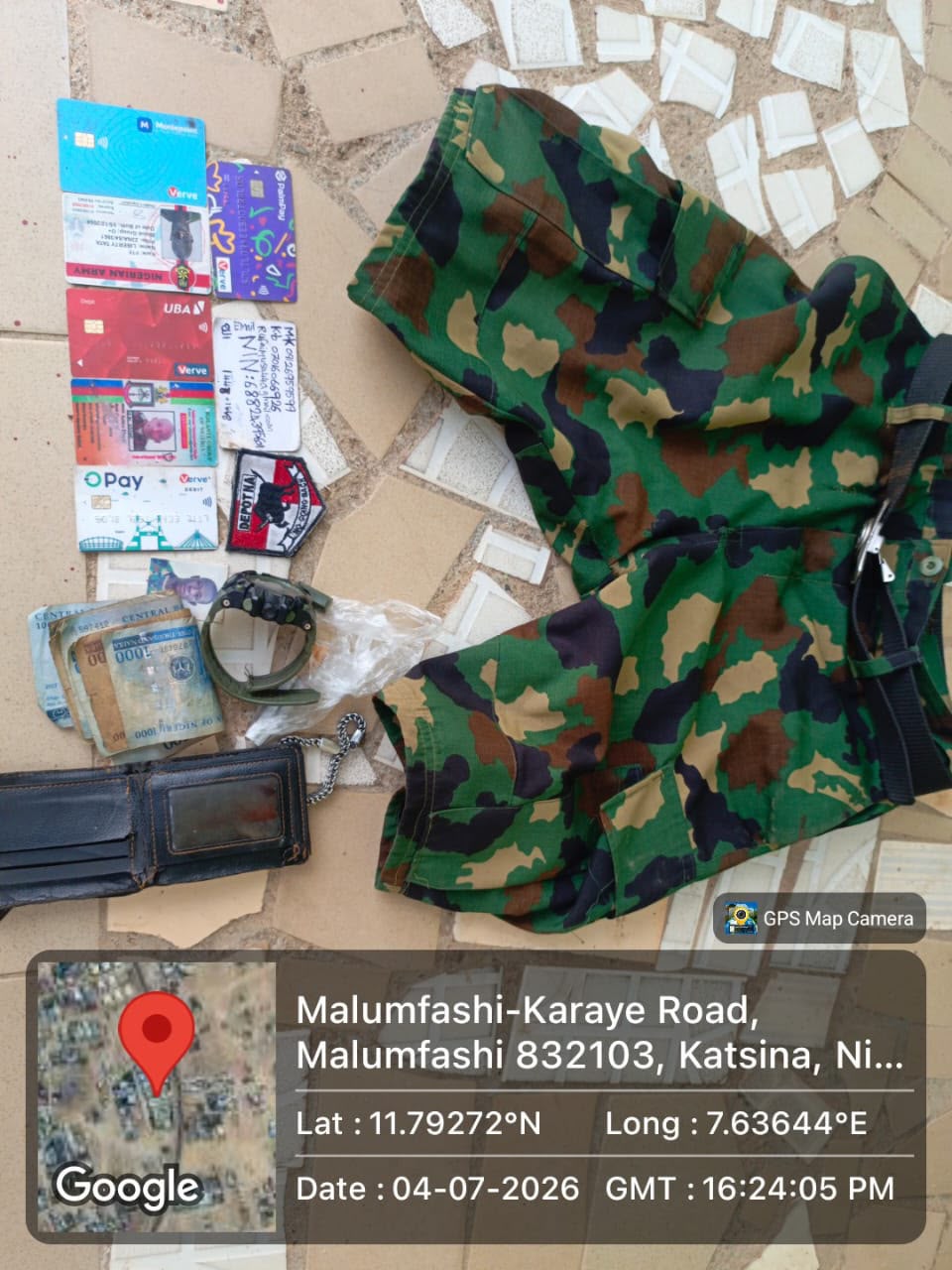
Troops Arrest Suspected Military Impostor in Katsina
By Zagazola Makama
Troops of 17 Brigade have arrested a suspected military impostor during a fighting patrol in Malumfashi Local Government Area.
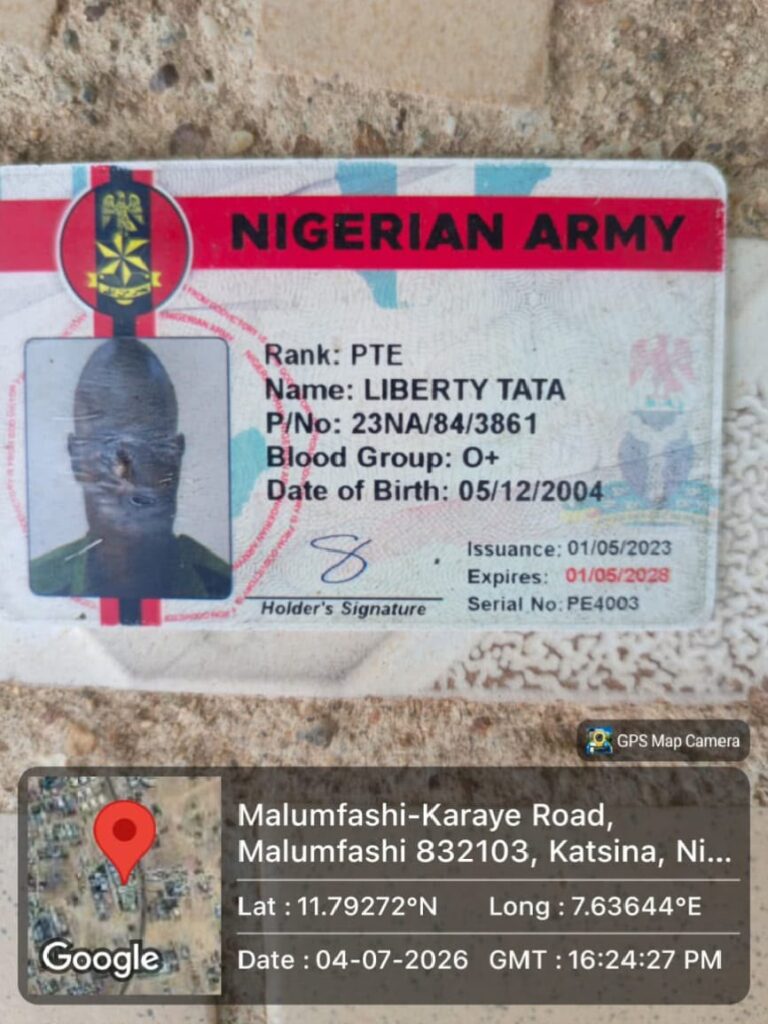
Security sources told Zagazola Makama that the suspect was apprehended at about 1:30 p.m. on July 4 by troops deployed at the Forward Operating Base (FOB) Malumfashi while conducting routine patrols within Malumfashi town.

According to the sources, the suspect was intercepted while wearing a woodland camouflage three-quarter short, raising suspicion among the troops.
A search conducted on the suspect led to the recovery of a fake Nigerian Army identity card, four Automated Teller Machine (ATM) cards, one woodland camouflage three-quarter short, a wristwatch and the sum of ₦17,000.
The suspect and the recovered exhibits are currently in military custody pending further investigation.
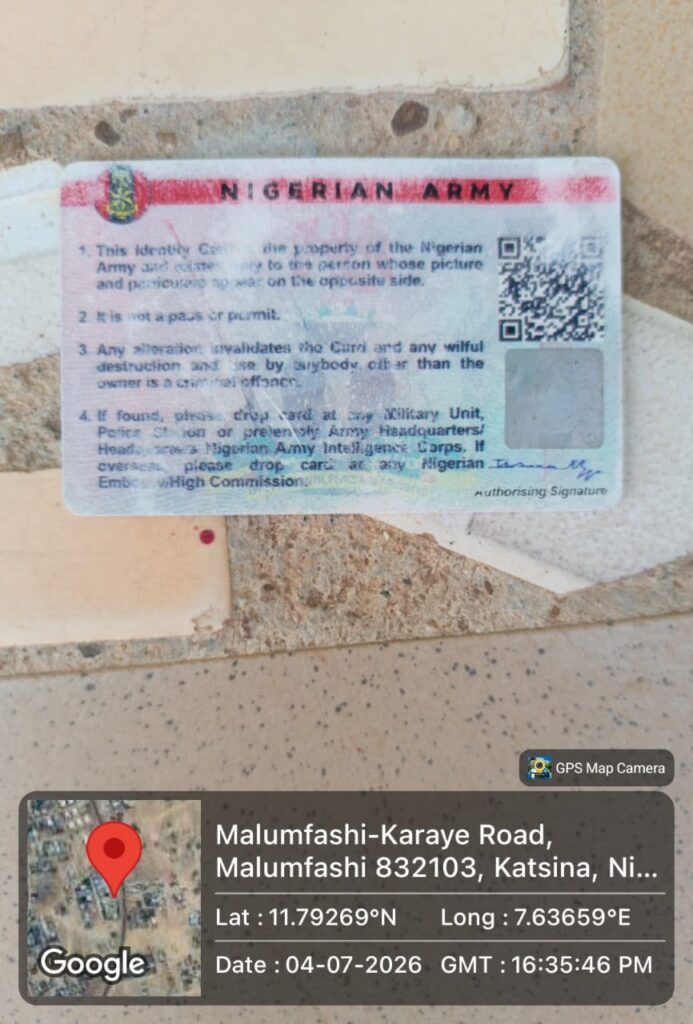
Military sources said the arrest forms part of ongoing efforts to curb impersonation of security personnel and other criminal activities within the area.
Troops Arrest Suspected Military Impostor in Katsina
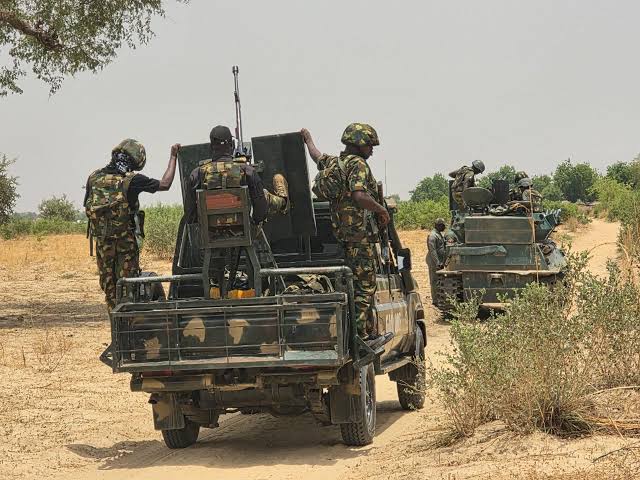
Troops Recover 50 Rustled Cattle, Repel Suspected Rustlers in Kaduna
By Zagazola Makama
Troops deployed at the Forward Operating Base (FOB) Kankomi have recovered 50 rustled cattle after repelling suspected cattle rustlers during an ambush operation in Chikun Local Government Area.
Security sources told Zagazola Makama that the troops responded to a distress call at about 9:55 a.m. on July 4 over the activities of suspected rustlers at Ungwan Gontu community.
According to the sources, the troops swiftly laid an ambush and made contact with the fleeing suspects, forcing them to abandon the stolen livestock and escape into the surrounding area.
During the operation, the troops recovered 50 rustled cattle, which were subsequently identified and handed over to their rightful owner.
Military sources said efforts are ongoing to track down the fleeing suspects as security operations continue to combat cattle rustling and other criminal activities across Kaduna State.
Troops Recover 50 Rustled Cattle, Repel Suspected Rustlers in Kaduna
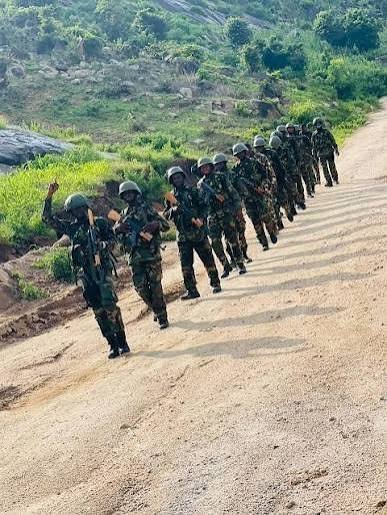
Troops Arrest Suspected Terrorist in Kogi, Suspect Confesses to Group Membership
By Zagazola Makama
Troops of 12 Brigade, in collaboration with Office of the National Security Adviser (ONSA) Hybrid Forces, have arrested a suspected terrorist during an operation in Lokoja Local Government Area.
Security sources told Zagazola Makama that the troops responded at about 1:00 p.m. on July 4 to reports of a confrontation between local residents and a suspected terrorist at a Ruga settlement behind Obajana community.
According to the sources, the troops swiftly intervened and arrested one suspect at the scene.
During preliminary interrogation, the suspect reportedly confessed to being a member of a terrorist group led by an individual identified as Haruna, which allegedly operates within the Okene general area.
The suspect is currently in military custody and is undergoing further investigation to establish the extent of his involvement and identify other members of the group.
Military sources said the arrest forms part of ongoing security operations aimed at dismantling terrorist and criminal networks across Kogi State.
Troops Arrest Suspected Terrorist in Kogi, Suspect Confesses to Group Membership

Troops Arrest Suspected Military Impostor in Katsina

Troops Recover 50 Rustled Cattle, Repel Suspected Rustlers in Kaduna

Troops Arrest Suspected Terrorist in Kogi, Suspect Confesses to Group Membership

Roger Federer’s Shock as DNA Results Reveal Myla and Charlene Are Not His Biological Children

THE PLIGHT OF FARIDA

FAILED COUP IN BURKINA FASO: HOW TRAORÉ NARROWLY ESCAPED ASSASSINATION PLOT AMID FOREIGN INTERFERENCE CLAIMS
-
 News2 years ago
Roger Federer’s Shock as DNA Results Reveal Myla and Charlene Are Not His Biological Children
-
Opinions4 years ago
THE PLIGHT OF FARIDA
-
 News1 year ago
FAILED COUP IN BURKINA FASO: HOW TRAORÉ NARROWLY ESCAPED ASSASSINATION PLOT AMID FOREIGN INTERFERENCE CLAIMS
-

 News2 years ago
EYN: Rev. Billi, Distortion of History, and The Living Tamarind Tree
-
 Opinions5 years ago
POLICE CHARGE ROOMS, A MINTING PRESS
-

 ACADEMICS2 years ago
A History of Biu” (2015) and The Lingering Bura-Pabir Question (1)
-

 Columns2 years ago
Army University Biu: There is certain interest, but certainly not from Borno.
-

 Politics1 year ago
2027: Why Hon. Midala Balami Must Go, as Youths in Hawul and Asikira/Uba Federal Constituency Reject ₦500,000 as Sallah Gift
