
News
FG REAFFIRMS ITS COMMITMENT TO PROVIDE ENABLING ENVIRONMENT FOR HUMAN RIGHTS PROTECTION IN NIGERIA

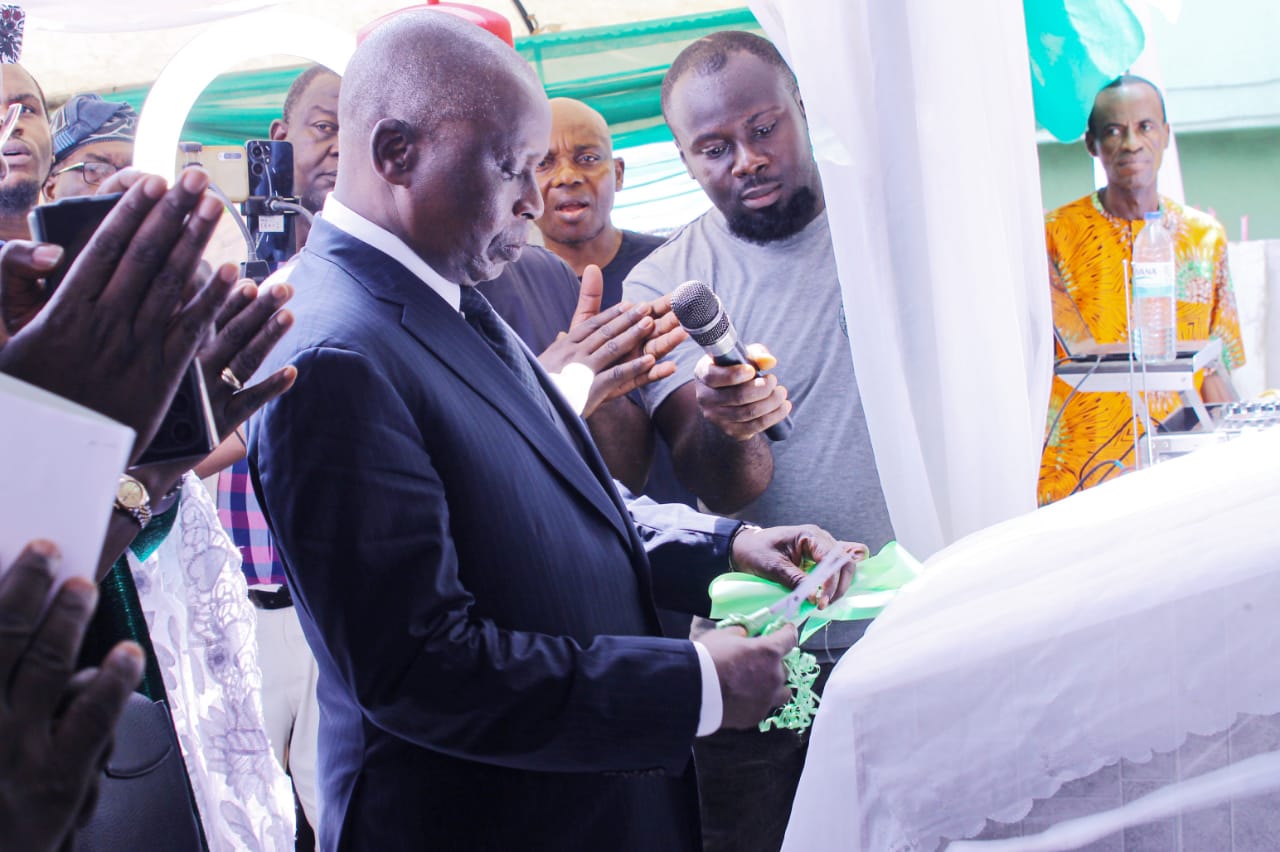
FG REAFFIRMS ITS COMMITMENT TO PROVIDE ENABLING ENVIRONMENT FOR HUMAN RIGHTS PROTECTION IN NIGERIA
— As Justice Minister, Prince Lateef Fagbemi, SAN Commissions NHRC’s Lagos State Office at Ikeja
The Federal Government has reiterated its commitment to the promotion, protection and enforcement of human rights in Nigeria by providing the enabling environment for the National Human Rights Commission (NHRC) to effectively realize its mandate.
The Government also promised to support the NHRC to own its offices nationwide to further entrench its independence and strengthen its strive to protect the rights of citizens.
The Honorable Attorney General of the Federation (AGF) and Minister of Justice, Prince Lateef Fagbemi, SAN who made this statement on the occasion of the commissioning of the Lagos State office of the NHRC noted that the operational independence of the Commission has been future strengthened with the construction of it own offices.
“Under the Paris Principles, such national human rights institutions are to be independent in the execution of their mandate, structure and operations” .
Section 6(3) of the NHRC Act 1995 as amended, stipulates that the Commission in carrying out it’s mandate and operations shall not be subject to the control of any authority or person, he added.
“Accordingly, the ownership of their place of operations (office) constitutes an important aspect of their independence. I am happy to say that since this administration, the government has not interfered with the independence of the Commission”, the AGF said.
The Chief Law Officer of the Federation noted that in fact, during the last dissolution of Boards of all parastatals, the government exempted the Governing Council of the Commission from the general dissolution of Federal Government Boards due to its independence under the enabling Act and the Paris Principles.
In her opening remarks, the Chairperson of the Governing Council of the NHRC, Dr. Salamatu Suleiman, FICMC, thanked the Honorable Attorney General of the Federation and Minister of Justice, and other highly distinguished guests for gracing the occasion of the completion and commissioning of the Lagos State office of the National Human Rights Commission in Alausa, Ikeja Lagos.
According to the senior lawyer, the history of the realization of this project needs to be told as a testimony of the determination of the Commission to strengthen its operations and independence.
She recalled that the Commission was established through the National Human Rights Commission Act 1995 as amended and that in its determination to entrench its independence from the beginning, the Commission commenced its daily operations from its own independently owned buildings in the six geo-political zonal headquarters of Lagos, Enugu, Port Harcourt, Kano, Jos and Maiduguri between 1996 and 2002.
“Over time however, the acquired Lagos office building was no longer befitting and structurally fit to meet the challenges and demands of a modern office suitable for the operations of a national human rights institution like the Commission.
The need for inclusivity and diversity in the working environment of the Commission necessitated a new office structure after 23 years of the acquisition of the Lagos office building and the other zonal headquarters”, the Chairperson narrated.
She observed that things like ramps, lifts, mediation rooms and conference rooms have become key components of any structure for conducting business by a national human rights institution like ours.
The project, she stated, was fully funded by the Federal Government of Nigeria with no donor support.
“The Commission is indeed grateful to the President of the Federal Republic of Nigeria, the Budget office of the Federation, the National Assembly for appropriating funds for the execution of this laudable project. It is our fervent hope that the dream of realizing the construction of the remaining State offices of the Commission will soon be a reality”, she added.
In his speech at the occasion, the Executive Secretary of the NHRC, Dr. Tony Ojukwu OFR, SAN said the Commission had identified the ownership of its offices as one of the indices of its independence under the Paris principles from inception, but due to inadequate financial resources in the Commission, it could not continue on the trajectory of owning all its offices, the way it had started at inception from 1996 to 2002.
The Chief Human Rights Officer of Nigeria recollected that the Lagos office being commissioned today was the first to be awarded in 2019 while the others were awarded in 2020.
“It is hoped that by the end of this year, the Commission will be completing at least 8 of the 9 projects while the 9th project will hopefully be completed before the end of 2025. The delivery period has been 4 to 5 years. This is due to the lean financial resources available to the Commission”, the Executive Secretary stated.
He used the opportunity to appeal to the National Assembly and the Budget office to appropriate more funds to help the Commission further realize its mandate to provide adequate protection to Nigerians when their rights are violated.
Finally, he thanked the Chief Judge of Lagos state, the Speaker of the Lagos State House of Assembly, the Hon Attorney General of Lagos state, the Commissioner of Police for Lagos state, civil society organizations, human rights defenders like Chief Femi Falana SAN, and the Media who work with us daily to resolve complaints on human rights violations.
Other dignitaries and stakeholders who also graced the occasion were, Chairman House Committee on Human Rights and Legal Matters, Hon. Abiola Peter Makinde, representative of the Speaker Lagos State House of Assembly, representative of the Commission of Police, Lagos State, Chairman Nigerian Bar Association, Ikrodu, Bayo Akinlade, representative of the Director General Federal Radio Corporation of Nigeria, representative of International Organisation for Migration (IOM), Victor Lutenco (Senior Programme Coordinator), representative of National Agency for the Prohibition of Trafficking in Persons (NAPTIP), Mr. Frederick Uche Oko, and the Vice Chairman NBA Lagos State, Esther Jimo, etc.
FG REAFFIRMS ITS COMMITMENT TO PROVIDE ENABLING ENVIRONMENT FOR HUMAN RIGHTS PROTECTION IN NIGERIA



Buni calls on emirs to lead peace missions in Yobe
By: Yahaya Wakili
The Executive Governor of Yobe State, Hon. Mai Mala Buni, CON, COMN, has called on the traditional rulers in the state to remain custodians of our heritage and to lead prayers for peace and unity among the citizens of the state.
He said our traditional institutions must continue to promote mutual respect, brotherhood, and peaceful coexistence, noting that the peace and stability we enjoy in Yobe State today must be protected by all of us.
The governor stated this today at Potiskum, the headquarters of the Fika emirate council, while attending a special prayer session marking the 70th birthday anniversary of the Emir of Fika and Chairman of the Yobe State Council of Traditional Rulers, HRH Alhaji Dr. Muhammadu Abali Ibn Muhammadu Idrissa, CON, CFR.
The Yobe State APC gubernatorial candidate, Alhaji Baba Mallam Wali MNI, FCAN, ably represented the governor. The emirate offered prayers for the continued peace, unity, and prosperity of Yobe State and the success of Governor Buni and the incoming governor, inshallah, Alhaji Baba Malam Wali MNI FCAN.
In his remarks, His Royal Father, the emir of Fika, Alhaji Dr. Muhammadu Abali Ibn Muhammadu Idrissa, CON, CFR, thanked His Excellency, Governor Mai Mala Buni, CON, COMN, for his support and called on citizens to be law-abiding, adding that there is no wealth greater than peace.
The emir also called on the people to pray for a bumper harvest this year’s farming season, as well as charged them to love one another and always promote peace in all their endeavors.
Buni calls on emirs to lead peace missions in Yobe

Buni urged youths in Yobe to actively participate in elections for competent candidates
By: Yahaya Wakili
Yobe State Governor Hon. Mai Mala Buni CON, COMN, has charged the youth in the state to participate actively in all the elections of competent persons for various political offices in the state and Nigeria.
He also assured the youth in the state that they have a prosperous future in their lives.
Governor Buni stated this at a two-day retreat organized by the Coalition of All Progressives Congress (APC) Political Organizations (COYAPO).
According to him, the youth constitute the larger population of the state; therefore, you must be actively involved to shape the politics and leadership of the state.
In his earlier address, the Director General of COYAPO, Alhaji Babagana Modu alias Bature Goniri, commended Governor Mai Mala Buni for the opportunity extended to youth in the state to participate in governance.
Buni urged youths in Yobe to actively participate in elections for competent candidates
Nigeria Launches National Strategy to Dismantle Organised Crime, Break Agency Silos
By: Michael Mike
Nigeria has launched a new National Strategy for Combating Organised Crime, signalling a major shift towards a coordinated, intelligence-led national response to criminal networks involved in cybercrime, drug trafficking, human trafficking, migrant smuggling and other transnational crimes.
The strategy, launched in Abuja with the participation of key government institutions, law enforcement agencies, international partners and civil society organisations, seeks to break down institutional silos and establish a unified framework for preventing, detecting, investigating, prosecuting and dismantling organised criminal groups operating within and across Nigeria’s borders.
The initiative was developed through extensive multi-agency consultations and technical collaboration with the United Nations Office on Drugs and Crime (UNODC).
Delivering the keynote address on behalf of the National Security Adviser, Major General Adamu Laka, National Coordinator of the National Counter Terrorism Centre, said a coordinated front against organised crime was essential to Nigeria’s national security and stability.
Laka stressed that inter-agency coordination could no longer be treated as optional, urging stakeholders to make concerted efforts to ensure that criminal networks are effectively disrupted.
He said building an effective response would require stronger collaboration and sustained commitment across institutions responsible for national security and criminal justice.
The strategy places particular emphasis on intelligence sharing, coordinated investigations, specialised operational capacity and stronger regional and international cooperation, reflecting the increasingly sophisticated nature of organised criminal networks.
It also provides for the protection of victims and witnesses, recognising that the fight against organised crime must extend beyond the disruption of criminal networks to protecting the people and communities affected by them.
The strategy comes amid growing concerns over the ability of criminal groups to exploit technology, cross-border mobility, economic vulnerabilities and illicit financial networks to expand their activities.
According to the UNODC World Drug Report 2025, an estimated 316 million people used drugs globally in 2023, while organised criminal groups have continued to adapt to global crises and expand illicit markets, including into Africa.
The UNODC Global Report on Trafficking in Persons 2024 also reported a global increase in identified trafficking victims following the COVID-19 pandemic, with children accounting for nearly 40 per cent of identified victims.
The reports underscore the increasingly transnational character of organised crime and the need for countries to strengthen cooperation among law enforcement, criminal justice institutions and other stakeholders.
Speaking at the launch, UNODC Country Representative Cheikh Toure welcomed Nigeria’s commitment to a whole-of-government and whole-of-society approach to tackling organised crime.
Toure, alongside Tolliver Derrick, Director of the United States Department of State’s Bureau of International Narcotics and Law Enforcement Affairs (US INL), expressed support for the strategy and its emphasis on coordinated, victim-centred and rights-based responses.
The approach is consistent with international best practices promoted by UNODC, including its Organised Crime Strategy Toolkit, which encourages countries to develop integrated responses that bring together government institutions, civil society, communities and international partners.
Participants at the Abuja launch identified stronger inter-agency and regional collaboration, operational readiness, specialised capacity and adherence to the rule of law as key pillars of the new framework.
They emphasised that no single institution could effectively confront the increasingly complex ecosystem of organised crime on its own.
According to participants, effective implementation would therefore depend on timely intelligence sharing, joint investigations, intelligence-led operations and sustained partnerships among security and law enforcement agencies, communities, civil society organisations and international partners.
The project coordinator from the National Counter Terrorism Centre and national consultants subsequently presented the strategy’s core objectives, implementation roadmap, assessment of organised crime in Nigeria and the Gulf of Guinea, as well as its monitoring and evaluation framework.
The presentations marked what stakeholders described as the beginning of the implementation phase, with emphasis now shifting from policy commitments to measurable results.
The strategy is expected to provide a common framework for confronting multiple forms of organised crime, including cybercrime, illicit drug markets, trafficking in persons, migrant smuggling and environmental crimes.
For communities affected by these crimes, the strategy represents an attempt to connect national security priorities with the protection of livelihoods, human rights and community safety.
The initiative received financial support from the United States Department of State’s Bureau of International Narcotics and Law Enforcement Affairs.
Nigeria Launches National Strategy to Dismantle Organised Crime, Break Agency Silos

Buni calls on emirs to lead peace missions in Yobe

Buni urged youths in Yobe to actively participate in elections for competent candidates

NDLEA Destroys N301bn Drugs, Vows to Cripple Cartels’ Financial Networks

Roger Federer’s Shock as DNA Results Reveal Myla and Charlene Are Not His Biological Children

THE PLIGHT OF FARIDA

FAILED COUP IN BURKINA FASO: HOW TRAORÉ NARROWLY ESCAPED ASSASSINATION PLOT AMID FOREIGN INTERFERENCE CLAIMS
-
 News2 years ago
Roger Federer’s Shock as DNA Results Reveal Myla and Charlene Are Not His Biological Children
-
Opinions5 years ago
THE PLIGHT OF FARIDA
-
 News1 year ago
FAILED COUP IN BURKINA FASO: HOW TRAORÉ NARROWLY ESCAPED ASSASSINATION PLOT AMID FOREIGN INTERFERENCE CLAIMS
-

 News2 years ago
EYN: Rev. Billi, Distortion of History, and The Living Tamarind Tree
-
 Opinions5 years ago
POLICE CHARGE ROOMS, A MINTING PRESS
-

 ACADEMICS2 years ago
A History of Biu” (2015) and The Lingering Bura-Pabir Question (1)
-

 Columns2 years ago
Army University Biu: There is certain interest, but certainly not from Borno.
-

 Politics1 year ago
2027: Why Hon. Midala Balami Must Go, as Youths in Hawul and Asikira/Uba Federal Constituency Reject ₦500,000 as Sallah Gift
