
News
Flood: Kadafur, Ndume leads Southern Borno stakeholders, others to sympathise with Zulum, Shehu


Flood: Kadafur, Ndume leads Southern Borno stakeholders, others to sympathise with Zulum, Shehu
… Present N210 million raised from individual donations
By Inusa Ndahi
Deputy Governor of Borno state, Hon Umar Kadafur and Senator Mohammed Ali Ndume on Tuesday led a powerful delegation of Emirs, former Deputy Governors and stakeholders from nine (9) local government areas of Southern Borno Senatorial District where they offered their heartfelt sympathies to Governor Babagana Zulum and the Shehu of Borno, Dr. Abubakar Garbai Al-Amin Elkanemi over the unfortunate flood disaster that have ravaged the entire 70% of the Maiduguri city.
The incident which started on Monday evening has left thousands of people dead, as many others still missing, with displacement of over two million people, and critical infrastructures worth billions of naira destroyed.
Introducing the purpose of the visit to Governor Zulum at the Government House, Senator Ndume who represent the zone at Red Chamber said, “sequel to the live broadcast last week, where the governor seek for assistance from well-to-do individuals, the leader of Southern Borno, Kadafur summoned a meeting of stakeholders of the zone, where it was unanimously agreed that willing people in Southern Borno from Nigeria and in Diaspora should contribute to a dedicated account ( NORDISK GENERAL VENTURES, ZENITH BANK 1228484797)”.
Presently he said, as at Tuesday morning, over N200 million have been credited from various donors, in which, the Delegation were at the Government House to sympathise with the Governor, Government and the good people of the state, and to also present a cheque of N200 million to the state government to assist in managing the plights of the displaced victims.
Presenting the Cheque to Governor Zulum, the Deputy Governor Kadafur thanked all those who have contributed their widow’s mite in one way or other, which shows the kind of brotherhood that exists between the Government and the people of Southern Borno.
“We are here Your Excellency on behalf of the Southern Borno people. We are not here alone, but with four of our Emirs of Biu Alhaji Mustapha Umar Mustapha II, Uba, Alhaji Ali Ismaila Mamza, Shani, Alhaji Nasir Mohammed Mailafiya and Gwoza Local Government Area, Alhaji Mustapha Idrissa Timta and many other stakeholders.
“First, is to commisserate with you and the victims of the devastating flood disaster, and secondly to Pray Allah (God) to grant Aljannatul Firdaus to Souls of those who have died and wish the injured ones quick recovery.
” We are also here to present a dommy cheque of N200 million to the State Government Flood Basket Fund. We want to assure you that you are not alone, as the people of Southern Borno are strongly behind you in this trying moment”. Kadafur said.
He also told the governor that more donations are still expected, which would be channeled judiciously to the state government in providing relief items to the victims and the rebuilding process.
Responding Governor Zulum expressed his deep appreciation to the Deputy Governor and the entire people of Southern Borno for not only coming enmasse to pay him sympathy, but also donated a quantum amount, which would be used transparently for the purpose intended.
He therefore enjoined the people to unite, as according to him, without unity, there is no progress in all ramifications.
While at the Shehu of Borno’s palace which was also affected and hitherto submerged for the past four days before it was drained, Kadafur presented another Dommy Cheque of N10 million contributed to the Monarch to assist in the running and fixing of some property destroyed in the palace.
The Royal Father who gave a little background of the Alau Dam which caused the flood after it collapsed, appreciated all the Southern Borno People, especially those who have donated out of their pockets to complement efforts of the state government and the Emirate in its recovery after the incident.
He prayed Allah to bless all those who have contributed in one way or the other since the incident happened.
In a related development, Kano based Business Mogul, Alhaji Aminu Al Hassan Dantata has visited the state where he sympathized and gave his personal donation of N1.5 billion to the state Government.
Likewise, members of the Borno State House of Assembly led by the Speaker, Rt. Hon. Abdulkarim Lawan has offered their condolences to Governor Zulum and presented a wholesome donation of N60 million.
More so, the Chairman Board of the North East Development Commission, NEDC, General Paul Tarfa (Rtd) and the Managing Director, Goni Alkali and the management team paid their condolences to Zulum where the unveiled N3 billion relief fund to Small and Medium Scale Enterprises, SMEs and other assorted food items to the victims.
Flood: Kadafur, Ndume lead Southern Borno stakeholders, others to sympathise with Zulum, Shehu


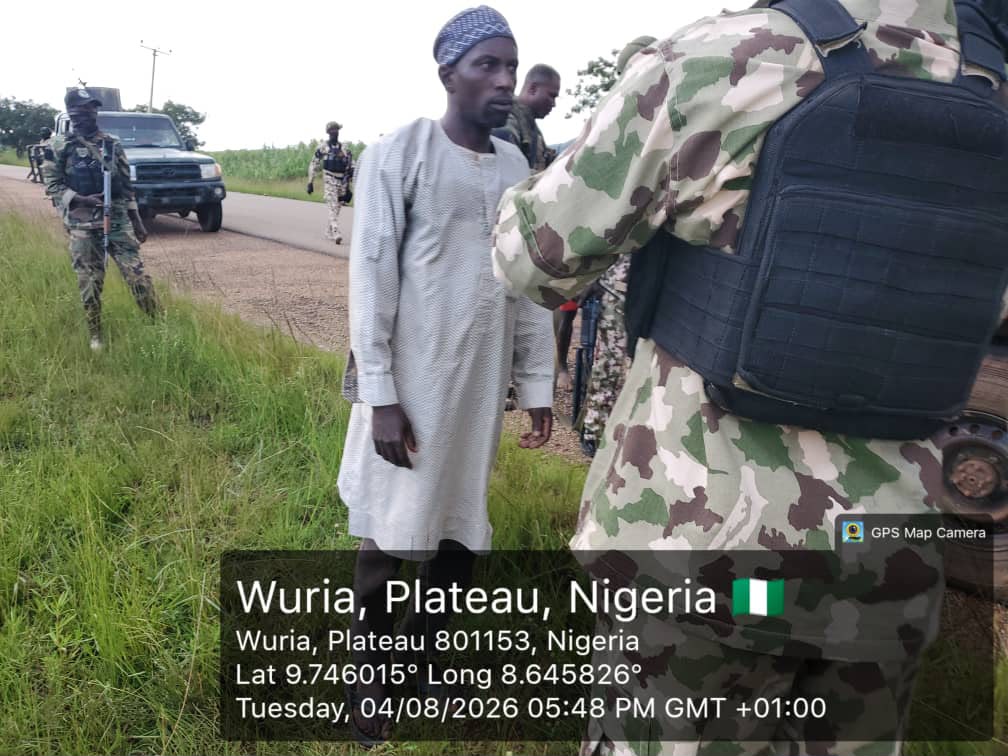
Troops Arrest Herder Over Alleged Farm Destruction in Plateau
By Zagazola Makama
Troops of Sector 1, Operation Enduring Peace , have arrested a herder following the alleged destruction of a farmland in Jos East Local Government Area of Plateau State.
Intelligence sources told Zagazola Makama that the troops of Sub-Sector 12 responded at about 12:30 p.m. on Aug. 4 to a report of farmland destruction belonging to Matthew Ezekiel at Kerker Community.
On arrival at the scene, the troops arrested Yusuf Zakariah, 17, a herder suspected to be connected with the incident.
The sources said efforts are underway to resolve the dispute peacefully, with both parties currently engaged in negotiations alongside the Ardo, Muhammad Zakariah, under the supervision of security personnel.
Operation Enduring Peace said it would continue to promote peaceful coexistence between farming and herding communities while ensuring that individuals found culpable for acts capable of disrupting public peace are brought to justice.
Troops Arrest Herder Over Alleged Farm Destruction in Plateau

Troops Rescue Injured Farmer, Seize 27 Cattle After Violent Herders’ Attacks in Plateau
By Zagazola Makama
Troops of Sector 8, Operation Enduring Peace have rescued an injured farmer and confiscated 27 cattle following separate incidents involving suspected violent herders in Mangu Local Government Area of Plateau State.
Intelligence sources told Zagazola Makama that the first incident occurred at about 4:05 p.m. on Aug. 3 when troops deployed at Komtul responded to a distress call over an attack on a farmer, Kopdi Istifanus, at his farmland in Maraban Village, Pushit District.
The sources said the troops’ swift intervention forced the suspected herders to flee, while the injured farmer was rescued and evacuated to Miton Clinic, Pushit, for medical treatment.
In a related development at about 6:57 p.m. the same day, troops responded to another report of herders allegedly attacking farmers across the Bwor River in Mangu LGA.
On arrival, the troops reportedly sighted some herders chasing farmers away from their farmlands while armed with knives.
According to the sources, the situation became violent when the herders allegedly attempted to attack the troops with a knife during efforts to restore order.
The troops consequently fired two rounds of 7.62 x 39mm special ammunition to subdue the assailants, who abandoned the knife and fled the scene, leaving behind their livestock.
Security personnel recovered the knife and confiscated 27 cattle belonging to the fleeing herders for further necessary action.
Troops are maintaining dominance in the general area, while efforts are ongoing to apprehend the fleeing suspects and prevent further attacks on farming communities.
Troops Rescue Injured Farmer, Seize 27 Cattle After Violent Herders’ Attacks in Plateau

Five ISWAP Bomb Experts Killed in Premature IED Explosion in Borno
By Zagazola Makama
Five suspected Islamic State West Africa Province (ISWAP) terrorists, including an alleged medical officer and four improvised explosive device (IED) specialists, have reportedly been killed in a premature explosion while assembling explosives in Marte Local Government Area of Borno State.
Intelligence sources told Zagazola Makama that the incident occurred at Maina Daya Village, located between Sabon Tumbu and Jubilaram, about 29 kilometres east of Monguno.

According to the sources, the explosion killed Usman Dan Fulani, described as an ISWAP medical officer, alongside two foreign Arab IED technicians and two ISWAP bomb-making experts.
The sources said the incident occurred while the terrorists were allegedly preparing improvised explosive devices for deployment, suggesting the group was planning further attacks along key military supply routes in the Sector 1 area of Operation HADIN KAI.
Security analysts believe the loss of experienced bomb-makers is a significant setback to ISWAP’s IED network and could temporarily weaken the group’s capability to carry out roadside bomb attacks in the Marte-Monguno axis.
Military sources disclosed that troops have been directed to exploit the development by intensifying patrols, cordon-and-search operations, and precision offensive actions around Monguno, Marte, and Gamboru Ngala to prevent the terrorist group from regrouping or rebuilding its IED capability.
Five ISWAP Bomb Experts Killed in Premature IED Explosion in Borno

Troops Arrest Herder Over Alleged Farm Destruction in Plateau

Troops Rescue Injured Farmer, Seize 27 Cattle After Violent Herders’ Attacks in Plateau

Five ISWAP Bomb Experts Killed in Premature IED Explosion in Borno

Roger Federer’s Shock as DNA Results Reveal Myla and Charlene Are Not His Biological Children

THE PLIGHT OF FARIDA

FAILED COUP IN BURKINA FASO: HOW TRAORÉ NARROWLY ESCAPED ASSASSINATION PLOT AMID FOREIGN INTERFERENCE CLAIMS
-
 News2 years ago
Roger Federer’s Shock as DNA Results Reveal Myla and Charlene Are Not His Biological Children
-
Opinions4 years ago
THE PLIGHT OF FARIDA
-
 News1 year ago
FAILED COUP IN BURKINA FASO: HOW TRAORÉ NARROWLY ESCAPED ASSASSINATION PLOT AMID FOREIGN INTERFERENCE CLAIMS
-

 News2 years ago
EYN: Rev. Billi, Distortion of History, and The Living Tamarind Tree
-
 Opinions5 years ago
POLICE CHARGE ROOMS, A MINTING PRESS
-

 ACADEMICS2 years ago
A History of Biu” (2015) and The Lingering Bura-Pabir Question (1)
-

 Columns2 years ago
Army University Biu: There is certain interest, but certainly not from Borno.
-

 Politics1 year ago
2027: Why Hon. Midala Balami Must Go, as Youths in Hawul and Asikira/Uba Federal Constituency Reject ₦500,000 as Sallah Gift
