
News
Gombe APC commends Dankwambo for not importing hoodlums

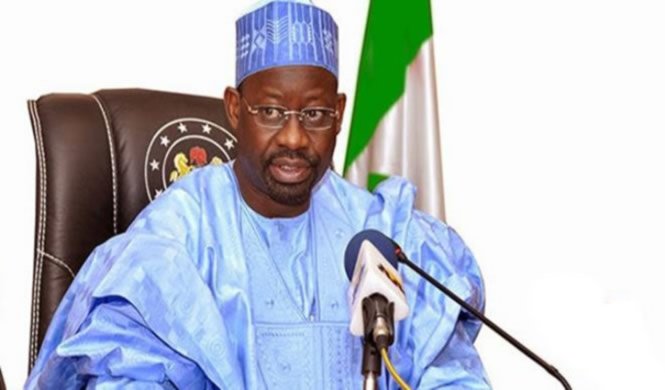
Gombe APC commends Dankwambo for not importing hoodlums
The Gombe State chapter of the All Progressives Congress (APC) has commended former Governor Ibrahim Dankwambo for not importing hoodlums into the state.
The reports gathered that Dankwambo was received last weekend by thousands of supporters who ushered him from the Airport to the secretariat of the Peoples Democratic Party.
Addressing journalists on Tuesday at the state’s secretariat, Publicity Secretary Moses Kyari said that unlike the visits of Danjuma Goje, former governor of the state and senator representing Gombe Central, and Jamil Ishayaku; a governorship aspirant of the PDP, where the state incurred losses, that was not the case with Dankwambo’s visit.
In November 2021, there was a clash where Goje’s convoy was allegedly attacked by hoodlums which led to the death of a person, with a property also lost, according to the Gombe State Police Command.
According to the Publicity Secretary, although Dankwambo had been absent from the state for three years, he was able to conduct the activities of his supporters within the law without bloodshed.
Kyari said, “The Gombe APC noted with delight how Dankwambo landed at the Gombe International Airport and proceeded to the PDP secretariat in the state along with his supporters and other chieftains, peacefully without disturbing the public peace.
READ ALSO: APC: Adamu Takes Over Media Centre, Displaces Journalists
“During Dankwambo’s visit, we observed that his supporters conducted themselves in a peaceful manner. His conduct was a sharp contrast to other Abuja-based politicians of the opposition PDP, such as former Governor Goje and Jamilu Ishyaku Gwamna who during their visits to Gombe, brought in heavily armed thugs bearing and brandishing very dangerous weapons and caused massive mayhem as well as the destruction of public properties within the state capital, which is not part of his senatorial district.
“This time around, we did not notice a serious breach of public peace. This is despite the fact that Dankwambo was visiting Gombe for the first time since he left office as governor. We sincerely commend Dankwambo for conducting himself in a manner befitting a man of his status and conviction.”
While commending the efforts of Governor Muhammadu Yahaya for cancelling an empowerment programme for fear of clashing with supporters of his predecessor, Kyari said that Yahaya had displayed his love for unity.
“We wish to also commend our dear governor and leader, His Excellency, Muhammadu Inuwa Yahaya, for once more demonstrating uncommon statesmanship in his usual character of peaceful disposition by shelving his earlier scheduled function of same Saturday, April 1 in the state capital on APC Square, which coincided with Dankwambo’s visit so as to guard against any possible clash by rival groups. This is highly commendable and it goes to show how accommodating, magnanimous and tolerant His Excellency is.
“We are equally happy with the conduct of our teeming party supporters, who remained calm and maintained decorum during Dankwambo’s visit, which is an indication that we are always peaceful in our conduct even in the face of provocation. This conduct is also a testimony of the peaceful nature of our party,” Kyari added.
He further noted that politicians should desist from overheating the polity in an attempt to engage electorates in consultation.
Kyari said, “I want to call on politicians, particularly aspirants of the opposition in the state to take a cue from our amiable governor, Alhaji Muhammadu Inuwa Yahaya, who preaches and practices politics of all inclusion and jealously guards the peace of the state is enjoying.
“We need more peaceful politicians and not those that use violence in the conduct of their politics and politicking, as well as leaving a trail of blood and pain anytime they visit the state.”







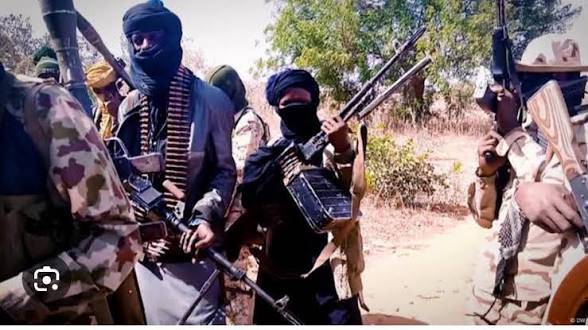
Bandits kill two police personnel, cart away weapons in Musawa ambush in Katsina
By: Zagazola Makama
Suspected armed bandits, allegedly affiliated with a notorious bandit leader, have ambushed a police convoy in Katsina State, killing two police personnel and carting away their service weapons.
Police sources said the attack occurred at about 5:50 p.m. on April 7, 2026, at Sabon Garin Garu village in Musawa Local Government Area.
The assailants, said to be in large numbers and riding on about 30 motorcycles, were reportedly affiliated with a notorious bandit leader identified as Muhammadu.
They ambushed a vehicle conveying five personnel of the Police Mobile Force (27 PMF) who were travelling from Zamfara State through Katsina State.
A swift response by police tactical teams, including patrol units and community watch groups, led to a gun duel with the attackers, forcing them to retreat.
Three of the police personnel were rescued unhurt during the exchange of fire.
However, two personnel were killed in the attack. They were identified as Sgt. Bilyaminu Babangida and PC Abdulaziz Musa.
The attackers also carted away the officers’ service rifles and a riot gunner.
Police reinforcements from Dutsinma, Kankia, Matazu and Kankara were subsequently deployed to block escape routes, while cordon and search operations were ongoing to apprehend the perpetrators and recover the stolen arms.
Security authorities said efforts had been intensified to restore calm in the area and prevent further attacks along the axis.
Bandits kill two police personnel, cart away weapons in Musawa ambush in Katsin
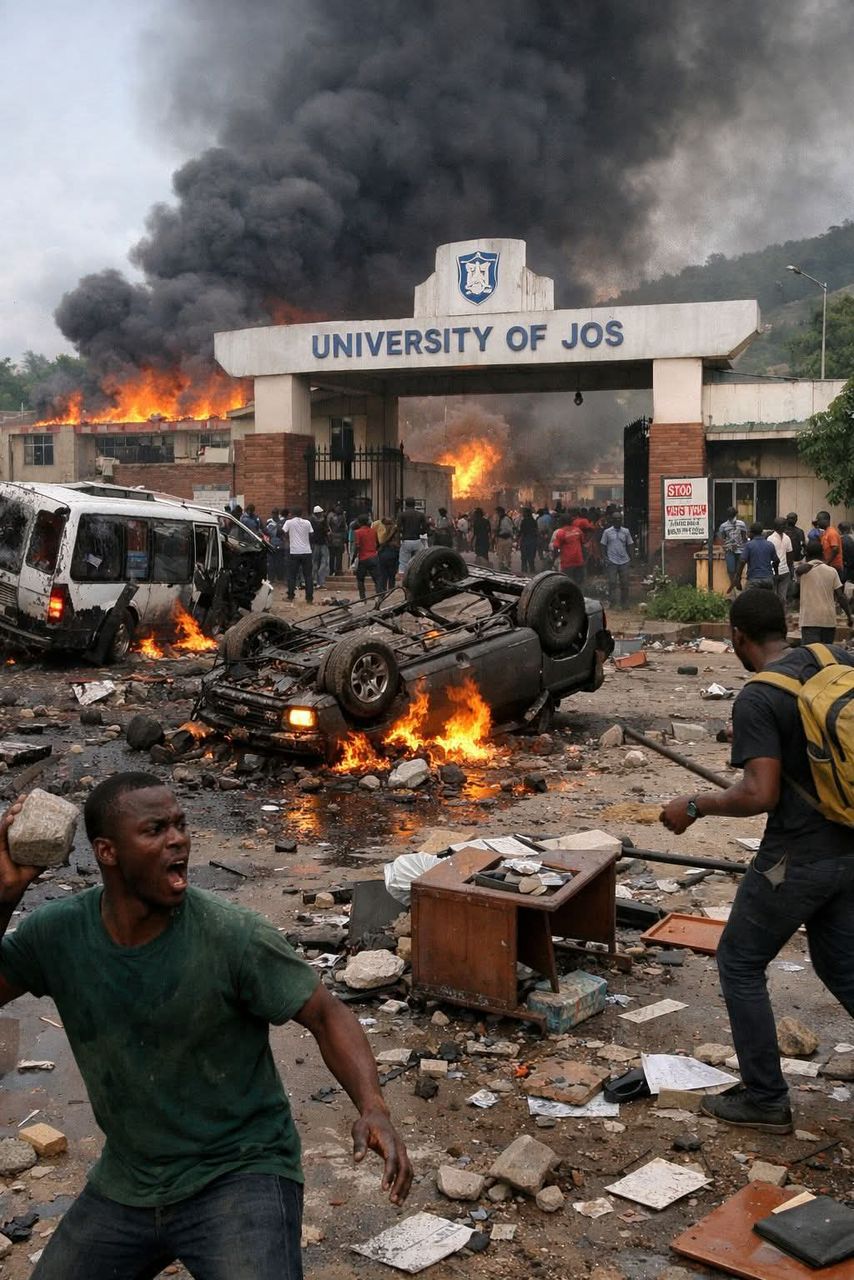
Fake report of unrest at unijos debunked, military assures campus security
By: Zagazola Makama
The Management of the University of Jos and the Nigerian military have dismissed as false and misleading a viral report alleging unrest, chaos, and destruction within the institution, describing it as a deliberate attempt to cause panic and misinformation.
The fake report, which circulated on social media alongside an image claimed to depict violence on campus, suggested that “student grievances had escalated into chaos” with alleged destruction and insecurity within the university environment.

However, checks by Zagazola and confirmation from university authorities indicate that the situation at the University of Jos remains calm, peaceful, and under control, with normal activities ongoing.
It was further gathered that the image accompanying the false report was generated using Artificial Intelligence and does not reflect any real incident within or around the university.
A senior security source told Zagazola Makama that the General Officer Commanding 3 Division, Nigerian Army and Commander Joint Task Force Operation ENDURING PEACE, Major General E.F. Oyinlola, personally led troops to the University of Jos following the circulation of the fake report.

During the visit, the GOC met with the Vice Chancellor of the institution and assured management of the Nigerian Army’s commitment to safeguarding the university community, students, and staff against any form of threat or security breach.
The military described the viral publication as “fake news deliberately designed to cause confusion, panic, and distrust,” urging members of the public to disregard it in its entirety.
Authorities further cautioned against the circulation of unverified content, especially digitally manipulated images, warning that such misinformation could incite unnecessary fear and disrupt public peace.
The University of Jos management also reaffirmed that there was no unrest or security breach on campus, stressing that academic activities were proceeding without disruption.
Security agencies assured continued surveillance and protection of the institution as part of ongoing efforts under Operation ENDURING PEACE to maintain stability across Plateau State.
The public has been urged to rely only on verified information from official sources and avoid sharing content capable of undermining peace and order in the state.
Fake report of unrest at unijos debunked, military assures campus security
Athena Observatory Warns of Deepening Structural Risks in Nigeria’s Democracy
By: Michael Mike
A new policy report has raised fresh concerns about the stability of Nigeria’s democratic system, warning that growing political fragmentation and institutional strain could undermine the credibility of elections ahead of the 2027 general polls.
The report, released on Tuesday by the Athena Election Observatory (AEO), marks the debut of its Political Landscape Monitor—a policy series designed to track and analyse the country’s evolving electoral environment. Titled “Nigeria’s Democracy and the Imperative of Competitive Politics,” the inaugural note paints a sobering picture of a political system struggling to keep pace with its own internal dynamics.
According to the Observatory, a pattern is emerging across Nigeria’s major political parties in which leadership disputes, fragile alliances, and factional battles are becoming increasingly common. While these crises may appear isolated, the report argues they are symptoms of a deeper structural imbalance.
At the heart of the problem, it said, is a widening gap between political activity and institutional capacity. Political actors, driven by the urgency of coalition-building and power consolidation, are moving faster than the rules and structures meant to regulate them.
“This is not just about party disagreements,” the report noted. “It is about the weakening of the systems that are supposed to organise competition, manage conflict, and ultimately guarantee meaningful choice for voters.”
The analysis drew from recent developments within prominent parties such as the African Democratic Congress (ADC), the Peoples Democratic Party (PDP), and the Labour Party, where internal tensions and contested leadership claims have repeatedly spilled into the public domain.
Observers say the trend reflects a broader shift in how political disputes are resolved in Nigeria. Rather than being settled through internal party mechanisms, disagreements are increasingly pushed toward external institutions—particularly the courts and electoral regulators.
The report highlighted the pivotal role of the Independent National Electoral Commission (INEC) in this process. Its decisions on which party factions to recognise can effectively determine leadership outcomes, making it a central actor in intra-party struggles.
While acknowledging INEC’s constitutional mandate, the Observatory cautioned that inconsistent or opaque decision-making could erode public confidence. It called for clearer procedures and stricter adherence to impartiality to prevent the Commission from being perceived as a political arbiter.
Equally significant is the growing reliance on the judiciary to settle political disputes. The report warned that while the courts remain essential for upholding the rule of law, their increasing involvement in intra-party conflicts risks displacing internal governance systems.
Legal interventions, it argued, should serve as a last resort—not a default mechanism.
“When courts become the primary arena for resolving political disagreements, parties gradually lose the capacity to govern themselves,” the report states. “Over time, this weakens the entire democratic ecosystem.”
Beyond institutional concerns, the Observatory drew attention to the implications for ordinary voters. A fragmented political landscape, it said, reduces the clarity and credibility of electoral choices, leaving citizens with options that may lack cohesion or long-term viability.
In such conditions, elections risk becoming procedural exercises rather than meaningful expressions of democratic will.
The report ultimately framed the issue as a national, rather than partisan, challenge. Strengthening the institutional foundations of political competition, it argued, is critical not only for credible elections but also for political stability and governance.
As Nigeria edges closer to another election cycle, the findings serve as a stark reminder that the health of a democracy depends not just on the conduct of elections, but on the strength of the systems that shape them long before ballots are cast.
The Athena Election Observatory said it will continue to publish periodic assessments under its Political Landscape Monitor, offering data-driven insights into the trends shaping Nigeria’s political future.
Athena Observatory Warns of Deepening Structural Risks in Nigeria’s Democracy

Bandits kill two police personnel, cart away weapons in Musawa ambush in Katsina

Several bandits killed as Army, DSS, Local Volunteer Forces Foil Attacks on Niger Communities

2027: Ishaya Malgwi does not reflect the sentiments or intentions of northern leadership nor the stance of Vice President Kashim Shettima.

Roger Federer’s Shock as DNA Results Reveal Myla and Charlene Are Not His Biological Children

THE PLIGHT OF FARIDA

FAILED COUP IN BURKINA FASO: HOW TRAORÉ NARROWLY ESCAPED ASSASSINATION PLOT AMID FOREIGN INTERFERENCE CLAIMS
-
 News2 years ago
Roger Federer’s Shock as DNA Results Reveal Myla and Charlene Are Not His Biological Children
-
Opinions4 years ago
THE PLIGHT OF FARIDA
-
 News12 months ago
FAILED COUP IN BURKINA FASO: HOW TRAORÉ NARROWLY ESCAPED ASSASSINATION PLOT AMID FOREIGN INTERFERENCE CLAIMS
-

 News2 years ago
EYN: Rev. Billi, Distortion of History, and The Living Tamarind Tree
-
 Opinions4 years ago
POLICE CHARGE ROOMS, A MINTING PRESS
-

 ACADEMICS2 years ago
A History of Biu” (2015) and The Lingering Bura-Pabir Question (1)
-

 Columns2 years ago
Army University Biu: There is certain interest, but certainly not from Borno.
-

 Opinions2 years ago
Tinubu,Shettima: The epidemic of economic, insecurity in Nigeria
