
News
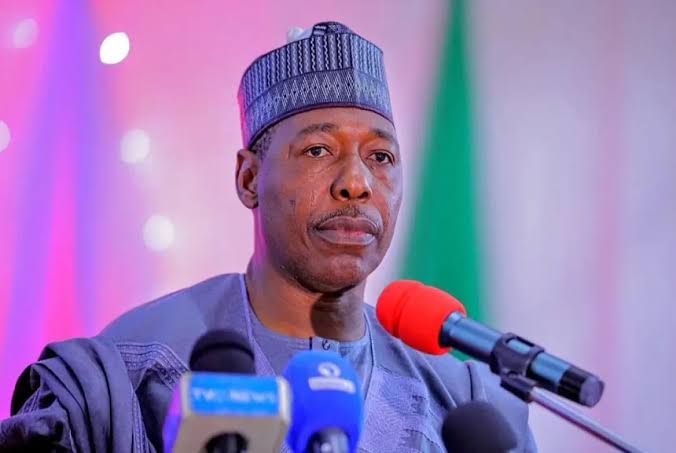
Governor Zulum flags off fertilizer sales, warns against diversion


Governor Zulum flags off fertilizer sales, warns against diversion.
By: Bodunrin Kayode
Governor of Borno State Babagana Zulum has warned that anyone who diverts fertilizer will be prosecuted no matter how highly placed.
In his speech while flagging off the sales of fertilizer in the state recently, the governor asserted that no resident would be spared, “no matter how highly placed,” the repercussions of flouting his directive.
Zulum noted that he is aware of the “risks” associated with the diversion of the commodity, which is why he is emphasizing that any form of diversion of fertilizer in the state by anyone high or low in the state will be punished.
He called on the intelligence agencies to wake up to their responsibilities by ensuring that all culprits are arrested and prosecuted for daring to divert the commodity within or outside the state.
“Culprits shall be dealt with, specifically those who are not farmers but intend to use proxies to get the commodities for any form of usage.
“I hereby call on traditional and community leaders to be very vigilant during this distribution of the fertilizers, which should be given to only registered members. All farmers must register to partake in the sales, which will be done at 50 percent of the price.
“Let me add that this government will stop at nothing to empower farmers in the state to achieve all their potential, which is why it is only fertilizers that will be sold at 50 percent prices. Other implements would be given free to them.” Said Zulum.
It is a known fact that insurgents are in desperate need of fertilizers, especially urea, which is used to assist them in the production of improvised explosive devices (IEDs) used to cause havoc to both civilians and the military in the 15-year-old conflict that has plagued the Northeastern region of Nigeria.
Tackling restrictions over farmlands
The governor expressed dissatisfaction over the back-and-forth some residents have been having with security agencies over their ancestral farmlands, in which they have been restricted from farming.
“I want you to report anybody who stops you as farmers from farming anywhere in the state. Such decisions can only be given by the state security council and nobody else. Nobody can take such a decision without consulting us at the security council.
“As long as you have clearance from us, you are free to farm anywhere. Ensure you have the clearance, which I can assure you nobody can deny you as long as we have given you clearance,” said Zulum.
The governor maintained that his government was on course in going into private partnership with a private investor to maintain the continuous functionality of the state fertilizer plant, which has remained comatose for some time now.
Making his remarks as the Chair of the agricultural transformation committee, the secretary to the state government, Tijani Bukar, assured that they will work with the World Food Programme to ensure that the sector is moved from where it is now to where it should be in the nearest future.
He hinted that the governor is worried about the recovery by returnee farmers who have lost virtually everything to the tragedy of the 15-year insurgency, which is why he is doing all he can to make them achieve the concept of recovery, which should make them happy.
Counting the blessings of the recovery program, the SSG said that Monguno was a typical example of a council area that superseded its expectations beyond all imagination.
“We have been achieving results so far. Monguno alone generated over N50 billion from beans alone in 2024. And this occurs because of the complementarity from the government.
“The concepts of resilience, recovery, and seed capital are key factors that the government will continue with to ensure that all registered farmers will prosper in the business of food security.
“Let me assure you that nobody should express any fear of any source because as long as you are a conscious farmer, you will get what is due to you as support for being a farmer.” Said Alhaji Bukar.
Commissioner of Agriculture Bawa Musari stated that in spite of all the challenges farmers have experienced in the state, he has not lost hope for their future but believes in the greenery of the entire state before the end of the farming season.
He called on Governor Professor Zulum to do all he can in his power to revitalize the fertilizer plant, which is a vital asset in the green revolution of the entire state.
Governor Zulum flags off fertilizer sales, warns against diversion



HAQ KA PANI: RECLAIMING INDIA’S RIGHTFUL SHARE
Mr. Atul Jain, Former Chairman,
Central Water Commission.
The Hon’ble Prime Minister’s Independence Day assertion last year that- “Haq ka pani will serve Indian farmers”- marks a decisive shift in India’s approach to the Indus Waters. Far from being a departure, it is a long-overdue correction of historical restraint that has disproportionately disadvantaged India while enabling persistent misuse downstream. It signals that India will no longer allow its rightful share of water to go underutilized and wasted while its own farmers face scarcity.
When the Indus Waters Treaty was signed in 1960, India, as the upper riparian, made a remarkable concession by agreeing to restrict itself to about 20% of the Indus system waters, allocating the overwhelming 80% share to Pakistan. This decision reflected extraordinary goodwill. The expectation was that such generosity would be matched by responsible conduct and a cooperative spirit. Instead, over the decades, that spirit was never reciprocated.
The Hon’ble Prime Minister’s statement must also be seen against the backdrop of repeated acts of cross-border terrorism emanating from Pakistan that have vitiated the trust. The long-standing reality, captured in the phrase, “blood and water cannot flow together”, is no longer rhetorical. Incidents such as the Pulwama terror attack, along with other attacks in the Valley, including the Pahalgam region, have underscored how sustained hostility undermines the very foundation on which cooperative arrangements like the Treaty rest. No agreement, however well-crafted, can remain insulated from a complete breakdown of trust.
At a structural level, the Treaty itself contained asymmetries that became increasingly untenable. It imposed considerable restrictions on India’s use of its allocated waters, yet places no corresponding obligation on Pakistan to justify its requirements or ensure efficient utilization. This is reflected in the widespread inefficiencies, losses in irrigation systems (estimated at about 47 MAF), inadequate storage, and poor water management on their side leading to large volumes of Indus waters (upto 35 MAF) flowing to the Arabian Sea unutilized.
Meanwhile, India has borne the cost of restraint. Region such as Rajasthan, Haryana have remained water-stressed, their agricultural potential constrained despite the availability of water that India is entitled to use. This imbalance is precisely what the statement seeks to correct.
“Haq ka pani” is, therefore, about rightful utilization—not denial. India is asserting that every drop of Indus system will now be used productively for irrigation, hydropower, and development.
Indian projects on the Western rivers, including Baglihar and Salal, highlight another dimension of the challenge. Over time, sedimentation has reduced their efficiency and storage capacity. Flushing operations, essential for maintaining dam safety and performance, were delayed for years due to unfounded objections and procedural hurdles created by Pakistan. The eventual need to remove accumulated sediment only reinforced the cost of such delays. Going forward, India’s approach will prioritize timely, state of art technical interventions, without being held hostage by malign and hyperbolic political theatrics disguised as technical differences.
The broader message is clear. First, India will fully utilize its rightful share of water in water-stressed regions. Second, it will no longer accept a framework where inefficiency and waste go unchecked on one side while artificial and unscientific constraints are sought to be imposed on the other. Third, it will assert its technical autonomy, ensuring that infrastructure creation and maintenance proceed apace, in line with current scientific thinking and international best practices.
This is not a repudiation of any customary principles; it is a response to the destruction of the foundational pillars of the Treaty. When the very promises that undergird a treaty are breached by hostility, terror, misinformation, and misuse, recalibration becomes inevitable.
For decades, India exercised patience, even at tangible cost to its own development. That era is giving way to one of clarity and balance.
“Haq ka pani” is an overdue commitment that India’s water will serve its people, its farmers, and its future. While some vested interests may try to mischaracterize it as a threat, it is nothing but a necessary course correction in a changing context.
HAQ KA PANI: RECLAIMING INDIA’S RIGHTFUL SHARE
News
Special Report: When Governor Zulum announces government plans to employ 50 youths each across 27 local governments in Borno
Special Report: When Governor Zulum announces government plans to employ 50 youths each across 27 local governments in Borno
By: Dr. James Bwala
The Borno State governor, Professor Babagana Umar Zulum, on Tuesday said that his administration is considering the employment of 50 youths being used as political supporters from each local government council of the state.
Speaking at the Palace of the Emir of Biu in the south, Professor Babagana Umara Zulum made this profound announcement that carries the potential to transform the socio-political landscape of Borno State. His declaration—that the government will soon employ 50 youths from each of the 27 local government areas into the civil service—addresses an urgent challenge faced by the region: the exploitation of youth as foot soldiers and their manipulation for unscrupulous political purposes.
This initiative not only promises to provide gainful employment but also seeks to dismantle the cycle of violence and disenfranchisement that has long plagued the youth of Borno. It is imperative to support and implement this policy fully, as it offers a viable pathway toward sustainable peace, economic development, and political stability in the region.
The governor said the issue of youth unemployment in Borno State is both a symptom and a catalyst of broader social instability. The region has endured years of violent conflict, largely fueled by insurgent groups who exploit the vulnerabilities of idle and disenfranchised youths. Many young individuals, deprived of legitimate opportunities, have been coerced or enticed into serving as foot soldiers, perpetuating cycles of violence that devastate communities and hinder progress.
He said by creating structured and formal employment opportunities through civil service roles, the government directly addresses one of the root causes of this unrest: the lack of meaningful engagement and economic empowerment for youths.
Governor Zulum’s strategy reflects a nuanced comprehension of the socio-political dynamics in Borno. Recognizing that many youths are manipulated for political ends, he aims to offer them not just jobs, but a dignified role within the governance system itself. This inclusion promotes a sense of ownership and responsibility among young people, which is critical for nurturing a generation that values peace, governance, and democratic principles.
“When youths see tangible benefits from engaging with the state apparatus, their incentives to participate in violent or unscrupulous activities diminish significantly. In this way, employment becomes a form of preventive diplomacy, transforming potential adversaries into stakeholders in the state’s progress,” Zulum said.
Critically, the policy’s design to distribute employment opportunities evenly across all 27 local government areas is a masterstroke of inclusiveness and equity. Borno State is ethnically and culturally diverse, and any developmental policy must reflect this diversity to avoid exacerbating existing tensions. By employing youths from every local government area, the government promotes balanced development and fosters unity across communities.
“This equitable allocation improves social cohesion and strengthens the legitimacy of government actions in the eyes of its citizens. It sends a clear message that no group is marginalized and that the benefits of peace and prosperity are shared collectively.” The governor stressed.
He observed that the envisaged employment drive has the potential to strengthen public institutions in Borno by infusing them with youthful energy, innovation, and commitment.
However, opponents might argue that such a large-scale employment program could strain the state’s financial resources or that it might not adequately address the deep-seated issues beyond unemployment, such as education deficits and infrastructural decay. While these concerns merit attention, they do not diminish the value of Governor Zulum’s initiative. Employment is a critical gateway to addressing other developmental challenges. With stable incomes, employed youths can invest in themselves and their families, pursue further education, and contribute to local economies.
Additionally, the reduction in violence and unrest that results from such employment programs can create a more conducive environment for rebuilding infrastructure and expanding educational access. Thus, the policy should be regarded as a foundational element within a broader multi-sectoral approach aimed at holistic development.
The timing of this employment initiative is particularly crucial. Borno State is at a crossroads, emerging from years of conflict but still grappling with its aftereffects. The social fabric remains fragile, and the potential for relapse into violence persists if structural problems remain unaddressed. Governor Zulum’s commitment to integrating marginalized youths into the civil service symbolizes hope and a forward-looking vision. It demonstrates proactive leadership willing to confront difficult realities and invest in human capital as the bedrock of peace and progress.
Governor Babagana Umara Zulum’s announcement to employ 50 youths from each local government area into Borno’s civil service is a bold and commendable strategy that promises to address multiple challenges faced by the state. By providing meaningful employment, the government tackles youth unemployment head-on, reduces the manipulation of young people for violent or political ends, and fosters greater social cohesion through inclusive development.
The initiative stands to rejuvenate public administration and catalyze broader socioeconomic transformation. It is essential that all stakeholders—including community leaders, civil society, and development partners—rally behind this effort to ensure its success. With sustained commitment and collaborative action, Borno State can harness the potential of its youth as architects of peace and drivers of development, paving the way for a more stable and prosperous future
- James Bwala, PhD, writes from Maiduguri.
- Special Report: When Governor Zulum announces government plans to employ 50 youths each across 27 local governments in Borno
News
The Commander Who Changed Ebonyi: How Lt. Col. A.A. Bako Won a War Against Fear—and the Hearts of a Grateful People

The Commander Who Changed Ebonyi: How Lt. Col. A.A. Bako Won a War Against Fear—and the Hearts of a Grateful People
By Zagazola Makama
When Lt. Col. A.A. Bako first arrived in Ebonyi State, few people knew his name. To many, he was simply another military commander posted to a state battling violent attacks by suspected members of the outlawed Eastern Security Network (ESN). Communities were gripped by fear, security personnel were under constant threat, and confidence in public safety had eroded.
Yet, within months, the quiet officer from Kano State would become one of the most celebrated military commanders ever to serve in Ebonyi, not because he sought recognition, but because he earned it on the battlefield and in the hearts of the people.
His story resurfaced on Tuesday when Ebonyi State Governor Francis Nwifuru, while receiving the Chief of Army Staff, Lt.-Gen. Waidi Shaibu, set aside his prepared speech to tell the remarkable story of an officer whose courage, leadership and selflessness transformed the state’s security landscape.
For the governor, it was more than a military success story. It was a deeply personal account of how one commander changed the trajectory of an entire state.
“I doubted him when I first saw him”
Governor Nwifuru admitted that he was initially unconvinced when the then Chief of Army Staff late Lt Gen Toareed Lagbaja assured him that help was on the way.
At the time, insecurity had reached alarming levels. Armed separatist fighters had established footholds in several communities, forcing residents to flee while security agencies struggled against heavily armed attackers.
Seeking urgent intervention, the governor approached the Army leadership.
“The Chief of Army Staff simply told me, ‘Consider it done. I will send somebody,’” Nwifuru recalled. That officer was Lt. Col. A.A. Bako. The governor confessed that his first impression was one of doubt.
“I looked at this young man and wondered whether he truly understood what Ebonyi was facing. I even thought he looked too young for the assignment.” Sensing his reservations, the Army Chief offered him reassurance.
“He told me, ‘Give him one month. If you don’t see any difference, I will replace him.’” One month later, the governor said, everything had changed.
Unlike commanders who directed operations from a distance, Bako chose to fight alongside his men.
According to Governor Nwifuru, the young commander quickly earned the confidence of officers and soldiers across the various Army formations in Ebonyi by leading from the front.
He was not merely concerned with planning operations; he believed in inspiring those who executed them. One conversation, the governor said, has remained with him ever since.
“The reward system is very important,” Bako had told him. “When officers perform well, appreciate them immediately. It motivates others to do even more.” That philosophy became part of his command style.
Gallantry was rewarded. Professionalism was celebrated. Every success became a source of motivation for the next mission. It transformed morale within the ranks and created a force that believed in itself.
The Battle That Changed Everything
For Governor Nwifuru, one operation forever defined Bako’s leadership. Suspected ESN fighters had launched a devastating attack near a police formation. The attackers possessed overwhelming firepower. The police, heavily outgunned, were forced to withdraw.
Fear spread rapidly. Then Bako arrived.
Instead of directing troops from a safe distance, he climbed into an armoured vehicle and personally led the assault. He did not care that bullets were flying everywhere,” the governor recalled. He moved forward himself. He directed the operation from the front.”
The fierce battle ended with the gunmen neutralised and their stronghold dismantled.
For the governor, however, the greatest victory was psychological. That operation changed everything. It changed the psychology of the criminals. It changed the psychology of our people.”
From that day onward, residents stopped panicking whenever reports of armed men emerged. “They would simply say, ‘The Army is coming.’ “And once they heard that, they became confident.”
Peace Returns
Under Bako’s operational leadership, intelligence-driven operations intensified.
Attacks were disrupted before they occurred.
Hideouts were dismantled. Criminal networks weakened. Public confidence returned.
Governor Nwifuru said the transformation was so profound that the state government strengthened its partnership with the military, providing logistics and rewarding outstanding officers.
Today, he said, the Army often acts before he even has to request assistance. Before I even think of calling for help, they have already responded. Every day I receive intelligence reports of planned attacks that have been foiled and suspects arrested before they could strike.”
The Day an Entire Community Came Out to Say Goodbye
If there was ever any doubt about the impact Lt. Col. Bako had on Ebonyi, it disappeared on the day he was posted out of the Nkwagu Military Cantonment in Abakaliki. What was expected to be a routine military farewell turned into an emotional community celebration rarely witnessed for a serving Army officer.
From the early hours of the day, residents abandoned their daily activities and converged on the cantonment. Market women.
Traditional leaders. Religious figures. Retired military personnel. Civil servants. Youth groups.
Children. Former National Youth Service Corps (NYSC) members. Entire families.
They came not because they had been invited, but because they wanted to say thank you.
Roads leading to the cantonment became lined with cheering residents waving flags, singing songs and offering prayers for the departing commander. Many struggled to hide their emotions. Others openly wept.
For many in Ebonyi, Bako was not merely leaving a military posting. He was leaving behind a safer state than the one he met.
A Legacy Beyond the Barracks
Among those paying tribute was former corps member, Glory Daniel Ajah. With emotion in her voice, she described a commander whose influence extended far beyond military discipline. Sir, your leadership was not just felt; it was experienced. You led with purpose, treated everyone with respect and made the cantonment a place of learning, growth and excellence.” Others described him as firm but fair.
Quiet but highly effective. Demanding but compassionate. Professional but approachable.
Soldiers remembered a commander who shared risks with them. Residents remembered a man who restored hope. Young officers remembered a mentor who believed leadership was earned, not imposed.
A Farewell Reserved for Heroes
The farewell ceremony itself reflected the respect he had earned. Military units under his command staged an impressive parade, displaying the discipline and professionalism he had instilled. Tributes flowed freely.
Songs filled the air. Banners bearing messages of appreciation fluttered across the cantonment.
Children of soldiers stood beside community elders as everyone joined in celebrating a commander whose service had transcended the walls of the barracks. There were no elaborate political speeches. No grand declarations.
Only sincere gratitude. It was less a farewell and more a community’s way of saying thank you.
The Measure of Leadership
Governor Nwifuru believes the greatest legacy of Lt. Col. A.A. Bako cannot be measured solely by the number of operations conducted or criminal hideouts dismantled. His true legacy lies in restoring confidence where fear once prevailed. “People see soldiers in uniform,” the governor reflected. But behind every peaceful community are officers who make difficult decisions and put their lives on the line for others.
“If nobody praises them, Ebonyi people will continue to appreciate them because we know the price they have paid for the peace we enjoy today.”
Long after the farewell parade ended and the convoy carrying Lt. Col. Bako departed Nkwagu Cantonment, the memory of that day remained etched in the minds of many. Lt. Col. A.A. Bako did not simply complete a military posting in Ebonyi.
He left behind a legacy of courage, trust and peace one that transformed a state once haunted by fear into one that now looks to the future with renewed confidence.
The Commander Who Changed Ebonyi: How Lt. Col. A.A. Bako Won a War Against Fear—and the Hearts of a Grateful People

HAQ KA PANI: RECLAIMING INDIA’S RIGHTFUL SHARE

Special Report: When Governor Zulum announces government plans to employ 50 youths each across 27 local governments in Borno

The Commander Who Changed Ebonyi: How Lt. Col. A.A. Bako Won a War Against Fear—and the Hearts of a Grateful People

Roger Federer’s Shock as DNA Results Reveal Myla and Charlene Are Not His Biological Children

THE PLIGHT OF FARIDA

FAILED COUP IN BURKINA FASO: HOW TRAORÉ NARROWLY ESCAPED ASSASSINATION PLOT AMID FOREIGN INTERFERENCE CLAIMS
-
 News2 years ago
Roger Federer’s Shock as DNA Results Reveal Myla and Charlene Are Not His Biological Children
-
Opinions4 years ago
THE PLIGHT OF FARIDA
-
 News1 year ago
FAILED COUP IN BURKINA FASO: HOW TRAORÉ NARROWLY ESCAPED ASSASSINATION PLOT AMID FOREIGN INTERFERENCE CLAIMS
-

 News2 years ago
EYN: Rev. Billi, Distortion of History, and The Living Tamarind Tree
-
 Opinions5 years ago
POLICE CHARGE ROOMS, A MINTING PRESS
-

 ACADEMICS2 years ago
A History of Biu” (2015) and The Lingering Bura-Pabir Question (1)
-

 Columns2 years ago
Army University Biu: There is certain interest, but certainly not from Borno.
-

 Politics1 year ago
2027: Why Hon. Midala Balami Must Go, as Youths in Hawul and Asikira/Uba Federal Constituency Reject ₦500,000 as Sallah Gift
