
News
HOW PLATEAU PASTOR ALLEGEDLY MASTERMINDED PLOT TO KIDNAP BISHOPS’ WIVES IN JOS


HOW PLATEAU PASTOR ALLEGEDLY MASTERMINDED PLOT TO KIDNAP BISHOPS’ WIVES IN JOS
By Zagazola Makama
What began as an alleged plan to abduct the wives of two Anglican bishops in Jos was reportedly uncovered by one of the very men recruited to execute the crime.
The case has sparked serious debate about the vulnerability of trusted individuals, the growing threat of insider involvement, and how criminal networks can exploit people with access to communities, institutions and security structures.
The alleged plot reportedly revolved around
Rev. Hassan Yunisim Mijah, 42, of Tudun Wada, Jos North, a clergyman described as a Rev. Canon under the Anglican Diocese of Jos.
Mijah was arrested alongside Sgt. Ezra Sunday, a Nigerian Air Force personnel, and OS Usman Khalid, a Nigerian Navy personnel. Both security personnel were reportedly attached to Sector 1, Operation Enduring Peace (OPEP), in Jos.
The Plateau State Police Command said the arrests followed credible intelligence concerning an alleged criminal conspiracy and a plot to kidnap the wives of Bishop Ephraim Gongden, the current Anglican Bishop of Jos, and retired Bishop Benjamin Kwashi. The intended victims were identified as Mrs Esther G. Gongden and Mrs Gloria Kwashi.
The whistleblower
According to accounts surrounding the investigation, the alleged conspiracy began to unravel when a naval officer approached by the suspected mastermind reportedly refused to participate.
The officer, described as a devout Muslim, allegedly told Bishop Ephraim Gongden about the plot after being approached to take part in the planned abduction. The officer reportedly visited the bishop at his residence in the Rantya area of Jos South Local Government Area and disclosed that he had been contacted by the syndicate.
Rather than participate in the alleged crime, he reportedly cited his religious convictions and moral upbringing as reasons for rejecting the assignment. The information immediately changed the direction of the case.
Instead of confronting the alleged mastermind directly, police operatives attached to the Plateau State Police Command’s Vigilance and Criminal Response Unit (VCRU) reportedly instructed the naval officer to continue playing along with the suspects while detectives monitored the operation. It was a classic attempt to allow the alleged conspiracy to reveal itself from within.
The safehouse trap
While the police were monitoring developments, Rev. Mijah allegedly contacted the naval officer and demanded an update on the arrangements.
According to information surrounding the investigation, one of the critical requirements was a safe location where the intended victims could allegedly be held after their abduction.
Working under police direction, the naval officer reportedly supplied an address that had been placed under police control on the outskirts of Jos. The alleged mastermind apparently believed the safehouse arrangement was genuine.
On August 7, 2026, at about 2:10 p.m., Mijah reportedly travelled to the designated location alongside Sgt. Ezra Sunday and OS Usman Khalid. The trio allegedly arrived to collect the keys to the supposed safehouse. Instead of receiving access to a hideout, they reportedly walked into a police operation.
Operatives of the VCRU who had been positioned at the location moved in and arrested the suspects. The Plateau State Police Command subsequently confirmed the arrest of the three men. The command said the suspects were interrogated and “confessed to the crime.”
The arrests also prompted the police to formally notify Operation Enduring Peace about the involvement of the two military personnel attached to the operation.
The alleged ransom plan
Investigators subsequently uncovered further details about the alleged plot. According to the information provided by the police, Mijah allegedly instructed his co-conspirators to demand a ransom of ₦100 million from the diocese following the abduction.
The alleged instruction reportedly came with a minimum acceptable amount of ₦50 million, suggesting that the kidnapping was allegedly planned as a financially motivated operation rather than an impulsive crime.
If established through the ongoing investigation and subsequent legal proceedings, the alleged ransom structure would indicate that the suspects had moved beyond merely discussing an abduction and had allegedly begun planning the financial demands that would follow.
An earlier attempt to recruit a militia gang
Investigators also reportedly uncovered another disturbing dimension to the alleged plan. According to the information provided, Mijah had initially attempted to contract Fulani Fulani Bandits to carry out the abduction.
That arrangement allegedly collapsed after the militia leader insisted that his men would sexually assault the two women during captivity.
Mijah reportedly rejected the condition.
The alleged failure of that arrangement subsequently led him to seek another group capable of carrying out the operation, eventually turning to military personnel.
The allegation, if established, presents a particularly disturbing picture of how criminal conspiracies can move between different networks in search of people with the required access and capability.
The alleged involvement of two personnel attached to a military security operation adds another layer of concern to the case. Security personnel routinely possess knowledge of movement patterns, locations, routines and vulnerabilities that ordinary criminals may struggle to obtain.
This is why insider threats are considered particularly dangerous in asymmetric security environments. An outsider may need to break through several layers of security. An insider may already know where the door is.
The case therefore goes beyond the alleged targeting of two bishops’ wives. It pointed out to how criminal elements can exploit relationships, access and institutional familiarity to facilitate crimes.
A familiar face in security circles
There is also an element of irony surrounding the allegations against Mijah.
Zagazola Media further learnt that the clergyman was reportedly regarded as being close to security personnel and had, on several occasions, provided information concerning suspected attackers planning to attack communities. That history reportedly made his alleged involvement in a kidnapping conspiracy particularly difficult to reconcile.
A person who is trusted enough to provide intelligence about attackers can potentially acquire knowledge about how security forces operate, what information they consider important and how their response mechanisms function.
This is precisely why intelligence services place emphasis on corroborating information, assessing sources and continuously reviewing the credibility of human intelligence.
The person providing information about the enemy must not automatically be assumed to be incapable of becoming part of the threat.
The alleged dispute with the church
Investigation has also reportedly uncovered a background of administrative friction between Mijah and the leadership of the Anglican Diocese of Jos. According to the information provided, Mijah had previously been dismissed by retired Bishop Benjamin Kwashi. He was later reinstated by the current Bishop of Jos, Rt. Rev. Ephraim Gongden.
Following his reinstatement, Mijah reportedly demanded payment of outstanding allowances or back-pay from the diocese. The diocese allegedly declined to settle the claimed arrears.
Another aspect emerging from the background information is Mijah’s reported political ambition.
The clergyman, described as an indigene of Adamawa State, is reportedly contesting for the House of Representatives seat representing Numan/Lamurde/Demsa Federal Constituency under the platform of the African Democratic Congress (ADC).
That political background has added another layer of public interest to the case, although his political activities, by themselves, do not establish any connection to the alleged kidnapping plot. The central issue remains the criminal allegation currently being investigated by the police.
Why the case matters
The alleged conspiracy illustrates one of the most difficult challenges confronting security agencies in an environment where criminal networks increasingly depend on access, information and personal relationships. Kidnapping operations do not always begin in the bush.
They can begin in conversations, through trusted contacts, inside communities, within institutions or among people who appear to have legitimate reasons for being close to potential victims. That is what makes insider threats particularly dangerous. In asymmetric warfare, the enemy does not always announce himself. He may not wear a uniform. He may not carry a weapon openly. He may even present himself as someone helping security agencies identify the threat.
That is why intelligence must be independently verified, regardless of whether it comes from a civilian, a community leader, a religious figure or even someone with access to security personnel.
Investigation continues
The Plateau State Police Command has confirmed that the suspects remain in custody while investigation continues. Operation Enduring Peace has also reportedly been formally informed of the arrest of the two military personnel.
Investigators are expected to establish the full circumstances surrounding the alleged conspiracy, determine whether additional persons were involved and examine the financial, logistical and communication links connecting the suspects.
For now, the case remains an allegation under investigation, and the suspects are entitled to due process and the presumption of innocence until proven guilty by a competent court.
But if the allegations are ultimately established, the case would represent a disturbing example of how criminal conspiracies can allegedly penetrate circles of trust and how one unexpected whistleblower can sometimes expose an entire network before the first victim is taken.
HOW PLATEAU PASTOR ALLEGEDLY MASTERMINDED PLOT TO KIDNAP BISHOPS’ WIVES IN JOS



2027: ActionAid challenges INEC over voter register errors, result transparency
…Demands state-by-state disclosure of complaints, access to signed collation sheets
By: Michael Mike
ActionAid Nigeria has challenged the Independent National Electoral Commission (INEC) to account for errors in the voters’ register ahead of the 2027 general elections, demanding a state-by-state breakdown of complaints, corrections made and unresolved cases, as well as greater transparency in the collation and publication of election results.
The organisation said Nigerians deserved clear answers on how errors in the voters’ register would be addressed and how results recorded at polling units would be tracked through ward, local government and state collation stages to ensure that votes were not altered or lost in the process.
In a statement issued on Monday in Abuja, ActionAid Nigeria said INEC must explain how voters could inspect results at each stage of collation and identify discrepancies between polling-unit figures and results subsequently announced at higher levels.
The demand comes amid concerns over the commission’s readiness to make collated results publicly accessible through its Result Viewing Portal (IReV). INEC’s Director of Information and Communication Technology, Lawrence Bayode, reportedly said the commission had yet to build and test the system required to upload collated results to the portal, which currently displays polling-unit result sheets.
ActionAid said INEC must disclose where signed result sheets from subsequent collation stages would be published, how quickly they would be made available after announcement and what mechanisms citizens would have to report discrepancies.
“Nigerians should never have to beg to see how their votes were counted. They are entitled to an account of what happened to every vote,” the Country Director, Andrew Mamedu, said.
He said the availability of polling-unit results on IReV should be matched by public access to signed ward results to enable citizens verify whether figures from their polling units were accurately transferred during collation.
ActionAid also questioned INEC’s handling of discrepancies in the voters’ register, particularly following the commission’s acknowledgement of multiple registrations and reported removal of more than 1.6 million records.
With a comprehensive review of the register deferred until after the elections, the organisation demanded explanations on what INEC could still address within the statutory timelines, urging it to publish the number of complaints received, verified, corrected and outstanding in each state and the Federal Capital Territory.
It also called for a timeline for the next public update, warning that unresolved complaints could deepen public distrust in the electoral process before voting begins.
ActionAid said the presence of a deceased relative’s name on the register should be sufficient grounds for a family to request an investigation, but stressed that allegations of voting in the name of deceased persons required separate evidence.
It warned that duplicate and outdated records could distort registration figures and create misleading impressions about voter turnout, adding that failure to respond to complaints could fuel suspicion ahead of the polls.
The organisation further questioned the circumstances surrounding INEC’s decision to postpone a comprehensive review of the voters’ register until after the 2027 elections, asking what changed between its earlier commitment to clean up the register and the decision to defer the exercise.
ActionAid urged the commission to explain when the decision was taken and why it considered the review unnecessary before Nigerians cast their ballots.
Citing Section 19 of the Electoral Act 2026, the organisation said INEC should strengthen public awareness of the procedures for inspecting the register, filing claims and objections, reporting deceased relatives and seeking reinstatement where eligible voters were wrongly omitted.
It called for the use of local radio and community organisations to communicate the procedures in local languages, particularly to voters who may face difficulties accessing INEC offices.
Mamedu said voters displaced by conflict, persons with disabilities and those living far from commission offices should not lose their place on the register because they could not respond to complaints at short notice.
He urged INEC to guarantee affected voters access to their status, a fair hearing where their eligibility was challenged and decisions they could follow up on.
ActionAid Nigeria called on the commission to publish a clear timetable for reporting voter register complaints and establish a transparent framework for public access to signed collation sheets, insisting that Nigerians must know before election day where to obtain the records and which INEC office would be responsible for addressing discrepancies.
2027: ActionAid challenges INEC over voter register errors, result transparency
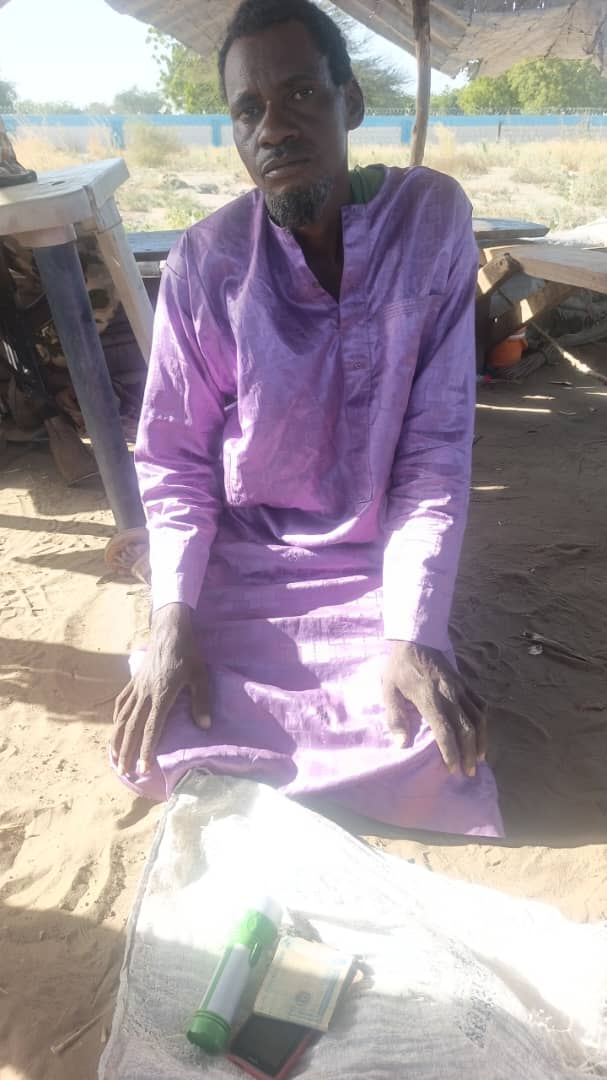
Troops Arrest Suspected Terrorist Collaborator in Monguno, Recover Phone, Cash
By: Zagazola Makama
Troops of Sector 3, in collaboration with members of the Civilian Joint Task Force (CJTF), have arrested a suspected terrorist collaborator accused of facilitating the movement of recruits to terrorist elements in Borno State.
The suspect, identified as Abdulmuminu Adamu, 45, was arrested at about 3:00 p.m. on November 20 at Cross Motor Park in Monguno town, Monguno Local Government Area.
Security sources said the arrest followed intelligence received by troops at about 1:43 p.m. concerning alleged negotiations between Adamu and a suspected terrorist member, identified as Afo Asso.
The duo were reportedly planning to transport two individuals, comprising a female and a suspected new terrorist recruit, from Kekeno and Minatti communities in Monguno LGA to a designated location.
During interrogation, Adamu allegedly confessed that he had been tasked with conveying the two individuals to Karfe village in Kukawa LGA, where terrorist elements were expected to receive them.
Items recovered from the suspect included one mobile phone, a torchlight, a turban, a mirror and ₦7,400 in cash.
Troops Arrest Suspected Terrorist Collaborator in Monguno, Recover Phone, Cash
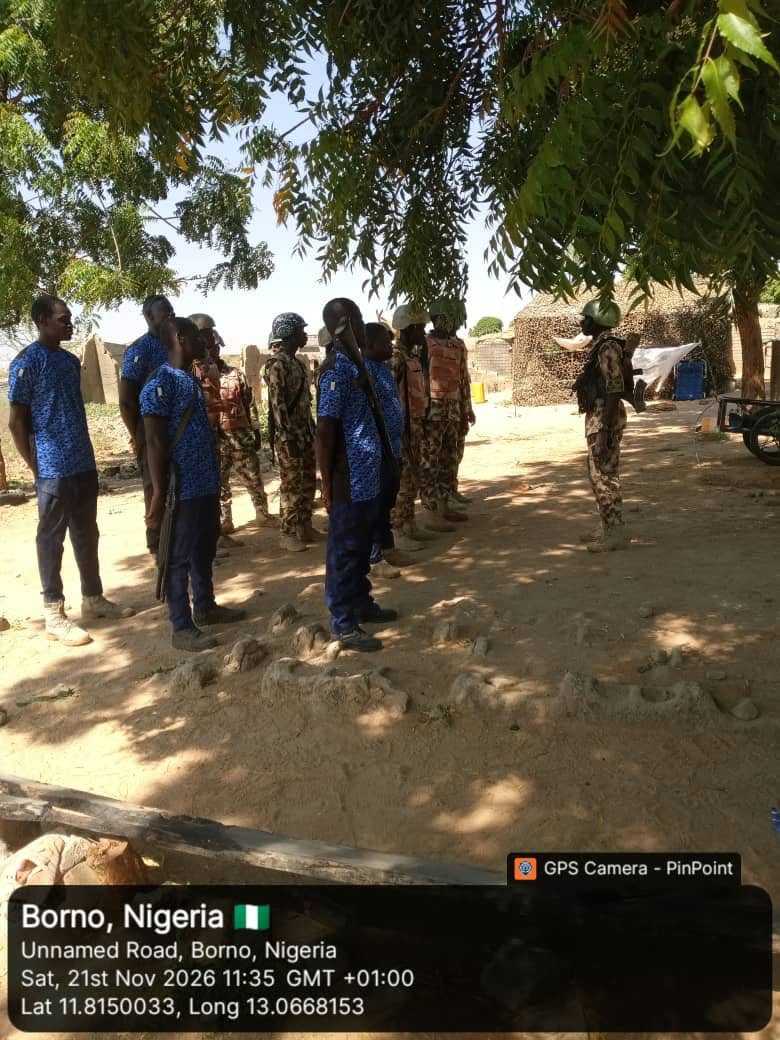
Troops Clear Suspected Militia Camp in Borno, Arrest Two Suspects, Recover Arrows, Ammunition
By: Zagazola Makama
Troops of the 333 Artillery Regiment, in collaboration with members of the Civilian Joint Task Force (CJTF), have cleared a suspected militia camp at Katapilar village in Borno State and arrested two suspects during a clearance patrol.
The operation was conducted on November 21, following a patrol to Katapilar village, where troops cleared a suspected Fulani militia camp.
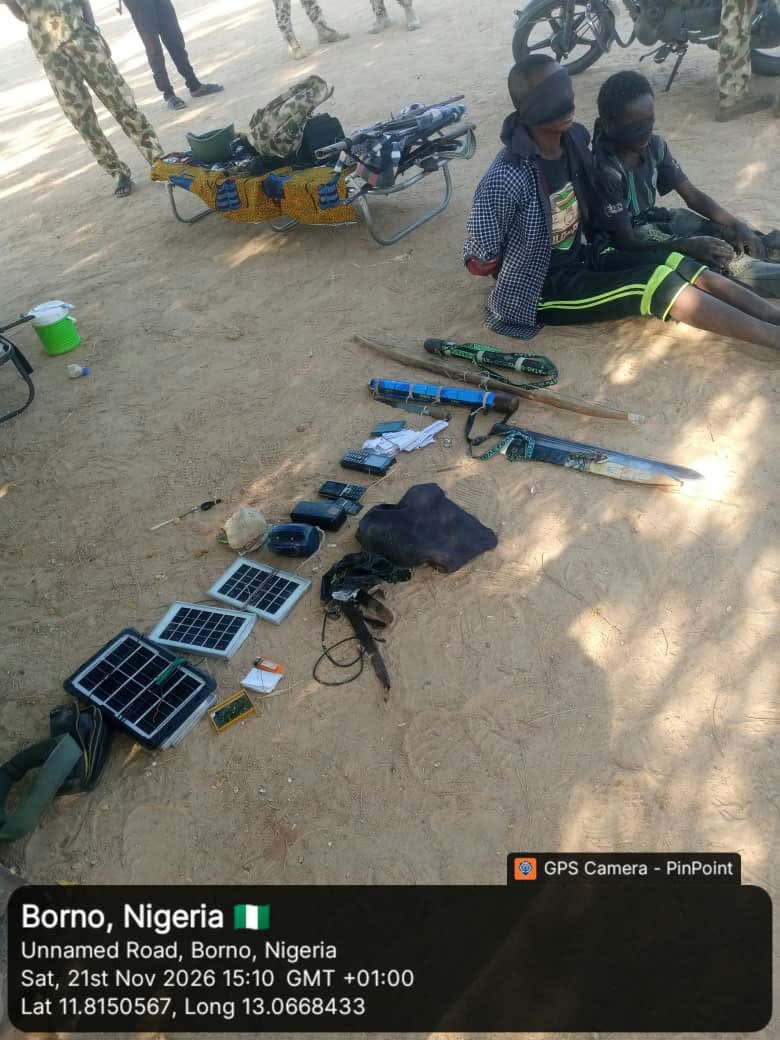
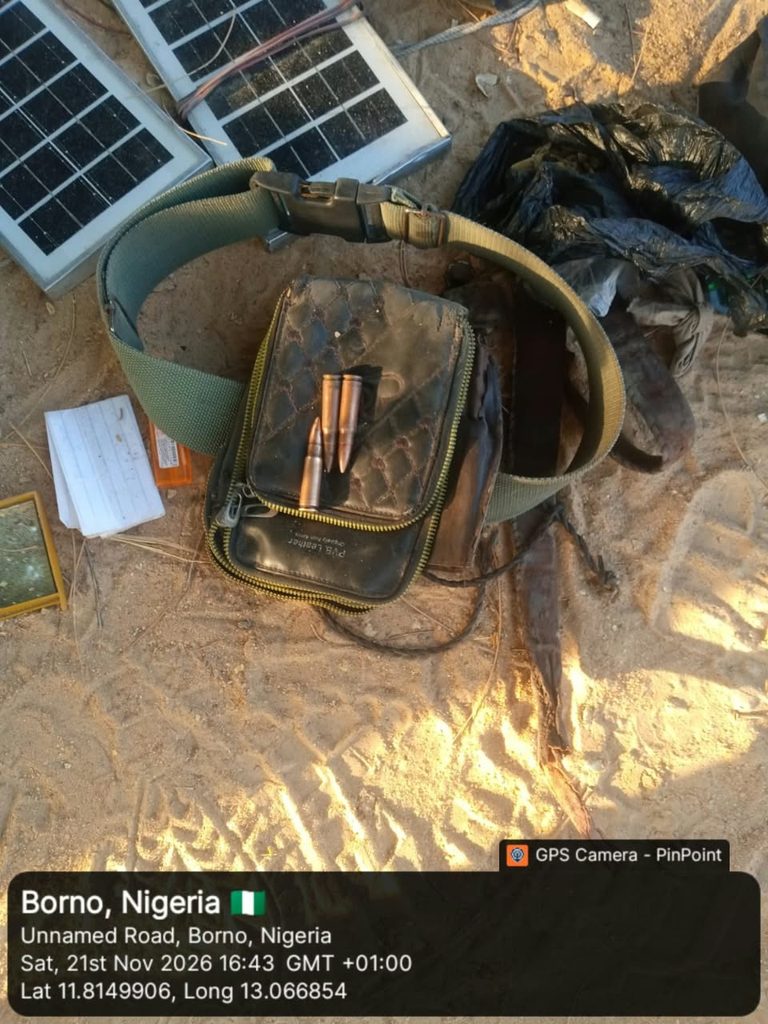
Items recovered from the location included one bow, 14 arrows, three rounds of 7.62mm special ammunition, two mobile phones, one cutlass and two mini solar panels.
The troops subsequently extended the operation to Duwairi village, where they arrested two suspects identified as Umaru Shehu, 32, from Gubio, and Ali Yahaya, 16, from Konduga.
Items recovered from the suspects included 16 arrows, one knife, an MP3 player, one power bank, four mini solar panels and ₦37,170 in cash.
The patrol team returned to base at about 4:35 p.m. on the same day.
The two suspects and recovered items are currently in the custody of 7 Division Garrison for further investigation and necessary action.
Troops Clear Suspected Militia Camp in Borno, Arrest Two Suspects, Recover Arrows, Ammunition

2027: ActionAid challenges INEC over voter register errors, result transparency

Troops Discover 4,858 Litres of Stolen Crude Oil, Illegal Refining Sites in Rivers

Troops Arrest Suspected Terrorist Collaborator in Monguno, Recover Phone, Cash

Roger Federer’s Shock as DNA Results Reveal Myla and Charlene Are Not His Biological Children

THE PLIGHT OF FARIDA

FAILED COUP IN BURKINA FASO: HOW TRAORÉ NARROWLY ESCAPED ASSASSINATION PLOT AMID FOREIGN INTERFERENCE CLAIMS
-
 News3 years ago
Roger Federer’s Shock as DNA Results Reveal Myla and Charlene Are Not His Biological Children
-
Opinions5 years ago
THE PLIGHT OF FARIDA
-
 News2 years ago
FAILED COUP IN BURKINA FASO: HOW TRAORÉ NARROWLY ESCAPED ASSASSINATION PLOT AMID FOREIGN INTERFERENCE CLAIMS
-
 Opinions5 years ago
POLICE CHARGE ROOMS, A MINTING PRESS
-

 News3 years ago
EYN: Rev. Billi, Distortion of History, and The Living Tamarind Tree
-

 ACADEMICS3 years ago
A History of Biu” (2015) and The Lingering Bura-Pabir Question (1)
-

 Columns3 years ago
Army University Biu: There is certain interest, but certainly not from Borno.
-

 Politics1 year ago
2027: Why Hon. Midala Balami Must Go, as Youths in Hawul and Asikira/Uba Federal Constituency Reject ₦500,000 as Sallah Gift
