
News
INEC Proposes Democratic Freedoms Compact to Safeguard 2027 Elections

INEC Proposes Democratic Freedoms Compact to Safeguard 2027 Elections
…NHRC warns of political intimidation, arbitrary arrests, hate speech; EU pledges support for protection of civic space
By: Michael Mike
The Independent National Electoral Commission (INEC) has proposed a Democratic Freedoms Compact to safeguard fundamental human rights, protect civic space and strengthen public confidence ahead of the 2027 general election.
The proposed compact is designed to guarantee freedom of expression, association and political participation, promote inclusiveness, ensure electoral transparency and accountability, and prevent violence, intimidation and other human rights violations throughout the electoral process.
INEC Chairman, Prof. Joash Amupitan, SAN, unveiled the proposal in a keynote address delivered on his behalf by Dr Hassan Umar at the 2026 Civil Society and Human Rights Defenders Forum on the State of Human Rights in Abuja on Wednesday.
The forum, organised by the National Human Rights Commission (NHRC) in collaboration with the European Union (EU), was themed, “Protecting Human Rights in Civic and Political Spaces in the 2027 Elections.”
Amupitan said the credibility of the 2027 elections would be determined not only by the conduct of voting and collation of results but also by the extent to which Nigerians could freely express their opinions, associate, campaign and participate in the political process without fear, discrimination or violence.
He warned that regular elections alone could not sustain democracy if citizens were denied the freedom to express dissenting views, organise, criticise government policies and hold public institutions accountable.
To address these concerns, the INEC chairman said the proposed compact would establish a framework for institutional conduct built around six critical commitments: protection of fundamental freedoms, inclusive participation, transparent elections, accountability for human rights violations, peaceful political competition and constructive engagement among stakeholders.
He called for stronger collaboration among INEC, the NHRC, security agencies, civil society organisations and the media to monitor, document and respond to violations before, during and after the elections.
Amupitan reaffirmed the commission’s commitment to conducting credible elections, ensuring equal treatment of political parties and candidates, strengthening transparency and promoting inclusive participation.
On the contentious issue of electronic transmission of election results, he maintained that the Electoral Act 2026 provided for electronic transmission, while INEC had developed guidelines to address possible technical and communication challenges.
He urged political parties, civil society organisations and other stakeholders to familiarise themselves with the commission’s guidelines and regulations to avoid misinterpretation of the procedures governing result transmission.
The INEC chairman also placed responsibility on security agencies to protect voters, candidates, election officials, observers and journalists, insisting that security personnel must operate professionally and impartially.
He said their presence at polling units and other electoral locations should reassure citizens and create a safe environment for participation rather than generate fear or intimidation.
Earlier, Executive Secretary of the NHRC, Chief Anthony Ojukwu, warned that Nigeria’s democratic space was facing mounting challenges that required urgent intervention as the country approached the 2027 general election.
Ojukwu identified political intimidation, arbitrary arrests, harassment of journalists and human rights defenders, hate speech, restrictions on civic participation and the exclusion of vulnerable groups as threats capable of undermining the credibility of the electoral process.
He said the commission convened the forum at a defining moment in Nigeria’s democratic journey, with the presidential and National Assembly elections scheduled for January 16, 2027, and governorship and State Houses of Assembly elections to follow on February 6.
According to him, the timing was particularly significant because political campaigns were already gathering momentum across the country, making the protection of civic and political freedoms increasingly urgent.
He stressed that democracy was not sustained by elections alone but by the freedom citizens enjoyed between elections to speak without fear, assemble peacefully, associate without obstruction and choose their leaders without intimidation.
Citing Sections 14, 39 and 40 of the 1999 Constitution, as amended, Ojukwu said sovereignty belonged to the Nigerian people, while constitutional guarantees protected freedom of expression, association and peaceful assembly.
He also referenced the African Charter on Human and Peoples’ Rights, which guarantees citizens the right to participate freely in the governance of their country.
The NHRC boss expressed concern that civil society organisations, journalists and human rights defenders continued to operate in an increasingly difficult environment characterised by harassment, arbitrary arrests and the potential misuse of laws, including provisions of the Cybercrimes Act.
He further raised concerns over political and voter intimidation, exclusionary nomination fees that could prevent women, young people and persons with disabilities from contesting elections, hate speech, incitement and the apparent absence of accountability for electoral offences.
Ojukwu warned that failure to prosecute electoral offenders could encourage impunity and embolden perpetrators to undermine the electoral process.
He disclosed that the commission had established a comprehensive human rights monitoring architecture to track political developments and election-related violations as campaigns intensified.
The mechanisms include a Human Rights Situation Dashboard, a human rights advisory and an Election Situation Room designed to monitor intimidation, suppression of political participation, harassment of journalists and other oversight actors, as well as violations of fundamental freedoms.
He said the commission was finalising an advisory on protecting political space and the right to participation in Nigeria, describing it as a flagship contribution to strengthening human rights protection during the forthcoming elections.
The advisory follows earlier interventions by the commission, including its February 2025 advisory on the protection of freedom of expression, which raised concerns about the interpretation and possible misuse of the Cybercrimes Act.
Ojukwu also disclosed that the commission was documenting violations, preparing cases for investigation and engaging INEC, security agencies, the National Peace Committee and other relevant institutions to strengthen accountability.
He said the NHRC’s Election Situation Room would remain operational throughout the electoral period, while election-focused dashboards and bulletins would be published regularly to provide information on human rights developments.
The commission, he added, would deploy monitors to identified hotspots and establish legal aid partnerships to respond to violations during and after the elections.
He announced that the forum would be transformed into a structured platform for sustained engagement between the commission and civil society organisations, with quarterly meetings, early-warning information sharing and rapid-response mechanisms.
According to him, the arrangement would facilitate coordination between the NHRC’s Situation Room and the Civil Society Election Situation Room, strengthen protection for individuals targeted for exercising their rights and ensure that stakeholders are held accountable for their commitments.
He said the forum would also adopt an outcome statement containing recommendations and a roadmap to guide its activities before, during and after the 2027 elections.
Ojukwu urged civil society organisations and human rights defenders to take ownership of the proposed framework, stressing that they were not spectators in the electoral process but essential partners in defending democracy.
He also acknowledged legislative efforts to strengthen the commission’s mandate and improve the legal protection of human rights defenders, expressing optimism that the reforms would create a more enabling environment for their work.
The NHRC executive secretary maintained that election-related violations must attract consequences, warning that the absence of accountability would weaken public confidence and encourage further abuses.
He said: “When elections go without violence, it is because of the work done long before polling day. Work that is sometimes invisible to the public.”
He added that the protection of democracy required collective responsibility and sustained commitment from government institutions, political parties, security agencies, civil society and international partners.
Also speaking, the EU Ambassador and Head of Delegation to Nigeria and ECOWAS, Gautier Mignot, reaffirmed the European Union’s commitment to supporting Nigeria’s democratic institutions and protecting civic and political freedoms ahead of the 2027 general election.
Mignot described the forum’s theme as timely, particularly against the backdrop of reports of election-related violence, hate speech, political intimidation and restrictions on citizens’ fundamental rights.
He warned that such incidents could erode public trust in state institutions and discourage citizens from participating in the electoral process.
The ambassador said free civic and political spaces, including independent media, peaceful assemblies, public forums and civil society organisations, were essential to ensuring credible, transparent and inclusive elections.
According to him, these spaces enable citizens to access information, debate public issues, scrutinise candidates and hold elected leaders and public institutions accountable without fear of censorship or retaliation.
He added that an open civic environment also allowed civil society organisations and active citizens to monitor election administration, track campaign promises and challenge government interference in the democratic process.
Mignot said weakening these safeguards could undermine citizens’ right to meaningful political participation and create opportunities for the suppression of opposition voices and manipulation of democratic rules.
He therefore urged all Nigerian stakeholders, including government institutions, political parties, civil society organisations and the media, to play their respective roles in ensuring a free, fair and credible electoral process.
The EU ambassador disclosed that the partnership with the NHRC had continued since 2024, when the first joint engagement provided a platform for human rights defenders to assess the state of human rights in Nigeria and develop collective responses to challenges confronting them.
He said the second engagement, held as part of activities marking the NHRC’s 30th anniversary, focused on reviewing the country’s human rights record over three decades and identifying emerging challenges requiring sustained intervention.
Mignot described the current forum as a continuation of the strategic partnership, adding that the EU was also preparing a new project with additional funding to deepen its collaboration with the commission.
He pledged that the EU delegation would carefully examine the recommendations and roadmap emerging from the forum and share them with its authorities and member states for further consideration.
He assured Nigeria that the EU and its member states would remain reliable partners in supporting democracy, good governance and the protection of human rights during what he described as a crucial period for the country’s democratic development.
In a goodwill message delivered on behalf of the Chairman of the Inter-Party Advisory Council (IPAC), Alhaji Yusuf Dantale, Prince Chinedu Obi urged political parties and their supporters to embrace issue-based campaigns, political tolerance and responsible communication.
IPAC cautioned against electoral violence, hate speech, voter suppression and political intimidation, stressing that political opponents must be regarded as competitors rather than enemies.
The council also advocated greater inclusion of women, young people and persons with disabilities in the electoral process, while urging security agencies and other relevant institutions to discharge their responsibilities with professionalism and impartiality.
Dantale said public confidence in the electoral system would ultimately depend on whether institutions could guarantee that votes counted and that Nigerians were able to exercise their democratic rights freely.
The forum brought together representatives of government institutions, diplomatic missions, political parties, civil society organisations, the media and human rights groups to assess the state of human rights in Nigeria and develop practical strategies for protecting civic and political freedoms ahead of the 2027 general election.
INEC Proposes Democratic Freedoms Compact to Safeguard 2027 Elections


Nigeria’s Philanthropy Sector Seeks Stronger Domestic Funding, Accountability
By: Michael Mike
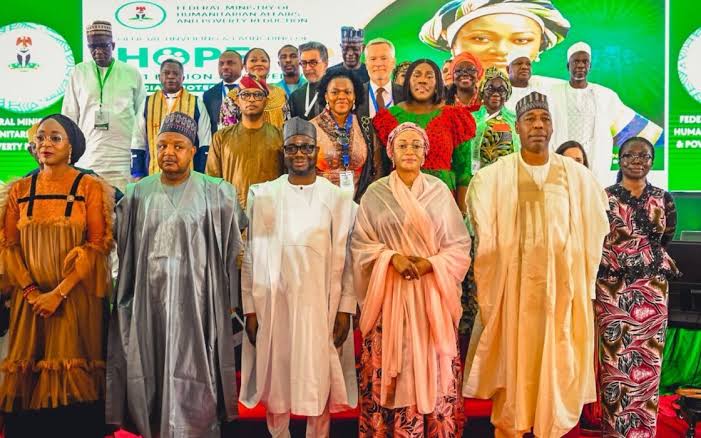
The TY Danjuma Foundation and key stakeholders in Nigeria’s philanthropic and civil society sectors have called for a major overhaul of the country’s philanthropy ecosystem, urging the establishment of an independent Nigerian Philanthropy Forum to mobilise domestic resources, strengthen accountability and reduce dependence on foreign development assistance.
The stakeholders warned that declining international aid, weak institutional coordination, poor financial disclosure and regulatory bottlenecks could undermine development interventions, particularly for vulnerable communities, unless Nigeria builds a stronger homegrown funding system.
The call was made at an ecosystem convening organised by the TY Danjuma Foundation in partnership with the African Philanthropy Forum (APF) and other development partners to explore strategies for strengthening domestic giving, improving the regulatory environment and restoring public confidence in charitable institutions.
Chairman of the Board of Trustees of the TY Danjuma Foundation, Mrs Hannatu Gentles, said the initiative was aimed at transforming Nigeria’s longstanding culture of generosity into a more structured, coordinated and sustainable force for national development.
She observed that although Nigerians were traditionally generous, much of their giving remained informal, limiting the ability to track contributions, coordinate interventions and measure their overall development impact.
Gentles disclosed that the Foundation had commissioned research into structured philanthropy in Nigeria and international best practices in regulating charitable organisations to identify institutional gaps and recommend policies capable of creating an enabling environment for domestic giving.
Presenting findings from the mapping exercise, Executive Director of the Nigeria Network of NGOs, Oluseyi Oyebisi, said Nigeria had no shortage of generosity but lacked the institutional infrastructure, reliable data and accountability mechanisms required to translate private contributions into measurable development outcomes.
He explained that the research was designed to develop a comprehensive database of non-profit organisations and philanthropic funding in Nigeria, particularly against the backdrop of declining international development assistance.
According to him, Nigeria recorded a 10 per cent decline in aid volume and outcomes, while 79 per cent of the country’s development assistance in 2024 came from donors that had subsequently announced funding cuts.
He warned that the emerging funding gap made it imperative for Nigeria to strengthen domestic resource mobilisation and develop alternative financing mechanisms to sustain critical development and humanitarian interventions.
The study also tracked approximately N373 billion in Host Community Development Trust funding across more than 536 projects, highlighting the scale of resources available within the country.
However, Oyebisi identified transparency and financial disclosure as major weaknesses in the sector, revealing that only 1.3 per cent of the organisations captured in the database provided information on their corporate social responsibility expenditure.
He further identified fragmented regulations, overlapping institutional requirements and weak confidence in financial reporting as obstacles to the growth of philanthropy, calling for harmonised policies, improved data management and stronger accountability standards.
On the proposed Nigerian Philanthropy Forum, Executive Director of the African Philanthropy Forum, Mosun Layode, said the country needed an independent institution capable of bringing donors, foundations, civil society organisations and other development actors together around a common agenda.
She stressed that the responsibility for establishing and sustaining the proposed institution must rest with Nigerian stakeholders, rather than APF, although the continental organisation was prepared to provide technical support, resources and pro bono assistance.
According to Layode, the forum must be properly registered, structured and independently managed, rather than remain an informal platform without the institutional capacity to sustain its operations.
She urged Nigerian donors and foundations to identify credible leadership and mobilise the initial financial resources required to establish the institution, with the long-term objective of building a financially sustainable organisation with its own office and independent operations.
Layode explained that APF was established as a continental institution and could not permanently serve as a substitute for a national platform, particularly as its leadership and institutional priorities would evolve over time.
Citing TrustAfrica as an example of an institution that grew beyond its initial support from the Ford Foundation, she challenged Nigerian philanthropists to invest in building an enduring institution that future generations would be proud of.
Also presenting findings from a comparative study of philanthropic systems in the United States, the United Kingdom and South Africa, Dr Ebrima Sall highlighted lessons Nigeria could adopt to strengthen its legal, regulatory and institutional frameworks.
He emphasised the need for clear legislation, effective collaboration, institutional capacity and accessible accountability mechanisms, citing the United Kingdom’s Charity Commission as an example of how public access to information can help donors assess the credibility of charitable organisations before making contributions.
Similarly, Co-founder of IdeaPlus Consultant, Dayo Olaide, called for stronger government engagement with foundations and civil society organisations, arguing that philanthropic institutions possess significant financial resources and influence that could be better harnessed for national development.
Olaide advocated the establishment of a proposed $300 million accelerator fund over three years to support interventions addressing neglected tropical diseases.
He also raised concerns over the tax burden on non-profit organisations, particularly building taxes, warning that excessive fiscal obligations could constrain their capacity to deliver social and development programmes.
In her closing remarks, Gentles reaffirmed the TY Danjuma Foundation’s commitment to advancing philanthropy in Nigeria, insisting that stronger institutional coordination, transparency and an enabling regulatory environment were essential to making domestic giving more strategic and impactful.
Quoting the Foundation’s founder and Chairman Emeritus, she said, “No one is too poor to give,” stressing that philanthropy should not be limited to financial contributions but could also take the form of assets, time, intellectual capacity and other resources that benefit society.
The stakeholders agreed that Nigeria’s transition towards a stronger domestic philanthropy system would require more than goodwill, calling for sustainable institutions, greater financial commitment from local donors, improved transparency and collective action.
They maintained that strengthening domestic philanthropy would not only help cushion the impact of declining foreign aid but also give Nigerians greater ownership of development priorities and the resources deployed to address the country’s social and economic challenges.
Nigeria’s Philanthropy Sector Seeks Stronger Domestic Funding, Accountability
Faces Behind the Figures: Nigerians Lost in Russia’s War
By Oumarou Sanou
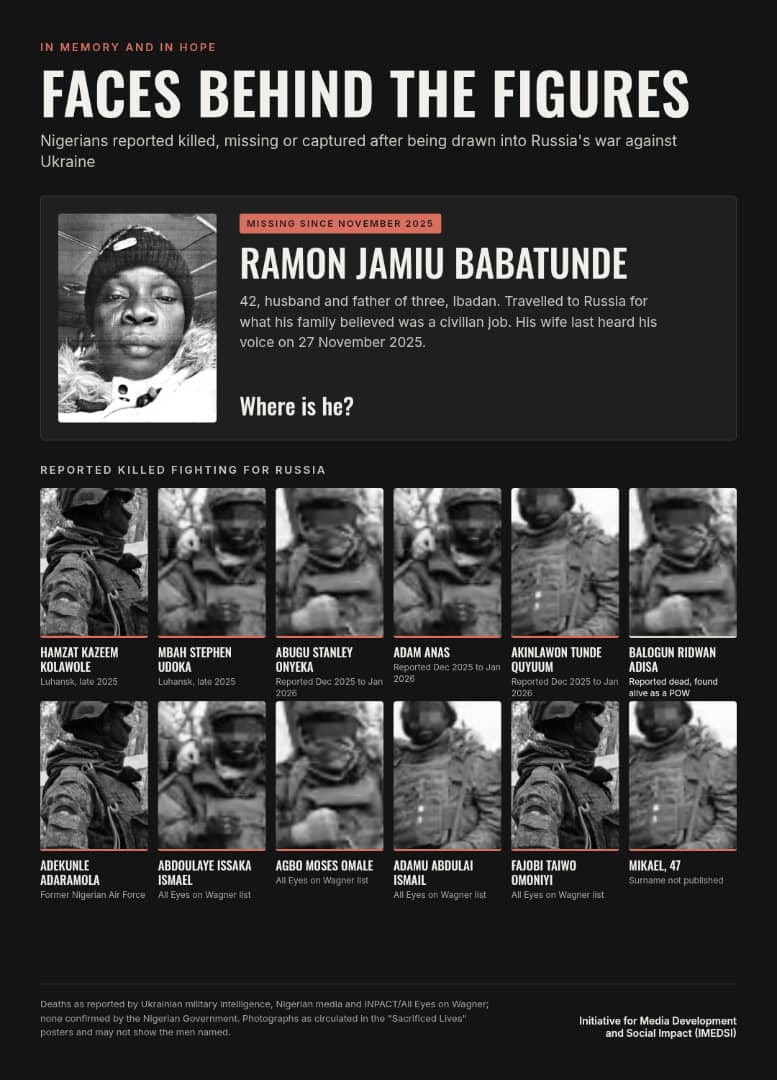
“Forgive your son.” Those were the words Balogun Ridwan Adisa chose for President Bola Tinubu when the Ukrainian outlet UNITED24 Media interviewed him while he was in captivity earlier this year. He is 32. He says he left Nigeria to feed his family and find work as a mechanic or engineer. He ended up in a Russian uniform near Lyman, in Ukraine’s Donetsk region, and surrendered to Ukrainian troops on 13 January 2026.
By then, Nigeria had already counted him among the dead. On 4 February, his name appeared in the press among four Nigerians said to have died fighting for Russia. The source was neither a Russian notification nor a Nigerian consular report, but a WhatsApp group run by African fighters. Adisa was alive. Nobody in authority had checked.
That single error captures how Nigeria is handling one of the quietest tragedies of our time. Our citizens are being lured into a war that is not theirs, and when they die, or are reported dead, the news reaches their families through messaging groups and foreign intelligence briefings rather than through their own government.
Moscow has denied wrongdoing at every turn. Yet on 10 September, Amnesty International concluded that Russia’s recruitment of foreigners in many cases amounts to human trafficking, documenting false job offers, contracts recruits could not read and deployment to the front after as little as two weeks of training.
The numbers are stark. The investigative collective INPACT/All Eyes on Wagner has documented 1,417 Africans from 35 countries recruited between 2023 and mid-2025, at least 316 of them killed. Ukrainian military intelligence, itself a party to the conflict, says at least 215 Nigerians had signed Russian contracts by May, with 25 dead or missing. Yet the greater danger is that, as the figures rise, the people behind them vanish from view. It is time to put faces to the names.
In his interview, Adisa says he arrived at a military base expecting work in his trade. Asked to sign a contract in Russian, he was refused a phone to translate it. “I did not know they were going to use me,” he says. Sixteen days of training later, he was at the front. A prisoner’s account to a Ukrainian-affiliated outlet deserves scrutiny, but his appearance alive settles one thing: the report of his death was wrong.
That matters for others on the same list. According to a Daily Nigerian investigation, Abugu Stanley Onyeka and Akinlawon Tunde Quyuum left Nigeria in November 2025 with Adam Anas and others, recruited for security jobs paying 200,000 roubles a month. The group reportedly travelled on tourist visas, signed papers in Russian without translation and were sent to the front after three weeks of training. Within three months, their names were on the same WhatsApp death list that wrongly carried Adisa’s. We do not even know with certainty whether they are dead. That uncertainty is itself an indictment.
Then there is Ramon Jamiu Babatunde, a 42-year-old father of three from Ibadan who, his family says, went to Russia for civilian work. Documents seen by the Initiative for Media Development and Social Impact (IMEDSI) show he entered on a tourist visa and that, within two weeks, a form bearing his name recorded his “voluntary” enlistment in a Russian assault unit. The same form warns that anyone who refuses will be detained, deported, banned from Russia, and made to repay the airfare. His wife, Mrs Adewunmi Suliat Ramon, last heard his voice on 27 November 2025 and petitioned the Ministry of Foreign Affairs in May. His one-year contract expired last month. He has not come home, and three children still do not know whether their father is alive.
Others have been named: Hamzat Kazeem Kolawole and Mbah Stephen Udoka, whose bodies Ukrainian intelligence said it recovered in Luhansk; Ayebusiwa Olabode Victor of Ondo State, reported killed near Kharkiv in May; Fajobi Taiwo Omoniyi, Agbo Moses Omale and others listed by All Eyes on Wagner. Memorial posters bearing some of these names now circulate online. Adisa’s case is a warning that such images cannot by themselves establish who has died. Families deserve certainty, not assumptions presented as fact.
This is why the silence of last month’s Russia-Africa Summit in Moscow is so disappointing. Ahead of the 28 to 29 October gathering, Amnesty International’s directors across Africa urged leaders to raise the trafficking of their citizens directly with the Kremlin. Kenya’s President William Ruto asked Moscow for help repatriating Kenyan recruits; Vladimir Putin offered no public answer. The summit drew 22 African heads of state, roughly half the number in 2019. For the Africans dying in Ukraine, there was no public commitment. Moscow did, however, find room for a Russia-Africa Media Forum that drew more than 200 participants from 46 African countries.
Other governments have shown what is possible. Kenya secured an undertaking from Moscow in March to stop enlisting its citizens and has brought more than 50 home. Ghana’s foreign minister confronted Sergei Lavrov in August over 62 Ghanaian deaths. Nigeria’s Ministry of Foreign Affairs issued a warning in February, and it has largely stopped.
Nigeria must do more. It should demand from Moscow a full list of Nigerians under contract, captured, missing or dead, and inform every family before social media does. It should work with Kyiv and the International Committee of the Red Cross to identify Nigerians held as prisoners of war, Adisa among them, and bring them home. NAPTIP and the police must pursue the agents behind these schemes and treat those deceived as victims of trafficking, not mercenaries who chose their fate. And Abuja, with the African Union and ECOWAS, should seek for every African state the no-recruitment undertaking Kenya obtained.
None of this is about choosing between Moscow and Kyiv. Strategic autonomy must never be used as an excuse to ignore the exploitation of our citizens, and public diplomacy is no substitute for consular access and accountability.
Ridwan Adisa asked his president for forgiveness. He is not the one who should be apologising. For Mrs Ramon and her children, the question remains painfully simple: where is their husband and father? Until it is answered, Africa’s diplomatic silence will be hard to justify, and African lives will remain cheap currency in other people’s wars.
Oumarou Sanou is a social critic, Pan-African observer and researcher focusing on governance, security and political transitions in the Sahel. He writes on geopolitics, regional stability and African leadership. Contact: sanououmarou386@gmail.com
Faces Behind the Figures: Nigerians Lost in Russia’s War
EFCC PETITIONED OVER N2.5M GTBANK FRAUD, UNAUTHORISED N138,000 LOAN
By: Michael Mike
A customer of Guaranty Trust Bank (GTBank), Mrs Stella Adepegba, has petitioned the Economic and Financial Crimes Commission (EFCC) over alleged fraudulent withdrawals of N2.587 million from two bank accounts belonging to her family, as well as an unauthorised N138,000 loan allegedly taken in her name.
The petitioner, Mr Adelani Adepegba, who filed the complaint on behalf of his wife and daughter, called on the anti-graft agency to investigate suspected insider collusion, alleged compromise of the bank’s security infrastructure and possible breaches of customers’ confidential banking information.
In the petition addressed to the EFCC Chairman at the commission’s headquarters in Jabi, Abuja, Adepegba alleged that the two accounts, both domiciled with GTBank, were compromised within 24 days through similar transaction channels.
According to him, his daughter’s Child Saver’s Account was allegedly accessed by fraudsters on October 8, 2026, at about 8 p.m., resulting in the unauthorised transfer of funds totalling N2.5 million through the bank’s Nigeria Inter-Bank Settlement System instant payment (NIP) channel.
He said three transfers of N399,000, N398,000 and N220,000 were made to a Moniepoint account belonging to one Abdulmalik Idris, while another N1.49 million was transferred to a Gomoney account operated by one Zainab Ibrahim.
The petitioner alleged that his wife, who operates the child’s account, received no transaction alerts and only became aware of the withdrawals after a GTBank staff member, identified as Boluwatife Akinwunmi, alerted her and offered to block the account.
By the time the intervention was initiated, however, the account had allegedly been emptied, leaving a balance of less than N2,000.
Adepegba said the incident was reported at a GTBank branch in Kubwa, Abuja, on October 9, where his wife was asked to document the complaint.
He, however, alleged that the bank subsequently responded by email, attributing the transactions to the use of his wife’s login credentials.
The petitioner said the incident was followed by another suspected breach on November 1, when N80,000 was allegedly transferred from his wife’s personal account to a FairMoney account belonging to one Jamilu Ahmad.
He put the combined withdrawals from the two accounts at N2.587 million.
Raising concerns over the circumstances surrounding the transactions, Adepegba insisted that his wife had physical possession of her mobile phone, SIM card and ATM card at their residence in Kubwa, Abuja, when the alleged fraud occurred.
He further maintained that she neither received any One-Time Password (OTP) prompt nor disclosed her PIN, password or USSD credentials to anyone. He also denied that she clicked on phishing links or authorised a SIM swap.
According to him, the circumstances raised serious questions about the bank’s security controls and the possibility of unauthorised access to customers’ banking information.
The complaint also alleged that the financial losses may have been compounded by further unauthorised deductions from his wife’s account.
Adepegba said N24,000 was deducted by the bank two days before the petition, and that when his wife visited the bank for clarification, she was informed that the money represented repayment for a N138,000 loan allegedly obtained by the fraudsters through her account.
He added that a further N19,000 allegedly stolen from the account had also been discovered, bringing additional concerns about the extent of the suspected compromise.
The petitioner faulted GTBank’s handling of the incidents, questioning how two accounts linked through family relationships, BVN details and telephone contacts could have been targeted within 24 days without effective security intervention.
He identified the repeated targeting of related accounts, alleged circumvention of two-factor authentication, transfers to the same beneficiary channels and the reported breach of the account despite a PIN reset after the first incident as grounds for suspecting possible insider involvement.
He urged the EFCC to investigate the incidents, trace and recover the allegedly stolen funds and conduct a forensic examination of GTBank’s staff and systems to establish whether customer information was leaked or security protocols were compromised.
Specifically, he asked the commission to compel GTBank to provide complete transaction logs, internet protocol (IP) addresses, device identification records and NIP transaction trace records relating to the disputed transfers.
He also called on the EFCC to direct Moniepoint, Gomoney and FairMoney Microfinance Bank to provide the full Know Your Customer (KYC) details of the beneficiaries and place the identified accounts under appropriate restrictions pending the outcome of investigations.
The petitioner maintained that the investigation should establish how the transactions were initiated, the devices and channels used, the identities of those behind them and whether any bank employee or external actor facilitated the alleged fraud.
As of the time of filing this report, the petitioner’s allegations had not been independently established, and there was no response from GTBank or the other financial institutions named in the complaint.
EFCC PETITIONED OVER N2.5M GTBANK FRAUD, UNAUTHORISED N138,000 LOAN

PCC Commissioner Applauds Buba’s Leadership, Commends UMTH’s Positive Transformation

UMTH, PCC Strengthen Ties to Improve Service Delivery and Protect Public Rights

Nigeria’s Philanthropy Sector Seeks Stronger Domestic Funding, Accountability

Roger Federer’s Shock as DNA Results Reveal Myla and Charlene Are Not His Biological Children

THE PLIGHT OF FARIDA

FAILED COUP IN BURKINA FASO: HOW TRAORÉ NARROWLY ESCAPED ASSASSINATION PLOT AMID FOREIGN INTERFERENCE CLAIMS
-
 News3 years ago
Roger Federer’s Shock as DNA Results Reveal Myla and Charlene Are Not His Biological Children
-
Opinions5 years ago
THE PLIGHT OF FARIDA
-
 News2 years ago
FAILED COUP IN BURKINA FASO: HOW TRAORÉ NARROWLY ESCAPED ASSASSINATION PLOT AMID FOREIGN INTERFERENCE CLAIMS
-
 Opinions5 years ago
POLICE CHARGE ROOMS, A MINTING PRESS
-

 News3 years ago
EYN: Rev. Billi, Distortion of History, and The Living Tamarind Tree
-

 ACADEMICS3 years ago
A History of Biu” (2015) and The Lingering Bura-Pabir Question (1)
-

 Columns3 years ago
Army University Biu: There is certain interest, but certainly not from Borno.
-

 Politics1 year ago
2027: Why Hon. Midala Balami Must Go, as Youths in Hawul and Asikira/Uba Federal Constituency Reject ₦500,000 as Sallah Gift
