
Columns
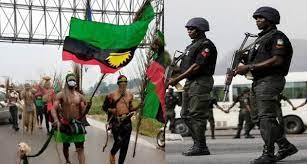
IPOB, Military And Breath Of Fresh Air In South-East

IPOB, Military And Breath Of Fresh Air In South-East
By: Zagazola Makama
The sustained massive descent of the military on insecurity in the South-East region in recent weeks has not just brought a breath of fresh air to the terrorized Nigeria’s most-commercially-vibrant region but also delivered joyful tidings to its peoples that the ‘dreadful’ terror group tormenting them, IPOB, can be banished to the pages of history anytime, any day.
IPOB has, over the last couple of years, not only suffocated a significant section of the region’s economic activities, especially with the most devastating and unacceptable restrictions on commercial activities, but threatened its political stability as an integral component of Nigeria.
The activities of the group showed frightful signs of shaking the foundations of the country’s nation-statehood. Our nation-statehood as Nigeria has to be maintained, considering the emerging global political and economic realities.
Practically, the activities of the criminal IPOB has been unacceptably restructuring and redirecting the five-state region towards a state-within-a-state arrangement between it and the Nigerian nation, priming the region for possible cessation.
The military, therefore, with its strategic increase in deployments if troops, launched its Operation Golden Dawn. Strategically scaling up and fine-tuning the operation, the military has accurately and sharply swooped at all forms terror unleashed by IPOB on the region with every needed decisiveness and finesse.
In a dispassionate assessment, every southeasterner, who no more cowers at the threat of any IPOB militia to not only his or her commercial activities but even his or her life, now jubilantly talks of seeing light at the end of the tunnel with regard to the end of terror and related criminality.
READ ALSO: https://dailypost.ng/2022/11/17/how-soldier-ran-amok-gunned-down-humanitarian-worker-two-colleagues-in-borno-eyewitness/
The flurry of fake news planted by IPOB, with which the social media is currently awash, are depressing signs of an anguishing, languishing and dying group not only suffering humiliating defeat but getting wiped out fast for the South-East to continue breathing fresh air economically and politically as a critical component of a proud and prosperous Nigeria.
For instance, IPOB has fabricated the fake news going viral in the social media that officers of Operation Golden Dawn have constituted a part of insecurity in Enugu by turning a blind eye on the activities of ‘Jihadist Fulani Herdsmen,’ arguing that Enugu State is no longer in the Hands of God.
This fake news precipitated unfortunate comments from southeasterners who are either truly ignorant or chose to be so on the mischiefs terror groups deploy to deceive people about the actual state of their strength and existence.
Lies, since time immemorial, have constituted one of the most-potent weapons of psychological war. And IPOB is deploy this weapon through the social media.
The group has conjured up the news that herdsmen killings in the South-East are organized by Nigeria government through the region’s state governors, troops and the police.
To every dispassionate southeasterner, this is everything but the truth.
The truth is troops of the Nigerian military are practically seen patrolling all the nooks and crannies of all the five hitherto IPOB-infested states day and night to pull them out of the depth of terror and all other related crimes into which they had been sinking fast.
Uncountable families across the region had lost loved ones and properties, especially in the ember months when criminals unleash terror in various forms.
In a dispassionate observation, the Operation Golden Dawn is fast restoring the golden joy of the ember months with southesterners now joining their fellow Nigerians in arrangements for a joyful Christmas, a satisfying stocktaking of the outgoing year and plans for a prosperous new year.
To every sane and well-wishing southeasterner, the viral take news all over the social media that troops of the Nigerian military are aiding terrorists is a conspiracy by criminal-minded Nigerians who have sworn to ensure that no section of the country enjoys any peace.
Their scheming towards the apocalypse of Nigeria seems ending in jeopardy considering the successes of the military in the war against insecurity and all forms of criminality designed against the country.
With the troops sustaining the tempo of their successful operations in the South-East, the more IPOB and all other criminal elements plan against the region as a critical component of a prosperous Nigeria, the faster their evil plans come to naught; and the deeper they sink into eternal frustration.
Thus, the more the South-East breathes fresh air.
***Zagazola Makama is a Counter Insurgency Expert and Security Analyst in the Lake Chad
IPOB, Military And Breath Of Fresh Air In South-East




Dadong: A Balanced Voice From Ungwan Rukuba
By: Balami Lazarus
What does it take to be a public mouthpiece? That was the question I asked Comrade Dadong Solomon Antibas. My chats with him were a balanced interface. The answers can be found in the write-up for your review.
Democracy like ours has brought to the limelight public mouthpiece voices; some are weak and political, while others are strong, progressive, constructive, and fearless, demanding progress, growth, and development as dividends of good governance in a peaceful atmosphere.
Governments created by democratic processes are never left alone without citizens asking questions and demanding dividends of democracy for their community and the country at large.
Comrade Dadong Solomon Antibas is a Nigerian, law-abiding citizen. Antibas, a security expert and popular public mouthpiece on the Jos Plateau, has earned the confidence of the people of his community, Ungwan Rukuba, and most parts of the state over the years. For his community, he is their immediate mouthpiece who has been speaking on their plights, calling the attention of the government under the leadership of Governor Caleb Manasseh Mutfwang to do the needful.
Personality like Solomon Antibas’ public impression of him by some citizens of the state is all about seeking relevance and political appointments. “I have no interest whatsoever in any political appointment. My sincere concern for my dear country and my state, Plateau, is peace, progress, growth, and development for future generations.”
Nigerians should begin to speak out on good governance at all levels. Citizens are also responsible for failing to hold them accountable and demand good governance in terms of security, social amenities, and infrastructure.
Ungwan Rukuba is one of the wards in the Jos North Local Government Area. It is an integral part of the city center. Unfortunately, the peaceful Ungwan Rukuba became a flashpoint. The terrorist attack of March 29th, 2026, has put a scar of insecurity on the area.
On insecurity, he said that Mr. President Ahmed Bola Tinubu has failed Nigerians woefully. “Insecurity is a bone of contention. The federal government must take decisive measures on the insecurity challenges bedeviling the nation.”
My findings on Comrade Dadong Antibas revealed that he is not a public affairs commentator or an analyst but a progressive and active public mouthpiece, a voice of the voiceless.
For some, Dadong is attacking the government under the leadership of Governor Mutfwang. ” Is speaking the minds of citizens on bad governance and holding the government of Governor Caleb Manasseh Mutfwang a crime”?
Despite threats on Solomon Dadong, they have not deterred him from speaking for and on behalf of other citizens living in the state. “I have no other way to hold the government accountable than to publicly speak and constructively criticize the leadership’s voicing out feelings and lots of the people…In democracy, governments are made by the people, and as such, they must provide for the collective needs of the masses who voted them in.”
Comrade Antibas is one among the few indigenous people of Plateau who are outspoken and speak with passion and a patriotic mind for his state and Nigeria. “I will live and die in Nigeria speaking, advocating, demanding, and/or holding both federal and state governments accountable for good governance.”
Balami, Publisher/Columnist, 08036779290
Dadong: A Balanced Voice From Ungwan Rukuba
Facts for Understanding Capital Market Investment
By: Balami Lazarus
I grew up in an academic environment where the language is the same: study well, have good grades and be what you desire to be in the future through academic discipline and training.
Many of my contemporaries and I were not spoken to in the language of trade and commerce. But here are some of us as businessmen, entrepreneurs, investors and in other business enterprises far from the academic language we were bred with.
There has never been a market like the capital market the world over where trade per day runs into billions of cash. While market capitalisation is in trillions. The case of the Nigerian Stock Exchange (NSE), now Nigerian Exchange Group, with its trade symbol (NGX) on the floor, is a good example.
Investing in the capital market is profitable for traders and short- and long-term investors. But understanding the market requires some basic facts, which are cash, knowledge, discipline and patience, important for investors to appreciate the market.
Recently a member of my social group came to me to seek my advice on what it takes to invest in the equity market (stock exchange). I was very candid with the fellow, informing him that he needs cash, knowledge, discipline and patience to invest in the capital market after having defined his position as an investor.
First an investor needs cash in his possession set aside to invest in the capital market, the gateway into the market. You can have the other three, but without cash you are not yet an investor.
Lack of knowledge about a business or investments has made so many persons lose money worth millions.
This is typical with good number of Nigerians who attempted to start a business or invest in some going concerns without basic knowledge and understanding of the intricacies of these investments or businesses.
The information and technology age has
made acquiring knowledge very simple; therefore, understanding the stock market is easy these days.
Basically, the capital market depends on and responds to information, government policies, and economic and political happenings/events within and without, which most often determines the graphic movements of the primary market deals on the floor. ‘Bullish’ or ‘bearish’ simply means the plus or minus of the day’s transactions.
The need for monitoring of the market is important for traders and short-term investors. However, with knowledge and careful monitoring of the market, it is a suitable place for short-term gains for investors with multiple numbers of holdings in blue-chip companies like Dangote Cement, Bau Foods, Nestle, Aradel, Okumu Oil Palm, Zenith Bank, Guaranty Trust Bank and others. But for long-term investors, whether the market is bullish or bearish, his investment portfolio is for future use.
Investments like those of the capital market, discipline and being committed are necessary to build a strong, high-quality, profitable portfolio of a large number of holdings of units spread over listed companies of the stock exchange that come with capital appreciation and dividends. This is important, especially for long-term investors.
And the turn key in this type of investment is patience. Generally investments need patience for them to mature for harvest.
In stock market investment, patience plays a vital role in this business. Therefore, for an investor who lacks patience, the capital market is not a tuft for him and shall never be.
To navigate through this market, investors must at all times apply this formula and have it printed on their hearts. Cash = stock units over time + patience = capital apreciation/dividends.
Today there are changes in the exchange which have improved trading. The time of trade has been extended to transactions and payments (T+1). Other electronic applications to aid and encourage investors in the capital market in an attempt to boost the Nigerian economy.
Balami, Publisher/ Columnist 08036779290
Facts for Understanding Capital Market Investment
The ‘Hyenas’ and The Fear of Radical Changes
By: Balami Lazarus
Nigeria’s persistent security challenges, governance shortcomings, and societal stagnation were discoursed in a recent controversial work titled “Radical Approach: Ways of Ending the Menace of Insecurity in Nigeria,” which has sparked vehement reactions. These responses, saturated with insults and threats, underscore not only the resistance to transformative ideas but also reveal deeper cultural and psychological barriers inhibiting national progress.
Hyenas occupy a complex place symbolically and ecologically. Known for their powerful jaws capable of crushing bone and their fearsome appearance, hyenas possess attributes of strength and resilience. Ironically, the very qualities that should have crowned them kings of the jungle remain unrealized due to internal flaws—excessive fear and greed. This metaphor resonates profoundly with the Nigerian socio-political landscape. Many citizens and leaders embody these counterproductive traits, which sabotage collective progress. The ‘hyenas’ here are those resistant individuals who react aggressively to change, fearful of losing entrenched privileges or comfortable mediocrity.
Despite their natural capacities, hyenas do not kill their prey outright but feed until the victim is entirely consumed, a parallel to how corruption, insecurity, and dysfunctional governance gradually erode Nigeria’s potential. Nevertheless, because of this fear and greed, the true power of the hyenas remains dormant. Similarly, Nigerians possess enormous potential—humans and resources alike—but systemic fear of radical transformation prevents the nation from ascending to greatness.
Resistance to radical change is hardly unique to Nigeria; however, the scale and intensity of opposition here are particularly pronounced. The author of the initial work rightly posits that fundamental restructuring or amicable separation (balkanization) may be necessary to ensure peaceful coexistence among Nigeria’s diverse ethnic and regional groups. While this proposition unsettles many, it is grounded in historical precedents where developing nations embraced bold reforms, coupled with decisive policies and enforcement mechanisms, to dismantle corruption and oppression effectively.
For example, South Korea’s transformative journey from a war-ravaged country to a technological powerhouse was marked by radical government-led reforms, strict anti-corruption measures, and an unyielding commitment to national goals. Similarly, post-apartheid South Africa undertook sweeping constitutional and institutional reforms to redress systemic inequalities. These examples suggest that change without fear, and with a clear vision, is achievable. In Nigeria’s case, however, political leaders often prioritize personal gain over national interest, shielding corrupt practices from scrutiny and accountability—a scenario that foreign nationals sometimes benefit from more than average Nigerians.
Hence, it is not just a question of reform but an urgent call for a radical overhaul of the political, economic, and security frameworks—an overhaul that will inevitably provoke discomfort among the ‘hyenas’ who thrive on the status quo. Their hostility reflects a deeper anxiety about losing undue influence rather than genuine concern for national welfare.
Those who dare to voice radical solutions face fierce backlash. The insults, threats, and online harassment directed at the author of “Radical Approach” epitomize the perils confronting reformists. Such antagonism stems from a culture where free expression is often conflated with subversion and where critical voices are silenced through intimidation rather than engaged with constructively. This atmosphere breeds cynicism and self-censorship, retarding public discourse essential for democracy and progress.
The paradox lies in the fact that while politicians and vested interests propagate falsehoods to maintain their grip, genuine advocates of change are vilified. This creates a toxic environment where truth-tellers face social ostracism, leaving the masses bewildered about whom to trust. The condemnation of the author’s suggestion to either restructure or separate the country illustrates how deeply sensitive and contested the issue of national unity is—yet it also reveals the urgency to address unresolved grievances before they escalate into greater conflict.
It is crucial to emphasize that opinions, especially those anchored in personal conviction and aimed at national betterment, deserve respect and consideration, even if controversial. Democratic societies thrive on diverse viewpoints and vigorous debate. The author’s claim to persist as a ‘honey badger’—an animal known for fearless tenacity—symbolizes the courage required to confront entrenched systems and societal fears.
Change is seldom comfortable; it disrupts established norms and compels individuals to rethink identities and power structures. But without this discomfort, stagnation ensues, and nations risk eventual decline or disintegration. In Nigeria’s context, the failure to act decisively invites greater insecurity, economic hardship, and social unrest, ultimately threatening the very fabric of the nation.
To overcome the paralysis induced by fear and entrenched interests, Nigerians must collectively embrace the concept of radical but non-violent reform. The analogy of hyenas vividly encapsulates the paradox of strength hindered by fear and selfishness—a situation familiar to Nigeria today. The vehement backlash against radical proposals for restructuring or separation signals a collective unease but also highlights the necessity for bold action. History teaches us that radical change, enforced with fairness and resolve, is often the catalyst for national rebirth.
Nigeria stands at a crossroads. Will it continue to be prey to internal fears and greed, or will it muster the courage to embrace transformative ideas, no matter how uncomfortable they may seem? Advocates like the author of “Radical Approach” bear the burden and honor of challenging the status quo. Their persistence embodies hope that someday, rationality and justice will prevail over hostility and inertia.
In this pursuit, Nigerians must shed the fearful mindset that binds them and instead harness their inherent strengths—diversity, resilience, and youthful energy—to reclaim their destiny. Only then can the nation finally silence the cacophony of ‘hyenas’ and evolve into a stable, prosperous democracy worthy of its vast potential.
Balami, Publisher/Columnist 08036779290
The ‘Hyenas’ and The Fear of Radical Changes

Zulum moves to resettle Konduga IDPs in four months

My Binoculars: What has Remi Tinubu got to do with Akara, Kulikuli, Boli, Dodo and Ekpa

Zulum Announces Closure of Konduga IDP Camp as Borno Accelerates Resettlement Drive

Roger Federer’s Shock as DNA Results Reveal Myla and Charlene Are Not His Biological Children

THE PLIGHT OF FARIDA

FAILED COUP IN BURKINA FASO: HOW TRAORÉ NARROWLY ESCAPED ASSASSINATION PLOT AMID FOREIGN INTERFERENCE CLAIMS
-
 News2 years ago
Roger Federer’s Shock as DNA Results Reveal Myla and Charlene Are Not His Biological Children
-
Opinions4 years ago
THE PLIGHT OF FARIDA
-
 News1 year ago
FAILED COUP IN BURKINA FASO: HOW TRAORÉ NARROWLY ESCAPED ASSASSINATION PLOT AMID FOREIGN INTERFERENCE CLAIMS
-

 News2 years ago
EYN: Rev. Billi, Distortion of History, and The Living Tamarind Tree
-
 Opinions5 years ago
POLICE CHARGE ROOMS, A MINTING PRESS
-

 ACADEMICS2 years ago
A History of Biu” (2015) and The Lingering Bura-Pabir Question (1)
-

 Columns2 years ago
Army University Biu: There is certain interest, but certainly not from Borno.
-

 Politics1 year ago
2027: Why Hon. Midala Balami Must Go, as Youths in Hawul and Asikira/Uba Federal Constituency Reject ₦500,000 as Sallah Gift
