
News
KACRAN Commends NEDC on Contributions Towards Prosperity of North East


KACRAN Commends NEDC on Contributions Towards Prosperity of North East
By: Michael Mike
The Kulen Allah Cattle Rearers Association of Nigeria (KACRAN) has acknowledged the North East Development Commission (NEDC) as a pivotal force for progress and prosperity in the Northeast region.
KACRAN noted that since its inception, the NEDC has operated under the stewardship of distinguished leadership, with a singular focus on driving the Commission’s success, insisting that it has put out unprecedented contributions towards augmenting the policies and programmes initiated by the Federal Government, which have been vital to the region’s advancement over the past four decades.
The National President of the association, Khalil Bello said: “KACRAN wishes to highlight the multifaceted role of the Commission across various sectors of human and social development. The NEDC’s commitment is evident in its support for security operations through the provision of utility vehicles and essential materials, which have significantly bolstered the fight against insurgency. This support has led to marked improvements in regional security, with the North East no longer being characterized as the epicenter of insecurity in the Northern part of Nigeria.
“The Commission’s proactive stance on matters critical to regional security and the welfare of its inhabitants is a testament to its potential as a transformative entity for the North East and its people.”
He said: “KACRAN is pleased to report on the NEDC’s openness to consider submissions from a diverse range of stakeholders, including state governors, local government councils, educational institutions, media, and various organizations committed to enhancing regional security and development. This inclusive approach has catalyzed the reconstruction of schools and healthcare facilities, as well as the establishment of new ones.”
He added that: “Recently, governors from the six states of the region requested the NEDC’s assistance in renovating and rebuilding educational institutions, aiming to alleviate the financial burden on state governance.
“KACRAN itself has benefited from the NEDC’s assistance through the provision of relief materials, water sources, and livestock feed, as well as support for members affected by cattle rustling or insurgency.”
The association commended the Commission for its equitable policy implementation, which has addressed initial concerns of potential marginalization, ensuring that the pastoralist community — a significant demographic in the region — receives its fair share of benefits from the Commission’s extensive development programmes.
He said: “KACRAN firmly believes that the NEDC’s dedication to integrity, justice, and unwavering commitment to President Bola Ahmed Tinubu’s vision will herald a new era of revitalization for the North East. The Commission’s inclusive approach promises to honor the diversity of the region’s populace, encompassing residents in urban, rural, and remote areas.
“In light of these developments, KACRAN calls upon His Excellency President Bola Ahmed Tinubu to consider increasing the NEDC’s annual budget. This will empower the Commission’s esteemed governing board to continue its vital work in reconstruction, development, and support for internally displaced persons who have suffered immensely due to insurgency.”
KACRAN Commends NEDC on Contributions Towards Prosperity of North East



Bandits kill two police personnel, cart away weapons in Musawa ambush in Katsina
By: Zagazola Makama
Suspected armed bandits, allegedly affiliated with a notorious bandit leader, have ambushed a police convoy in Katsina State, killing two police personnel and carting away their service weapons.
Police sources said the attack occurred at about 5:50 p.m. on April 7, 2026, at Sabon Garin Garu village in Musawa Local Government Area.
The assailants, said to be in large numbers and riding on about 30 motorcycles, were reportedly affiliated with a notorious bandit leader identified as Muhammadu.
They ambushed a vehicle conveying five personnel of the Police Mobile Force (27 PMF) who were travelling from Zamfara State through Katsina State.
A swift response by police tactical teams, including patrol units and community watch groups, led to a gun duel with the attackers, forcing them to retreat.
Three of the police personnel were rescued unhurt during the exchange of fire.
However, two personnel were killed in the attack. They were identified as Sgt. Bilyaminu Babangida and PC Abdulaziz Musa.
The attackers also carted away the officers’ service rifles and a riot gunner.
Police reinforcements from Dutsinma, Kankia, Matazu and Kankara were subsequently deployed to block escape routes, while cordon and search operations were ongoing to apprehend the perpetrators and recover the stolen arms.
Security authorities said efforts had been intensified to restore calm in the area and prevent further attacks along the axis.
Bandits kill two police personnel, cart away weapons in Musawa ambush in Katsin
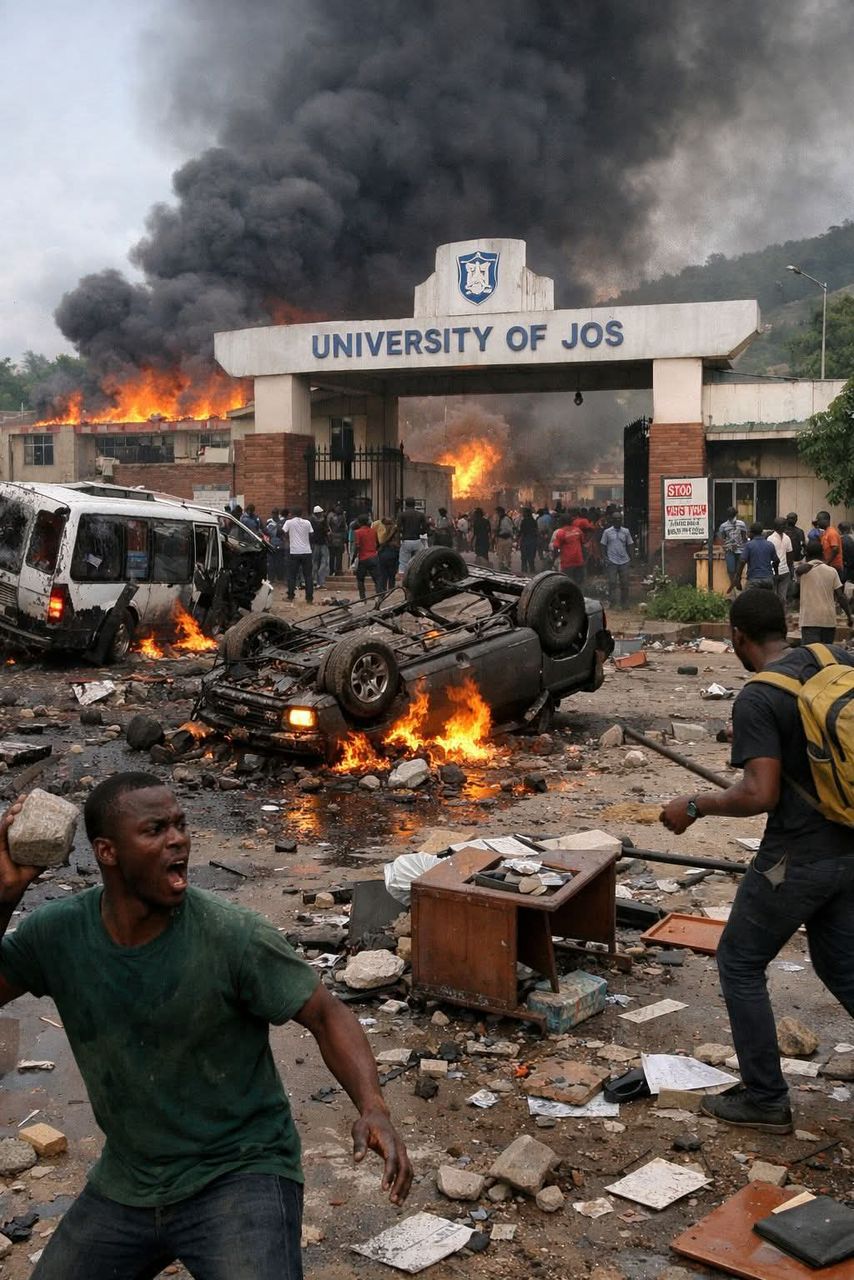
Fake report of unrest at unijos debunked, military assures campus security
By: Zagazola Makama
The Management of the University of Jos and the Nigerian military have dismissed as false and misleading a viral report alleging unrest, chaos, and destruction within the institution, describing it as a deliberate attempt to cause panic and misinformation.
The fake report, which circulated on social media alongside an image claimed to depict violence on campus, suggested that “student grievances had escalated into chaos” with alleged destruction and insecurity within the university environment.

However, checks by Zagazola and confirmation from university authorities indicate that the situation at the University of Jos remains calm, peaceful, and under control, with normal activities ongoing.
It was further gathered that the image accompanying the false report was generated using Artificial Intelligence and does not reflect any real incident within or around the university.
A senior security source told Zagazola Makama that the General Officer Commanding 3 Division, Nigerian Army and Commander Joint Task Force Operation ENDURING PEACE, Major General E.F. Oyinlola, personally led troops to the University of Jos following the circulation of the fake report.

During the visit, the GOC met with the Vice Chancellor of the institution and assured management of the Nigerian Army’s commitment to safeguarding the university community, students, and staff against any form of threat or security breach.
The military described the viral publication as “fake news deliberately designed to cause confusion, panic, and distrust,” urging members of the public to disregard it in its entirety.
Authorities further cautioned against the circulation of unverified content, especially digitally manipulated images, warning that such misinformation could incite unnecessary fear and disrupt public peace.
The University of Jos management also reaffirmed that there was no unrest or security breach on campus, stressing that academic activities were proceeding without disruption.
Security agencies assured continued surveillance and protection of the institution as part of ongoing efforts under Operation ENDURING PEACE to maintain stability across Plateau State.
The public has been urged to rely only on verified information from official sources and avoid sharing content capable of undermining peace and order in the state.
Fake report of unrest at unijos debunked, military assures campus security
Athena Observatory Warns of Deepening Structural Risks in Nigeria’s Democracy
By: Michael Mike
A new policy report has raised fresh concerns about the stability of Nigeria’s democratic system, warning that growing political fragmentation and institutional strain could undermine the credibility of elections ahead of the 2027 general polls.
The report, released on Tuesday by the Athena Election Observatory (AEO), marks the debut of its Political Landscape Monitor—a policy series designed to track and analyse the country’s evolving electoral environment. Titled “Nigeria’s Democracy and the Imperative of Competitive Politics,” the inaugural note paints a sobering picture of a political system struggling to keep pace with its own internal dynamics.
According to the Observatory, a pattern is emerging across Nigeria’s major political parties in which leadership disputes, fragile alliances, and factional battles are becoming increasingly common. While these crises may appear isolated, the report argues they are symptoms of a deeper structural imbalance.
At the heart of the problem, it said, is a widening gap between political activity and institutional capacity. Political actors, driven by the urgency of coalition-building and power consolidation, are moving faster than the rules and structures meant to regulate them.
“This is not just about party disagreements,” the report noted. “It is about the weakening of the systems that are supposed to organise competition, manage conflict, and ultimately guarantee meaningful choice for voters.”
The analysis drew from recent developments within prominent parties such as the African Democratic Congress (ADC), the Peoples Democratic Party (PDP), and the Labour Party, where internal tensions and contested leadership claims have repeatedly spilled into the public domain.
Observers say the trend reflects a broader shift in how political disputes are resolved in Nigeria. Rather than being settled through internal party mechanisms, disagreements are increasingly pushed toward external institutions—particularly the courts and electoral regulators.
The report highlighted the pivotal role of the Independent National Electoral Commission (INEC) in this process. Its decisions on which party factions to recognise can effectively determine leadership outcomes, making it a central actor in intra-party struggles.
While acknowledging INEC’s constitutional mandate, the Observatory cautioned that inconsistent or opaque decision-making could erode public confidence. It called for clearer procedures and stricter adherence to impartiality to prevent the Commission from being perceived as a political arbiter.
Equally significant is the growing reliance on the judiciary to settle political disputes. The report warned that while the courts remain essential for upholding the rule of law, their increasing involvement in intra-party conflicts risks displacing internal governance systems.
Legal interventions, it argued, should serve as a last resort—not a default mechanism.
“When courts become the primary arena for resolving political disagreements, parties gradually lose the capacity to govern themselves,” the report states. “Over time, this weakens the entire democratic ecosystem.”
Beyond institutional concerns, the Observatory drew attention to the implications for ordinary voters. A fragmented political landscape, it said, reduces the clarity and credibility of electoral choices, leaving citizens with options that may lack cohesion or long-term viability.
In such conditions, elections risk becoming procedural exercises rather than meaningful expressions of democratic will.
The report ultimately framed the issue as a national, rather than partisan, challenge. Strengthening the institutional foundations of political competition, it argued, is critical not only for credible elections but also for political stability and governance.
As Nigeria edges closer to another election cycle, the findings serve as a stark reminder that the health of a democracy depends not just on the conduct of elections, but on the strength of the systems that shape them long before ballots are cast.
The Athena Election Observatory said it will continue to publish periodic assessments under its Political Landscape Monitor, offering data-driven insights into the trends shaping Nigeria’s political future.
Athena Observatory Warns of Deepening Structural Risks in Nigeria’s Democracy

Bandits kill two police personnel, cart away weapons in Musawa ambush in Katsina

Several bandits killed as Army, DSS, Local Volunteer Forces Foil Attacks on Niger Communities

2027: Ishaya Malgwi does not reflect the sentiments or intentions of northern leadership nor the stance of Vice President Kashim Shettima.

Roger Federer’s Shock as DNA Results Reveal Myla and Charlene Are Not His Biological Children

THE PLIGHT OF FARIDA

FAILED COUP IN BURKINA FASO: HOW TRAORÉ NARROWLY ESCAPED ASSASSINATION PLOT AMID FOREIGN INTERFERENCE CLAIMS
-
 News2 years ago
Roger Federer’s Shock as DNA Results Reveal Myla and Charlene Are Not His Biological Children
-
Opinions4 years ago
THE PLIGHT OF FARIDA
-
 News12 months ago
FAILED COUP IN BURKINA FASO: HOW TRAORÉ NARROWLY ESCAPED ASSASSINATION PLOT AMID FOREIGN INTERFERENCE CLAIMS
-

 News2 years ago
EYN: Rev. Billi, Distortion of History, and The Living Tamarind Tree
-
 Opinions4 years ago
POLICE CHARGE ROOMS, A MINTING PRESS
-

 ACADEMICS2 years ago
A History of Biu” (2015) and The Lingering Bura-Pabir Question (1)
-

 Columns2 years ago
Army University Biu: There is certain interest, but certainly not from Borno.
-

 Opinions2 years ago
Tinubu,Shettima: The epidemic of economic, insecurity in Nigeria
