
News
KACRAN Rejects State Police, Pushes Jobs and Dialogue as Solution to Insecurity

KACRAN Rejects State Police, Pushes Jobs and Dialogue as Solution to Insecurity
By: Michael Mike
The Kulen Allah Cattle Rearers Association of Nigeria (KACRAN) has opposed the growing calls for the establishment of state police, insisting that massive job creation and sustained dialogue offer a more effective and enduring solution to the country’s worsening insecurity.
The association said creating state police forces would amount to treating the symptoms of insecurity rather than addressing its root causes, which it identified as poverty, unemployment, resource-based conflicts and social exclusion.
In a statement signed by its National President, Hon. Khalil Mohd Bello, KACRAN said extensive consultations and field engagements across the North-West and North-Central regions convinced the association that economic empowerment and community-based conflict resolution mechanisms are more sustainable pathways to peace than setting up new policing structures.
KACRAN noted that Nigeria enjoyed relative peace in earlier decades not because of the existence of state police but because traditional institutions, community structures and economic opportunities helped manage disputes before they escalated into violence.
The association warned that pastoralists could become vulnerable to victimisation in states with anti-grazing laws if state police were established. It also raised concerns that some state governments could deploy their police forces against political opponents and other citizens, thereby undermining democratic principles and civil liberties.
According to KACRAN, the financial implications of creating and maintaining state police formations would be enormous, particularly for states with limited revenue bases. It argued that scarce resources would be better spent on improving access to water, agriculture, healthcare, education and employment programmes rather than building another security bureaucracy.
The association further cautioned that establishing state police could trigger operational conflicts and rivalries between federal and state security commands, potentially complicating coordination and weakening security responses.
Pointing to the Niger Delta Amnesty Programme initiated under the late President Umaru Musa Yar’Adua, KACRAN said dialogue had previously succeeded in reducing violent conflicts and could again serve as a powerful tool for resolving contemporary security challenges if properly institutionalised.
The group also warned against weakening existing security arrangements involving the military, the Nigeria Police Force and community vigilante groups, many of which are already supported by state governments through logistics and operational assistance.
Instead of creating state police, KACRAN urged the Federal Government to embark on massive recruitment into the police, military and other security agencies to bridge manpower shortages. It also called for aggressive investments in job creation and food security programmes to prevent unemployed youths from being recruited into criminal networks.
The association further advocated empowering traditional rulers and community leaders as first responders to local disputes and integrating them into formal conflict resolution mechanisms backed by government support.
KACRAN reaffirmed its commitment to partnering with the Federal Government and security agencies in efforts to restore peace, protect livelihoods and preserve Nigeria’s unity.
KACRAN Rejects State Police, Pushes Jobs and Dialogue as Solution to Insecurity



DSS Set To Appeal Life Sentence On Ansaru Terror Commanders
*Seeks Maximum Penalty On Behalf of Murdered Oriire Teachers
By: Michael Mike
The Department of State Services (DSS) is set to appeal Monday’s life sentence handed two top commanders of the Ansaru Terror organization by a Federal High Court, Abuja.
Justice Emeka Nwite had, shortly after Mahmud Usman, a.k.a Abu Bara’a/Abbas/Mukhtar, the self-styled Emir of Ansaru; and Abubakar Abba, a.k.a Mahmud al-Nigeri/Malam Mamuda, pleaded guilty to all the 32-count charges against them, sentence both men to life imprisonment.
However, a top official of the Service, said they considered the life sentence as too light a punishment for the crimes allegedly committed by the Ansaru commanders.
The official said the Service found it curious that, both convicts were on the verge of pleading guilty to the charges, but changed their minds shortly after some persons believed to be members of the same Ansaru organization kidnapped pupils and teachers in Oriire, Oyo State.
“For the nearly 60 days the kidnappers held on to the pupils and teachers of Oriire, the Ansaru commanders in our custody changed. One of the top conditions the abductors gave was the unconditional release of these same Ansaru commanders in exchange for the Oriire kidnap victims,” he said.
“From ‘not guilty plea,’ the two men at the penultimate court session, said they were undecided on what plea to take. Justice Nwite even had to hand them an ultimatum to make up their minds on or before Monday’s sitting. After the Oriire rescue, they came to court to plead guilty to all the charges,” he added.
According to the top official, allowing the two terror commanders walk away with life sentences would not serve the cause of justice for the two Oriire teachers beheaded by their abductors.
“The reason the terrorists beheaded the two Oriire teachers was to put pressure on government to release these two Ansaru commanders. It, therefore, wouldn’t be fair to see two men beheaded and their families are made to live with the losses without adequately bringing the culpits to book,” he declared.
DSS Set To Appeal Life Sentence On Ansaru Terror Commanders

Farmers praise Zulum over fertiliser subsidy
Some farmers in Bayo Local Government Area (LGA) of Borno have commended the state government’s intervention in subsidising and distributing bags of fertiliser to support the rural farmers.
The News Agency of Nigeria (NAN) reports that Gov. Babagana Zulum of Borno had on July 8, in Kwayar Kusar, inaugurated the sale and distribution of 200 truckloads of NPK fertiliser.
The commodity, according to Zulum would be sold to farmers, across the state at a 50 per cent subsidised rate, to support farmers during the 2026 wet season farming.
The governor also distributed free agricultural inputs to 120,000 farmers to boost food production and improve livelihoods across the state.
The farmers in separate interviews with NAN in Gamadadi community of Bayo LGA on Monday, confirmed receiving the subsidised fertilisers, as their counterparts in Biu, Hawul, Kwayar Kusar and Shani LGAs.
Daudu Hudu, the head of farmers in Gamadadi Ward, said every unit in his ward had received the subsidised fertiliser, reaching over 75 per cent of their farmers in the ward.
Hudu said the commodity, came as a relief to many farmers, in view of the high cost of fertiliser and the unavailability of resources to procure the commodity.
He said that the state government’s intervention in subsidising fertilisers annually had been helpful in retaining many farmers in the vocation, stressing that the high cost of inputs was discouraging most people from farming.
According to him, with the 50 per cent off the market price of the commodity, farmers were able to buy twice as much as they would have bought with their money.
“The state government of Borno is really supporting farmers, especially when you compare with other states; this is why we are commending our Governor, Babagana Zulum.
“Without this support, many farmers would struggle to cultivate their farms and may even abandon their farms which would have affected the food security efforts of government,” he said.
On her part, Mrs Hauwa Shehu told NAN that the support has been of immense impact especially in empowering women farmers who were more affected by high cost of farming inputs.
For Hassan Bayo, a rice farmer from Gamadadi, said he would have abandoned rice cultivating this year but for the fertiliser support from the state government.
They, however, appealed to the Federal Government to reintroduce the Anchor Borrower’s Programme initiated by the previous administration of late President Muhammadu Buhari, to support farmers.
Farmers praise Zulum over fertiliser subsidy
Digital Violence: NHRC, NBA Women Forum Mobilise Against Online Attacks on Women Lawyers
By: Michael Mike
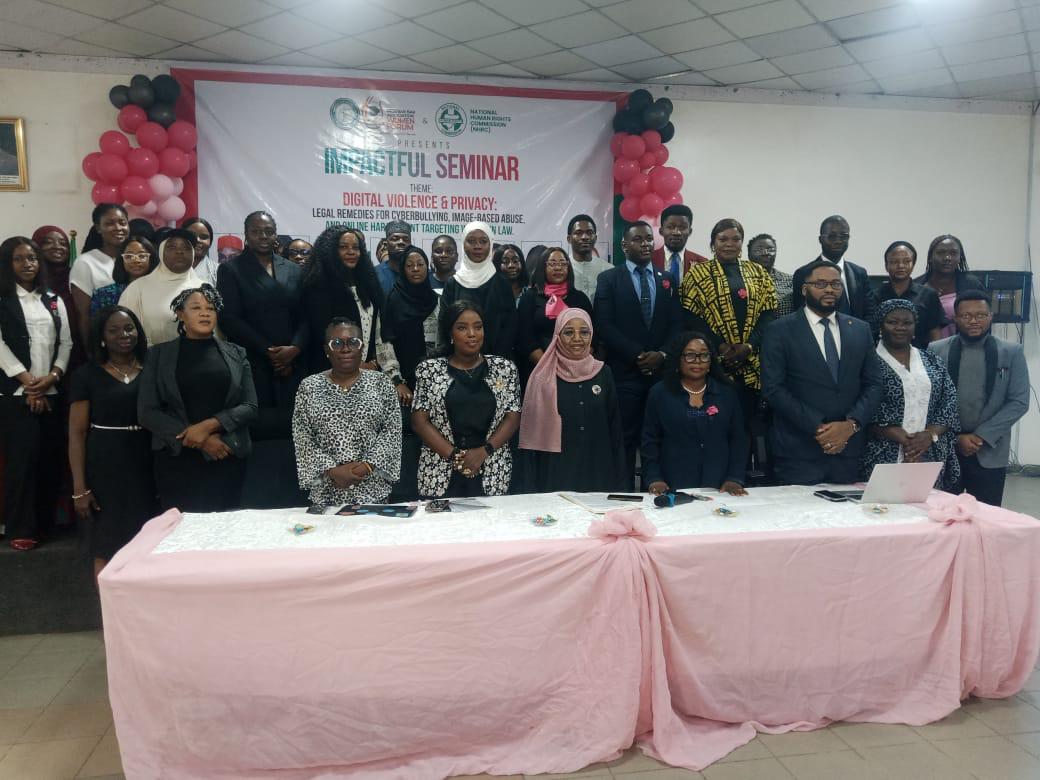
The National Human Rights Commission (NHRC) and the Nigerian Bar Association Women Forum (NBAWF) have launched a renewed institutional push to confront the growing wave of digital violence against women in the legal profession, warning that online abuse is increasingly being used to intimidate, silence and undermine women’s participation in public life.
The two organisations, at a high-level seminar in Abuja on Monday, called for greater awareness of legal remedies, improved reporting mechanisms, stronger institutional collaboration and enhanced digital security to protect women lawyers, judges, academics, law students and other women in the justice sector from technology-facilitated abuse.
The seminar, organised around the theme, “Digital Violence and Privacy: Legal Remedies for Cyberbullying, Image-Based Abuse and Online Harassment Targeting Women in Law,” brought together legal practitioners, judicial officers, human rights advocates and digital rights experts to examine the growing threats posed by the misuse of technology.
The development comes against the backdrop of the increasing use of social media and other digital platforms as tools for professional engagement, public advocacy and civic participation. However, the same platforms have also created new avenues for cyberbullying, cyberstalking, identity theft, doxxing, online intimidation, non-consensual sharing of intimate images and coordinated attacks against women.
Opening the seminar on behalf of the Executive Secretary of the NHRC, Chief Tony Ojukwu, the Commission’s Director of Legal Services, Hajiya Rabi A. Anwar, said technological advancement had transformed communication and professional practice but had also created new frontiers for human rights violations.
She said women in the legal profession were increasingly exposed to digital attacks capable of damaging their reputation, compromising their privacy and threatening their personal and professional security.
According to her, the abuses were not simply the unpleasant consequences of modern technology but serious violations of fundamental rights to dignity, privacy, equality and freedom from discrimination.
She warned that the consequences extended beyond individual victims, as persistent online harassment could intimidate women into silence and discourage them from seeking leadership positions, participating in public debates or maintaining a visible professional presence.
“Digital violence can silence women, restrict their participation in public life and undermine their professional advancement,” she said.
Anwar said the NHRC’s mandate to protect and promote human rights covered both physical and digital spaces, stressing that the emerging nature of online abuse required institutions to adapt their strategies and strengthen cooperation.
She identified the Cybercrimes (Prohibition, Prevention, etc.) Act, the Violence Against Persons (Prohibition) Act, the Nigeria Data Protection Act, 2023, and constitutional protections for fundamental rights as some of the legal instruments available to victims of digital violence.
However, she said the principal challenge was increasingly becoming the lack of awareness among victims and the public about the remedies available to them.
“Many victims do not know where to report, how to preserve digital evidence or which institution has the responsibility to intervene,” she said.
She explained that the seminar was therefore designed to move beyond theoretical discussions by providing participants with practical knowledge on litigation and other remedies, preservation of digital evidence, content takedown and de-indexing procedures, data protection complaints, cybersecurity and strategic advocacy.
She urged participants to use the knowledge acquired to protect themselves, assist victims and contribute to the development of a stronger national response to digital violence.
The NHRC further pledged to sustain its partnership with the NBA Women Forum and work towards translating the recommendations of the seminar into concrete policy initiatives and institutional action.
In her remarks, the National Chairperson of the NBA Women Forum, Mrs Agnes Fache-Omoya, described digital violence as a serious human rights and professional challenge that could affect virtually every aspect of a woman’s life.
She said the growing visibility of women lawyers online, while creating opportunities for professional engagement and public advocacy, had also exposed them to increased risks of cyberbullying, online intimidation, identity theft, image-based abuse and other forms of technology-enabled gender violence.
Omoya said the legal profession could not claim to be advancing gender equality while women lawyers were forced to choose between professional visibility and personal safety.
“No female lawyer should have to choose between professional visibility and personal security,” she said.
She reaffirmed the commitment of the NBA Women Forum to ensuring that women in the legal profession could practise and participate in public life with confidence, dignity and freedom from harassment both online and offline.
According to her, the partnership with the NHRC was particularly significant because the protection of women in the digital space required more than individual vigilance.
“It requires strong institutions, effective laws, accessible remedies and a professional community that refuses to normalise abuse,” she said.
She urged participants to promote responsible digital conduct, ethical online engagement and stronger solidarity within the legal profession.
Experts at the seminar examined the legal and institutional responses available to victims of cyberbullying, online harassment, image-based abuse and privacy violations. Discussions also focused on cybersecurity, responsible digital citizenship, evidence preservation and the need for victims to report abuses rather than suffer in silence.
The event ended with calls for sustained public education, improved institutional response mechanisms and more effective enforcement of existing laws.
Participants stressed that as Nigeria’s legal profession and public institutions continue to embrace digital technology, the protection of women online must become an integral part of the country’s broader human rights, gender equality and justice agenda.
The consensus was that digital spaces must not become new arenas for discrimination and intimidation, but platforms where women can participate freely, safely and equally in professional and public life.
Digital Violence: NHRC, NBA Women Forum Mobilise Against Online Attacks on Women Lawyers

DSS Set To Appeal Life Sentence On Ansaru Terror Commanders

Farmers praise Zulum over fertiliser subsidy

Digital Violence: NHRC, NBA Women Forum Mobilise Against Online Attacks on Women Lawyers

Roger Federer’s Shock as DNA Results Reveal Myla and Charlene Are Not His Biological Children

THE PLIGHT OF FARIDA

FAILED COUP IN BURKINA FASO: HOW TRAORÉ NARROWLY ESCAPED ASSASSINATION PLOT AMID FOREIGN INTERFERENCE CLAIMS
-
 News2 years ago
Roger Federer’s Shock as DNA Results Reveal Myla and Charlene Are Not His Biological Children
-
Opinions4 years ago
THE PLIGHT OF FARIDA
-
 News1 year ago
FAILED COUP IN BURKINA FASO: HOW TRAORÉ NARROWLY ESCAPED ASSASSINATION PLOT AMID FOREIGN INTERFERENCE CLAIMS
-

 News2 years ago
EYN: Rev. Billi, Distortion of History, and The Living Tamarind Tree
-
 Opinions5 years ago
POLICE CHARGE ROOMS, A MINTING PRESS
-

 ACADEMICS2 years ago
A History of Biu” (2015) and The Lingering Bura-Pabir Question (1)
-

 Columns2 years ago
Army University Biu: There is certain interest, but certainly not from Borno.
-

 Politics1 year ago
2027: Why Hon. Midala Balami Must Go, as Youths in Hawul and Asikira/Uba Federal Constituency Reject ₦500,000 as Sallah Gift
